Certainly Maceration Is Normal For Boys, Ben. But…

…not during Algebra.  Now, wash your hands and finish your polynomials.

Yesterday I had my wine tasting acumen publically mocked by Ben Fawcett because I dared to suggest that I am a fan of Beaujolais—or rather, because  I like the grapey and unfettered freshness that a process known as ‘carbonic maceration’ brings to the Beaujolais buffet.

Not Ben Fawcett

The exact rebuke was this: ‘Then you have got a not so great palate. It is basically to make a red wine more fruitier but it always, always spoils it and has the opposite result.’

Two ‘alwayses’ in that dis too, Ben, which is about as superfluous as oaking a Jean-Pierre Teissèdre Villages.  See, when something is ‘always’ once, it’s ‘always’ for always.

But that’s an English lesson.  Apparently, you’re less linguistically anal than moi, and would prefer to give wine lessons, which is totally groovy since I am always up for enological enlightenment.

Not Ben Fawcett

So I will quote your coaching drill verbatim, sans persnickety ‘sics’:

“Buy a simple Spanish red for £6 – £7, an Italian and a French. It will prove it. The first to will be pure, from a place and taste good but basic the french will reek of jam and false aromas.”

Okay, Ben, so I tried that and it turns out that my corner store won’t accept British money since it’s in Detroit.  But okay; point taken, if I am reading your point correctly.  Let me expostulate, but first I must (with permission) change the ‘to’ in your third sentence to ‘two’, because a ‘to’ in that spot is as needless as, say, chapitalizing Domaine des Terres Dorées Fleurie.

It appears you hypothesize that if I spend £6.50  (USD equivalent = $10.23) on a wine from Spain or Italy, I will be getting a pure, terroir-true and delicious beverage.  But if I drop the same coinage on a  French wine, I can expect (your words) the reek of jam and false aromas.

Not Ben Fawcett

Well, let’s leave out the obvious: That carbonically macerated wine from Spain is widely available and includes wonderfully diverse selections from Estancia Piedra, Adegas Galegas, Muga and Bodega F. Remírez de Ganuza.  Meanwhile, back in the Boot, luminaries like Angelo Gaja and Marchesi Antinori are the proud pioneers of Vitello Novello, Italy’s version of Beaujolais Nouveau.  Rather than mention that all these CM wines are available at your magic quid-point, let’s instead take a peek at your reek: Jam.

Jam reeks, Ben?  Really?  Toe jam maybe, but ironically, though the unctuous scent of blackberry jam and blueberry preserves is highly prized in certain warm-weather varietals like zinfandel and cabernet sauvignon, it appears only sporadically in wines that have undergone carbonic maceration—which lean toward fresh, ripe-berry flavors rather than those of stewed fruits.

DEFINITELY not Ben Fawcett

But that’s as may be.  What really fascinates me is your concept of ‘false aromas’.  Now, if I was to review a 2009 Christophe Pacalet Moulin à Vent and write that the wine shows ‘…the distinct bouquet of purple, laced with aromatics of Mona Lisa, followed by the smell of sky, serendipity  and Mozart’s Symphony No. 19 in E-flat major,’ you could probably make a case that I’m picking up some false aromas.

Otherwise, Ben, if you can smell something, it’s real, not false.

But What Is Carbonic Maceration Anyway? And Who Is Ben Fawcett?

A couple of good questions; second one first: I have no freaking idea who Ben Fawcett is, just some random Facebook weenie whose wrist-slapping of yours truly inspired thought about the science behind the first question:
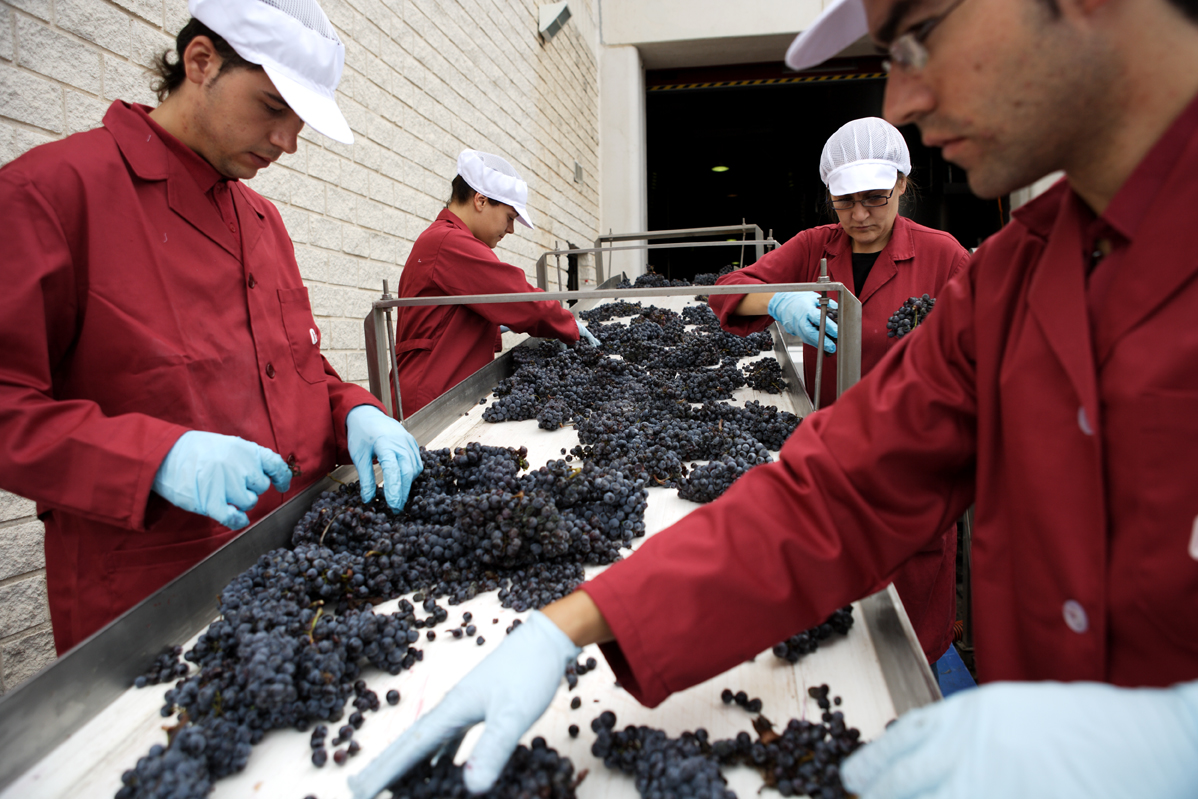
Carbonic Maceration

As practiced by the majority of Beaujolais vintners, carbonic maceration involves stacking whole gamay grape clusters in a closed, oxygen-free tank rather than fermenting them following an aerated pre-crush as most other winemakers do.  In the CM process, the weight of the top layer crushes the tier below it, and in time, you are left with three distinct strata: juice on the bottom, pulp in the middle, and on top, whole grapes bathed in the CO2 produced by the fermentation happening underneath.  That’s the carbonic part.  These grapes are naturally spackled with ambient yeast cells, which convert the juice within to ethanol—the skins split without the need for pressing, and that’s the maceration part.

The resulting wine is simple and fruity and generally intended to be consumed young, although most cru Beaujolais producers use the same technique—also called ‘whole berry fermentation’—to make wine that reflects its individual terroir and can, in good years, develop considerably with age.

And I happen to appreciate the unique flavors that CM produces; in small wines like Beaujolais Nouveau, these can range from ripe bananas to Cherry Jolly Ranchers to Bazooka Joe bubblegum; in cru wines, they can range from fresh plum to sweet pomegranate to raspberry to some elusive and ultra-alluring earth notes.

These wines do not suit everybody’s tastes, which is fine.  But to dismiss them because they tend toward the buoyant, the easy-drinking and non-ponderous side of the wine spectrum is a travesty of tipple-ology and deserving of multiple whacks with the snob stick.

Yeah, this means you, Fawcett:  Ben dover

*UPDATE*  Based on his gracious surrender, Ben Fawcett is now officially an ally.  Andy, however, is trying to force the British spelling of practice down my throat, so he is now the enemy.  See how it works?  A lot like ‘1984’.

Posted in Beaujolais, FRANCE, Gamay | Tagged , , | 12 Comments

Tits For Taittinger: S.A.G, Not Saggy

As a connotation, as a concept and as a cliché, Champagne is a titillating tipple, entangled in seduction, raveled in sex and wrung out into seven-ounce flutes as a morning-after testimonial.  Therefore, when I developed an instantaneous crush on Champagne Taittinger’s new global spokesperson, it was all part of Dom Perignon’s  game plan from the gitty-up.

Vitalie Taittinger

Apparently, mademoiselle’s genetic double-helixes are all in order, too: She’s a Taittinger (Vitalie, daughter of Tait owner Pierre-Emmanuel), and if you want to your compare your tastes to my own, you can check her out on the red carpet at the Los Angeles Shrine Exposition Center for the 18th Annual Screen Actors Guild Awards® this Sunday, Jan. 29.

A Taittinger toast to kick off this silly, self-congratulatory Hollywood lovegasm is a 12-year-old Screen Actors Guild Awards tradition, but this is the first time that the Champagne house will be represented by the heiress apparent; she’ll be hanging around at the show, backstage in the green room and will be popping Taittinger Brut la Francaise corks during the afterglows.

True to her new role as Global Ambassador, she says, “Elegance, beauty, and passion define Champagne Taittinger and make the SAG Awards such a dazzling night. We are thrilled to toast to actors-as their gifted performances have the power to move and inspire, like Champagne,” but she says it in such a hot little French accent that you’ll want to go all Gomez Addams and start kissing her wagina.

(Not a typo, silly! http://www.urbandictionary.com/define.php?term=wagina)

But Enough of this Childish Nonsense.  Let’s Talk History

Founded on the outskirts of Rheims in 1734, the Taittinger clan did not get involved with the estate until the twentieth century, and so, as a Champagne name, it’s one of newest houses in the region.  It’s also one of Champagne’s smallest (major) producers, responsible for about 5 million  bottles a year compared to, say, 26 million from Moët, owned by the largest luxury corporation in the world, Moët-Hennessy-Louis Vuitton.

Pierre-Emmanuel Taittinger, whose dead body I'd have to date Vitalie over.

At least MHLV is French.  Gratefully, Taittinger’s courtship, and eventual marriage to a major foreign investment group in 2005 had a happy ending.  Sold to the American hotel company Starwood in 2005, other Champagne houses—along with cooperatives, distributors and customers—quickly realized that the Connecticut-based hospitality group had goals which did not align with Champagne’s venerated brand culture and could result in a major breakdown of the equilibrium of the industry.  The following year, Pierre-Emmanuel Taittinger managed to buy the company back.

Referring to a business strategy suited to an estate of Taittinger’s size, Vitalie now says: “Taittinger couldn’t be run [like Moët].  However small, every market is important to us.  When you are a family business, we do the wine but we are supporting it with family spirit. For us it’s very important to meet those who are our friends.”

Friends in high places doesn’t hurt, and hence, the Hollywood face-time that Taittinger receives with its prominent support of the SAG Awards.

And hence, more history:

“Come Quickly, I Am Drinking With The Stars!  Like, There’s Brad Pitt With His Tongue Down Jennifer Aniston’s Throat”

For some reason, snobs of the Hollywood Clusterbleep Trifecta® (the Golden Globes®, the Academy Awards® and the S.A.G®.s) hate the former, believe that the Oscars are overhyped, overproduced anticlimactic, but consider the energy fields at Shrine Exposition Center akin to what the ancient Incans felt at Macchu Picchu.

William Hoehne

About the Oscars, Yahoo’s William Hoehne says, “By the time the Oscars come on you already know who is going to win because each voting branch of the academy has its own guild with a far larger membership then the academy has.”

And as for the Golden Globes, starstruck Toronto Star reporter Ron Salem whines: “They are essentially useless, because it’s like 90 people who vote on it, most of whom aren’t even journalists. I mean more people voted on hall monitor when I was in high school than vote for the Golden Globes…”

Mee-fucking-ow, baby!

On the other hand, The Screen Actors Guild awards are (apparently) revered because they are voted on by actors—all 120,000 members of the guild are eligible to cast ballots, with the nominees coming from about five thousand ‘specially chosen’ dues-payers.

Creed Bratton starred in the shortlived series Dork from Ork.

Not only that, but according to ‘The Office’ actor Creed Bratton, the 12-pound S.A.G statuette, (known as ‘The Actor’) has the hottest bod of all the award figures, and he refers to its ‘buns of bronze’ as ‘inspiring’.

Like Vitalie (who only dates from 1979), and Taittinger (from 1932), The S.A.G. Awards are babes-in-the-woods compared to others in the awards circuit, having been created in 1995 as an accolade to recognize outstanding members.  By contrast, The Golden Globes are 70 years old and the Academy Awards turn 83 this year.

As always, Las Vegas has poked it’s glamorous, glittery, Mephistophelean snout into the mix, offering predictions on potential winners. To give you an idea of what the oddsmakers are prognostocating:

For Best Actor, the current favorite is George Clooney (The Descendants) at 1/3; Best Actress is Meryl Streep in The Iron Lady at 5/8 and Best Picture, The Artist at 2/7.

If you’re a risk taker, go with The Tree of Life at 50/1—keeping in mind that that’s a hell of a lot better than the odds Vegas will give you on me ultimately ending up with Vitalie Taittinger.

Posted in Champagne, GENERAL | Tagged , , , | 1 Comment

British Columbia: Gem of A Whole Different Ocean

I’ve been drinking, thinking and inking wine for about twenty years now, but every now and again, a growing region pops up that existed so far on the periphery of my mental wine map that I never gave it so much as a passing ‘Huh?’

British Columbia is one such spot, and I’d say ‘my bad’ except that I vowed to neutralize (with extreme prejudice) the next person who used that odious phrase—and I have a dentist appointment this afternoon

In any case, learning more about B.C.’s wine industry better qualifies as ‘my good’.  Often supposed too cold or too wet for grape cultivation by outsiders, it turns out, in fact, that much of the province’s interior is bone dry and sultry hot throughout the growing season.

Officially (meaning ‘recognized by Canada’s Vintners Quality Alliance) there are five B.C. appellations.  All are in the south; three are to the west of the Cascade Mountains and two—the Okanagan and Similkameen Valley—are to the east.  The westerly DVAs (Designated Viticultural Areas), Vancouver Island Region, the Gulf Islands and the Fraser Valley Region are cool and damp, and late-ripening varietals suffer accordingly—as they do all the way down the coast.  For them, reliance is frequently on mildew-resistent crossbred grapes like bacchus, siegerrebe and madeleine sylvaner, which make lovely and distinct wines, but don’t always haul in the sellout crowds.

British Columbia’s eastern appellations, however, huddle in a rain shadow behind a fourteen thousand foot cloud-shield that creates semi-arid desert—the most northerly of such biomes in the world.  Despite its 49° of latitude, canny viticulturists knew as far back as 1859 that the area could be a suitable habitat for vitas vinifera, but like it did in California, 1920’s Prohibition legislation bunged up their barrels and signaled the end of serious wine production in the province.  That is, until the mid-Seventies, when the Osoyoos Indian band established a commercial vineyard dedicated to riesling, ehrenfelser and scheurebe.

Today, Okanagan Valley, with help from nearby Similkameen, produces 90% of British Columbian wine.  Although German varietals can still be found in most of the hundred-plus wineries, certain microclimates have proven ideal for fussbudget grapes like pinot noir, chardonnay and syrah, and recent plantings have included heat-hankerers like zinfandel, sangiovese and tempranillo.  Even so, with temperatures which have been known to  drop below 13°, the area is every bit Ontario’s rival for ice wine, and in fact, plenty of Niagara Peninsula wineries own property here.

Peerless Pyramid

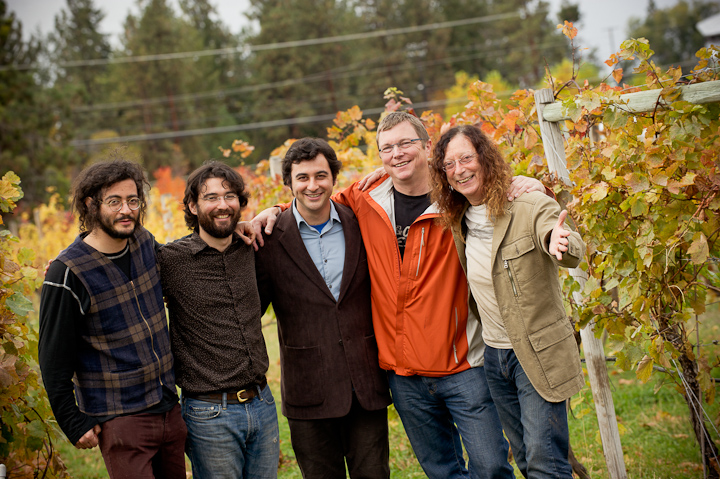
Yes, Stephen Cipes looks like the biodynamic winemaking type.

Front and center in Okanagan, just outside the capital city of Kelowna, is Summerhill Pyramid Winery, established in the 1980s by Stephen Cipes.  A New York developer, Cipes believed that the area was ideal for producing small, intensely-flavored clusters—a hallmark of fine wine production.  So he purchased land, then a number of clones from France, and, as he describes it, “…personally planted them on my hands and knees.”

Later, when he discovered that planting them in soil was more productive, a remarkable winery was born.

Known for its adherence to sustainable agriculture, Summerhill is currently producing more organic wine than all other Canadian wineries combined, using 80% organic grapes (with the rest in transition)  and is on the short path to Demeter Biodynamic certification.

Yes, the crew does too.

Now, I will not go all hypocritical here, since I have always maintained that—via my understanding of biodynamics as opposed to simple ‘earth-first’ horticulture—there is something a bit alakazammy about it.  I won’t go into the cow horn and moon cycle clichés, mostly because I don’t need to: Biodynamics are not the strangest practices going on at Summerhill.  These are pyramid power people.

Seriously so.  The pyramid-shaped structure at the Summerhill facility is, apparently, the most precisely aligned pyramid in the world outside the big one at Giza.  Referred to by Cipes as ‘a sacred chamber’, it is used not only as as a storage for the wines, but as a meditation stop during winery tours where visitors can take a five minute breather to explore the knowingness of eternity.

According to Cipes, “We are mostly liquid and we are affected just like the wine is affected. The effect is clarification. If a wine has a flaw in it, the flaw is accentuated. If the wine has good qualities, they are enhanced. When humans enter this sacred chamber, it is a grand opportunity to clarify our own inner selves. This chamber helps us to get to the knowingness of who we are…”

Who am I to argue?  Summerhill Pyramid wines have been blowing the competition out of the tub for decades, and it was named 2009’s ‘Canadian Wine Producer of the Year’ at the International Wine and Spirits Competition in London.

Do not be dissuaded by the fact that Summerhill Pyramid wines are available in the United States only  via direct shipment—it saves you a trip to the corner bodega, and the Wine Direct ‘fulfillment provider’ is in complete compliance with the states that allows this form of wine delivery.

In fact, you should do what I did: When you place your order, include all the dull Mach 3 razor cartridges you can scrape up from the bottom of your bathroom drawer and ask Stephen Cipes to stick them in the pyramid for an hour or so, and send them back with the wine.

As to why, true pyramid people will be happy to clue you in.


Tasting Notes:

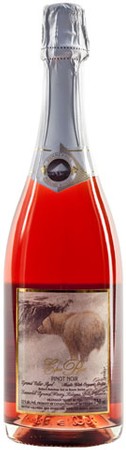
(Each bottle bears a replica painting of a B.C. critter by Robert Bateman, and $1 per bottle sold will be donated to the ‘Get To Know Your Wild Neighbors’ non-profit organization).


Summerhill Pyramid Cipes Pinot Noir Rosé, Okanagan Valley, NV, about $30:
  Pinot noir is one of central B.C.’s success stories, and it follows that the sparkling wines would be sensational.  This is not Neil Diamond’s Cracklin’ Rosie—it’s an exceptional méthode champenoise that defines the British Columbia sparkle style: Dramatic and intense with crushed strawberry, juicy watermelon and fresh red cherry aromas, some yeasty brioche on the palate and a nice clean, finely-toned finish.

Summerhill Pyramid Organic Pinot Gris, Okanagan Valley, 2008, around $20:  Crisp and medium bodied, the wine is very dry and shows characteristic notes of Bosc pear and almond on the nose, with clean, creamy citrus nuances and light tropical layers leading to a soft, distinctly acidic finish.

Summerhill Pyramid Organic Pinot Noir, Okanagan Valley, 2007, around $30:  A nice mineral-laden pinot, not too massive, but juicy with black cherry, raspberry, beetroot and a touch of rhubarb.  Subtle, smooth vanilla softens damp earth and hints of coffee; the tannins are restrained and blend seamlessly with the fruit and spice.

Summerhill Pyramid Organic Merlot, Okanagan Valley, 2007, around $30:  Pretty big at 15% alcohol, this merlot displays sweet and supple wild cherry notes and a charming mind-palate of Asian spice, cassis, blackberry underscored by a fresh, elegant acidity and ripe, soft tannins.

ICE WINES

Summerhill Pyramid Riesling Icewine, 2007, about $55 (187 ml): Bursting with luscious scents of apricot, dried pineapple and honey, this is a beautifully balanced nectar; there’s a vibrant structure built around contrasting sugars and acids and an almost hedonistically unctuous mouthfeel.  A textbook after-dinner wine, wonderful alone or just as wonderful with sweet, tropical desserts.

Summerhill Pyramid Pinot Noir Icewine, 2007, around $65 (187 ml):  Forget the dessert with this one—it’s too pricey and scrumptious to clog up with food.  Containing a hefty 22 g/l of residual sugar, winemaker Eric von Krosigk’s sweetest baby is serious and world-class; rich and ultra-ripe, loaded with candied cherries, stewed cranberry, Watermelon Jolly Ranchers and an opulent, melt-in-your-mouth finish.

Posted in CANADA, Onkanagan | Tagged , , , , | 5 Comments

Pairing Wine With Spices: The ‘It’ Flavors Of 2012

Once a year, the multibillion dollar spice spigot called McCormick & Co. releases a sprinkle of predictions about what flavors will be in vogue during upcoming months—a compilation collected by their posse of parlously picky palate probers including staff chefs, sensory scientists, marketing experts and food technologists.

They obviously take themselves very seriously, and so do their fans.  According to Kevan Vetter, McCormick’s Executive Chef, “We’ve already had over a dozen requests for the list since last October, which speaks to the credibility we’ve established with our customers.”

Chef Kevan Vetter

It may speak less glowingly of their customers’ credibility since the list doesn’t come out until January, but it’s interesting to note that many of the unusual  ‘flavor pairings’ that McCormick’s predicted for 2011 did indeed wind up on top-flight restaurant menus.  Whether this indicates a Nostradamus-like skill set among company soothsaying savor surmisers or simply that a lot of chefs read the list first and design their menus second is hard to gauge.

Jan was the cute one anyway

But I suspect the latter.  Question: How farfetched is the idea that two chefs independently decided to match fennel with perri perri sauce, mustard seed with vermouth, caramelized honey with adzuki beans and ancho chili with hibiscus?

Answer: About as farfetched as my own 1974 McCormick prediction that Marcia Brady would be doing nude scenes by the end of the decade.

Actually, it took until 1981.

Anyway, this year’s pairing prophecies are equally bizarre, and contain  like-levels of gustatory guesswork.  Eggplant with harissa??!  Personally, I can’t stand the former and have never heard of the latter, but it doesn’t matter because the opinions of my puerile palate were not solicited.

Rather, Marianne Gillette, Vice President of Applied Research at McCormick, maintains: “We have a special creative process which allows us to pull together consumer insights with our own extensive knowledge of flavor that spans all the way from an individual aroma molecule to understanding how a full menu works, to map out a consensus opinion on what people will be eating in the future.”


Now, This Is Food For Thought: What About Drinking?    

Most reputedly ‘serious’ overviews of food and wine pairings wind up being borderline useless unless they take into consideration the very flavor elements upon which McCormick stakes its multinational claim: Spices.  Alone, most elements of a meal are fairly neutral, and without a prior understanding of how each plate is seasoned, it’s hard to play nuance against nuance when looking for an appropriate wine.  The overall ‘weight’ of the dish, along with acidity, richness and fat is important, but everything else being equal, a recipe that is heavily seasoned with, say, paprika or sage or khmeli suneli… or harissa… will suggest a specific eno complement.  It’s too mail-it-in to recommend off-dry gewurtztraminer or riesling with spicy fare; a bit of experimentation will bring to the surface alternatives like Albariño from Rías Baixas or Vouvray; functional reds include Dolcetto and Barbera.

But what about the real left-field trends track in McCormick’s esoteric list?  What are we to do with the dills and the coconuts and the honeys and the sofritos?  These are tough calls for the most trench-tested sommelier, and not every recommendation will suite every palate.  But that’s the fun of mix ‘n’ match ‘n’ trial ‘n’ error: One man’s meat is another man’s poisson.  Smart people who do not use ‘n’ in sentences call this ‘The Empirical Method’.

Here’s a personal shot at some potential drinking buddies for the top eight of McCormick’s 2012 Flavor Forecast:


1)  Blueberry with Cardamom

Dish:  Spiced Duck Arepas with Blueberry Sauce

Serve with: A rich, fruit-forward red with rounded tannins and a nice acidic backbeat; look for something fragrant and silky with  notes of berries and spice.

Specifically: Viader Cabernet Franc, ‘Dare’, Napa, 2005, about $25:  Sourced from small selected blocks from vineyards in the Oakville and Howell Mountain, the wine’s foreground shows a moderate intensity of blueberry and plum with secondary notes of cocoa, tobacco and cardamom.

*

2)  Cumin with Sofrito

Dish: Sofrito Stuffed Skirt Steak

Serve with:  A tart, juicy red wine with bright fruit wrapped around a sparkly soul; look for a wine big enough to stand up to chile and tomatoes, but subtle enough to mirror the dish’s myriad spices.

Specifically: Harvest Moon Sparkling Zinfandel, Russian River, 2009, about $38:  A serious wine in a category that many folks snicker at; this vintage Method Champagne saw six months in neutral barrels and 11 on triage; it displays dried cranberry, white pepper, yeasty bread dough and crisp, refreshing effervescence.

*

3)  Dill with Mint and Melon

Dish: Chicken Gyro with Melon-Mint Tzatziki

Serve With:  A savory and crisp white, medium-bodied with steely acidity and upfront herbal notes backed by ripe vine fruits.

Specifically: Matua Valley Sauvignon Blanc, Marlborough, 2007, about $13:  This classic Marlborough sauvignon blanc shows pristine varietal character—grass and citrus on the nose, a brisk mid-palate loaded with melon, grapefruit, lime zest and mint, and ultimately, a long, juicy finish.

*

4)  Grapefruit with Red Pepper

Dish: Grilled Oysters with Grapefruit and Red Pepper Relish

Serve With: A snappy young red without intrusive tannins; look for something from a cooler climate with tart red fruit, bright acid and minerals profiled throughout.

Specifically: Domaine Vacheron Sancerre Rouge, 2008, about $40:  A somewhat rare bird—red Sancerre—offers a unique interpretation of pinot noir—sharper and steelier than Burgundy, it provides a purity of fruit, not a lot of earth, but flint and slate drawn from the soils of the Loire Valley.  Elegant and almost ethereal, it provides a foil to the creaminess of oysters and a mirror to the red peppers both in color and ripeness.

*

5)  Vanilla with Butter

Dish: Vanilla Butter Poached Scallops with Sweet Potato Puree.

Serve with: Oaky chardonnay—this one is such a no-brainer that I’ll do a little border hopping and suggest a wine which does not receive as much credit is it as due considering that it always manages to compete in reliability, consistency and affordability.

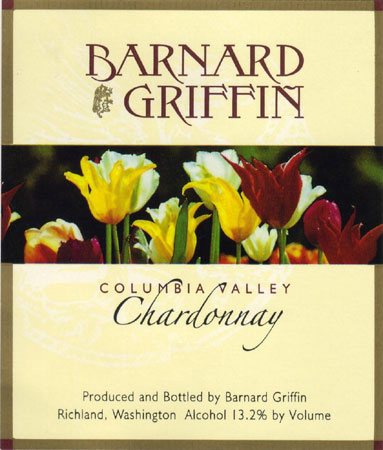
Specifically: Barnard Griffin Chardonnay, Columbia Valley, 2009, about $13:  An alluring nose of tangerine and ripe apple translates into a pretty, well-integrated blend of lime, dried herbs and creamy pineapple.  Finishes crisp, but with a tinge of sweet vanilla.

*


6)  Ginger with Coconut

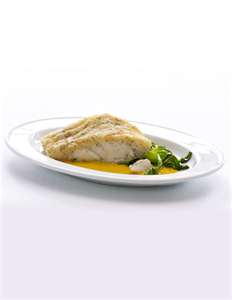
Dish: Braised Cod with Gingered Carrot-Coconut Sauce

Serve with:  A sharp, exotic white with fruit and spice layers and an edge of crispness sufficient to slice through the fatty coconut milk.

Specifically: Yves Cuilleron Condrieu, La Petite Côte, 2008, about $60:  Rich (and priced for the rich), this volatile viognier is mellowing with age to become a peach and honeysuckle-scented sensation.  Rounded and Rhône-ish with a supple grip of citrus and white flowers, the wine—unlike many viogniers—sees some oak.  It is half-fermented in older barrels and shows it off with subtle coconut flavors.

*

7)  Eggplant with Honey & Harissa

Dish: Roasted Eggplant Harissa Bisque with Parmesan Tuiles

Serve With:  An aromatic, off-dry white with a concentrated core of flowers, dried fruit and stone.

Specifically:  Blandys Verdelho Madeira 5 Year Old, about $22:  Honeyed and nutty, this medium-sweet Madeira is saturated with fig and plum pudding, but retains a bite of orange marmalade.  Should offset the pepper punch of the soup while adding a creamy counterpoint to the cream in the bisque.

*

Way, way, way too many lemons, right?

8)  Meyer Lemon with Lemon Thyme, Limoncello & Lemon Peel

Dish: Meyer Lemon, Lemon Thyme, Limoncello and Lemon Peel Sorbet

Serve with: Who cares?  …There’s so much lemon in this dish that any such complimentary flavors in a wine will likely kill you—and I have no intention of becoming McCormick’s Grim Reaper.

Specifically: Lemon Creek Snow Moon Ice Wine, Lake Michigan Shore, 2008, about $35:  Luscious aromas of caramelized orange peel, apricot and honey melt into a full, sweet and unctuous mid-palate with quince, brown sugar and citrus oil on the finish.

Posted in GENERAL, PAIRING WINE AND FOOD | Tagged , , | Leave a comment

The Drupe Dupe: Extra Virgin Olive Oil. P.S.; Neither Was Your First Wife

This is a website about drinking, so whenever I wander off topic and enter the realm of cuisine—a subject about which I know even less than wine—I do so at the peril of my long-suffering readers.

Technically however, I suppose that olive oil is a liquid, and honestly, ever since I read that the Mediterranean Diet has been linked to longer, healthier happier lives filled with job promotions, Skelta G-Force sports cars and dates with ‘It Girls’, I have taken to guzzling a half-gallon of olive oil per day.

Strictly Extra Virgin, of course, since it’s better for you.

Mmmmm!  Tree grease!

For those of you who wanted to know but were afraid to ask, ‘Extra Virgin’ is a 1930’s term that first began appearing in Hollywood trade journals to describe celebutante Shirley Temple, and was later usurped by Walt Disney as a sexual metaphor in ‘The Little Mermaid’ (originally titled ‘Scent of a Woman’) since Ariel not only didn’t, she couldn’t.  Fish do not have sex, of course—they do this weird onanistic spawning-season ritual too gross to go into.

In the context of olive oil, the first use of ‘Extra Virgin’ (or ‘E.V.O.O.’, as that chubby little morselette Rachael Ray—so desperate to get her crap on the table in under thirty minutes that she doesn’t have time to pronounce words—calls it) can be traced to Max Fleischer’s early Popeye shorts.  Businessman first and artist second, Fleischer understood that if the Popeye, Olive and Bluto love triangle was ever resolved and one of these schmucks finally got to schtupp the anorexic shiksa, the cartoon’s popularity would go belly-up.

It was the Italians—never adverse to a little pilfering, whether  protection money from Sam’s Produce, ten million from Lufthansa or Britannia below the Forth-Clyde line—who then snagged the label ‘Extra Virgen di Oliva’ to describe drupe fat.

Give me an oil that’s been around the block a few times like Ilona Staller.

The grade is regulated by an intergovernmental organization called the IOC, and to qualify, an oil must contain no more than 0.8% acidity and be judged ‘superior’ by a panel of tasters.  Drop the ‘Extra’, and the oil is allowed a 2% acid content and the tasting panel must merely label it ‘good’.

Below the Virgin grade is not, as you might expect, ‘Easy, Plain-Looking Olive Oil With Father Issues’, but ‘Pure’—usually a blend of Virgin and refined production oils which are extracted through use of chemicals and filters.  This is followed by neutral-tasting ‘Olive Oil’ of 1.5% acidity, then ‘Pomace Oil’, which is not legally permitted to wear the name ‘Olive Oil.’

Bringing up the rear is non-food grade Lampante, generally used in lamps, Fiat engines and movies starring Ilona Staller.

But how assured are we that we are getting the grade of olive oil that the label proclaims…?

Ay, There’s The Rub—And Where The System Falls Apart

In the first place, the United States does not subscribe to IOC standards, nor is it a member nation of this organization; the USDA uses a system first developed in 1948 before the IOC even existed, and refined (no pun) it in 2010.  Whereas it is meant to regulate shippers and importers, the hard, cold-pressed facts seem to suggest that up to 70% of olive oils on the American market are frauds, and those claiming  that they are ‘Imported From Italy’ actually contain oil from Turkey, Tunisia, Morocco and Greece.

Turnip-sorting Swedes

And it may not even be olive oil.  Despite its reputation for purity and near sacrosanct salubriosity, olive oil turns out to pretty easy to fake. One batch in Spain contained poisonous rapeseed oil and killed 700 people, while with some regularity, what we buy as Extra Virgin winds up being flavored oil from Swedish turnips.

Blood from a stone is one thing, but raise your hand if you knew that you could get oil from a turnip?

‘Make Them An Offer They Can’t Refine’

Although we all recall that Don Corleone’s olive oil importing business was his front, raise your other hand if you knew that this side of the character was based on a genuine Wise Guy—Brooklyn crime boss Joe Profaci who used Mama Mia Importing Company to protect himself from federal tax evasion charges and so earned his nickname, ‘The Olive Oil King’.

Like Corleone, despite numerous attempts on his life, Profaci wound up dying of natural causes in 1962.

His countryman Domenico Ribatti fared less well.  As the owner of Riolio, an Italian olive-oil producer based in Puglia, Ribatti routinely sold Turkish hazelnut oil and Argentinean sunflower-seed oil as Italian Extra Virgin Olive Oil and became one of Italy’s most influential importers.  By the early nineties, however, his extensive real-estate holdings and Swiss bank accounts had raised the eyebrows of the Guardia di Finanza’s military-police force, and by 1993, he was indicted for fraud against the EU.  He plea-bargained a sentence of thirteen months and ultimately observed the code of omerta:

Leonardo Colavita, owner of Colavita Olive Oil Company, said, “Ribatti was a gentleman, because he didn’t name names. If he had named names, a lot of other folks in the trade would have gone to jail.”

‘Why don’t you come upstream and see me sometime…?’

Now,  I’m not certain what they serve you as a bread dip in Italian prisons, but according to Amanda Knox, it ain’t Manni.  This exclusive Tuscan IGP, the most expensive olive oil in Italy and only available in 25 restaurants worldwide, is made from the rare drupe olivastra seggianese grown at a specific elevations; it’s the current cult favorite of superstar chefs like Thomas Keller and Jean-Georges Vongerichten.  How much will it set you back?  About five times as much as uranium: $17 per ounce.

Still, if you’re willing to lay out that kind of scoot for an Extra Virgin, you might just be a able to interest The Little Mermaid in some illicit spawnography after all.

Posted in GENERAL | Tagged , , , , | 1 Comment

Only 98 Photoshopping Days Left Until The Bordeaux en primeur

“I’m on a seafood diet.  I see food and I throw up.”

– Runway model Filippa Hamilton-Palmstierna

A pair of recent headlines—one excoriating Ralph Lauren for photoshopping cover-girl Filippa Hamilton-Palmstierna to resemble Bobby Sands during Extreme Unction and another excoriating University of Connecticut cardiovascular researcher Dipak Das for photoshopping the benefits of red wine based on data he fabricated—could not, on the surface, be more dissimilar.

Body dysmorphic disorders and resveratrol perks?  Winos and waifs, bulimia and Beaujolais, thin vs. vin? It would take a genius far above my pay grade to tie these antitheticals together.

This is hot??

Where might one even begin to look for such a visionary in this mixed-up, muddled-up, shook-up world?

Inside Karl Lagerfeld’s skin, that’s where.

Let’s start with those anorexic amazonians strutting our catwalks from Mauthausen to Milan, Majdanek to Manhattan.  Of their detractors (like German magazine Brigitte), Karl, the krusty Kraut kackles:

“These are fat mummies sitting with their bags of crisps in front of the television saying that thin models are ugly.”

Karl Lagerfeld: Whiplash or stylin' collar?

The 78-year-old Karl Lagerfeld, whose own astonishing 92-pound weight loss shows that he walks the same (treadmill) walk he talks, is the creative director for the fashion house Chanel.  His design ouvre is described as having ‘drippy drapey elegance’ and other than the ‘fat mummies’ line, the funniest thing he’s ever done was duck when PETA threw a tofu pie at him (for using fur in his designs) and hitting Calvin Klein instead.  Talk about ‘friendly fire’—Klein is an outspoken PETA supporter who refuses to use animal skins in his collections.  Had I been Klein, I’d have gotten so pissed at PETA that I’d have slaughtered a flock of newborn lambs on CNN.

But What Does This Have To Do With The French Paradox?

Coco Chanel: Haut Couture's Mata Hari?

For wine lovers born after 1991, the term ‘French Paradox’ does not refer to France’s 1986 refusal to allow Americans to fly over air space we liberated for them in 1945 (from an enemy, incidentally, with whom Coco Chanel famously slept); it stems from a 60 Minutes feature attempting to explain why French people suffer a low incidence of heart disease despite having a diet rich in saturated fats.  One factor mentioned was that the French drink a lot of red wines containing resveratrol, a chemical linked to longevity in mice.

Apparently—and thus the headline fodder—some of these studies  were the ones that Dipak Das faked; which as far as I am concerned is no issue at all and simply means we get to start the testing over from scratch.   Screw you, Dipak and bottom’s up, winos; I’m conducting my own longevity research this time:  How do you feel now?  Now?  Now???  Have another and get back to me.

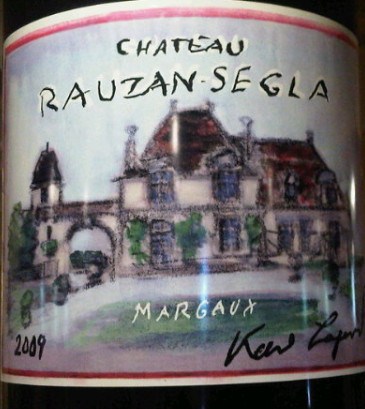
Meanwhile, on Monday I received an email announcing the release of one of those reveratrol-rich reds, Château Rauzan-Ségla 2009, a Margaux  Deuxièmes Cru.  For wine lovers born after 2008, the ‘09 vintage is promising to be one of the best in a hundred years.

Founded in 1661 by Pierre de Rauzan, the 130-acre Rauzan-Ségla estate was acquired in 1994 by Chanel, and this particularly stellar vintage, which also represents the château’s 350th Anniversary, will bear a custom label designed and signed by the great Karl Lagerfeld himself—and will sell for a healthy $130 per bottle.

How Good Is It?

Well, I have no idea since the VP of International Affairs at Chanel’s PR firm did not offer to send me a review sample.  She did, however, offer to turn me on to some cool photographs of the signed wine bottle, which I suppose is better than nothing considering I have no intention of shelling out the equivalent of a month’s worth of cable in order to offer free promotion to someone else’s snooty product.

“I hate the notion of a second line. It’s condescending and patronizing.”

– Karl Lagerfeld

Non-Photoshopped Filippa Hamilton-Palmstierna. And the problem is...?

I may, however, tuck into a fifth of Ségla, Rauzan-Ségla’s second line.

It’s where the Château sticks all its surplus grape juice; like most luxury estates and fashion houses, Rauzan-Ségla sells a cheaper ‘equivalent’ meant to mirror qualities of their branded baby with, perhaps, a bit less polish and structure.  These cheaper ‘seconds’ are invariably money-makers for the parent company and bargains for us on a non-household name budget: You should be able to pick up an ’09 Ségla for around $40.

Minus-Sized Me.

In the meantime, based on what I have been provided by Chanel, this is the best I can do with the Grand vin cuvée without sacrificing food—and these days, the market for rail-thin, heroin-chic, middle-aged male models like myself is somewhat limited.

Looking Notes:

A Picture of Château Rauzan-Ségla, Margaux, 2009: 

The photograph of this wine is well-defined—digital, but still classic in style with a nice concentration of green photosites along with hints of amaranth, bright cerulean and indigo and an intriguing note of bokeh in the background. This is a magnificent shot of Rauzan-Ségla, easily equal to what I ogled at the ‘Pictures of 2009 Wine Bottles en primeur’ last May.  Firstly, the depth-of-field is much more focused than usual at this nascent stage of memory-card compression; the white-balance is just about perfect, there is a vibrancy to the pixels that is really enthralling and the poise on the post-processing (Adobe Photoshop CS5 V.12.0 Extended?) ranks alongside photographic images of the hallowed Chateau Margaux itself.  The only flaw that could be found with this photograph is that the Chanel people appear to have digitally altered the bottle to make it appear skinnier.

Serve with: Tofu Pie.

Posted in Bordeaux, FRANCE, GENERAL | Tagged , , , , | Leave a comment

Can’t Get Much Cooler Than This Fonz: Fonseca Bin No. 27

What do Arthur Fonzarelli and Bin No. 27 have in common?

Both are feisty and irrationally cool, both dwarf their categorical co-stars in popularity, both have pinged in and out of cultural relevance—and prior to the early seventies, nobody had heard of either one.

Furthermore, did you know that both are from Portugal?

'Fonzie'

No?  Well, I suppose it is now time for a one-time-only shout-out to the punk band Fonzie, twice touted ‘Best Portuguese Act’ at the MTV Europe Music Awards.  Nominations notwithstanding, as representatives of the punk genre, they pretty much bite the bag.

Not so that slithery-sweet sip of scrumptiousness from demarcated Douro in northern Portugal…

Port.

From the oldest defined and protected wine region in the world, Port is often served as post-prandial (look it up) molar crumbler, but can be found in pre-prandial white, dry and semi-dry styles if you’re so inclined.   Like its neighbor Sherry, Port has the ability to change personalities to suit the role as easily as Henry Winkler—but unlike the latter, with Port it’s not called ‘acting’, it’s called ‘being’.

Selected Port Winography:

BARREL-AGED PORTS

Tawny Porto, Miss Transgender America, 1956

Tawny Port:  Speaking of rôle-playing, so enamored am I with the term ‘Tawny Porto’ that I used it as the name of a female impersonator in my unpublished, un-optioned and unproduced musical extravaganza Wholsom Prison Blues, which you and the rest of Western civilization have thus far chosen to ignore.  Well, short of wearing a peignoir and a gaff, to qualify as Tawny Port in Portugal you need to begin as a ruby port, then climb into an oak barrel for a minimum of two years, which would, of course, also qualify you as a nutcase, but would impart to your profile some nice, nutty overtones.  Tawny ports are slightly oxidized, accounting for their burnished brown-gold color, and rank medium-sweet to sweet on the cloy-ometer.  Those that bear an official ‘age’ designation are blends of Ports whose barrique-age averages 10, 20, 30 or 40 years.

Colheita:  A tawny port from a single vintage specified on the label.  Unlike ‘Vintage Port’, which sees about 18 months in oak, Colheita Ports may have been aged for up to 20 years.

Garrafeira: A rare incarnation that combines qualities both of oak aged and vintage Ports, the wine is highly regulated by the IVDP (Instituto dos Vinhos do Douro e Porto, Port’s legal advisory board).

BOTTLE-AGED PORTS

Ruby:  The Joanie Cunningham of Ports.  Ruby is the youngest, lightest and easiest to understand of the myriad styles into which the species has evolved.  Characterized by fresh berry flavors, it is blended to the tastes of individual producers, but generally contains at least five of 48 allowable Port grapes.  Like Joanie, Ruby Port is bright, stable, sassy and (in later episodes) full-bodied.  I wouldn’t have suggested that either is ‘cheap’, but Joanie shaboinking Chachi was a game-changer; Ruby is the cheapest of the bottle-aged Ports.  Serve with: Shortcake.

Sorry, Charlie

Vintage Character Port:  The Chuck Cunningham of Ports.  Once a prominent member of the cast, ‘Vintage Character’ was dropped as a term by the IVDP following the 2001 season, and disappeared as though it never existed.  Such Ports are richer that Rubies and must be approved by the IVDP’s tasting panel—the Câmara de Provadores.  They are considered to be the standard-bearers for a producer’s ‘house style’ and legally, they now must be referred to as ‘Reserve’ Ports.

White Port: The Potsie of Ports.  Formerly a winemaker’s afterthought, prominent shipper Ernest Cockburn once loudly opined that ‘the first duty of port is to be red.’  Thanks for that slice of brilliance, Ernie, and also for your nonsensical name—when I was a sommelier and somebody asked, ‘Do you have any Cockburns?’ I always replied, ‘Only if I use sandpaper.’

Bouncy, lightweight and somewhat unsophisticated, white ports are made from a variety of white wine grapes, including esgana cão meaning ‘dog strangler’. They slip down nicely as an aperitif, lightly chilled and often mixed with tonic and/or Cointreau.  Serve with: Wonder Bread spread with Miracle Whip and Campbell’s Cream of Cracka soup.

Rosé:  The Ralph Malph/Pinky Tuscadero of Ports.  Silly but sincere, this is Port’s red-haired stepchild; a new category released by Pocas and Croft of the Taylor Fladgate Partnership.  Like the short-lived careers of Mr. Williams and Ms. Kelly, Rosé Port is a bit of a joke, with a critical reception like something out of the demolition derby—in part because it isn’t particularly good.

First released in 2008, Rosé Port may in fact be the moment when the appellation finally jumped the shark.

'Nanu F.U.'

Late-Bottled Vintage (LBV): The Mork from Ork of Ports.  Perhaps the least understood, and in ways, most palatable among the Ports, LBVs are the product of a single, but often ‘undeclared’ harvest; for the most part, they are ready to drink upon release.  They can be found in two styles—filtered, which require no decanting, and unfiltered, which do—but which, unlike filtered Ports, can improve with a few more years of bottle aging.  Meant to replicate some of the character of Vintage Ports, they are lighter, less complex, and certainly less expensive than the blockbusters from declared vintages, but the latter make up only about 2% of the regions output and can be priced into the low stratosphere.  Nonetheless, LBVs undergo rigorous organoleptic testing by the Câmara de Provadores before they’re awarded the coveted Selo de Garantia—Port’s equivalent of an Emmy.

Crusted: The Mr. C of Ports.  A wine that wants to be all things to all people at all times, Crusted Port is blended from the two or three vintages and cask matured without filtration, resulting in its casting off a scab-like ‘crust’ of sediment made of grape residue. These wines are dense, velvety and ripe, but have never been well-known or particularly popular and today, the category is nearly as dead as Tom Bosley.

Vintage: The Mrs. C. of Ports.  Finally, the most venerable, concentrated and long-lasting of the Ports, from vintages ‘declared’ by conventional shippers only about three times per decade. They’re barrel-aged for a maximum of 2½  years before bottling in order to preserve the ruby color and fresh-berry flavors, but they require another ten to forty years in the bottle before they reach full maturity.  (Sensational wines from single vineyard sources in years not ‘declared’ are often sold as ‘Single Quinta’ Ports).

The oldest Vintage Port is from 1863—coincidentally, the same year that Marion Ross was born.  And, like Ms. Ross, it is still available.

*

January 27, 2012 is International Port Day!

I’ve looked online and stopped by two of the last three remaining Hallmark stores, and I cannot for the life of me find a greeting card category for this most sacred of fetes.

Hang on—it wouldn’t, by any chance, be one of those ‘made-up’ holidays, would it?  I mean, I’d hate for anyone to think I’m a cynic.

For The Love Of Port's Roy Hersh and Mini-Me

Alas, it turns out that International Port Day is indeed the fortified wine world’s answer to Kwanzaa.  Created by The Center for Wine Origins (CWO) and listed on the For The Love Of Port (FLOP) website, the event is an valiant attempt to shore up flagging Port sales worldwide, and to slap the wrists of anybody outside of Douro who dares use the demarcated and legally protected name ‘Port’.

High on FLOP’s hit-list is the N.Y. Port Authority, porterhouse steaks, Port Huron and Natalie Portman.

As part of the effort to raise public awareness to the joys of their pet, CWO and FLOP have launched a contest where the grand prize winner will receive a berth in the April 2012 Port Explorer’s Tour of Portugal.  To qualify, you need to hold a Port-themed event in your restaurant, bar, hotel, basement, daycare center or prison block, and whoever comes up with most unique promotional idea wins.

Now, while the notion of a weeklong Iberian getaway certainly rocks my world, when you read the contest’s fine print you find that ‘airfare is not included’.  Which means that I’m expected to spend time organizing and filming (required to win) at a potentially rented facility, laying out cash for all sorts of wine on the off-chance that I might somehow come up on top of the Port pool.  Conservatively, that should set me back many hundreds of dollars.

For control comparison, the Michigan Lottery’s Mega-Millions Grand Prize is $50 million and costs a buck.

The 27 Club

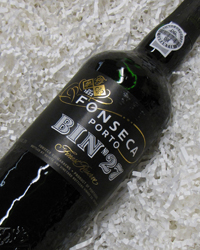
Still, if you’d rather visit Portugal than buy it, one of the wines that’s a must-serve at your Port Party is Fonseca Bin No. 27.

Created for the personal consumption of the Fonseca clan (and stored in private bin # 27), this Reserve Port produced primarily from wines from Fonseca’s own quintas in the Cima Corgo and thus shows an exceptional quality from year to year.  Decanting is unnecessary, and the wine can continue to age in the bottle.

At around $15 per bottle, Bin No. 27 is among the most approachable and consistent Reserve Ports available.  It is plush, firm and creamy with a deep bouquet of macerated blackberry and licorice intermixed with plum, cherry and sandalwood alongside a nice silken seam of tannins.

With respect, FLOPpers, you may keep your Theme Party contest—for me, a snifter of Port calls for reflective solitude: A roaring hearth fire, a blizzard outside the bay window (but naturally, Port in any storm) and most importantly, a copy of the epic book of poetry Os Lusíadas by Luís Vaz de Camões.

Of course, since I can’t actually read Portuguese I’ll probably get bored after a couple of pages and switch to TV Land and Happy Days re-runs.

Posted in Port, PORTUGAL | Tagged , , , , , , , , | Leave a comment

Drugs ‘N’ Stuff: Why Can’t We All Just Get Along?

'We are the world, lemme at the children...'

I used to make fun of songs like ‘We Are The World, We Are The Children’, but you know what?  Every once in a while, who among us hasn’t taken a moment from our hectic daily grind to glance wistfully across an elementary school playground and envied the throng of Ritalin-soused kids all playing together—whether it’s tag or four-square, jumpsies, dodge ball or the new PC-approved visionally-challenged person’s buff, all of these young folks are friends—black, white, brownish-yellow, grey (anemic) and burnished bronze.   Yes, I know—the black kids are are all clotted together in one end of the yard with the whites in the other while the Chinese kids have skipped recess altogether to cram for the upcoming Mathlete competition… but in Matthew 18:3, the point is still eloquently made:

‘…And Christ answered, ‘Verily I say unto you, Except ye be converted, and become as little children, ye shall not see the Kingdom of Heaven…’

That’s not meant for us adults, of course.  Grownups have sovereign nations to invade, smokin’ babes to scam on, snuff flicks to rent, taxes to evade and whoa, look at the clock… it’s almost time for last call.  No, the childrenification to which Matthew refers is better employed as an olive branch in the grass-roots (no pun) Drug War between pharmaceutical opiates and illegal marijuana.

Truth Theory, an incendiary on-line rag, recently published an article with a tone that I feel is unnecessarily combatitive; it dealt with prescription medicine vs. cannabis—or as we hepcat streetniks say, ‘dillies vs. muggles’—as a way to manage pain.

Tony Gooch

The cheeky author, Anthony Gucciardi, actually relies on ‘statistics’ to make his case, stating that in 2008, pharmaceutical pain relievers were responsible for more than 15,000 deaths in the United States alone, more than heroin, marijuana, caffeine, Jolly Ranchers and cocaine combined.

Come on, Gooch—anybody can quote ‘statistics’.  For example, did you know that in 2011, Detroit Tiger Justin Verlander had his best season in major league history with a 2.40 ERA (up from 3.45 in ‘09), a .192 opposing batting average (career best) and 250 strikeouts and only 57 walks?

Anyway, it is my Major Premise that this squabbling between addictive substance connoisseurs is utterly uncalled for.  Whether they are prescribed by a doctor or skived from a Jamaican, this is still America, and there there should be enough junkies to go around.

You know what we call people like Tony Gucciardi in my neighborhood, where the Percodan lies down with the spliff and the Lortab with the crank and blow together?

A shit-disturber, that’s what.

So Who Is This Guy ‘Gooch’ Anyway?

Chris Kassel's resumé

According to his LinkedIn profile, Anthony Gucciardi is an ‘award-winning  investigative journalist in the field of health research’.  Big whoop—anybody can win awards; they’re dime a dozen, like statistics. Besides, I too am an investigative journalist with credentials stretching from here to that little shelf above the printer next to me, and if Tony wants a little vs. in his life, I’m primed and pumped to mix it up over his so-called ‘pot and pills’ debate, which to me is no debate at all since I’m in favor of both.

The Case For Chronic: Weed is a Wonderful Thing—Too Bad It’s All Wasted on the Youth.

Tony argues that the government is trying to keep marijuana out of the hands of We The People, and that ends up being a hard claim for me to rebut considering that pot is illegal.  I concede him this point.  However, I do maintain in cross-examination (‘CX’ in debater parlance):

‘A bipod-mounted  FM 3-22.68 machine gun is also illegal, but you can’t grow one in your backyard, can you?  Having  a hoard of handy herb requires no munificent Big Brother—all you need is some delinquent teenager from whom to yoink seeds, the gonads to plant them in the easement behind the garage and a little climactic help from He who commands, “And let the earth bring forth grass…” (Genesis 1:11).’

Gooch also avouches that researchers conducted 18 trials proving cannabinoids extremely effective in treating chronic pain.  More importantly, he persists, “There were no adverse effects.” (Emphasis his).

Well, duh; we all know that hash is harmless, especially compared to other intoxicants.  We’ve all seen the headline Man Gets Drunk, Slays Family,  but have we ever seen Man Smokes Joint, Slays Family?

Nope—although in fairness I once recall seeing Man Smokes Joint, Forgets To Slay Family. 

'Don't bogart that joint, Herbie.'

What I’ve never understood is this: Since shwag will grow almost anywhere you plant it, and since kids with bags of it always remove the seeds before stoking the bowl, why should there ever be a supply issue?  Do you realize that if every stoner simply tossed those seeds out the car window, there wouldn’t be a federal agency large enough to handle the subsequent situation, and Herbert Hoover’s 1928 campaign promise of   ‘A car in every garage, pot in every chicken’ would finally become reality?

All you potential Johnny Hempleseeds out there need to get with the program, STAT.

The Case For Codeine: Can Anything That Causes Rush Limbaugh to Lose Credibility Be Bad for Society?

‘One death is a tragedy, 15,000 deaths is a dime-a-dozen statistic’

–  Josef Stalin 2: 32-36

First of all, Tony, a lot of those deaths were suicides, and if they didn’t have the Nembutal, they’d have done something messier, like Hemingway did, or something wetter, like Virginia Woolf did, or something more annoying, like Kurt Cobain did, who listened to Creed until his brain exploded.

Therefore, my Minor Premise is: Nobody but a geeterhead on a week-long meth jag buys into the ‘accidental overdose’ hustle.  Forgetting that you already took a Dilaudid?  That I can see.  Forgetting that you already took a Dilaudid thirty-nine times in succession?  Not so much.

As for Rush Limbaugh (the man who once claimed that heroin addicts should be executed), his public admission that he was, in fact, addicted to OxyContin—synthetic heroin—came about only because his jones caused him to go deaf.  Would that the Ditto-heads could be as fortunate.

In conclusion, the world of drug abuse should be large enough to embrace all sorts of controlled substances—black (Phenaphen with Codeine, 325 mg.), white (Tramadol Hydrochloride, 50 mg.), red  (Opana, 10 mg ) or yellow  (Hydrocodone Bitartrate, 325 mg.).

Wasn’t it Michael Jackson, the ‘King of Pop (-ping Pills)’ who said, “There comes a time when we heed a certain call; When the world must come together as one.  There are people dying [of improperly administered propofol], and it’s time to lend a hand to life:  The greatest gift of all…”  ?

One of my favorite investigative journalistic buzz-phrases is ‘at the close of the day’, and I will employ it here:

God bless us, every one.

At the close of the day don’t you think that we’d all have more fulfilling addictions if we simply heeded the words of convicted felon Rodney King, whose passionate 1992 press conference brokered peace across the ghetto?

“I just want to say, you know, can we all get along? Can we get along? Can we stop making it, making it horrible for the older people and the kids?   Please, we can get along here? I mean, we’re all stuck here for a while. Let’s try to work it out. We all can get along.”

Amen, Rodney.  Amen to you, sir.

Posted in GENERAL | Tagged , , , , | Leave a comment

How It’s Made®. This Episode: Babies, Buzzes and Hangovers

Maybe once in a lifetime—if you’re lucky—somebody invents something that truly rocks the planet, and it’s fair to suggest that Ron Popiel had nothing to do with any of them.  If you’d lived in the disease-ridden slop-pit destined to become Ljubljana, Slovenia in 3100 BC, it would have been the wheel.  Two thousand years later it was the printing press, and you can thank one man and one man alone—Johann Gutenberg—for the stack of Hustlers beneath your mattress.  In 1769, James Watt modified a Newcomen engine by adding a separate condenser, thus allowing future generations to invent the amazing steam-driven personal computer, no bigger than a box car.

Detroiter Leon Czolgosz: Another loco boy makes good.

In 1899, the head of the U.S. Patent Office advised President McKinley to close the office because ‘everything that could be invented has been invented.’  Had the ineffably wise and universally beloved (to all but sour-puss assassin  Leon Czolgosz) McKinley taken him up on that, we’d be living in a world without cars, Pocket Rockets, refrigeration, telephones or the unnamed ‘ass-kicker’ described in United States Patent 6293874 (issued September 25, 2001) as ‘An amusement apparatus designed to inflict repetitive blows to the user’s buttocks’.

An ironic side note to the McKinley assassination story?  Had his surgeons shown sufficient stones to employ the newly invented X-Ray machine, they could have found the bullet lodged in his back muscles, removed it and likely saved his life.

What’s Thomas Alva Edison Done For Me Lately??

Not much, that’s for sure.  Yet nonetheless, you—yes, I am speaking to you Ms. Stare-Provoking-Hairdo With Visible Underwear Sitting on a Rodeo Bleacher Smoking Winstons While Drinking Pabst and Eating Olive-Stuffed Baloney Whose Six Kids All Have Names That Start With The Same Letter—and you Mr. Mullet In a Flea-Market-Purchased Dale Earnhardt T-Shirt Spitting Skoal Juice And Knowing Why Hank Williams Jr.’s Nickname Is ‘Bocephus’—the pair of you are living in the most remarkable era that the History of Inventions has ever known.

As valuable a component to our precious modernity as Fuzz Busters are, along with free internet porn and K-Mart car stereos, that is not where this column is headed.  No, this is a website devoted to the activity in which you participate before speeding home in your F-Body Camaro IROC with Kid Rock cranking on the Soundstorm 40-watt in order to Google Jenna Jamison:

Drinking.

And if the following two products don’t utterly change your life … Well, we simply don’t call that living.

Dried Dutch Courage

Russia may be a riddle wrapped in a mystery inside an enigma, but Holland is a borrelnoot wrapped in a gezelligheid inside a pickled herring.  Even so, precocious students at Helicon Vocational Institute in the Netherlands have invented a product that finally addresses a timeworn quandary with which we’ve all struggled:

‘If you were trapped on a desert island with only one powdered drink mix, what would it be?’

Answer: Not Tang, not Kool-Aid, not Carnation Instant Breakfast, but Booz2Go, Powdered Alcohol, the Dutch solution to fake IDs and pat-downs by prom chaperones.

Created as a final Food Technology project by ludicrously-named students Harm van Elderen and Martyn van Nierop, the mix can be reconstituted by adding water, and will produce a low-alcohol (3%) sparkling lime-flavored drink which in the Netherlands is perfectly legal.  But at $2.50 for a half-gram pack, Bacardi Breezers are seriously cheaper.

Meanwhile, the Germans market their own pixilating pixie-dust called Subyou which has an oomph-level (4.8%) more to the taste of a self-respecting dipsomaniac.  Sold under the portmanteau ‘alcopop’—a European category that covers girly drinks like Smirnoff Ice and Skyy Blue, Subyou comes in four flavors including Blood Orange which the ads claim, ‘Makes Even Vampires Weak’.

Not to be outdone by the Euroweenies, the American company Pulver Spirits was set to release a stateside alcohol powder in 2010, but I can find no reference to confirm if they actually did it.  Their website domain name is up for sale, which probably doesn’t bode well for those of us hoping to snort lines of vodka off the bar at O’Grady’s Pub.

But, speaking of O’Grady’s, reconstituted booze seems like an idea with ‘Ireland’ written all over it, since what does the Emerald Isle have in greater profusion that anywhere else in Europe?

That’s right:  Water and drunks.

Dihydromyricetin

When it comes to hoity-toidy Bordeaux and Chivas chugging, the Chinese may talk a good line, but when the cat’s really out of the bag—and if the Chinese don’t stir fry it—it turns out their actual annual per capita consumption of alcohol is quite pathetic, falling somewhere between Belize and Swaziland at about a gallon per year.  By contrast, the average aforementioned Irishman drinks nearly four gallons a year.  So, it stands to reason that it would be our Red neighbors to the east, and not our green neighbors to the west, to have unleashed dihydromyricetin, or DHM, upon an unprepared and slightly tipsy world.

Chinese Raisin Tree

According to Jing Liang, lead researcher in a UCLA study gauging the effectiveness of DHM—an extract of the Chinese Raisin Tree—to sober you up after a hard night’s swigging:

“DHM will reduce the degree of drunkenness for the amount of alcohol drunk and will definitely reduce the hangover symptoms.”

She adds: “In time, it will reduce an alcoholic’s desire for alcohol.”

Well, that’s just fine… for those of us who drink scotch for the taste and beer because we like to get all bloaty and burpy and go to the bathroom every ten minutes without having to deal with the inconvenience of a euphoric buzz.  The hangover bonus is a head-scratcher, and granted, we’d all be better off if every lush who left the bar was suddenly soberized, but I am wondering if the health effect on individuals able to consume endless quantities of booze without passing out will ultimately outweigh that.

I’ll leave the physiological consequences of using DHM to the medics, but I will suggest that if escapades that began as ripcord wasted were magically made straight, a number of society-changing realities would inevitably follow:  Karaoke bars would suffer like ski slopes in snowless winters, fewer babies would be conceived in the back seat of cars, fewer men would find out that their best friends really, really love them, fewer crotches would be grabbed, fewer absolutely-sworn-to-secrecy-hope-to-die secrets would be revealed, fewer three-hundred pound concrete gargoyle sculptures would be sold (okay, so that probably applies only to me)…

…but above all—more diamond rings would be returned to Kay Jewelers in the morning with the relieved retort, ‘What in the name of Christ was I thinking…’

Posted in GENERAL | Tagged , , , | 1 Comment

Att. Winos: Turns Out It’s Brain Buds More Than Taste Buds

N’wabudiké Bobangi

In this vale of toil and sin where your head grows bald but not your chin, there are very few universal experiences.  One of them is this:  You’re in your car, at the club or listening to music in your friend’s Man Cave—or Mom Cave—and you hear a tune with which you fall in love.  You buy the CD and listen again in a different setting only to discover that the song is nowhere nearly as good as you remember.

Oddly, the identical phenomenon happens to N’wabudiké Bobangi, a Mandinka shaman who lives in a real man cave in the foothills of Kilimanjaro and has no dash deck, no car, no electricity and no friends.

Victoria Moore is not only a better wine writer than moi, she's prettier.

And something similar occurs in the world of wine.  Victoria Moore, a canny Daily Telegraph scribe, recently wrote about South African vintner Chris Mullineux’s experience of drinking—and neither recognizing nor particularly liking—his own wine at a tasting in England.

Apparently, this is not an isolated ‘doh!’ moment.  When French researcher Frédéric Brochet offered veteran tasters a pair of similarly-priced, mid-level Bordeaux reds decanted into two different bottles, one with a cheap Vin de Table label and the other wearing the logo of a ‘Grand Cru’, subsequent notes described the so-called Grand Cru as ‘woody, complex, and round’ and the identical pour in the plonk bottle as ‘short, light, and faulty.’

Lest this prove a one-off, Brochet conducted another experiment with an enology class during which he served two wines, one white and one red.  The students described the white as typically ‘fresh, dry, honeyed and lively’ and the red as ‘intense, spicy, supple and deep.’  Unfortunately for them and their career paths, the red wine was the white wine once again, only this time colored with red food dye.

From this, what can we conclude?  That professional wine tasters are mountebanks, cons, frauds and quacks who wouldn’t know their casks from a hole in the barrel?

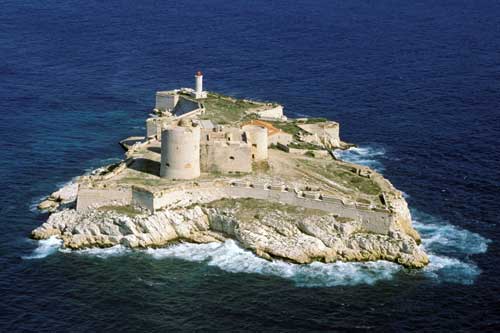
Château d'If

Or that, like Edmond Dantès, this dastardly shit-disturber named Frédéric Brochet who feeds his pupils carcinogenic food dye should be chained to the walls of Château d’If until he agrees to stop mocking us brilliant Bangers Out of The Tasting Note?

I vote the latter.

But if I take baby-step away from such defensive caviling, it’s clear that these experiments illustrate something profound about the strange science of flavor perception and the ‘why’ behind the ‘how’.  In fact, neuroscientist Gordon M. Shepherd at Yale University believes that the brain’s conceptualizing of flavors is the foundation of an entirely new scientific field which he calls neurogastronomy.

Brochet

Any first-year wine student—with the possible exception of the ding-jimmies in Frédéric Brochet’s class—will tell you that taste is primarily smell, and part of Shepherd’s mission is to disprove the theory that human olfactics were diminished during the evolution process; rather, he believes that our sense of smell is far more powerful and essential than had previously been assumed.

“We think our lives are dominated by the visual sense,” he says.  “But the closer you get to dinner, the more you realize how much your real pleasure in life is tied to smell.  It taps into all our emotions…”

Here, the ‘catchy tune’ analogy comes again into play.  Most of us have experienced the odd, overpowering sense of nostalgia that music can produce—even music we’ve never heard before.  Likewise, day-to-day smells that we encounter—including those that waft up from a glass of wine—can (and should) foster a wealth of memories.  Being able to recognize what these smells are, or remind us is of, is part of the ‘art’ of wine tasting, and comprises most of what we scrawl as tasting notes.

Because for some reason I’ve always been able to identify specifics behind scents, I figured that my sense of smell was unusually acute.  Yet over the years, I’ve come to realize that in fact, my ‘nose’ is no better than average—but somehow, I seem to possess near total recall about things I’ve smelled in the past.  I dream smells almost nightly and can summon up weird mental aromatics of virtually every house I’ve ever been inside—Shepherd calls these spatial pattern memories ‘images of smell’.  When tasting wines, I can usually manage to nail down bouquets in fairly detailed layers—which is one of the reasons I pursued wine as a side-career.  Not sure if this is an ability that everyone shares, but I think so—I have just spent more time obsessing about it, dwelling on it and talking about it—certainly, I have aroma-yabbered to the point where I’m told to shut up.

So I will—and allow Dr. Shepherd to regain center stage.

Gordon M. Shepherd

In his recent book  Neurogastronomy: How the Brain Creates Flavor and Why It Matters (Columbia University Press, 2012), Shepherd offers a fascinating overview of the mechanics of smells—how the nose picks up cues from the back of the mouth and how, when eating and drinking the act of breathing in and breathing out work together to produce the most complex of human sensations—not ‘taste’, but ‘flavor’.

“In fact,” Shepherd explains, “Molecular biologists have discovered that the sensory receptors for smell form the largest gene family in the human genome.”

Wine tasters, therefore, spend more time sniffing than they do slurping, and the actual ‘tasting’ phase is more or less to see if the wine performs to the palate the same pas de bourrée as it does to the nose.

The problem is, as Chris Mullineux discovered the hard way, these sensations can be as volatile as a vendaval, and one man’s leather is another man’s brett, while one woman’s goût de pétrole is another woman’s kerosene funk.

And potentially, these smells are not even there.  In what was perhaps his most telling experiment, Shepherd asked tasters at Brown University to sniff and summarize their impressions of a series of liquids which—unbeknownst to them—were all water, though some were dyed.  Invariably, the notes on the colored water mentioned clichéd fruit juice descriptors and the subjects perceived non-existent scents that matched their expectations.

At the very least, these experiments point to the value of ‘blind tastings’.

Proust trying to remember where he left his keys

French novelist Marcel Proust’s works—especially Remembrance of Things Past—delve so deeply into the precept of ‘flashback flavors’ that involuntary memory is often referred to as Proustian memory.  In the classic ‘madeleine’ episode in the novel’s opening, such a flood of emotion is triggered within the mind of The Narrator after he nibbles a tea cake that the rest of the plot stems from it:

“…And suddenly the memory revealed itself. The taste was that of the little piece of madeleine which on Sunday mornings at Combray (because on those mornings I did not go out before mass), when I went to say good morning to her in her bedroom, my aunt Léonie used to give me, dipping it first in her own cup of tea or tisane. The sight of the little madeleine had recalled nothing to my mind before I tasted it. And all from my cup of tea.”

Would that my own tasting notes were half so eloquent—and indeed, whenever I read that passage I understand how soundly Proust rubs my nose in it.

Posted in GENERAL | Tagged , , | Leave a comment