Brys Is Nice: Try ‘Dry Ice’ For Sugar And Spice

Take my advice and read this twice:

Brys Dry Ice is gold-medal nice; and Patrick Brys is that in a trice—as sisters Katie and Stephanie Brys can likewise entice.  

No, I’m not channeling the ghost of Dr. Seuss; it’s a mnemonic device (okay, I’ll stop rhyming now) to ensure that you remember how to pronounce ‘Brys’.  Unlike me, who forgot and made the mistake of pronouncing it like that Jewish covenant ceremony wherein they lop off the fleshy little tchotchke from a malchick prick on the eighth day of a young boy’s life, then hold a big feast where the main course is, often, unfortunately, ironically, brysket.

Of course, the Bryses could take the easy way out and simply change the spelling to Bryce, but in that case, somebody might mistake this cool, supernally-attractive Michigan family with that deranged Washington Nationals rookie Bryce Harper who blew a such a bipolar gasket on Friday night (over going 0 for 4; welcome to the Majors, psycho) that he hit himself in the head with his own bat.

Personally, I’d rather be confused for Hassidic foreskin than for loony-tunes Harper.

Patrick Brys

Far more mellow, engaging, bright and non-violent is Patrick Brys—the Prodigal Son returned to the family fold after many years of college-going, house buying and wild, wild West wandering.  Armed with a marketing degree and a world-view, Patrick became Brys Estate Vineyard Operations Manager in 2010, and also, the porte-parole de famille who deals with squirrely wine writers (me) when we show up unannounced and want an interview.

Acquitting himself admirably, Patrick sat me on the beautiful, if season-dependent patio annexed to the tasting room—a brick and mahogany gem—and ran through a series of current Brys releases.

But First, Some Background Noise:

Eileen and Walter Brys entered the wine biz via the most common route: Health insurance.  Well, maybe by ‘common’ I mean ‘absolutely anomalous’, but it is true that a lot of retiring Michigan wine lovers (some of whom are in the insurance biz) dream about opening a winery—and that far fewer actually have the chutzpah to do it.  The Bryses searched Texas, California, Oregon and New York before pulling the ol’ Dorothy-Gale-From-Kansas, “If I ever go looking for my heart’s desire again, I won’t look any further than my own backyard…” 

Yes, I stole this photo, okay??

Settling on an eighty-acre 1890’s homestead halfway up the Old Mission Peninsula, the brace of Brys unleashed their first vintage in 2005 to accolades, kudos and laurels—even a few medals.  Renovation of the once-derelict property has been ongoing, and the property now boasts a guest house, tasting room and 32 acres committed to vinifera va-va-voomeries.

Such as:

Brys Estate Dry Riesling, Old Mission, 2011, about $20:  A characteristic sweet/tart Michigan riesling; juicy with mandarin orange and apricot and shored up by lemon-lime acidity; the wine shows the sort of refined elegance that has become a hallmark of winemaker Coenraad Stassen’s style.  Riesling harvest is usually three to four tons per acre—a bit much to create a really deep and complex example, but for the purpose at hand—which I suspect is a user-friendly food wine—the bill is well fit.

Brys Estate ‘Naked’ Chardonnay, Old Mission, 2011, around $22: Now that the vines are maturing, one surprise (to me) about Michigan chardonnay is the emergence of distinct, definable tropical fruit flavors.  This one, wisely left unoaked, shows a profound pastiche of pineapple, banana, mango, guava and kiwi; this is a wine to prove that Old Mission may indeed have a unique handle on this often ‘blank canvas’ varietal.

Brys Estate Pinot Blanc, Old Mission, 2011, about $24:  A beautiful, envelope-pushing rarity: Michigan pinot blanc.  Now nearly bullied out of Burgundy, the varietal has found new life in the New World, and here produces a typically nose-neutral wine with integrated acidity, pear and apple notes and a nutty (almond) finish.

Brys Estate Pinot Noir/Riesling, Old Mission, 2011, around $15:  Any time a truly weird blend like this comes across the board, my hypnapompic image is of a winemaker saying, ‘What the heck are we going to do with the leftover pinot noir and riesling?’  No idea if this is the case here, but the wine comes across as simple, succulent and strange: Traces of tangerine, strawberry, cherry and cinnamon lace a rosé-esque blush; it does not appear to have aspirations beyond being a quaffable porch-pounder, but the wine world is plenty big enough for these.

Brys Estate Cabernet Franc, Old Mission, 2010, about $35:  A Tasters Guild International award winner, this driza-bone (listed at 0.00% residual sugar—for real?) cab franc shows the Northern face of this early-ripening varietal.  Less acidic than cabernet sauvignon, it is often used as a secondary or even tertiary blending grape in France, but here it produces lone-varietal wines of noblesse and polish.  The rich Brys 2010, from five low-yield acres, displays bright blackberry, plum, oak spice and vanilla along with an appealing tension between sweet and savory fruit notes.

Brys Estate Dry Ice, Old Mission, 2008, around $75:  December 7, 1941 may live in infamy, but December 7, 2008 shows a bit more promise.  That’s the chilly evening that riesling was picked for the Brys Estate’s signature ice wine.  With residual sugar of 6.8%, Dry Ice is indeed dry by dessert wine standards, and is a congenial concentration of baked apple, dried pineapple, nutmeg, apricot nectar and lively, grapefruit-flavored acidity.

*

Meanwhile, the gorgeous Brys girls have moved back to Texas, but Walter Brys’s niece Judy Shaughnessy has picked up some of the slack as Tasting Room and Wine Club Manager.

Which for clan Brys wound up being a perfectly nice splice, any way you roll the…

Ivories, shakers, tombstones, Boggle bits… anything but ‘dice’.

Posted in Michigan, MIDWEST, Old Mission Peninsula | Tagged , , | Leave a comment

How To Buy Wine In The Most Dangerous City In America

“How ya gonna keep ‘em down in the slum,

After they’ve seen El Ayyyy?”

– Apologies to Joe Young and Sam M. Lewis

Before vs. After

I won’t say the name of the Flint lounge where I had this conversation, because the bartender has been there twenty years and probably shouldn’t be talking about her customers in a manner that results in being publicly quoted.  But what she said tickled the bleep out of me:

“Back in the day, he used to come in all frowzy and stuff, in sweats and a ball cap, just like a normal guy.  Last time he was in, he had a bunch of handlers with him.  He was dressed in slick clothes and was all tan and had his hair brushed and everything.”

See, this amused me, because I thought Michael Moore cultivated his Moonbat McWacky public scruffball image as carefully as Alfalfa did his phallic, pomade-soused cowlick.  Which I think he did, until Laurent D. of Privé Salons in Beverly Hills got a hold of him and finagled a makeover that included highlights and lowlights for the vaguely spiky do he sported at the People’s Choice Awards.

Can you make a silk purse from a sow’s ear?  Likely not, which is why Mr. Laurent had to use the whole sow.

Okay, That Was Mean…

“Leggo my ego.”

Michael Moore is one of those people about whom one’s opinion is unilateral, with no middle ground, no equivocating and absolutely no waffling—the latter in fear that Moore might grab your waffle and devour it before you could pop him with a Nugent-approved assault rifle.

Michael Moore you either love or hate, but not both—correct?

Not:  And I’m Living Proof

“We shall see thee no Moore.”

See, I wrote a bunch of stuff for Moore when he was editor of Michigan Voice, and he complained about, snickered at, rewrote or rejected every damn one of them.  Frankly (ever the vindictive one), I did an ebullient Irish Sean-nós stepdance when I learned that Moore’s tenure at Mother Jones (for which he abandoned Flint a heck of a lot quicker than Roger Smith did) was only four months long, and that he’d been shit-canned for doing unto others as he’d done unto me.

That’s the hate part—at least half of it.

The other part is self-hate: I hate myself for loving his films, every last one of them.  And that’s the love part.

Alright; so, I’m a messed up bundle of cognitive, intervention-worthy contradictions; at least I appreciate a good joke:

Guy goes into a bar and sees another guy trying to light his Bic with a match.  “Are you out of flint?” he asks.  “Nope,” replies the second guy.  “Hamtramck”.


Flint Groans—Meet The Flint Moans

Moore was right about one thing: In the wake of GM’s wake, Flint has really let itself go.  Currently, the average household income is under $30,000—46% below the national average.  Flint’s poverty rate is 36.2%, making New Orleans (at 21%) seem like Monte Carlo during high-roller tourist season. The city’s 2013 budget includes higher taxes, apparently meant to fund comprehensive cuts to every single municipal department including police and fire; part of the wit and wisdom of Emergency Financial Manager Michael Brown.

To gild this particular lily, last year in commemoration of 22 instances of violent crime per 1,000 residents—including 53 murders and 1,500 aggravated assaults—Flint was named ‘America’s Most Dangerous City’ by numerous publications including The Wall Street Journal and Huffington Post.

It’s enough to drive a fella to drink, so it sure would be nice to have a place to do it.

Flint: Between a Rock and a Hard Place

Other than the seedy, erstwhile factory-rat bar where I had the Moore conversation, Flint is really remarkable as being one of the very few American cities of more than 100,000 residents that has no restaurants.  I mean, literally, none.

I’m not talking about chains like Fuddruckers or coney joints where the kitchen staff curses at one other in some bizarre Balkan dialect or anywhere that has the word ‘Family’ tacked onto the name and actually advertises their goulash instead of trying to sneak it past you—I mean decent, ambitious places where they have a chef instead of a cook and you pay at the table, not at the cash register on the way out.

What they do have is a plethora of package liquor outlets—‘party stores’ in Midwest parlance.  The city of Flint alone has sixty (eighteen more  than authorized by the state) and if you can get past the folding iron bars, wade through the pork rinds, cheese-flavored carbohydrates, Keebler Sugar Wafers and Rolling Rock displays, you’ll find that most actually stock a few dusty bottles of ‘stuff in which the word wine appears somewhere on the label’.  And if you don’t mind waiting twenty minutes in a line in which nearly everyone else is buying Daily 3 and 4 tickets and half-gallons of Black Velvet while clutching bridge cards and diapered, dysgenic kids, and then dealing with a clerk who is still bleary from his/her nightly ten-minutes-to-two-until-two AM rush, you’ll find that you can actually pay for one.


What it is that you’re paying for is a different story.

Therefore, in my never-ending anti-journalist’s crusade to bring useful, hard-hitting information to shut-in drunks, I made the personal pilgrimage to Flint, risking life, limb and liver disease to uncover just what that may be.

The following compendium of crapola is not meant to be comprehensive; these are merely the liquor stores I hit before becoming overwhelmed with the need to do some personal ‘celebrity spotting’ like that silly drink jockey and her braggadocio Michael Moore story.

Now, realistically, this is Dort Highway, not Wilshire Boulevard or Fifth Avenue, and I knew I had a better chance of spotting Dudley Moore than I did Michael Moore, who’s now become far too Ulmer Scale A-List to hang out in Flint more than once in a coon’s age—if it was him I wanted to ‘encounter’, I’d head up to Torch Lake in Northern Michigan, where the ‘Voice of the Occupy Movement’—who encourages we militant 99% to continue our good fight against the wealthy—has his two million dollar lakefront luxury mansion.

But who’s to say I couldn’t find some Moores who were neither dead nor bankable nor in current Tinseltown demand—which for them may all be the same thing?

How about Demi?  Or Roger?  Or Melba?

Or in absolute, go-for-broke, desperation pinch, Mary Tyler?

I’ll report in on that when I feel like it. In the meantime, here’s where you can buy wine in the most dangerous city in America:

 Zerka’s Stop & Shop; 1395 W Bristol Rd, Flint MI

The Biblical proportions of this smart, well-appointed junk foodery may be lost upon the staff, but not upon Judaic scholars who know, of course, that ‘Zerka’ is the Hebrew term for the River Jordan.  Yet there is no Jordan Cabernet to be found amid the Ding Dongs and Ho Hos, nor even any sacramental Manischewitz, although Lisa the Cashier—whose elegant ensemble and simple hairstyle evoked the ‘Old Hollywood’ of Hedy Lamar or Jean Harlow—recommended Barefoot Moscato, her personal favorite, or, if I wanted something with a little more ‘oomph’, Seagram’s Sweet Tea Flavored Vodka.  Which is technically not wine, but like I’m going to give Hedy Lamar enology lessons?

Liquor & Smokers Outlet & Dollar Deals: 1390 Bristol Rd, Flint MI

Any place that so unabashedly caters to extremely cheap people bent on self-destructive habits is at the tippy-top of my personal Ulmer Scale; this boutique—mere yards from Zerka’s—shows that the Flint zoning and planning coordinators have testicles of titanium when dealing out SDD Off-Premise licenses.  I asked the salesperson—looking stunning in her coral, strapless (Louis Vuitton?) poly-cotton smock, by the way—for a wine recommendation, and she asked if I’d ever heard of Sutter Home.

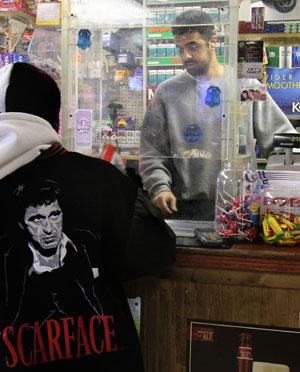
Obviously I walked in with sommelier/wine writer written all over my Salvation Army AKOO hoodie.

Last Chance Party Store: 5545 S. State Rd, Goodrich, MI

In the boondocks of suburban Flint, the Last Chance is helmed by a tan, t-shirted, gnarly old dude who keeps tabs on area shootings, reporting two the night before I stopped in, one per day on average in Flint, including three party store owners over the past few years.  No word on whether the crimes were precipitated by frustrated connoisseurs who will find several brands of charcoal on the Last Chance shelves, multiple kinds of Copenhagen and Red Seal tobacco, dozens of colon-canceraries like Twinkies, Doritos, Kit Kats and True Moo Chocolate Milk, but only a single wine label: Gallo Family Vineyards.  This screams ‘Mafia bootleg infiltration’ to me, but what do I know?  I opted for the sauvignon blanc because it looked less brown and contained more alcohol per volume than its sister varietals pinot grigio and ‘Sweet Chardonnay’ and found it to be predictably and generically gluggable.

Corner Stop Food Store; 3271 S. Dort Highway, Flint MI

“Give me a pack of Swisher Sweets, a Mega Millions ticket and something I can use to blow up airplanes.”

Here on the non-Caucasian side of town, you can do some serious bargain hunting—provided your thing is Magnum Malt Liquor (two 40-ouncers for three dollars), Tilt Premium (containing 12% alcohol along with caffeine, ginseng and Guarana; ideal for the health/trend-conscious derelict) or methamphetamine (there’s a ice cream truck stationed permanently out front which I guarantee is selling more than Good Humor Jimmy Cones).  It’s strictly self-serve, of course, since all transactions are done through Armormax thermoplastic so thick that advice solicitation is impossible.

Now, I’m not as big on conspiracy theories as, say, Michael Moore is, but something rotten is clearly at work here:  The Corner Stop’s fine wine selection is limited to the effeminate kaleidoscope of MD 2020 flavors like Banana Red and Kiwi Lemon, wine coolers and girly Riunite labels like Lambrusco and Lancellota, and for a few pennies more, a genuine imported stocking-stuffer: Opera Prima Sparkling Pink Moscato from Tierra de Castilla, Spain.  Isn’t it obvious that there is some sort of methodical eunuchization being imposed upon Flint’s wino community?  Possibly part of a massive government eugenics plot to ensure that undesirables like unemployed ghetto drunks are so wussified that they cannot reproduce??

Come on, Mike: Flint, bad guys in Washington, oppressed masses being systematically sterilized via the one product they can’t live without, cheap booze?

This one has your name written all over it.

Posted in GENERAL | Tagged , , | Leave a comment

2 Lads Winery: Laddie Come Home

In setting the kibble-strewn stage, Lassie Come Home was a 1943 MGM tearjerker starring Roddy McDowell (as young Joe) and ‘Pal’ (who played Lassie) that ultimately launched the syrupy television series; in the film version, the Yorkshire Carraclough family, having fallen on hard times, are forced to sell Joe’s border collie to some rich Scottish laird, and the rest of the flick involves the dog’s idiotic, utterly-implausible journey from Scotland back to Yorkshire, where Lassie is reunited at the last possible second with poor, forlorn Roddy, who’d by then given up all hope of seeing her again.

As you might suppose, there was not a dry eye in the house, except among litigation attorneys who realized that the dog’s sale had been final and she’d soon be wrenched from Roddy’s trembling arms and returned to Nigel Bruce, Duke of Rudling—the rightful owner.

My Version…

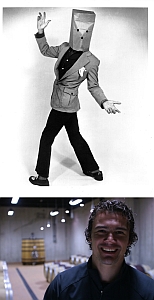
Chris Baldyega

In the re-telling, I play Lassie, Chris Baldyega of 2 Lads Winery is Joe, and if you can do a passable Highland brogue, you can be the Duke of Rudling.

Thus far, alas, our story does not have a happy ending.

Cornel Oliver

Since having met Lad 1 (Chris Baldyga) at a 2009 wine tasting and threatening him with an interview ever since, thrice have I made the arduous trek from my suburban Detroit dog kennel to the spectacular 2 Lads Winery on the Old Mission Peninsula, crossing mountains and rivers, encountering  evil shepherds, conniving traveling salesmen and kindly old people who sell me beer at gas station convenience stores.  And yet, panting, drooling, tail wagging, every goddamn time I get there, neither Laddie is home. (Lad 2 is Cornel Oliver).

I strongly suspect the script writers.

A Tasting Room Fit For a Duke

2 Lads Winery

Every time I walk into the 2 Lads state-of-the-art facility—an awesome blend of ultra-contemporary aesthetics and functional, gravity-flow grape-processing practicality—I note that if for no other reason, they need the massive size to contain the elephant in the room:

That is, although Cornel and Chris command the press attention (or would, if I could figure out when the heck they’re coming home), there’s a 3rd Lad with pockets deeper than those in the Duke of Rudling’s kilt.  Arguably the most stunning winery design in Michigan, there likely are not enough border collies in the contiguous United States that you could sell in order to afford this joint.

But, no matter.  It was not the poured concrete bar or the sensational view of the East Bay beyond which drew me North, nor in the end, even a chance to shit-shoot with either of the Lads: It was their wine.

Caryn Chachulski

And pouring that early May afternoon was assistant winemaker/wine educator Caryn Chachulski, a woman of vinous charm and substance who can not only carry the torch during the 2 Lads’ AWOLishness, but kick the flame up a notch—which is probably why she sports the additional title of ‘Social Media Marketer’.  Trained at CSU in Fresno, she came aboard the good ship 2 Lads in 2007 after a stints at L. Mawby and can walk a taster through subtleties in the selections that you’d really require extensive process knowledge to acquire.

Here’s what she was offering:

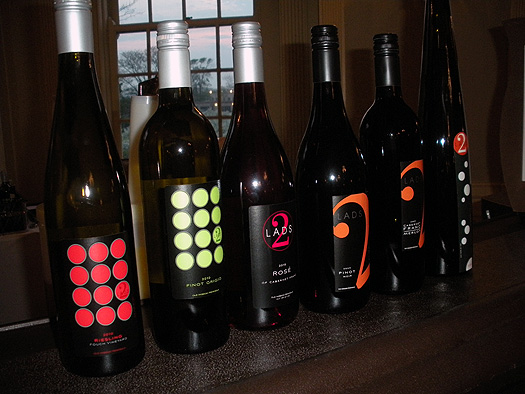
2 Lads Winery, Pinot Grigio, Old Mission, 2010, (about $17):  Of the 22 acres that 2 Lads has in vine, about a quarter is pinot grigio, and as a result, it’s the grape on which Laddish reputations are staked.  Oddly, their two blocks—600 feet apart—have such markedly different terroirs that one is used for still wine; the other for sparkling.  The 2010 still grigio was drier than the vintage it preceded and followed, and predictably, it is shivery with tight acidity underlying honeysuckle on the nose and apricot, citrus and tangerine on the palate.

2 Lads Winery, Sparkling Reserve, Old Mission, 2009, (about $25):  The first, and as far as I can tell, only vintage of this blend (75% chardonnay/25% pinot grigio) is produced via traditional, painstaking méthode champenoise and shows delightful, yeasty brioche notes, with the chardonnay offering bright lemon, apple and a bit of pineapple; the pinot grigio kicks in a little Bosc pear.

2 Lads Winery, Reserve Chardonnay, Old Mission, 2010, (about $ sold out):  Harder to find than a Lad, so I report on it further only because the irony of sampling a wine you can’t buy is identical to writing about winemakers you can’t interview.  French oak fermentation and seven months on the lees lent the wine vanilla cream and sweet butter; pleasant, fruity and nicely complex, with lemon zest, fig and Granny Smith apple.  I’d tell you what clones they use, but you probably can’t find those either.

2 Lads Winery, Cabernet Franc Rosé, Old Mission, 2011, (about $19):  2011 may be the Northern Michigan vintage that ultimately raises the bar for cabernet franc; being a big fan of dry, Cabernet d’Anjou-style rosé, I don’t have the slightest issue with the Lads sinking a good portion of the harvest into just that.  The wine has as much punch as plenty of cool climate pinot noirs, with such springtime flavors as instantly recall those of Loire’s versions: Rhubarb, strawberry and raspberry followed by a distinct and succulent whiff of grenadine.

2 Lads Winery, Cabernet Franc/Merlot, Old Mission, 2010, (about $25):  The sensationally warm season brought both the cab franc and merlot (45% of the blend) to full ripeness; as a result, the wine boasts opulence and breeding with rich ripe cherry, Damson plum and licorice—and none of the weedy pitch of pepper that may show up in this blend during chilly seasons.  Bold and self-confident, the wine finishes with a long, silken sigh.

*

Speaking of long, silken sighs, while I sit at my lonely keyboard and wait to see if either Laddie Comes Home, or if this column draggles a sound bite from at least one of the Lads (which I’ll then promptly add), I shall fill up the remaining space with some trivia regarding Lassie Come Home which may not help you in your quest for Old Mission Peninsula wine appreciation, but may net you a winning berth on Jeopardy:

  • Proddy BigDowell

    Roddy McDowell (Joe Carraclough), dead since 1998, is reputed to have had one of the largest tallywhackers in Hollywood; he ranks #9, between Owen Wilson and Frank Sinatra—being named both ‘Rod’ and ‘Dowell’ is but icing on that cake.

  • ‘Pal’, dead since 1958, the collie who won the film’s title role, was initially rejected by director Fred Wilcox, but any rumors about doggie-style on casting couches have long since been discounted.  Pal’s last cinematic appearance as Lassie was in the first episode of the 1954 television series.
  • Lithe and gorgeous even at age 12, Liz Taylor also showed off acting prowess as Priscilla, the Duke of Rudling’s granddaughter; this was still decades from the time she’d renounce her United States citizenship, move to England and covert her body to pounds.
  • Lasting until 1973, everyone knows 1) That the dogs who played the female Lassie were invariably male, and that 2) Six collies overall were used in the role.  What’s not so well know is that for the role of Tommy Rettig’s mother, six June Lockharts were used—all of whom were also male.

Various June Lockharts used to portray Tommy’s mommy


Posted in Michigan, MIDWEST, Old Mission Peninsula | Tagged , , , , | Leave a comment

Zima, Why Can’t I Quit You?

Left: A woman’s woman. Right: A hip-flask’s hip-flask.

I have a friend called Cori who recently asked me for some bourbon advice because she planned to give her boyfriend a fifth of small batch for his birthday, and although she’d already found the liquor, she was iffy on giving him a pewter hip flask to pour it into.  In posing to me the question of whether or not a pewter hip-flask was sufficiently macho, she referred to me as seeming like a ‘man’s man’.

Now, if the truth is told—even though Elton John, Clay Aiken, Neil Patrick Harris and Ricky Martin are all clearly men’s men—other than being told, ‘Gosh, honey—are you ever handy with that reciprocating saw,’ being called a man’s man is a consummation devoutly to be wished.

And thus, we all aspire to it.

How?

Personally,  I don’t smoke Le Bijou Churchill cigars, I douse them in a pewter hip-flask’s worth of Ass Reaper Hot Sauce and eat them.  I swim naked in Lake Michigan in December, even when sober.  I hunt wild Barbary boars with nothing but a butter knife and I run marathons with a Yugo strapped to my back.  I read my teenage daughter’s diary.

And frankly, hon, screw the power tools.  Real men believe that only a wuss would use a reciprocating saw when the same job can be accomplished with the fingernails.

Add to that the fact that bourbon is indeed my chug of choice, and in my own mind, my man’s man status is confirmed.

You’re right, dear Cori.  I am all of that, aren’t I?  I must be.  Right??

Repression: One of the Most Haunting Concepts in Psychology

In fact, repression is the foundation upon which clinical analysis rests—I know, because I studied it at college for many years before I realized that I had accidentally checked ‘psychotherapist’ instead of ‘alcoholic vagrant’ on the back of the career-day matchbook.

I recall (without needing therapy) a landmark case that was presented in one of the few classes where I actually paid attention:

In Redwood City, California, a middle-aged dude named George Franklin was convicted of murder twenty years after the crime based solely on the re-emergence of childhood memories in the mind of his now-adult daughter Eileen.  Her flashbacks apparently impressed not only her shrink, but also the San Mateo district attorney and a jury of Franklin’s peers, because he was convicted of 1st degree murder in less than twenty-four hours.

Thanksgiving with the Franklins!

Unfortunately, the whole thing wound up being bullshit, and after six years, Franklin’s conviction was overturned and he was released.

Bet Thanksgiving dinners in that family are a riot, huh?

Repression: One of the Silliest Concepts in Psychology

I use that anecdote merely to reference a personal memory that unsuppressed itself shortly after Cori’s kind and perfectly accurate assessment of my testosterony character:

In my mind’s eye, out of the blue, I saw myself cutting the grass in 1994—not with my teeth, either, but astride a chartreuse-green and canary-yellow rider mower.

And it gets worse.  Inside the mower’s cupholder (an asinine but requisite accessory for those of us who at least minored in alcoholism) was not a beer, not a manly tumbler of single malt scotch, not even a borderline-prissy Jack-and-Coke.

It was a douchey, lemon-lime flavored Zima.

Bet You Didn’t Know That Bulgarian Winters Were Made For Girly-Men, Did You?

Back in the ‘90s, when no self-respecting male would drink a wine cooler, somebody at Coors Brewing Company had the genius notion of marketing to us a clear malt beverage instead.  Had they referred to it as an ‘alcopop’ as they might in 21st century nomenclature, we wouldn’t have touched it with a ten-foot pole; instead, they called it a ‘beer alternative’ or (absurdly) a ‘malternate’, and suddenly, according to statistics, fully half of male American drinkers decided that they needed to try a ‘malternate’ at least once.

The fact that Coors named it ‘Zima’ didn’t hurt, either: Zima is a Slavic word meaning ‘winter’, and you don’t get much more butch than January in Belorussia, do you?

Małgorzata Dydek, a ten foot Pole

If repressed memory serves,  I was one of those schmucks who figured that if the stuff was good enough for a ten-foot Polack, it was good enough for me.

Allowing myself to further circumnutate the soot and cinders of my severely dissociative mind, searching for other cases of ego-abuse so egregious that I probably padlocked them inside some inaccessible mental crawlspace, I came up with many Zima-related memories—including me jettisoning empty after empty into a wooded area on my property.

See, that’s it.  Game, set, match.  The whole idea instantly becomes nuts:  Me, Mr. Earth-First Greenpeace Save-The-Whales-But-Carpet-Bomb-Monsanto-Headquarters, polluting the planet I will leave my bratty, misbehaving and dress-like-alcoholic-vagrants children, throwing returnable, non-biodegradable bottles into the woods where I might easily hit an endangered species of squirrel, simply because I—who might climb the daunting Slavic peak Hora Hoverla mid-winter, dressed in skivvies—was too lazy to walk to the house… (??!)

Yeah, right.

The Explanation Then?

Simple, according to G.K. Ganaway’s Alternative Hypotheses Regarding Satanic Ritual Abuse Memories (1991):

These so-called ‘memories’ are merely manifestations of my terror, rage, guilt, depression and overall behavioral dysfunction based on my awareness that Zima was ever foisted upon us men’s men Y chromosome carriers.

Duh.

So, just to be sure, I went out back and gamely dug through the area where I ‘remembered’ having thrown Zima bottles, braving poison ivy, spider webs and icky, slimy gastropods like the badass stud that I am.

And now, damn it all, after I’m done with repressed memory therapy, I have to start in on this sudden outbreak of hallucinations.

Back To the Zima Story

In his paper entitled The Long, Slow, Torturous Death of Zima delivered before the 99th Annual Convention of the American Psychological Association in San Francisco, Brendan Koerner confirmed what most of us had already suspected:

It’s all David Letterman’s fault.

Zima’s popularity peaked in 1994, when 1.3 million barrels were sold, but constant mockery by the gap-toothed, late night television yuckster finally awoke those of you metrosexuals who actually did drink Zima while mowing the lawn that after your Bottega Veneta man purse, your hair highlights, your electrolysis and your nuclear tan, no further emasculation was necessary.

Shortly thereafter, Zima stock began to plummet as precipitously as Letterman’s Nielsen ratings, and a mere two years later, sales were down by two thirds.  Domestic production of the effete sugar water—which is actually made by filtering cheap beer through charcoal, then adding fake citrus flavor and corn syrup—ended in 2008.

Today, Zima is Produced, Marketed and Sipped Only in Effeminate Japan

See, Prime Minister Noda; there’s something else we suspected all along:  In the end, all that Banzai! and kamikaze and fight-to-the-last-man-in-the-rathole crap was about as phony as Eileen Franklin’s repressed memory, wasn’t it?

Thanks again, Cori.  This Bud Light Lime-A-Rita’s for you.

Posted in BEER | Tagged , | Leave a comment

Verterra Winery And My Personal Quest For Jim Harrison

You. I mean, then.

Long ago and far away, when many of you whippersnappers were still drinking wine out of Evenflo baby bottles and I was scarcely old enough to steal vodka from my parents’ liquor cabinet, I headed up to the Leelanau Peninsula to search for my then-literary idol, Jim Harrison.

At the time, Mr. Harrison had only published a handful of novels and was still a Northern Michigan landmark instead of a Hollywood wonk-eyesore; inevitable stylistic comparisons were made between him and Hemingway.

Even so, then as now, my reading preferences leaned toward Harrison, and in fact, Warlock and Sundog were foundations of my fantasy to pursue fiction as an occupation.

My success in that particular venture should be glaring, as you are reading an obscure wine book instead of a NY Times bestseller.

That Ernest, always shooting his mouth off.

Anyway, my quest for Harrison himself bore more fruit.   Like any good novel groupie, I’d have loved to have shot the shit with old Ernest, but by the time I was born he’d already left his hypothalamus on the cove molding of his Ketchum foyer.  However, I had been assured by the alcoholic intelligentsia that Jim Harrison—a native son of Grayling, Michigan—could be found in a specific Leland bar more nights than not.  So up I went, my ticker fluttering and flip-flopping, no doubt expecting that Harrison would embrace some random downstate teenager, take him under his wing, edit, spell check and rewrite heartfelt drivel, set him up with a publisher and find him a local girl to boff.

Hey, it could happen.

Instead (cutting to the chase), I found him in a condition which I believed to be half-tanked (I could be wrong), trying to scam on barfly chicks (I could be wrong), playing an odd billiard game called bank pool (I could be wrong; maybe nine-ball) and received a quick, cursory, courtesy-free brush-off (I’m not wrong).

Bitter?

Seriously?  I’m getting mileage out of that friggin story to this day.

But, What Does This Have To Do With Verterra Winery?

Doug and Shawn

The Bluebird—the bar where this all happened—is owned by the same dude that owns Verterra, Skip Telgard.

In fact, I like to believe that the entire vivacious Verterra venture, which includes Skip’s partner Paul Hamelin, winemaker Shannon Walters and consultant Doug Matthies, was conceived right there at the hundred-seat Bluebird bar over a growler of Good Harbor Fishtown White.

But I could be wrong.

However it happened, it happened right; the winery’s first vintage won seven medals at the Michigan Wine and Spirits Competition and last month, the next vintage took Pacific Rim Wine Competition’s Best In Class for Pinot Blanc 2011 and Chaos White Cuvée 2011—a category that required unanimous ‘ayes’ from the judges.

To ice that cake, Verterra’s Dry Riesling 2011 won a gold medal at the same competition.

Trust me, vineyards that have specialized in riesling for decades aspire to take home gold at the Pacific Rim.

Taste Amid the Ghosts of Sweeney Todd, Bill Dauterive, Figaro and Floyd The Barber

As a Latin contraction, Verterra translates into ‘true earth’—unless, of course, you happen to speak Latin, in which case it really doesn’t. More like ‘spring earth’.

But, that’s no biggie.  The Verterra tasting room is the biggie.

Ensconced within a 1927 building shell that originally housed S.R. Gains’s tonsorial parlor (Latin for barbershop) and a Jim Harrison-approved pool hall, the short-board maple flooring and funky-looking borrowed-brick exterior has the place oozing the alluvia of D.I.Y. history.  Within, manager Jeff pours through the award-winners with expertise and aplomb (Latin for flyness), pointing out, amid his schpiel, that one of the most unique and exciting things about Verterra is that it is family-owned and operated.

Now, that’s worth a column in itself, because if me and my family—extended or otherwise—ever opened a winery together, the only exciting part would be the 911 domestic violence calls and the only unique thing about it would be how quickly it closed.

But holding it together quite remarkably is Paul Hamelin, his wife and winemaker son Geoff, crediting (in this order) Shannon Walters and the true earth—especially the trio of magnificently productive vineyards from which the winery draws fruit.

Now, anybody who knows Walter’s work knows that he could make award-winning wine out of the cladophora algae that clogs  Grand Traverse Bay, but with the advantage of his solid rep (based on seventeen stellar years of vintership in Michigan), he doesn’t have to.  So impressive is he both as a technician and an artist—he’s been called (somewhat belatedly) ‘the guy who can finally put Michigan on the world’s wine map’—that his skills are in demand at wineries throughout Leelanau and Old Mission.   The fact that he’s hauling down medals for each of them—so many that gold no longer seems an element precious enough to do these wines justice—he’s maybe into X-Kryptonite territory by now—proves that his purple thumb is pressed with equanimity upon the foreheads of his patrons—(English for patroni).

Shawn Walters

Of course, as Galileo did for the Marchese del Monte and the Grand Duke of Tuscany; as da Vinci did for Cesare Borgia and as Michelangelo did for Lorenzo de’ Medici, Verterra’s owners find their social status improved by their canny t magic-touch wines.  Okay, that’s an exaggeration, but they do get to sit and gloat before awestruck wine writers such as I, who may not perch upon the same belletristic throne as Jim Harrison, but whose eyes, at least, track.

Tasting Notes:

Among the Verterra wines we sampled was Reserve Red, 2010 (around $25), a blend of cab franc, merlot and syrah, steel fermented separately and aged in half-American/half-French oak ‘stave barrels’ (frankly, I’m not sure what other kind exists, but I didn’t write the copy) and blended post-malolacticly.  The results—laced with blackberry and supple with spice (to my palate, anise and cinnamon), tamed tannins and long in the finish—took a gold medal at the 2011 Michigan Wine & Spirits Competition.

Dry Gewurztraminer, 2011 (about $18) is part of a tiny 187 case lot.  The web site claims ‘we get tired of saying the full name’ and refers to it not by its Cliff’s Notes version, ‘gewurtz’ but by the Cliff’s Notes version of the Cliff’s Notes version:  ‘Gwertz’.  It leans lightly to the floral side of the palate, but not too much—Walters harvests early to avoid the over-saturation of classic Alsace rose petal/Turkish Delight flavors.  It’s a wise move considering that the only real drawback to this delightful varietal is that its ‘strength of character’ can be so pronounced that it dominates everything with which it comes in contact.  That’s why it is inevitably recommended as a match to spicy cuisine: Like X-Kryptonite, whose whose radiation and odor can imbue Earth-based life-forms with temporary superpowers, gewürztraminer and, say, incendiary Bengal curry, can grapple together without a clear dominator.

Chablis-modeled Unwooded Chardonnay, 2010 (about $16)  was fermented in steel and shows citrus, apple and tropical fruits on a forward nose, solid, integrated acidity and a crisp conclusion.  As Shawn points out, the vineyard is young, and a few more years should show what this popular varietal can do in Leelanau.

The Bluebird on My Shoulder is Also on the Wagon??

Left: Michigan Wallyeye. Right: Michigan Walleye

So, the last time I stopped by The Bluebird, I noted that nearly the entire staff was too young and ditsy to recognize George Harrison let alone Jim Harrison, so I didn’t bother asking.

On the way out, however, I noted a hostess of such profound maturity (that is not Latin for old, damn it) that she’d probably recognize Benjamin Harrison.

So I inquired after the crusty, lazy-eyed poet, sharing my erstwhile pilgrimage to seek him out, to which she replied, ‘Oh, back then, lots of young people did…

Great.  Being herded into a category with a thousand other silly little twits with the same goddamn story to tell really made my night.  On the other hand, she shared the news that Harrison still stops in when he’s in town.  Now 74 years old and phlebotomizing gravitas, having proven himself an author able to hold his own against literary giants like Faulkner, he has apparently grown sedate and comfortable in his discerning dotage.

She insisted that he sat quietly and enjoyed a drink-free dinner: A plate of fried whitefish—the house specialty—casting his weird, solitary eyeball toward neither Farmer’s Daughter, pool table nor arsenal of booze bottles.

That’s what she said, anyway.  But she could be wrong.

*

Actual Bluebird review from Urbanspoon:

Mobile review by Clean plate club (6 reviews)

‘Our dog had a great time, and our pizza was good.’

Posted in Leelanau Peninsula, Michigan, MIDWEST | Tagged , , , , , , , | 4 Comments

20 Reasons Why I Grow Pot—And 20 More Why You Should Too

Say what you want about the Mexican drug lords, but they do not fuck around.  If you happen to show up on their radar screen, you may discover that a Columbian necktie is not something you can purchase at Lisa Kline Men on Robertson Blvd. in L.A., nor does one go particularly well with a Charvet French-cuff dress shirt.  Rather, it’s a technique whereby a bad guy is strapped to a chair while a worse guy offers him anatomy lessons; the victim’s throat is slashed and his/her tongue is pulled out through the wound, the subsequent condition of which is said to resemble a necktie.

The main problem with this method is not as obvious as you might think,  because it isn’t the bad guy who gets thus accoutered; it’s his wife and children, one by one, while he—strapped to a chair, as previously mentioned—is forced to watch.  Frankly, whether or not he’s killed in the aftermath is immaterial: In the meantime, the situation has tended to get his attention.

Give Peace A Chance?

We fired the shit heard round the world.

Since the term ‘War On Drugs’ was first coined by the crook Richard ‘I’m No Crook’ Nixon in 1971—three years before the quitter Richard ‘I’m No Quitter’ Nixon quit—somewhere in the neighborhood of two hundred thousand drug-related murders have come down in Mexico—nearly a quarter of those over the past five years.  This includes cartel members, military personnel, federal and local police officers, politicians, journalists, lawyers, human-rights activists, students, migrants from Central and South America and a handful of U.S. government employees like the consular official killed in Ciudad Juarez and a customs agent gunned down in San Luis Potosi.  It does not included the quantum of corpses not yet discovered; mass graves in remote deserts throughout the country are commonplace.

Meanwhile, since 1971, the number of American inmates incarcerated for drug offenses in state and federal prisons and local jails has skyrocketed by more than 1000%; the fact that a disproportionate number (four in five) are black or Hispanic (compared to overall drug-abuse among these groups of under 20%) is a story for another day.

Because, Today’s Core Study is Neither Black nor Hispanic; It’s the Indigenous Rarámuri People of Northern Mexico.

Hernán Cortés

Talk about a culture that has been run through the cheese grater; the Rarámuri—a.k.a. Tarahumara—have, through the centuries, done their best to avoid Spanification, Mexification and drugification with varying degrees of failure.  Slower than agave syrup to adopt the customs of Hernán Cortés and company, their language, religion and culture is today much as it was in the 16th century.  They remain an isolated and agriculture-based society—the main thing that has changed over the past ten years is the crops that they cultivate.

Exploitation of this ancient, profoundly spiritual race—who have lived in the forests and canyons of Chihuahua’s Sierra Madre mountains for more than two thousand years—began with the Conquistadors.  Unable to defeat them, the Spaniards subjugated them, forcing them to work their silver mines until 1696, when a full-scale Indian rebellion took place and ultimately drove the Rarámuri survivors into deep, virtually inaccessible Sierra Madre boondocks.

Rarámuri woman

And that’s where they remain today.  Unfortunately, it happens to be among the largest stand of old-growth pines in Mexico, and after Spain recalled their soul-hungry Missionaries (whose legacy remains in the weirdest Easter ritual on the planet: Parading, executing, then burning a straw Judas effigy who has a giant penis sticking out of his pants), the next group of Rarámuri abusers were the loggers, who systematically robbed them of their land via bogus promises and corrupt deals.  Copper Canyon—once the heart of the Rarámuri’s sequestered lifestyle, was penetrated by the Chihuahua-Pacific Railway during the last century and is today a jumble of sewage lagoons and smoke-belching mills.  The old-growth forests have been razed four times in a hundred years, with most of the 23 species of pine winding up as American toilet paper.

Americans, along with the Mexican government and the drug capos, have been equally happy to  wipe their asses with the Rarámuri themselves.  Recognizing the value in the desperately detached regions where the Indians crept once the prime timber was gone, trafficantes have approached them—often at gunpoint—with deals they shouldn’t refuse.  The traditional Tarahumara trio of corns, beans and squash has been largely supplanted by marijuana.

David T. Johnson

Opium poppies are grown as well, but according to David Johnson, former Assistant Secretary of State for International Narcotics and Law Enforcement Affairs: “Cannabis is the the cash cow.”

And regrettably, that’s as true for the farmers as for the narcos—faced with juggernaut U.S. agribusiness, most Rarámuris couldn’t earn a living on their old-school staples anyway.  So, raising pot is the logical extension of their twenty centuries of subsistence farming.

And remember, nearly all of what they grow is smuggled into the United States via ten trillion devious channels so that little Jordan Junior and young Sofia Sophomore can smoke a bowl before the prom; so that Grandma can get a little relief from chemo nausea and so that overgrown oafs like Whoopi Goldberg can brag to Elizabeth Hasselback that they enjoy the odd doobie or six, then waddle off to blabber at Give A Damn rallies.  LGBT activism is fine—you never know but that Jose Luis Ortiz would have grown up and joined in, except that he was shot to death at the age of three by Tijuana marijuana traffickers who mistook him for the child of a cop trying to interfere with Whoopi Goldberg’s supply chain.

If you get a break in your blabberage, Whoopi, consider giving a damn about him.

Where’s Johnny Hempleseed When We Need Him?

Kassel vintage 2009

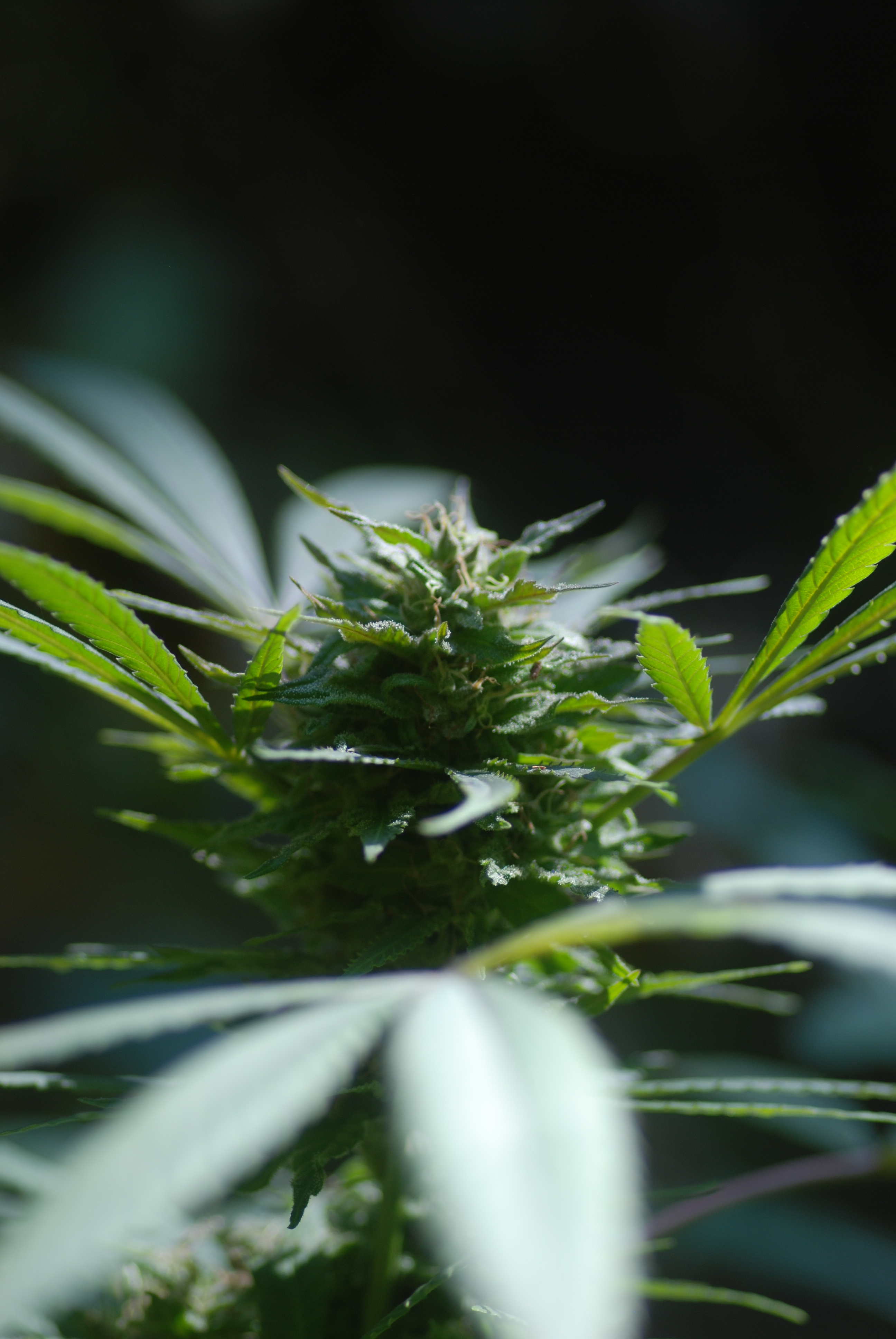
I can tell you from personal experience that marijuana is a lot easier to grow than heirloom tomatoes.

Meanwhile, marijuana smuggling remains a multi-billion dollar business in Mexico, where it’s become an unconscionable, unholy abyss; a nightmare for which there is no possible moral justification from any front, political, religious or mom-and-dad-with-the-gateway-drug-lectures.

Kassel vintage 2010

We’re talking about a substance that can be planted along freeway berms, in abandoned house lots, in open fields, raised bed gardens and backyard easements—except that some self-righteous dweeb in Washington says that it can’t be.

Are you telling me that, if Americans won’t give up their belyando spruce and their blunt blasting—and they won’t—you’d rather that it flowed through narco-channels with its associated dead toddlers, taxpayer-sponsored jail time and Columbian fashion statements instead letting the average ganja gangsta toss a handful of seeds out the living room window?

If the answer is yes, I’d be curious as to what it is that you’re smoking.

The Few, The Brave, The Severed Heads Displayed In The Town Square…

Rarámuri kid: Heartstringy enough??

The Rarámuri have not universally embraced the traffickers, of course, but opposition is not a real good career move.  Over the past decade, forty tribal leaders have been publically assassinated for speaking out in favor of maintaining the millennial Rarámuri way of life, of the preservation of a beautiful vanishing culture and of the sanctity of the gawi wachi—Sierra Tarahumaran for ‘the place that nurtures us.’

Forty. 

You want reasons to overturn current laws against growing marijuana?

There’s twenty for you and twenty for me.

Get the Help Needed to Quit for Good

Posted in GENERAL, MEXICO | Tagged , , | 1 Comment

Kassel Is Emasculated By An Empowerpuff Public Relations Morselette (And Brian Howlett)

Ever heard of a cocktail called a Mint Julep?  How about a Mai Tai?

Yeah; me too, so why is the publicist from Empower Public Relations sending me emails listing them among ‘Five Cocktails You May Not Have Heard Of’?

Brian Howlett

The question—which started off as a serious one—becomes rhetorical thanks to my buddy Brian Howlett.  Brian is a social-media-marketing guru from California (word: If becoming a guru is on your bucket list of things do before you die, social media is an easier pathway than studying the Vedānta for six decades then sitting on a mountain waiting for some moke to ask you a question) who made the following transcendental observation:

I’ve heard of these cocktails not because I am a lifelong śiṣya of spiritual knowledge based on the ‘The Essential Hindu Bartender’s Guide’, but because I’m old.

Ouch³

'Nuff said?

Specifically, Howlett (who’s way, way older than me and likely drinks Moscow Mules out of a copper mug) suggests that the list compiler was probably a card-carrying Powerpuff Girl womanana who really hadn’t heard of a Mint Julep or a Mai Tai.

Which is fine, because she’s probably hotter than most women Brian’s age.

For the record, the other three on her mystery drink list were the Cairpirinha, Brazil’s national cocktail; Soju—Korean rice liquor, not even a cocktail—and the St. Germain—made with ‘blooming elderflowers from the Alps’, which I suppose you’d have to get a Swiss guru to pick for you.

Jerry Thomas, The Swami of Swigology

I write about wine a lot, but I have an equally soft spot in my hollow leg for classic cocktails and their origins, and of course, for the indisputable, irrefragable, unequivocal Grand Guru of Grog, Jeremiah P. Thomas (1830 –1885).

Nicknamed ‘The Father of Mixology’, Thomas was a tavern owner and hotel bartender who was in such demand during the Gold Rush that in his heyday, he earned more than the Vice President.  Author of the original American cocktail book The Bon-Vivant’s Companion (published in 1862 by Brian Howlett Press; Chico, CA), Jerry Thomas is credited with inventing the Martinez—precursor to the Martini—the Blue Blazer (made by igniting whiskey and pouring it from glass to glass), the Tom Collins and the Flip, made with raw egg—this was an era when real men didn’t whine, they simply dealt with their salmonella.

Speaking of eggs, Thomas was an odd one.  Fond of dressing fly with Parisian gold watches and kid gloves, he had a strange fixation with gourds and sat as president of the National Gourd Club, and, despite being a lousy Wall Street speculator who died broke, I am willing to bet my entire 401 k that he never heard of St. Germain or a friggin Soju and would have snickered like a banshee if he had.

"Make mine a double."

Therefore, Gen-Yers:

The next time I have one too many bourbon and waters (2012 bartenderesses: Made with bourbon and water ) and try to scam on one of you twenty-something Powerpuff echo boomers, I have no intention of learning how to pronounce ‘Cairpirinha’ to do it.  And if I use ‘Soju’ in any sentence, it’s gonna be: ‘Soju come here often?’

Posted in GENERAL, LIQUOR, Miscellaneous | Tagged , , , | 1 Comment

Alabammy Bound—And Gagged, When It Comes To Dirty Bastard Ale

Here are some things that used to be illegal for a black person to do in Alabama:

  • Marry a honky
  • Urinate in the same pissoir as a white person
  • Be treated for an illness by a white doctor
  • Be committed to the same mental asylum as a white Governor
  • Be buried near dead white people

Here are some things that it is currently against the law for a black person to do in Alabama:

  • Drive while blindfolded (Section 32-5A-53)
  • Play solitaire on Sunday (Section 13A-12-1)
  • Wrestle a bear (Section 13A-12-5)
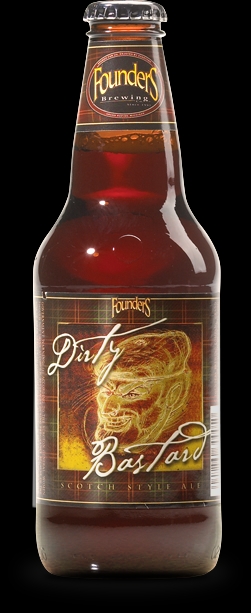
  • Buy Dirty Bastard Ale (illegal per Alabama Beverage Board ruling of April 19, 2012).

Why The Sudden Clamor From The Alabammer Yellowhammers?

Because the name ‘Dirty Bastard’ constitutes an obscenity, that’s why—at least according to  Bob Martin, an attorney with the Alabama Alcoholic Beverage Control Board who, as of last Thursday, banned the beer from the heart of Dixie—regardless of your race—in a move specifically designed to “…keep dirty words away from children.”

Meanwhile, based on 2007 statistics, 38% of Alabama children are, in fact, bastards, and nearly 20% of them can’t read anyway.

A Baseborn Beer From a Brace of Ball-Busting Brewers

“We don’t brew for the masses,” insists non-bastards Mike Stevens and Dave Engbers, makers of Dirty Bastard Scottish-Style Ale in Grand Rapids, Michigan.  “Instead, our beers are crafted for a chosen few, a small cadre of renegades and rebels who enjoy a beer that pushes the limits of what is commonly accepted as taste…”

Alabamites?  Evidently, you need not apply.

And having thus relinquished your cherished title of ‘Rebels’, you are forthwith commanded to remove Confederate flags from your pickup trucks, your biceps and any automobiles that you’ve given names to; you are instructed to finally learn the words to the ‘Star Spangled Banner’ then teach it to us Yanks, and above all, you are compelled to stop pronouncing words like someone funneled a liter of blackstrap molasses into your sinus cavities.

Oh, and if you’re still sequestering a couple of strapping young bucks down there in the lower forty?  Turn those in too—we have an election to win.

Dirty Bastard Ale: A Rebel Without A Grandfather Clause?

Founders Brewery Company produces Dirty Bastard alongside Double Trouble (also the name of a 1985 porn flick), Devil Dancer (what the First Baptist Church of Birmingham calls you if you study ballet) and KBS (which is only two ‘K’s away from sharing a name with another hallowed Alabama institution).

All other Founders Brewery products are, as far as I know, perfectly  welcome in the Cotton State, as are—for reasons unknown—Fat Bastard wine and Raging Bitch beer, both of which received the Liquor Board’s seal of approval many moons ago.

I must conclude that these obscenely-named products have either been grandfathered in, or else, in 1957, when Louis Armstrong (a bastard Negro) and Ella Fitzgerald (a bastardess Negress) regaled us with ‘Stars Fell On Alabama’, they forgot to mention that one hit Bob Martin in the noggin.

And yet, far be it from me—a native Michigander—to question Southern logic; I mean, I know that we’re talking Alabama, where Silly String is prohibited and where you can’t  make someone laugh by wearing a fake moustache in church without breaking the law (Sec. 39-15).

But in Michigan, we can’t sell cars on Sunday (435.251), get drunk on a train (436.201) or electrocute a dog, even by accident (287.279a).

I must say, however, that our laws prohibiting incest are pretty cut and dry.

♪   “I’d walk a million miles for one of your smiles, my Sammy…”   ♪ ♫

In Alabammy, You Can Whammy Your Mammy Or Your Sister Tammy Or Your Tranny Brother Sammy…

If you’re from Alabama,  whether you’re white or black, it is perfectly legal to marry your mother. (Section 30-1-3).

The other forty-nine states are encouraged to slam a Dirty Bastard instead.

*

Founders Brewing Company

235 Grandville Ave SW, Grand Rapids, MI 4950; (616) 776-1195

info@foundersbrewing.com

Posted in BEER | Tagged , | 5 Comments

Let’s Slip Out Of These Dry Clothes And Into A Wet Martini

For those of you who think there is only one authentic martini—four parts gin, one part vermouth and an olive the size of Luca Brasi’s left coglione—Louie The Lush and me have an offer you can’t refuse.

And speaking of vermouth, for those of you who automatically free-associate a Martini (with his buddy Rossi) wine label with that odd botanical apéritif, believe me,  my Martini is a different guy.  Mine is Louis M.; the Genoan wanna-be winemaker who emigrated to California in 1899, realized his shortcomings, then hightailed it back to Italy to study the art among the Old World masters.

“Touch this, frocio…”

Beginning in 1911, Louis Martini began crafting rich, redolent reds in Pleasanton, 40 miles inland from San Francisco.   Like many of his countrymen, he not only scoffed at Prohibition but used it to make a killing—his, of course, was on law’s right side.  L.M. Martini Grape Products Co. specialized in sacramental wines and grape concentrates for homemade wine—a backbone of Italian family tradition that was hardly going to let Eliot Ness stick his untouchable schnozz into things.

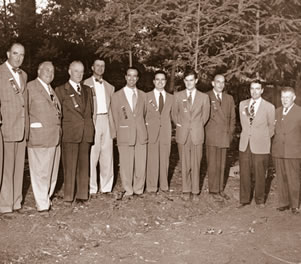
NVVA, 1943: Original gang of grape gurus.

In 1933, when the Washington Brain Trust finally woke up and passed the 21st Amendment, Louis M. built an eponymous winery in the heart of the Napa Valley and began to employ techniques that soon became signatures among his competition: Temperature-controlled fermentation, using wind machines to combat frost, planting cabernet sauvignon in red, volcanic soils (Monte Rosso on the Sonoma side of the Mayacamas Mountains) and ultimately,  becoming one of the first California vintners to bottle merlot as a stand-alone varietal.  His establishment of the Napa Valley Vintners Association in 1943 proved instrumental in raising the status of the region’s wines, chiefly by offering vintners a forum where they could exchange ideas and work collectively.

In 2002, after three generations of Martini management, E.J. Gallo bought the winery—although Mike Martini still makes the wine.  He lists a zinfandel, a chardonnay and a moscato in his wine line, but Mike’s focus—as it’s always been—is on cabernet sauvignon.

So that’s what I where I’ll direct my federal investigation.

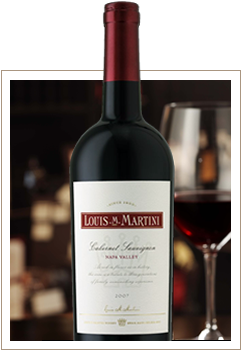
Louis M. Martini Cabernet Sauvignon, Napa Valley, 2009, about $30:  2009 was a pretty solid growing season in Napa with moist spring and mild summer than encouraged even ripening.  And then came October, when a pair of major downpours upset the Napa apple cart, which was, unfortunately, filled with grapes at the time.  Vintners who picked early did well; those who gambled did not.  I am thinking Martini played it safe, at least for a portion of this fruit, because there’s no obvious dilution of flavors evident.  The nose is big and black fruit focused; current, rum cherry, Damson plum and blackberry with some herbal notes.   The palate is jammy, showing components of mocha and tobacco with slightly grainy tannins and a rounded, integrated finish.

Louis M. Martini Cabernet Sauvignon, Alexander Valley, 2009, about $35:  This one is a genuine chest-thumper, Mike: An opulent, multi-layered cab with traction; you’d be wise to plunk down the extra fiver for the Alexander Valley fruit.  Dark and sensual with wildflowers notes to underscore a compelling concentration of brambly forest berries, cassis and anise; earth tones move in at mid-palate, with damp soil, damp stone and beautiful juicy saturation: A textbook wet Martini.  Grapes must have arrived at the crusher with tannins fully mature—the finish is long, silky, smooth and satisfying.  A wine for tonight, or a whole lot of potential tomorrow nights.

Plus, both wines show an elusive, intriguing character of ripe olives that occasionally shows up in cool-weather cabs; it should not be the slightest bit off-putting, despite its now inevitable association with Luca Brasi other testicolo.

Posted in Cab/Merlot, Napa | Tagged , , , | Leave a comment

Frei Vs. Fre: One Has An ‘I’; One Doesn’t. One Has A ‘High’; One Doesn’t.

Mad Magazine was the fundamental catalyst in my kidhood drive to write humor for a living.  Advancing alcoholism is why I made wine, beer and spirits my venue.

Remember that old Spy vs. Spy panel cartoon?  Where the white ‘n’ black pointy-schnozzed secret agents were endlessly into each other’s shite with bombs and dynamite and similar WMDs?  I was too young to get the Cold War connotations and never really thought that their dialogue-free, predictable schtick was particularly funny, but many decades later, here I am making plays on Antonio Prohías’s strange little strip’s title to kick off a story on booze-free wine.

Actually, it’s not really about booze-free wine.  It’s about Frei Brothers Reserve, a winery which is staunchly pro-alcohol.  So we’ll fob off the Fre faulting on footnotes and focus foremost on Frei.

Frei Is Frei Free

Although the 112-year-old Frei family farm has been free of the Frei fraternity since Jimmy Carter was in office, the Modesto mammoth who purchased it—E.J. Gallo—has made an exemplary effort to keep the Frei fantasy functioning: That is, terroir-driven wines committed to environmentally-friendly practices—in the vineyard, the winery and even in the package.  Frei has recently launched a new bottle that uses 15% less glass, corks made from greener cork and recycled, carbon-neutral paper stock for their labels.

Sustainable has been Frei policyspeak virtually since old Andrew Frei planted the first vines in 1890, and it’s a good thing too.  Because in order to sustain my loyal sippage, they have to sustain sufficient ABV.

Unlike Fre…

Look closely: You can see Sutter Home sort of toward the bottom.

Fre (from Sutter Home from Trinchero from Dante’s Tenth Circle of Hell) is a wine-like substance made for teetotalers.  It’s made for abstinents, prohibitionists, Mormons, Muslims and Mahayana Buddhists; it’s made for those sad sacks with the five-year tokens and for all the little children of the world who need a cabernet sauvignon to pack into their little Fester Bestertester lunchboxes and not get expelled.

Fre is what MADD has foisted upon us functioning Frei-fried sots:

In short, Fre is the enemy.

Learning about Fre’s bloodthirsty, evil-genius technology (through which they extract the alcohol from innocent chardonnays, moscatos, zinfandels and merlots) had the same sobering impact upon me as did reading about Josef Mengele’s attempts to turn brown eyes blue.  On both occasions, I spent the rest of the day in a sort of depressed, misanthropic fugue.

I won’t bore you with Third Reich details, but Fre?  Better put on your seat belts, because it’s gonna be a bumpy ride.

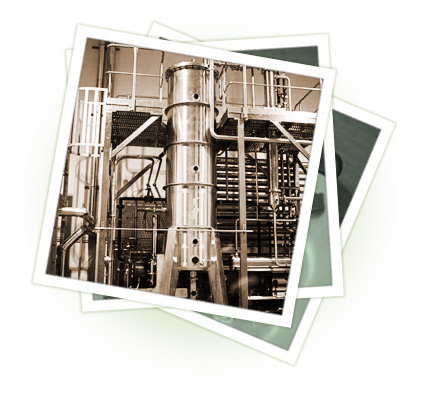
First, having sufficiently fattened up their victims in standard fermentation tanks, they lead them surreptitiously down the cattle-chute of doom, up the ladder of the mechanism diabolically-named ‘spinning cone’ and pour them in.  It’s only then that the poor ethanol molecules realize that they’ve been slated for… I’ll use a euphemism, darlings:

‘Removal.’

“Mr. Sutter Home:  Tear down this cone!!” – Ronald Reagan

Then, inhuman centrifugal g-forces transform the wine into film, following which, the nitrogen gas introduced to the bottom of the column rips from the glorious nectar everything of black-market value, including aromatics, flavors, gold teeth and passports.  These are then horded by ‘technicians’ while the cone temperature is increased and the remaining liquid is returned to the column for the final insult: Dealcoholization.

When it emerges, the ‘wine’ can scarcely claim the name—it has less than .05% of its kick remaining; similar to the re-educated Winston Smith state that orange juice reaches (as Fre is so proud to point out) after sitting out on your counter all night.

And like old, festering, room-temperature orange juice, it is not—in this critic’s opinion—fit for human consumption.

What, Me Worry?

MAD vs. MADD

However, unlike James Suckling (who apparently prefers cash on the barrel-head; preferably made of new limousin oak), I have contacted my Sutter Homeboys with what I feel is a generous offer.  If they are willing to send me all the alcohol they’ve extracted from Fre, along with free alcohol-free Fre samples, I will reconstitute the stuff myself and offer them unbiased, ethical, if bought-and-paid-for reviews.

Unlike Mr. James, I am willing to work for free Fre.

In the meantime, while I am waiting to hear from them, I will cover a trio of real wines.

Tasting Notes:

Jim Collins, Frei viticulturist

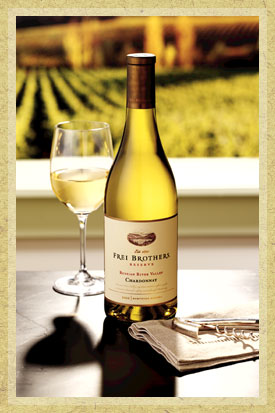
Frei Brothers Reserve Cabernet Sauvignon, Alexander Valley, 2009, ABV 14.3 %, about $27:   Behemothic bouquet with black cherry, cassis, dark chocolate and plum evolving into the palate, and then, into a tannin-smooth finish.  Particularly appreciated was the alcohol.

Frei Brothers Reserve Zinfandel, Dry Creek Valley, 2009, ABV 14.9%, about $20:  Vivacious, vibrant vino—a surprise, since the vintage was a good book with a lousy ending.  Rain came heavy and early in Dry Creek, causing growers to do a triage on what to pick and what to leave.  The wine ends up succulent and warm, with classic zinfandel notes of mulberry, brambly raspberry, smoke and black tea bound in nice acidity.  The alcohol was nice, too.

Frei Brothers Reserve Chardonnay, Russian Rivers Valley, 2010, ABV 13.9%, around $20:  Quite ‘yellow’ focused’ on the nose, with peach, Golden Delicious apple and lemon notes; the palate is creamy and tropical with a velvety malo mouthfeel and a finish which shows, but does not exploit, the oak; might make a nice pairing with roast suckling pig.

The alcohol is all that, too.

Posted in CALIFORNIA, Dry Creek, Sonoma | Tagged , , , | 2 Comments