Twist Makes Me Shout

I normally don’t review water—for three good reasons.  First, I’ve never been poster child for ‘Find A Happy Medium’ campaigns, and considerable research has led me to believe that if you drink too little water, you die, and if you drink too much water, you also die.

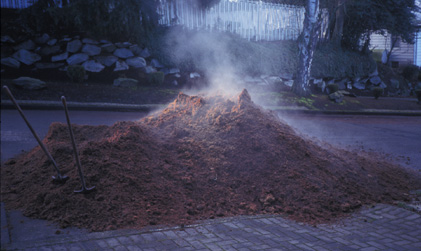
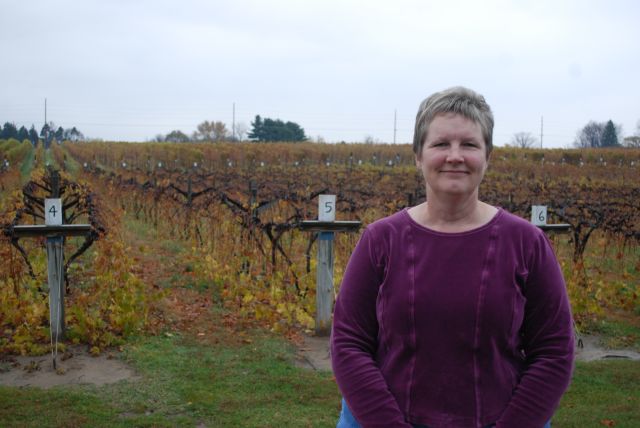
Recycling day at the Kassel's

But thirdly and most importantly, the whole water culture sucks.  Not to put an Andy Rooney spin on it, but when I was a kid, getting a glass of water was easy: You got a cup, walked to sink, filled it up from the tap, et voilà.  For my kids, it’s a full-blown Broadway production.  I have to get in my car, drive to Costco, pay seven bucks, drive home, carry the heavy box into the house, pour them their stupid water, then deposit the empty bottle in my blue recycling box which I have to take to the curb every friggin Tuesday evening.

Seriously???

The phrase ‘Did you get a water?’ did not exist when I went skipping off to grade school—‘water’, as I recall, had no article attached to it.

Native Turunggare speaker

But Rules, Like Solemn Vows, Were Made To Be Broken

When I waited to the very last second to sign up for college, I discovered that all the useful language courses like Japanese and German were filled; all that was left was Assyrian,  Dongxiang, Uzbek and Turunggare (which is only spoken by five people on the planet—four of whom believe that World War II is still going on)…

…and then there was Advertising.

Since I was unable to get into Med School where I had intended to major in Diseases of the Rich, I opted to aim for a Business degree instead—and therefore, learning the language called Advertising seemed to be the logical choice.  And I must say, this course prepared me for the real world as much as my Bachelor’s in Convincing Inbred Rubes to Build Another Wal-Mart Right Where the Community Home For Disabled Vets Now Stands degree.

Domaine de Pegau, Chateauneuf-du-Pape

I use it in wine reviewing almost daily, where ‘Smells like horse shit’ becomes ‘Styled after the earthy wines of Sicily and Southern Rhône’; ‘The idiots picked too early’ becomes ‘Slightly vegetal with notes of green pepper on the mid-palate’ and ‘Reeks like a charnel house clogged with burnt flesh’ becomes ‘Contains empyreumatic odors of smoke, toast and roasted meats.’

I’ve also discovered that as facile as I am at writing in Advertising, I am equally adept at translating it: Hence, this column.

When I received an email from Molly Maguth of Behrman Communications touting ‘Twist’—a new bottled water—I actually began to hyperventilate.  Never before had I seen such a masterpiece of copy since the spin-doctors wrote, ‘It all depends on what the meaning of ‘is’ is’ for Bill Clinton’s Grand Jury testimony.

I will repeat the email in toto, with my linguistic notes below for you folks fluent in the argot of ‘Truth’ and ‘Reality’, but not so much in ‘Advertising’.

Ergo (asterisks mine):

‘Originating from the pure wells of the Pacific Northwest*, TalkingRain Beverage Company has redefined natural water* yet again with a fresh, flawless, crisp spin on water.’

*1)  Pesticides, nitrates and pathogens have contaminated much of the Pacific Northwest’s groundwater.  According to pnwaterweb.com: Public water supplies are regularly tested under the Safe Drinking Water Act; however, private wells are generally not tested on a regular basis since testing is not required. 

*2) Water’s chemical formula is H2O.  Not sure much redefinition is required.

#

‘Simply put*, Twist is zero-calorie*, naturally sweetened, non-carbonated, preservative-free, antioxidant-rich all natural premium water available in a medley of fruit flavors sure to please the palates of any water connoisseur*.’

*1) This is ‘simply put’ how? It took  30 words to say ‘The stuff tastes like lemons’.

*2) Water without calories?  Now there’s a concept.

*3)  Head’s up, marketing team: Little M’wbwe Kakuma, dying of thirst in a Darfur refugee camp, may be a ‘water connoisseur’, but I assure you,  Ralston Throckmorton III—or whichever Gold Coast ‘premium water’ demographic you’re targeting—is not.

#

‘Bottled in a sleek euro design* for shelf and table top appeal, Twist delivers the quintessential essence of fruit flavor and healthy hydration*.’

*1)  Euro design = Looks more expensive than it is, but requires a hotshot packaging engineer, making it more expensive than it needs to be.

*2) Healthy hydration = Drinking water is good for you.

#

‘The watersmiths* at TalkingRain, located in Preston, Washington*, instill its water with the perfect blend of juice, green tea extract and fruit essences.  Bypassing artificial ingredients and sweeteners, twist drinks are rooted with a touch of stevia* for extra allure and sweetness’.

*1) Watersmiths?  Who thought that one up? Some Madison Avenue copywritersmith?

*2) Preston is a mill town, and the logging industry is the primary cause of water pollution in Washington.  In fact, Preston sits on a tributary of the Snoqualmie River Basin, about which the Washington Department of Ecology says, ‘Higher nutrient levels and low dissolved oxygen levels in these tributaries may be associated with high fecal coliform inputs.’

*3)  ‘Rooted’? Are you sure this is the correct predicate?  Not sure how a beverage can be ‘rooted’, but anyway, stevia imports were restricted by the FDA because ‘toxicological information is inadequate to demonstrate its safety’.  I’m allured, aren’t you?

#

‘After 20 years in the premium beverage business, TalkingRain Beverage Company wanted to make water exciting*, sexy* and popular*’.

*1)  It’s hard to get ‘excited’ over something that covers ¾ of the world’s surface.

*2)  The only time water is sexy is when it’s in a hot tub filled with Jessica Alba.

*3)   Any budget for an ad campaign intent on making ‘popular’ a product without which you will die within six days is probably ill spent.

#

Open Note to Behrman Communications and Ms. Molly Maguf:

Fish out of water

Now, I since I am no doubt in hot water with you, let me just say that this is actually a watered-down version of what I originally intended to publish; after all,  I’m a wine critic, so when confronted with this task, I was a bit of a fish out of water.

At least we proved the old adage, ‘You can lead a scribe to water, but you can’t get him wet’.

But I’ll test the water:  If you’re interested, please continue to send me the stuff that really makes my mouth water:  wine samples.

That is, if I didn’t throw the baby out with the bath water and we can look at this column as water under the bridge.


Posted in GENERAL | Tagged | Leave a comment

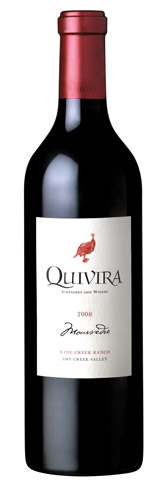
Quivira Mourvèdre: Waste Not, Want More

Moi??

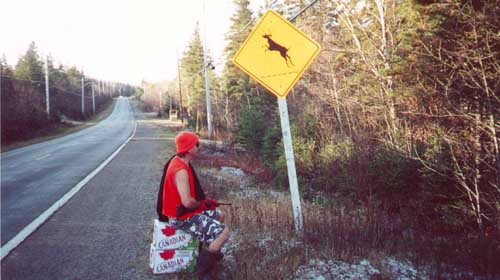
In these days of symbol scrimping, font frugality, typeface saving and character conserving, when we are all responsibly turning our keyboards down to 62° (I won’t waste an ‘F’ for ‘Fahrenheit’ since it should be obvious—what do I look, Canadian?), it’s sort of disheartening to see a winery that wantonly wastes letters.

Yes, Quivira, this means you.  Brownie points for carpooling your name since we know that ‘Q’ never goes anywhere without that poky little midget ‘u’, but really, is calling your wine ‘mourvèdre’ entirely necessary?  What do the ‘u’, that dopey accent grave or the silent ‘e’ bring to the party?

And Don’t Get Me Started on Quivira’s Winemaker… 

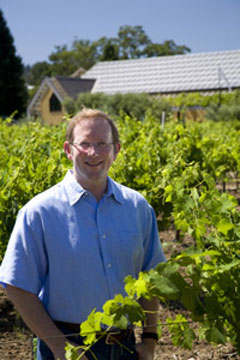
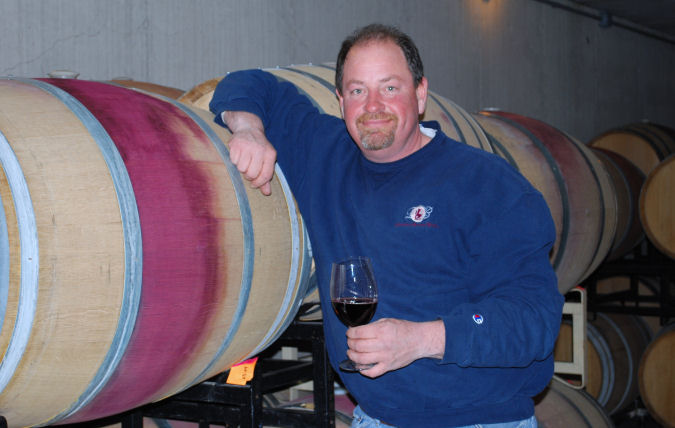
Hu Chapel

I’m sorry, Hugh Chappelle, but seriously??  In this imploded economy, where waste not, want not is policyspeak, you feel compelled to splurge on ‘p’s, ‘l’s and ‘e’s in your last name?  With kids going to bed solecistic in China?  For shame, sir—these are expenditures that our grandchildren will have to subsidize.

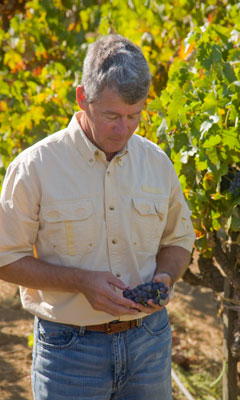
Peet Kite

And (mention this to your boss, too), if you guys were really Earth First, you’d spelled ‘Hugh’ and ‘Kight’ the way they sounded, and then there’d be enough ‘g’s and ‘h’s for the rest of humanity.  You don’t want us Fundamentalist Christians praying to ‘Od in Eaven’, do you?  That’s a one-way ticket to ell.

And if all that isn’t bad enough, a vineyard called Wine Creek Ranch Estate Vineyard?  Come on, fellas—five names, already?  Three of which (ranch, estate and vineyard) are pretty much the same thing?  Do we even want to go there?

We Don’t…

Therefore, I’ll talk about the winery instead.

The thriftily named 'Ned'

Situated in Dry Creek Valley, Sonoma, Quivira was founded in 1981 by Holly and Harry Wendt and purchased in 2006 by Pete and Terri Kight.  Both couples adhered to a simple dream: To build upon ecologically sound agricultural principles to produce world‐class wines.  Currently comprised of four vineyards, all within the Dry Creek AVA (Wine Creek Ranch, Goat Trek Vineyard, Katz/Absner Ranch and Anderson Ranch), there’s a total of 93 acres planted to zinfandel, sauvignon blanc, various Rhône varieties (including mourvèdre) and a number of oddballs like counoise and sauvignon musqué.

In an effort to increase ‘fruit saturation’—an eno-term meaning intensity of flavor and depth of color—Quivira’s vineyard manager Ned Horton looks at the smaller picture.  Under his persnickety watch, focus has shifted from acre to acre to plant and block, and up to sixty percent of the grapes are culled.

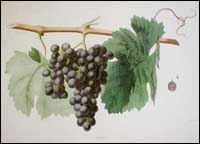
Mor-ved on the vine

Nowhere did this priority re-alignment prove more vital than in the cultivation of mourvèdre.  As a varietal that tends to ripen late even in ideal conditions, the heavy rain that often characterizes late Autumn in Sonoma makes a successful harvest a challenge.  Thinning the fruit to one cluster per shoot helps, but the labor intensity requires pushes this wonderful wine to the top echelons of Quivira pricing.  Still, at $32 retail, it’s a gem.

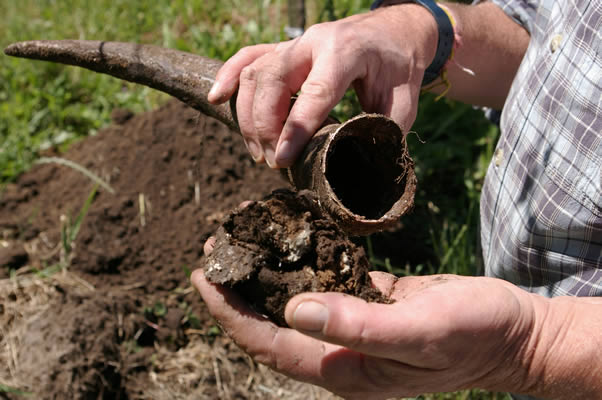
Tooting Their Own Cowhorn

Demeter certified in 2005, sustainable farming is at the core of the Quivira agricultural philosophy.  In the past, I’ve scoffed at biodynamics as pseudo-pscience, mostly for it’s pspirituality, which calls for some pretty weird preparations (animal manure buried in cowhorns at the Autumn equinox in order to capture the universe’s etheric and astral forces); but I have never taken issue with the essential wisdom behind the witchcraft.  That is, that a farm should be self-sustaining and able to create and maintain its health and vitality without the addition of commercial fertilizers or pesticides.  I believe that winemakers like Hugh Chappelle and Pete Kight who take to heart a rigorous methodology tend to produce better wines—with or without cowhorns.  The self-described ‘obsessiveness’ that they  employ to monitor soil conditions and the phases of the seasons have paid quality dividends vintage after vintage, and if they want to credit Rudolph Steiner (biodynamic’s founder), more power to them.  I don’t think that Steiner was a crackpot—far from it.  I think he was a snake-oil huckster on par with Pat Robertson and Amway’s Jay Van Andel.

That Said…

…It’s Chappelle and Kight who are making the spectacular wines, not me.  All I do is drink them, take down notes and praise the hell out of them in writing.

Od in Eaven

Still, as a sort of cheapskate biodynamic columnist who believes in word conservation, sentence management and a self-sustaining alphabet, I take exception to overly-verbose, word-depleting practices among non-scribes, who may or may not need to use these letters again in their lifetime.  But, sure as Od is in His Eaven, I will.

Hugh Chappelle says:  “Successful natural winemaking requires an integration of vineyard and winery where farming practices are optimally aligned with the desired qualities of the finished wine.”

I’d have said: ‘Take care of Momma and she’ll return the favor.’

Tasting Notes:

Quivira Mourvèdre, Wine Creek Ranch Estate Vineyard, Dry Creek Valley, 2009, about $32:  Whew; that was a mouthful.  So is the wine—with a bigger nose than Gérard Depardieu, it’s redolent with dark, foresty fruits like blackberry and wild raspberry, spiced with white pepper and pipe tobacco; the palate fairly bursts with rich cassis notes, smoke, roasted coffee bean and yeasty graham cracker.  Eighteen months in large foudres and small barriques lends a toast and elegance to a long, leathery, lingering finish.  A year or two in the cellar should produce an even more complex wine.

Posted in CALIFORNIA, Dry Creek, Mourvedre | Tagged , , , , | Leave a comment

Michigan Viognier: Domaine Berrien Sounds The Clarion

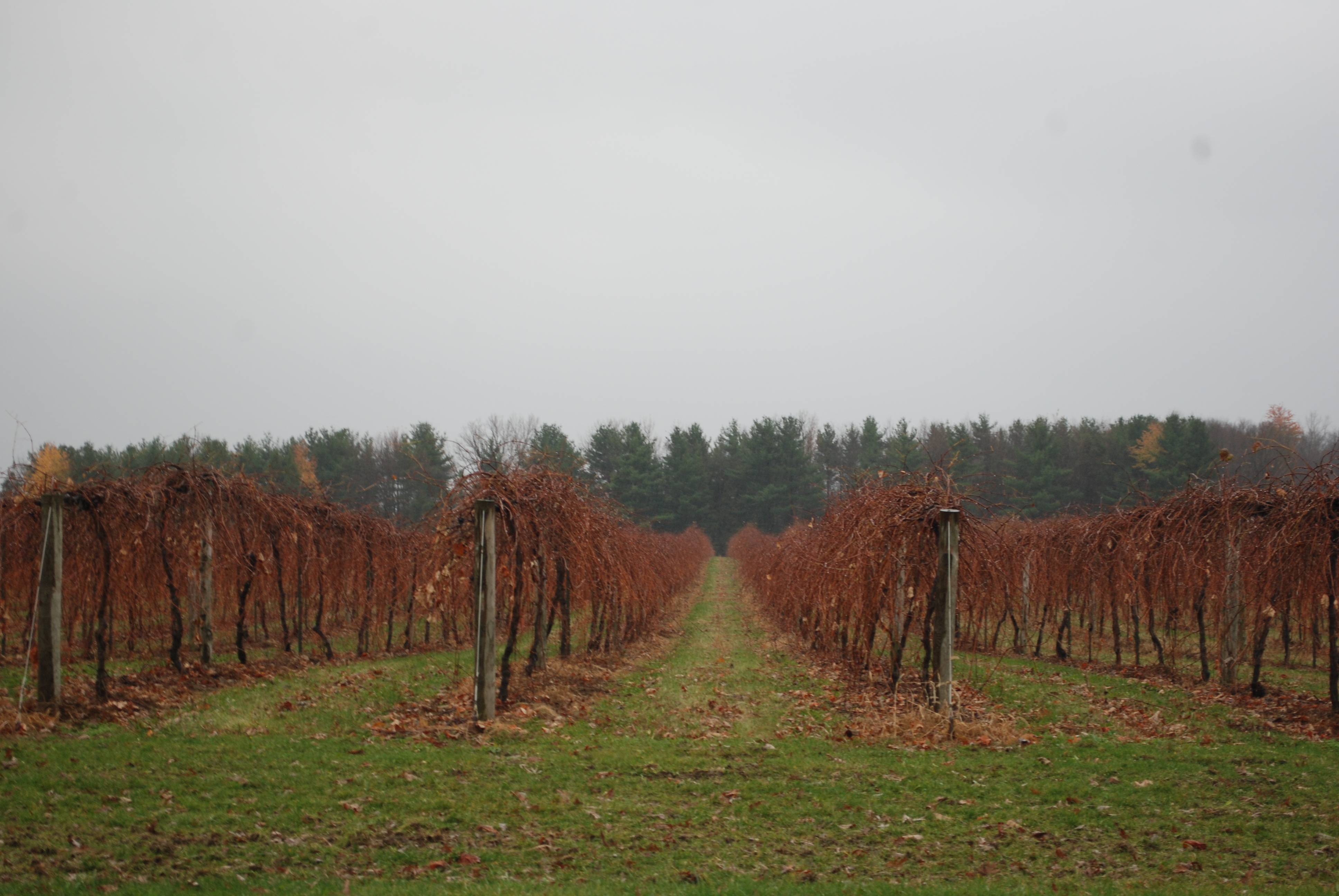
If Paris In The Spring was a coin, the flip side would be Michigan in November.  Post-Halloween—in boondocky counties like Berrien especially—everything deteriorates into the sort of dreary dystopia imagined by Huxley and Wells.   Cornstalks turn colors not seen outside autopsy rooms, pumpkins rot on porch steps, paint peels from abandoned farmhouses, rain dumps down as For Sale signs go up, Happy Hour at the Dew Drop Inn runs from 3 -5 PM, leaving twenty-two subsequent hours to contend with.

So yesterday, naturally, this is precisely the spot where I chose to get lost.  And not just lost—severely, howlingly, expletively so.

Driving blindly through rural farmland, the first thing you notice are that there are no street names, no gas stations, no CVS stores or even random escapees from prisons or assisted living joints that you could ask for directions.  You also notice that there’s nothing on the radio except born-again babble, really bad country music and oldies stations with a penchant for that most hideous of all musical genres, ‘70s soft rock. But then—just as the conviction, ‘Sooner or later this stupid road has to hit an Expressway’ fades to ‘Abandon all hope, ye who enter here…”— you (in this case me) see a sight that ultimately corroborates St. Anselm’s ontological proof of God’s existence.  No, not an I-94, Next Right sign…  Even better: Grape vines.

Agrarian Domaine Berrien Saves This Lost Barbarian

And there it was, shining like a lighthouse beacon upon a storm-ravaged shore: sweet refuge; Domaine Berrien Cellars, home to Lake Michigan Shore’s favorite Rhône Rangers, Wally & Katie Maurer.I stumbled upon the Domaine Berrien Tasting Room with less than fifteen minutes to closing time, having just missed the syrah punch-down, and by default, the punchdowner—Wally Maurer had by then skedaddled back to the homestead.  Katie was there, however, and was more than happy to lead me on a palate promenade through the winery’s latest releases (tasting notes follow) and share a bit of Domaine Berrien’s history, suddenly making my need for speed seem silly indeed.

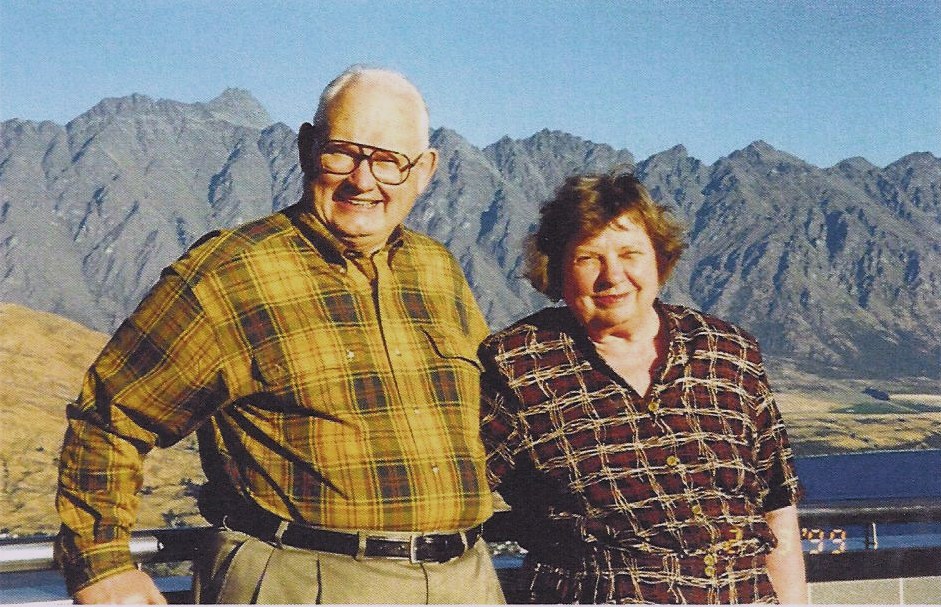
Tom and Abigail Fricke

The eighty acre spread that is now Domaine Berrien was first planted to grapes in 1992 by Katie’s parents, Tom and Abigail Fricke after they’d bought the land from a cherry grower.  Tom had been a partner in Wally’s cellar winemaking and both had a keen onward-and-upward philosophy, but the Maurers were then trapped in Chicago, living out a quotidian nightmare while dreaming of the weekends they could spend at the farm.

Meanwhile, rather than dive into a full-fledged winemaking operation, Tom Fricke was content sell his surplus grapes to local vintners while continuing his travels and enological research. What he discovered was astonishing: As Katie recalls, “He became convinced that the microclimate of Berrien County was similar enough to that of Northern Rhône to make the cultivation of syrah, marsanne, rousanne and viognier possible.” In fact, the property is situated at elevations of around 900 feet, making it one of the highest points in the county. Plus, the phenomenon known as ‘lake effect’ provides an extended growing season that allows red wine grapes to fully ripen.

“Our vines are located on south-facing hills and trellised north/south,” Katie continues.  “That brings even sunlight to both sides of the vine, translating to quality and complexity in the finished wines.” Such fortuitous terroir allows the couple to slap a somewhat ambitious addendum on their label: ‘Estate Grown’.  This is a legal mandate ensuring that the grapes within the bottle are grown ‘on land owned or controlled by the winery within the boundaries of the labeled viticultural area.’  (TTB, 27 CFR 4.26)

Wally Maurer

Wally Maurer writes, ‘All of our wines are made from grapes grown in our vineyards and all of our winemaking and bottling takes place right here on site as well.  This gives us the control over the grapes and we make decisions all during the growing year that maximize the quality (not quantity) of our grapes.  This gives us a higher probability of producing the most premium wines.’

Alas, both Abigail and Tom Fricke passed away in 2007, but they stuck around long enough to see Domaine Berrien founded in 2001, after Wally and Katie chucked in Chicago for the sticks of Berrien.  I know, I know—friends don’t let friends buy vineyards.  But in this case…

…Deep Sandy Loam Wound Up Being Pay Dirt

Katie Maurer

“Our first vintage produced only 750 cases of wine,” reports Katie, “but it sold out quickly.  Now we’re up to 4,500 cases, all made from grapes grown here on the property.  We were the first winery in Michigan to release a commercially grown and vinified syrah, and I have to say, it was due to Dad’s foresight and vision.  Along with my Mom, his memory lives on in the vineyards.” Among the wines sampled, not all were Rhône expats; Domaine Berrien’s ‘Crown of Cab’ is considered their top selection—it contains all five allowable Bordeaux varietals for reds.  My review of the 2006 ‘Crown of Cab’ was somewhat less than stellar, but what do I know?  Anyway, this time around, the vintage over which I kvetched with Katie was 2008, and it redeemed itself considerably.

And yet, for my tastes, the wine that packed in the most surprises was the 2010 viognier—a recalcitrant little minx if ever a varietal were.  Before New World wineries like the Maurer’s tried their hand at viognier, scarcely 35 acres remained in France, its motherland.  Part of the deal is that it is low-yielding and difficult to grow, being especially sensitive to damp mildew in wet climates… like Berrien County.  Even so, Domaine Berrien is producing a neat, aromatic viognier that is loaded with nuance and depth. Not only was I impressed that Wally and Katie are able to successfully farm this fractious fruit, but that they can get away with selling it for under $16 a bottle.

Jen Bixby

“Well,” responds Jen Bixby, Domainatrix of the DB tasting room, “when you’re pushing a varietal that doesn’t have a lot of shelf exposure, it’s all about education, education, education…” Jen offered me some valuable education, too—nothing to do with the wine she pours, though.  It was how to navigate my way back to a homeward-bound  highway.

And you know what?  With a new winery to write about and a gentle viognier buzz floating around my central nervous system, Michigan in November winds up being a pretty spectacular place after all.

Tasting Notes:

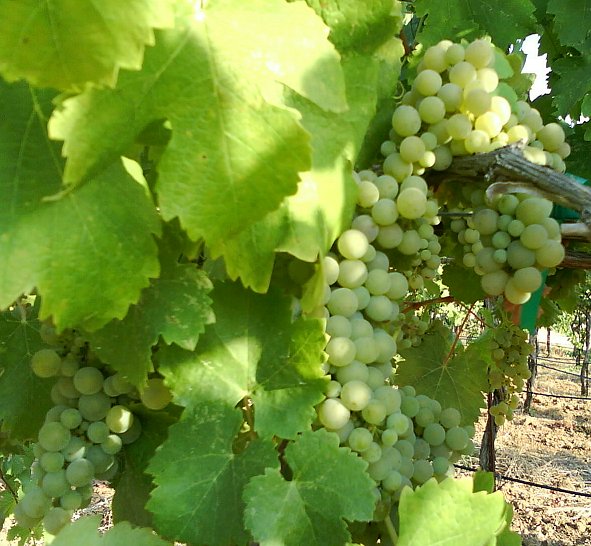
Viognier on the vine

Domaine Berrien Viognier, Martha’s Vineyard and Tom’s Vineyard, 2010, around $15.50:  I have a sharp tongue, but it’s usually pretty good at picking out   residual sugar percentages.  With Domaine Berrien’s 2010 Viognier, my mouth was still full when I blurted out 2.3%, which was not only rude and messy, but wrong.  An instant later, the whole floral, fruity, fantabulous quaff dried out.  In fact, this vintage was picked at 22.8° brix.  Below 22° brix, viognier is a bore and hardly worth bottling, and though the .8° may seem a negligible uptick in sweetness, a mysterious viognier trait is how quickly the aromatics and sugars develop after that magical plateau is reached.  The art of producing top-flight viognier is recognizing precisely when to harvest—something that Wally Maurer apparently has down.  The wine is scrumptious, with subtle honeysuckle, orange blossom and pineapple on the nose, followed by an extremely fruit-sweet mid-palate (which I mistook for residual) juicy with tangerine, grapefruit, apple and a touch of anise.  Finishes tart and a trifle quickly; being cold fermented in stainless, there’s no oak to throw a farewell party once the wine’s in the gullet.

*

Domaine Berrien Cabernet Franc, Abigail’s Vineyard, 2009, around $15.50:  Not a bad output for a very challenged vintage.  The wine lags a bit in fruit, but there is a solid core of recognizable cab franc cranberry and raspberry with a bit of bell pepper to indicate the short season.  Bright acidity balanced by a bit of malolactic cream; the wine sees a full year in casks and ten months in the bottle before release.

Domaine Berrien Pinot Noir, Martha’s and Katherine’s vineyards, 2007, around $15.50:  I tasted this wine last year, and it has undergone a nice aromatic evolution since then; it glows with tart cherry and violet and finishes with a toasty bite from French oak.

Domaine Berrien ‘Crown of Cab’, Abigail’s Vineyard, 2008, around $19.50:   Far more fruit-forward than the ’06, this Crown featured rich with soft slate, blackberry, smoke and earth winding through well-integrated tannins and hints of dark chocolate.

Domaine Berrien Marsanne, 2009, around $13.50:  Bright citrus and stone fruit dominate the nose; the palate is light but pure with apricot and lemon grass as the dominate flavors.  Certainly a great introduction to this varietal for the eager neophyte.

Domaine Berrien Rousanne, Martha’s Vineyard and Tom’s Vineyard,  2010, , around $13.50:  The wine’s first impression is of a surprisingly full-bodied white; various scents of mango, grass, rose petals and mineral lead to a dry, refreshing finish.

Posted in Lake Michigan Shore, Michigan, MIDWEST, Viognier | Tagged , , , , | Leave a comment

The House of Wine Awards, 2011: Amy

When your ten-year-old asks you what ‘irony’ means, here’s what you tell her:

“Amy Winehouse will go down in history for giving detox a bad name…”

The July death of the twenty-something drugstress—who may have been on the rock-ravaged road to recovery—was apparently the result of alcohol withdrawal.

This little-known phenomenon happens when a confused brain ratchets up hormone production to compensate for its missing  supply of Ketel One, flooding the body with abnormally high levels of serotonin, epinephrine and dopamine.  According to Betty Ford Clinic director Dr. Harry Haroutunian, “About half the people who come off steady and regular alcohol use will have some manifestation of the syndrome.”

At least we know why she said ‘No, no, no’ when they tried to make her go to rehab.

Among the myriad tragedies for fans and family that her crazy but probably timely death begets is that Amy Winehouse herself will miss out on Billecart-Salmon’s fabulous Champagne tasting at Thomas Gibson Fine Art on Bruton Street in London this Wednesday, November 9, at 6:30 PM.

The tasting (£19.00), will include samples of Billecart-Salmon Brut NV, Billecart-Salmon Brut Rosé NV, Blanc de Blancs Grand Cru, Cuvée Brut Sous Bois NV and Vintage 2004 Extra Brut.

Gerald Laing

Accompanying the fizz fest will be an exhibition Pop Art exponent Gerald Laing.

Billecart’s bubbly blow-out is dedicated collectively to  John Barrymore (whose last words before succumbing to cirrhosis were, “Die?  I should say not, dear fellow…”), Brendan Behan (who claimed, “I only drink on two occasions—when I’m thirsty and when I’m not” before dying of drink-induced diabetes), Jack Kerouac (whose writing style became ‘stream of unconsciousness’ when he croaked of an internal hemorrhage caused by his favorite breakfast: malt whiskey) and Billy Holiday (who died of liver disease after having squandered her earnings for drink—at the time of her demise, she had $0.70 in the bank…)

"Pair me with a Taittenger, PLEASE"

I Know What You’re Saying…

…Why would a respected, two-hundred-year-old wine house lend its name to a celebration of these pathetic sots, each of whom ultimately proved that their thirst outranked their talent and that chug-a-lugging had more value than their children?  And (despite being named for an anadromous trout), why would the family-owned Billecart-Salmon donate product to said bacchanalia when it was the very commodity they produce that killed off these luminary lushes?

The answer is that they did not.  All the above, except for the date and place of the Champagne tasting, is pure made-up claptrap.  In fact, the Mayfair tasting is dedicated to Amy Winehouse, the only one among the artists mentioned that died from NOT drinking.

If your ten-year-old is still unclear on the concept of ‘irony’, let her read this.

Tasting Notes:

None.  By sponsoring the Amy Winehouse Pop Art Expo & Champagne Tasting,  Billecart-Salmon forfeited any claim to having taste.

If You MUST:

Pop Art Expo & Champagne Tasting

Ministry of Wine is glad to welcome you to an exhibition dedicated to Amy Winehouse by Pop Art exponent Gerald Laing, during which you will enjoy an exclusive champagne tasting.
James Thomas, from Billecart-Salmon, will guide you through their fantastic range and you will try the following champagne:
– Billecart-Salmon Brut NV
– Billecart-Salmon Brut Rosé NV
– Blanc de Blancs Grand Cru
– Cuvée Brut Sous Bois NV
– Vintage 2004 Extra Brut

Tasting price: £19.00
Date: Wednesday 9 November
Time: 6:30pm until 8:30pm
Address:
Thomas Gibson Fine Art
31 Bruton Street
Mayfair
London W1J 6QS

Posted in Champagne | Tagged , , , | Leave a comment

Napa Cellars Wines: Generically Delicious!

I know, bubeleh; I know.  After earning your MBA from the Carnegie Mellon School of Business and your Ph.D from MIT, after a brief teaching stint at Stanford Graduate School (for which you wrote three textbooks on macroeconomics) and your subsequent position on the President’s Council of Advisors and later, as Chairman of the Federal Reserve, you’ve decided that you’d rather have my job.  A wine writer.

Guess what, boychickel…  You can bloody well have it.

Vos iz?  A problem? You don’t know from grapes?  Or phenolic bioflavonoids, like quercetin-3-glucoside?  But you do, as the following exercise shall demonstrate:

I will list four wines, and then, in no particular order, a set of vintner’s tasting notes.  You tell me which Napa varietal goes with which winemaker description:

The wines:

  1. Napa Cellars Chardonnay, 2010
  2. Napa Cellars Zinfandel, 2008:
  3. Napa Cellars Sauvignon Blanc, 2010
  4. Napa Cellars Merlot, 2009

Joe Shirley

The notes, from winemaker Joe ‘You Can, In Fact, Call Me Shirley’ Shirley:

  1. Zesty aromas of grapefruit and mandarin orange followed by orange blossom and passion fruit on the palate. A warm climate wine, it displays bright acidity on the well-rounded finish.
  2. Warm and inviting aromas filled with blackberry, plum and a faint touch of raspberry.  Savory hints of olive round out the beautiful nose.
  3. Bright brambly fruit, berry cobbler and classic spice on the nose are complemented by juicy raspberry, baked cinnamon apples, and dried cherries on the palate.
  4. Rich, buttery, spicy and toasty, boasting beautiful aromas that conjure scents of home-baked apple crisp.  The flavors are lush with ripe pear, apple and a touch of tropical pineapple and guava.  The wine is delicately balanced with a long and sweet toffee finish.

See that—it’s easy.  It goes like this:

  1. = Sauvignon Blanc
  2. = Merlot
  3. = Zinfandel
  4. = Chardonnay

You’re not such a shmeggegie after all, are you, tchatzhkellah?


What Was All That About?

Fair question.  It’s this: I have been reviewing California wines for more than twenty years, and so generic have the above varietal descriptions become that most winemakers and wine writers could do them in their drink-induced sleep.  They are of some use at blind tastings, where—using these profiles—you can generally pick out a given varietal quite easily, thus allowing more time for the esoteric guesswork of vintage, AVA and label. But for a consumer looking to evaluate a wine’s unique profile before purchasing it, it must become rather pointless to read the same ol’ same ol’ in tasting notes.

Lychee nuts

And I’m as guilty as anybody.  In trying to define the often indefinable, it’s easy to fall back on hackneyed descriptors rather than really digging deep.  For example, I—like many of my bro’s and sisters in scribedom—have used ‘lychee’ ad nauseum to characterize gewürztraminer, but truth told, I’d seen that odd Middle Eastern fruit in other reviews first and had to figure out where I could buy one in meat-and-taters Detroit to find out what a lychee actually tastes like.  Guess what?  I found one, and it tastes exactly like Alsatian gewürztraminer.  Okay, so the representation is accurate, but to be really true to myself I’d have to quit the wine biz, become a Israeli fruit critic and described lychee nuts as having ‘a bouquet and palate strongly reminiscent of a 2010 Hugel Gewürztraminer’.

Likewise sauvignon blanc and gooseberries.  I’d wager that not one American wine critic in ten is really all that familiar with the nuance flavors of gooseberries—I know I’m not, and I used to have a gooseberry bush in my backyard.  But it pops up endlessly in reviews. And don’t get me started on ‘cat pee’.  Every bit as ubiquitous as ‘gooseberry’ in tasting notes, there’s actually a New Zealand sauvignon blanc called ‘Cat’s Pee On A Gooseberry Bush’ .  But, what component of cat urine makes it unique from, say, dog, gerbil, ferret or human urine?   I suppose it’s down to marketing mitigation; ‘cat pee’ sounds sort of cute—almost dainty—whereas if you wrote that the wine ‘tastes like a houseful of piss’, you might start getting nasty-grams from your editor.

Loire River's humble and fog-free beginnings

Even stranger is the common, and likely psychosomatic portrayal of Pouilly-Fumé—and by default Fumé Blanc—as ‘smoky’, no doubt because ‘fumé’ is French for smoke.  But I have tasted both extensively and never once picked out anything like smoke—they tend to be mineral-focused wines possessing a certain stone character that can be called ‘flinty’, but flint is three degrees of separation from smoke—you use flint to make sparks, which makes fire, which makes smoke.  Anyway, I’ve read that the fumé name comes from the smoke-like mist that often arises from the Loire River—or the grayish dust that sometimes settles on the grapes.  Qui sait?

‘Barnyard’, ‘damp straw’, even ‘manure’ are fair evaluations for a lot of hot-climate, bret-tinged reds from Southern Rhône, Italy and Spain—these feral pheromones sometimes hit you in the muzzle with a blunt farm tool.  But, ‘wet saddle leather’, which shows up as often?  Far be it from me to judge the private lives of my fellow wine critics, but moi, I try to keep my nose as far as possible from anywhere a jockey’s sweaty ass has been.

On To Napa Cellars…

Gott Hangover?

Napa Cellars—one of twenty-six siblings scrambling for alpha position within the Trinchero Family—is known for wines that can be called , without debate, textbook examples of the archetypal paradigm known as the quintessentially emblematic Napa style.  Founded by Rich Frank and Koerner Rombauer in 1996, the winery nestles in the heart of Napa, surrounded by Oakville vineyards, and, on the Trinchero website, surrounded by labels with diverse genealogies.  That includes wines by dead people with familiar names (Newman’s Own), wines from living people with past participle names (Joel Gott), wines with French names (Folie à Deux), wines with sexually-innuendoed French names (Ménage à Trois), wines with dopey names (Red Belly Black) and wines that are just plain dopey (fre—which has had the alcohol remove via centrifugal force).

In contrast, ‘Napa Cellars’ is—like Pat Nixon’s respectable Republican cloth coat—a sensible, utilitarian kind of a name, and by golly, the wines are level-headed as well.

Shirley gets up early

Since 2007, that’s been down to  Joe Shirley, a winemaker whose impressive pedigree was launched at Sonoma Cutrer in 1997 and augmented at Trinchero’s Napa winery.  According to his boss Bob Trinchero (whose dubious legacy is having invented white zinfandel), Joe is a sensory-driven and artistic winemaker.  But Joe sees himself as a more earth-driven fellow.  He claims, “I spend a lot of time in the vineyards making harvest decisions. I find that every extra hour spent at harvest-time has way more impact than an hour spent in the cellar in the winter.”

I dig him for that.  So, in the digging—along with the delving and the mining, I am going to use Shirley’s framework of notes (above), and try to unearth some of  elusive and subtle flavor and aroma notes that burrow through the familiar song and dance.

And I promise not to use such descriptions as require a trip to Piggly Wiggly’s pricey produce aisle.

Tasting Notes:

Napa Cellars Sauvignon Blanc, Napa Valley, 2009, about $17:  This unmistakably California sauvignon blanc has zesty aromas of sweet alfalfa and Key lime followed by geranium, sesame seed and baked apple on the palate. A warm climate Sauvignon Blanc, it displays bright acidity on the well-rounded finish.

Napa Cellars Chardonnay, Napa Valley, 2010, about $20:  Tantalizing aromas of fig, peach pie and baby powder integrate seamlessly into luscious flavors of lemon zest, pineapple, and honeysuckle.  This creamy chardonnay is soft up-front while nuances of butterscotch and walnut linger on the balanced finish

Napa Cellars Merlot, Napa Valley, 2008, about $20:  The 2008 Merlot makes a beautiful first impression with a brilliant, clear garnet hue.  Aromas of wild blueberry, cinnamon, horehound and mint lead to a very well balanced palate. Firm acidity supports fruit on the mid-palate with notes of dried dill, pomegranate and crème de cassis.

Napa Cellars Zinfandel, Napa Valley, 2009, about $20:  Bright forest berries, loam, and classic zinfandel cinnamon and clove on the nose are complemented by candied apple, Raisin Bran, and hot chocolate on the palate. Petite sirah was added to enhance the color and fill out the mid-palate. This classic Napa Valley Zinfandel displays grippy tannins and nuances of peppercorn, blackberry jam and espresso bean flavors lead to a finish with creamy toast on the finish.

Napa Cellars Cabernet Sauvignon, Napa Valley, 2008, about $25:  This Cabernet Sauvignon has a beautiful nose with layers of Bing cherry, flint and new leather with hints of roasted allspice.  The tannins build a nice core structure with a round mouthfeel. Toasted almond, dried blueberry and Coca Cola flavors lead to a finish with well integrated oak.

Posted in Cab/Merlot, CALIFORNIA, Chardonnay, Merlot, Napa, Sauvignon Blanc, Zinfandel | Tagged , , , , | Leave a comment

Amazing Wine Facts With Which To Bore Your Friends, Annoy Your Neighbors and Pick Up Hot Babes

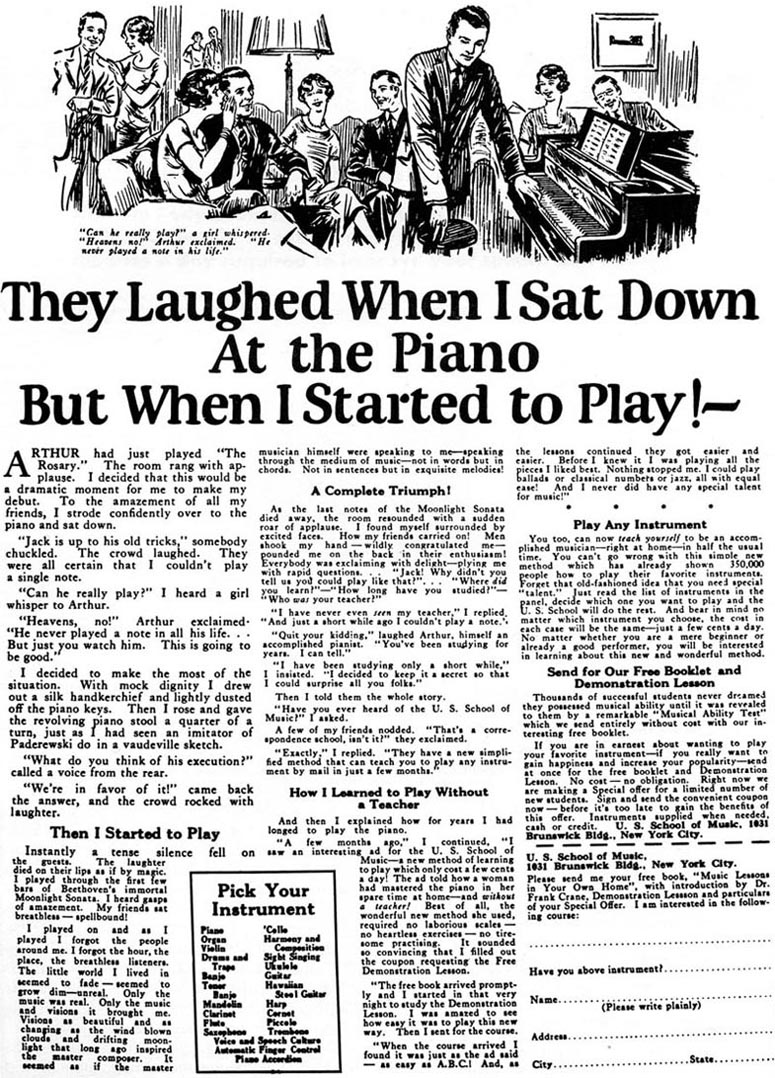
They laughed when I sat down at the piano, but when I started to play with myself, they asked me—in no uncertain terms—to get the hell out of their villa.

Well, those callous, holier-than-thou sophisticates actually did me a favor.  Socially ostracized from my gated community, I was forced to re-invent myself—this time as a wine writer.  Overcoming the shame heaped upon humiliation submerged in embarrassment, I began to find methods other than exposing myself to ‘break the ice’ at cotillion balls (no pun) coming-out (no pun again) formals and cocktail (third time’s the charm) parties.

I learned every single thing I could about wine, devouring statistics as eagerly as an autistic kid memorizing Major League Baseball ERAs.

Lady Doña Clitoreña

Imagine, if you will, the following scenario:

It is Paris, Nuit Blanche 2011.  While ambling through the contemporary-art scene in the Versailles Château, I spy Her Most Excellent Lady Doña Clitoreña Vagintiña, 1st Duchess of Coochuela, Countess of Cervixia and Lady of Bojingo.  She’s wearing a lime-green Donatella Versace bias-cut evening gown, and she looks ravishing—but if I ravish her, I serve serious jail time.  So instead, I sidle up in my white, silk-collared Dior Homme waistcoat and whisper seductively in her ear:

“Did you know that the average yield from an acre of vineyard is four tons—although this can vary greatly depending on the grower?”

A pair of coopers from Lexington, KY

It piques her interest, so I follow up with:

“Three reasons why more and more producers are going ‘American’ with their oak? Cost, cost and cost. A barrel from south-central France’s Limoges is currently upwards of $800, while a barrel made by some mullet-wearing inbred in Kentucky can be as low as $300.”

Then I slip in for the kill:

“It takes about five hundred grapes to make a single bottle of wine.  So if you figure maybe 100 grapes in a cluster, that’s five clusters per bottle.  Can you imagine such a mesmerizing eventuality, my voluptuous Valenciana vixen?”

And I’m in like Flynn.

*

This technique, my brothers, is foolproof; so in the interest of furthering our creepy Cro-Magnon cause, I will outline a few more handy wine facts that should loosen-up your tied tongue whenever you’re trying to score with someone multiple light-years above your social station and who intellectually outranks you by triple-digit IQ points.

(Incidentally, all these useful bonne bouches—and more besides—can be found in my self-help best seller, ‘How To Pick Up Slutty Heiresses Other Than Paris Hilton’).

*

Scam-lines to try out the next time you run into a morselette of royal lineage:

  • “This may surprise you, Cupcake, but a vine must be about three years old before it can produce useful grapes.  And five before it reaches full production…”
  • “Unlike you, Angel Puss, who I would not guess to be a day over eighteen, a vine may be thirty years old before it reaches its peak of performance—about the time when you’ll be hitting that ol’ looks wall and will need to be traded in…”
  • “How many vines are planted per acre, Doodle Bug?  So glad you asked.  Depending on the vintner, between 500 and 1300…”
  • “Did you say South Beach Diet, Love Muffin?  You’ll be pleased to note that although a five-ounce glass of dry wine may contain 125 calories, none are ‘fat’ calories and there is but a gram of carbohydrates in each…”
  • (L) What 9% of Napa looks like. (R) What the rest of Napa looks like

    “Since you have a Ph.D in Applied Physics from the Cambridge College of Mathematics, Sugar Booger, I’m sure realize that the 45,158 acres planted to vineyards in Napa represents only 9% of its total land area…”

  • “Oh, and Snuggle Bunny, while we’re on the topic, 58,000 represents the number of acres  in Napa Land Trusts that can never be developed—more than 20,000 of these are in conservation easements, and 38,000 in agricultural preservation…”
  • “Look, beeotch, I already told you about how many grapes it takes to make a bottle of chenin friggin blanc.  Oh, how many bottles per barrel?  Sorry:  Three hundred…”
  • Bye, Bye, Berlusconi

    ’Oh say can you drink, til the dawn’s early light..?’  Damn straight I can, Schnooky-Lumps, ‘cause I’m a burgundy-blooded American.  In terms of wine production, we Yanks may lag a bit behind Italy, Spain and France—any and all of whom we could nuke to quarks in a cocaine heartbeat—but as of 2010, we skedaddled past those frog-eating Gauls in terms of wine consumption.  Okay, so our population is three times bigger, so what?—if I want any lip out of you, Poopsy-Woopsy, I’ll call your plastic surgeon…”

  • “And finally, Tootsie Pie, the real kick in the most superficial of our three gluteal muscles—the maximus—is that the largest corporate holder of Napa vineyards is not even American. The company is called Diageo and it’s owned by those slang-slinging, eel pie-eating, Lucozade-slurping Brits…”
  • “…What’s that you say, Rumpy-Diddle? I offended with you with that last remark because not only are you British yourself, but your title is Her Royal Highness The Princess Twatolyn Throckmorton of Crapstone, Duchess of Crotch Crescent, Countess of Wetwang?  Well, lookee here, you Holiday Skin-wearing, Benny Hill-watching, Bebo-posting, scurvy-prone Redcoat: We kicked your arses out of Yorktown in 1781 and we’ll sure the hell kick ‘em out of Carneros, too.  P.S., buy a bloody toothbrush…”

Are you suspect?

There you have it, malchiks—and if these gems can’t help you score a nubile scion-ette from the extended family of some King or Queen regnant, my gay-dar is gonna blow a 112 Hz cathode tube.

Posted in GENERAL | Tagged , | Leave a comment

A Custom-Painted Wine Glass By Becky Suriano Will Make You The ‘It’ Taster At Wine Shows, Absolutely Guaranteed

Artist Becky Suriano of Wine Me? refers to her hand-painted wine glasses as ‘highly collectible’.

A very unique perspective, I thought—isn’t ‘collectible’ (like ‘unique’) a word without qualifiers?  I mean, something is either collectible or it isn’t.  You can’t be ‘highly collectible’ any more than you can be ‘very unique’.  Or, for that matter, ‘absolutely guaranteed’; you’re guaranteed or you’re not.

Correctomundo?

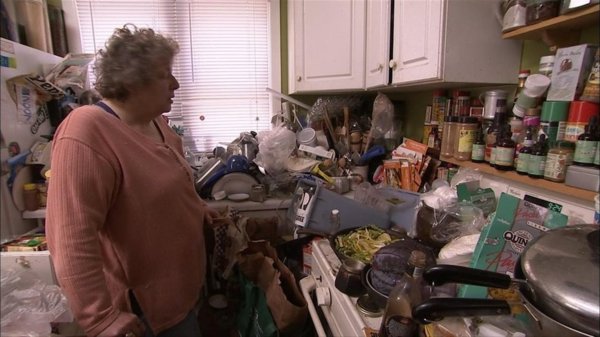
Then I caught an episode of ‘Hoarders’, that A&E documentary series about psycho pack-rats who collect everything from snack wrappers to junk mail to cats (some dead)—items which, to us non-disposophobia suffers, may be considered not only uncollectible, but highly uncollectible.

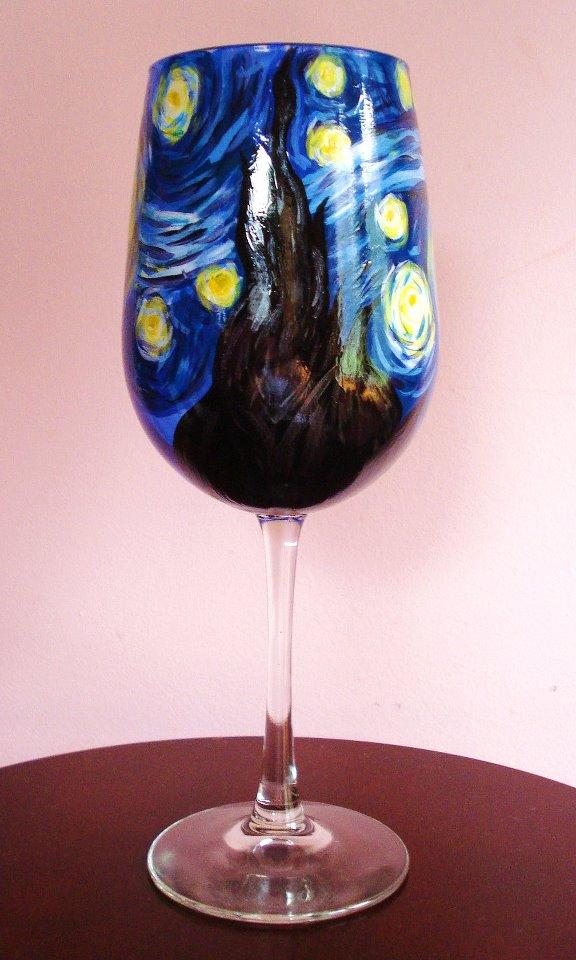
You win, Becky; I lose.  I’ve seen the (somewhat opaque) light through one of your meticulously-crafted wine glasses—in particular, the one that has a reproduction of Van Gogh’s ‘Starry Night’ painted above a Shakespearian quote: ‘Lend me your ear…’

I’m kidding about the quote, of course, but the beautiful Van Gogh reproduction on the glass, along with hundreds more in Becky’s catalogue, is exceedingly unique.  Formidably unique, even.

Inspired by nature, fashion, music, pop-culture and fine arts, New Jersey native Becky Suriano got into the glass painting biz after a search for a stylin’ glass that reflected her genuinely unique persona—one that she could take with her to the wine festivals she loves.   Unable to find one, the artist and self-described ‘reformed rebellious party girl’ painted one for herself.  And so many heads did it turn at tastings that she had her eureka moment over a glass of gewurtztraminer: This was a niche market that she could tap into without much start-up costs and perhaps, realize her long-time life goal of living an idealist/entrepreneur’s life while building a successful business and doing something about which she is passionate.

Becky Suriano: Pretty as a prayerbook and talented too.

Within its first year of operation, Wine Me? racked up an impressive seven thousand FaceBook followers and showed sales figures that were astonishing for what is essentially a no-overhead operation.  Suriano now faces the very real (can something be ‘very’ real?) possibility that demand will outstrip her ability to supply, so she’s investigating mass production techniques, ideally to be followed by a worldwide distribution network along with a number of flagship retail outlets.  (Can there be more than one ‘flagship?)

Wine Me? also plans to expand inventory into other glassware (martini glasses, beer mugs) and additional product lines like wine markers, t-shirts, tote bags and dinnerware, but for now, the top-selling items are wine glasses—the most popular of which are ‘Trees’, ‘Owls’, ‘Mushrooms’, ‘Butterflies’ and, of course, Van Gogh’s ‘Starry Night’.  Prices range from $15 to $80 per glass, and custom designs to reflect your personal program or to commemorate special moments are welcome:

Starry night

“We’ll do anything,” says Suriano, “from Salvador Dali to seascapes, holiday themes to Michael Jackson and the Grateful Dead.  Wine Me? is committed to perfectionism and attention to detail, and combining that with our colorful style, we’ve seen some very happy customers and generous word-of-mouth promotion.”

Suriano is also committed to charity work, donating time and creations to such magnanimous causes as Shopping Night Out, a benefit for Beating Cancer, In Heels at the William Bennett Gallery in SOHO, NYC H’art Fest and a benefit for the Leukemia & Lymphoma Society at Superfine in Brooklyn.

All of which is a grand lesson in how the mind of an entrepreneur works.  According to Becky, a little God-given talent doesn’t hurt, but above and beyond that requirement is a double-helping of chutzpah.

Oh, and an idea that is radically, acutely and hugely unique and totally real—and that, my friends, is the whole and nothing-but-the truth.

*

Wholesome horseplay at the WV Wine & Jazz Fest

The dope on contacts:

winemecompany.com

facebook.com/winemecompany

twitter.com/winemecompany

winemecompany@gmail.com

Posted in GENERAL | Tagged , , , | Leave a comment

Celebrities Who Own Wineries: The Ego Has Landed

Disclaimer:  What follows are the bitter ramblings of a winery-owner, Hollywood hambone, Heisman-Trophy-winner, rock-star wannabe.  They are to be taken with a grain of salt—whatever that means.

And not only ‘taken with a grain of salt’—a lot of these cherished folk axioms make no sense.  To wit.: ‘You can’t have your cake and eat it, too.’  (…In which case, there is no sense in having your cake, since it’s sole worth is if you can eat it).  Viz.: ‘There’s more than one way to skin a cat.’  (Yeah?  I can’t think of any, nor a particular reason why someone without Asian ancestry would try to come up with one.)

On the other hand, some seasoned saws are very apropos, especially to this column.  i.e.: ‘Those who can, do.  Those who can’t, teach.  Those who can’t do or teach become wine writers.  Those who can’t do, teach or write but still have shitloads of disposable income buy wineries.’

Separation of  L.A. and AVA,  (First Amendment , U.S. Constitution, proposed (but never enacted) 4 July, 1776)

California has offered more to this fine, Allah-fearing nation that we can ever give back, but it all can be distilled down to two paradigms: Napa Valley and Scarlett Johansson.

But it’s like Venezuela: They’ve given us oil and pabellon criollo, but I wouldn’t want to mix the two in a bowl and have it for supper.

Likewise, Hollywood and barrel wood. That idiotic, billion-dollar Band-Aid—the concrete wall that President Bush wanted to build on our southeast border—would be of more use stretching from San Luis Obispo County (just above La La Land) to Lake Havesu City, Nevada.  Forget about keeping illegal immigrants out—we need them to pick our merlot for twelve cents an hour.  Our primary duty as drink-sodden patriots should be keeping celebrities out of wine country.

Why?  Well, if you have to ask, let’s just say it’s like the legal loophole that allows Kevin Bacon to play professional guitar.

Fair to say, however, with the price of a single acre of prime Napa grapeland well into six figures, the only people who can even consider jumping into fermentation vessels these days are those with many dollars in offshore accounts.  And like it or not, this includes such wealthy wankers as Tommy Smothers, Barbara Streisand, Wayne Gretzky, Mariah Carey and Olivia Newton-Synonym-For-Outhouse, who may or may not be using start-up graperies as a tax write-off via the massive losses that generally dog the first few vintages.

Additionally, there’s the caché factor, wherein a winery uses a celebrity’s name as a marketing tool.  Seriously, could you find a better example of this than Martha ‘Jailbait’ Stewart’s E.J. Gallo partnership?  As if the diva ex-con doesn’t have her silly name stamped on enough crap, she enters the wine game with Martha Stewart Vintages, the drinking of which is punishment more cruel and unusual than watching vintage episodes of Martha Stewart Living.

(Regarding Whatever, Martha! , the FLN comedy series that relies upon those very clips, Martha said,  “Contrary to popular opinion, I do have a sense of humor…”—which if true would have compelled her to round out her portfolio of cabernet, chardonnay and merlot with ‘pruno’, the wine you learn to make in prison using fruit cocktail juice and bread yeast).

Celebrity-owned wineries are no new phenomenon, of course.  And some of them have yielded wonderful results—Fess Parker Vineyards, the Fred Mac Murray Ranch and Rubicon Estate Winery (owned by Francis Ford Coppola) have all won applause and awards for spectacular, highly-decorated, imminently-collectable wines. Profitable?  Put it this way:  Coppola claims to have made scads more from his wines than he ever did from his films.

I am afraid that these are the exceptions.  Much as I like Carlos Santana, it’s as a shredder, not a vintner.  Nor as a perfumist (Santana Cologne and Perfume), or a cobbler (Carlos By Carlos—Women’s Shoes) or a restaurateur (Maria Maria restaurants)—truly, this dude has become the Martha Stewart of Latin fusion.  Last straw was Santana DMX, a middle-of-the-road sparkler released in partnership with Mumm’s winemaker Ludovic Dervin; it appears that the extent of input that Carlos had into the actual commodity was to taste a bunch of blends and say, ‘Okay, I like this one.’  I’m relieved to report, without the slightest fear of being called out for an atrocious pun, that after a single pressing Santana DMX fizzled out.

*

“It’s a bodacious, cheeky little wine, filled to the brim with the spicy essence of sexy, slippery snakiness,” alliterates the former Mr. Tawny Kitaen, Whitesnake frontman David Coverdale about Whitesnake Zinfandel, 2010.  “I recommend it to compliment any and all grown-up friskiness and hot-tub jollies…”

Coincidentally, Dave, I recommend throwing the world’s collection of Whitesnake CDs into that same hot-tub, only this time filled with your stupid wine.  Now they’re ‘Deep Purple’, too, ah-ha-ha-ha-ha.  In 2005, VH1 voted Whitesnake the 85th Greatest Hard Rock Band of All Time, and I have to say, when my son’s team came in 85th place in the South Oakland Soccer League, my first impulse was not to post it to Wikipedia.  But, to each his own, Dave, and if you think ‘snakiness’ is a plus in a wine descriptor, cool—that’s your each or possibly your own—but moi, if I want my wine to taste like snake, I pick up a carafe of Chinese shéjiue–the wine with the Mangshan pit viper floating in the bottle.  Say, there’s a marketing hook for you (overdue, granted, since you haven’t had a chart-topper since the 80’s): Pack each bottle with a California King Snake.  They’re albino, as befits your band name, and frankly, without it, an erudite glass of vintage red hardly seems the appropriate sup for an evening of screechy, head-banging power ballads.

*
Jonathan Mortimer Smith, Esq.

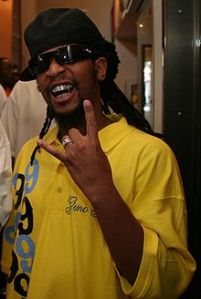
Gary Vaynerchuck has been referred to as ‘a celebrity wine critic’, but it’s not clear if that means he’s the celebrity or that he critiques celebrity wines.  Either way, he came in 40th place in Decanter’s list of influential wine people, which is better than Coverdale’s 85th place, but still sort of twinkling at the periphery of wine relevance.  I mean, when my daughter’s gymnastic team came in 40th place at the… oh, never mind, I already used that joke.  In any case, Belarusian Vaynerchuck gave Little Jonathan Chardonnay, 2006—the winery owned by rapper L’il Jon—a kick-rump 89 points.  Now, at first pass, a dreadlocked homie from an Atlanta hood best known for Get Crunk, Who U Wit: Da Album, may not seem the sort of chap that can produce wines on a level of, say, a 1990 Chateau Meyney Bordeaux or a 1996 Groth Cabernet Sauvignon, but both of these wines are 89 pointers as well, and it is what it is.  And there’s also a chance that some of this L’il Jon gangsta/playa persona is more a product of management than of reality—in fact, L’il Jon’s birth name is distinctly lacking in ground-level street cred: Jonathan Mortimer Smith makes him sound more like a blue-blooded pharmaceutical heir from New Canaan, Connecticut than a thug.  Alex Henderson of allmusic.com does not believe that L’il Jon has a gangsta life-agenda, but rather ‘is conveying serious sociopolitical messages’.  I know, swallow the throw-up and don’t breathe in anybody’s face for a while.  You be the judge, though: When his ’06 Chardonnay took a silver medal in the 2009 L.A. Wine and Spirits Competition, the former Celebrity Apprentice—who followed up Get Crunk with We Still Crunk!!, Kings of Crunk and Crunk Juice—tweeted the following sociopolitical manifesto to his Twitter site:

“For all yall sukkas that were hating on my wine, check this out!!  We winning awards!!!  Get U Some!” 

*

We’ve watched Dan Ackroyd’s maturation trajectory from a wild ‘n’ crazy Cajzli to a bass-smoothie-making T.V. pitchman to the reserved and less self-destructive Blues Brother.  And as you’ll recall from that comedy classic, the Brothers’ taste in wine was pretty straightforward: It was the A-Train to Night Train or no train at all. As he aged and bloated and grew sort of unfunny, Ackroyd took on roles befitting a middle-aged Tinsel Town laird, holding his own against luminaries like Anthony Hopkins and Jessica Tandy—especially in his Academy Award-nominated portrayal of Boolie in Driving Miss Daisy (Nuts).  Along the way, his appreciation for decent wine increased proportionately.  Having experienced plenty of gutter wines in his home town of Ottawa, he became enamored of the world-class whites being produced in Niagara, Ontario, and invested in Diamond Estates Wines & Spirits, saying,  “I could see the value of putting my name on wines because people up here, in Canada especially, trust the Ackroyd name as someone that’s honest who will give them a great experience for a good price.”

"I can pronounce, but not spell, 'sommelier'."

And his offerings are all that.  With Diamond, he produces four VQA award-winning wines as well as an ultra-premium ice wine, and his 2008 joint venture with Sonoma’s DeLoach resulted in the superb Dan Ackroyd Discovery Series.  These wines slip down the gullet with elegance and style; what sticks in the craw is Ackroyd’s marketing self-portrayal as a simple Ottowan farm-boy bumpkin by using such label slogans as ‘Made from 100% Snob Free Grapes’ and ‘We can’t pronounce Sommelier either’.  By his insistence in claiming non-pretentiousness, he actually becomes that much more pretentious—we assume that anyone who is fluent in French and casually drops names like Château Trotanoy,  Château d’Yquem and mocha dacquoise in the course of interviews can probably pronounce ‘sommelier’.  Eh?

*

Emilio's backyard

Like Elwood was to Jake, Emilio Estevez is to Charlie Sheen: No apparent death wish.  Rather, the eldest son of Martin Sheen has a wine wish, which’s he’s realizing in his urban vineyard in Malibu; he farms a single acre in partnership with Casa Dumetz and his winemaker wife Sonja Magdevski —80% is pinot noir, which sells out immediately.  The larger blocks of Casa Dumetz vines come from the Tierra Alta Vineyard in Santa Ynez Valley where it’s warm enough for Rhône rhôck-stars like viognier, syrah and grenache. Emilio and Sonja also produce a sparkling syrah (champagne is not just for Breakfast Club anymore) and a syrah rosé which Wine Enthusiast Magazine creams all over.   There’s some of each available at pricing ranging between $25 to $35 a bottle.  Winning!!

*

We lusted after her in Goodfellas and bled with her in Medicine Man; then, when she hit the wall looks-wise, we admired her in The Sopranos.  Now we’ll raise a glass of  Montepulciano d’Abruzzo from Bracco Wine—one of nine regional Italian DOCs hand-picked by the Brooklyn-born Lorraine Bracco—to toast her interest in becoming yet another celebrity wine huckster.  When asked by Wine Spectator about her background in wine, Bracco replied: “I lived in France for ten years…”, which is a bit like saying “I’ve seen Swan Lake a bunch of times, therefore I’m qualified to play oboe in a symphony.”  But I’ll go all Malfi and withhold judgment.  I can, however, judge Bracco Wine’s Barolo, Amarone Classico, Chianti Classico, Chianti Classico Riserva, Montepulciano, pinot grigio, Brunello Di Montalcino, primitivo and recently, Rosato—or at least, because they are highly allocated and I am evidently not allocatable, report that reviews have been molto favorevole (that’s ‘good’). As is the Italian style, these are wines that need to be enjoyed at the dinner table, which is too bad, because the best place for a Malfi wine—obviously—is on the couch.

*

What’s the deal with 80’s hair-metal bands and wine labels anyway?  Now it’s Mötley Crüe’s one-octave vocalist Vince Neil and his Vince Vineyards.  Vince affirms a long-standing love of high-end wine, rivaled only by his love of high-end narcotics and high-end hookers, and created the brand in conjunction with Russ Dale and vintner Harry Parducci.

Upon release of his ’03 Napa Cabernet and ’03 Sonoma Chardonnay, Neil said, “I have enjoyed great wine for most of my life and wanted to create something that others could appreciate.”

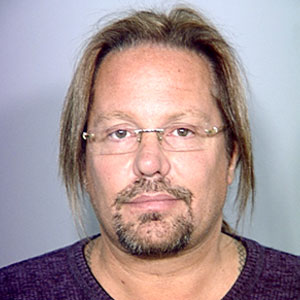
You have the right to remain silent--and by God, how we wish you would.

You go, frontman!  Unfortunately, there’s reason to suppose that ‘others’ are not so enamored with Neil’s weakness for wine—and it also speaks to the TTB’s weird rules concerning who can and who can’t get a wine label approved.  In 1984, a totally shit-faced Neil opted to take the logical step of driving to the liquor store to get even shit-faceter.  Along for the joy-ride was Hanoi Rocks drummer Razzle Dingley.  Alas, they never made it.  Neil hit an oncoming car, killing Dingley and leaving the occupants of the other vehicle with permanent brain damage.  For this silly lapse in judgment, the high-pitched screecher served fifteen nearly interminable days in jail, and lest you think that such a cruel and inhumane sentence must surely have rehabilitated him, consider that Vince ‘Can’t Change Me’ Neil was arrested in 2007 for DUI, again in 2010 for DUI, and in 2011, for assaulting his girlfriend while completely blotto.  On the plus side, Mötley Crüe dedicated an album to Dingley, which probably goes a long way to making everything hunky-dory with the drummer’s next-of-kin.

As responsible consumers, of course, we should keep an entire cluster-galaxy between us and Neil’s label, but as it turned out, 2003 was the only vintage of Vince Wine ever released.  That’s the good news.  The bad news is that he dropped the project to focus on something much more gnarly and near to the hearts of metalheads: His own brand of tequila.

*

What could be further removed from the genteel world of double decanting and carbonic maceration than three-chord grindcore heavy metal?  Football, that’s what.  Figure that last year the annual NFL advertising spend by Anheuser-Busch, representing such brands as Busch, Bud, Labatt, and Beck’s, topped $82 million, followed closely by Miller/Coors at $62 million.  And further figure that the wine industry/football expenditure was, in the final pecuniary analysis,  a grand total of nothing.  In fact, in 2009, wine ads overall declined by 22% during Superbowl week.  It seems evident that gridirons and keggers are having a brass-bound, infrangible love affair—one that our Lady-on-the-Lees will never bust up.  Still , you never know—malolactic minx that she is…  and the following pigskin pros, even those without necks, are nonetheless up to their necks in the wine game:

Phallic? Get out--this is Mike Friggin Ditka.

“I’ve drank every kind of wine there is,” says past-participle-challenged Mike Ditka, retired NFL tight end and former coach of the Bears and the Saints.  “If I had a penny for every glass of wine I’ve had in my life, I’d be a millionaire.”  Hard to fathom that last one since Ditka has a net worth of over $44 million, but we’ll leave it alone and focus instead on Mike Ditka Wines.  In partnership with Mendocino Wine Company, he produces four varietals (cabernet, chardonnay, merlot and pinot grigio) and a flagship blend called Kick Ass Red, showing that the Hall of Famer has the same respect for the art of winemaking that he does for  biographer Jeff Pearlman, about whom Ditka said, “If I saw him, I’d spit on him.”   Fair warning, Jeff: If Ditka drinks as much cab as he claims he does, you can look out for some purple spit.

*

Meanwhile, back in Walla Walla, former Patriot QB Drew Bledsoe could not have found a better partner than Chris and Gary Figgins of Leonetti Cellars with whom to make wine. Bledsoe grew up a mere 400 yards from the Leonetti vineyards, and the impression I get is that he is the real deal, fascinated with every aspect of winemaking ‘from dirt to bottle’.  His label, Double Back Wine, produced 900 cases of cabernet sauvignon in the premiere 2008 vintage; it was of exceptional quality and it sold out quickly.

*

I tried to score an interview with former University of Michigan cornerback Charles Woodson to talk about his Napa Valley winery and the release of his flagship wine TwentyFour, about which Woodson says, “It’s a wine of giving back and paying forward.”

But no luck, so I didn’t get a chance to challenge the ruling on the field by asking him how, at $150 a bottle, he figures he’s ‘giving’ back anything.  Selling back is more like it.  And the only paying forward will be the bank note you’ll need in order to afford the wine.  That said, I did try it, and it’s a hella red; its rich, chocolaty nose charges forward with multiple layers of sweet tannins,  a firm juicy fruit backbone and a mocha finish that goes well into overtime.

*

Bo and Cathy in 2006

As long as I’m on a U of M roll, I must mention Cathy Schembechler’s paean to her husband Bo, who is to Michigan football folklore what Paul Bunyan is to the tall tales of Michigan lumbermen: mythos.  Bo Schembechler Wines is a series of limited-edition bottlings showcased by Ann Arbor-based Studer Enterprises.  There’s a blended white and a merlot; both are perfectly drinkable, of course, but they are marketed more as a collector’s item for fans of the late, fiery ‘coach’s coach’ whose final speech, made the day before he died, was to extort Michigan players to remember ‘the team, the team, the team!’

*

Now, after all that puerile, occasionally mean-spirited expostulation, this may come as a shock, but in the category of superstars who have wineries but probably shouldn’t, I am giving Madonna and Madonna Wine a total Get Out Of Jail Free card.

Why?  Three reasons.  One, she’s from Michigan, the wine’s from Michigan and I’m from Michigan.  Two, I dig her father, vintner Tony Ciccone, who I happen to love hear preach—especially about wine.  And third, this is my column and I will do whatever the fork I want with it, even if, like ‘A penny saved is a penny earned’, it makes no sense.

Papa Tony with his bottles

Tony’s limited-edition Madonna series, featuring his kid on the label, is but one of many interesting wines  from his vineyards, including an edgy dolcetto—the only example of that varietal to emerge from Michigan’s beautiful Leelanau Peninsula.  I’m not really sure if Madonna herself now has a stake in Ciccone Vineyards,  but I believe she stepped up to the plate when the winery—like most businesses in hinterlands of Northern Michigan—needed an infusion of support.

After all, what good is it being a pop diva if you can’t help out Pop?

Posted in GENERAL | Tagged , , , , , , , , | Leave a comment

Novemberfest, 2011: A Random Trio

What’s that?  It’s Oktoberfest?  I thought Oktoberfest was in September.  And I thought October was spelled with a gentle Anglo-Saxon ‘c’ instead of a massive, intimidating Teutonic ‘k’.
What’s up with that, anyway?  Cologne with a ‘K’, Caesar with a ‘K’, commando with a ‘k’—hell, even my own last name starts with a ‘K’ when by all rights—being a homonym for that Royal rock pile in Balmoral—it should not.  Inconvenient?  Not only do all those misplaced ‘k’s’ overwork my laptop, but I can never order a pizza without slowly spelling out my patronym, letter by letter, lest the Castle family winds up with my double cheese and green olives.

Oktobeer Fest, 1810

‘Kassel’ notwithstanding, Germans have long, funny names, and the history of Oktoberfest is soaked with them.  The chronicle begins in 1810 with the marriage of the son of Count Palatine Maximilian Joseph of Zweibrücken and Augusta Wilhelmine of Hesse-Darmstadt to Therese of Saxe-Hildburghausen; the subsequent wedding party was held in a Munich field called die Theresienwiese.  So bonkers an occasion did it prove to be that the Bavarian Royal Family figured they’d mollify the masses—reeling from poverty and near-constant warfare—by holding it every year.

And that they have done, religiously—at least when they were were not unscabbarding their swords and the peasants were not dying of cholera.  Over the centuries, Oktoberfest has been cancelled 25 times—twice due to disease epidemics and twenty-three times because the uppity-ups couldn’t play nice with the neighbors.  In 1813 it was Napoleon, in 1866 it was the Prussians, and in 1914-1918 and 1939-1945, it was you and me.

Short of making them give back Poland and Alsace and writing ‘I Will Not Bomb London’ a billion times on the blackboard, there seems to be no better penance for these touchy Teutons than the shuttering of the Ochsenbraterei/Spatenbräu Festhalle.  Apparently, it works: They’ve been heeding Mr. Do Bee’s gentle Romper Room admonishment ever since:  “Boys and girls? Do Bee a good Master Race and forget about world domination.”

And since 1947 (with the notable exception of 1980’s pipe bomb planted by right-wing extremist Gundolf Köhler which killed thirteen people—including Gundolf), sailing has been pretty consistent.

A Million Gallons of Beer on the Bar

Which is not to say that it’s been restrained—far from it.  Oktoberfest is the largest, most out-of-control party in the world; it makes the Mardi Gras look like Sammy Six-Pack’s backyard weenie roast.

A few stats to offer a clue as to how off the hook it can be:

In 2010, six million revelers consumed 119 oxen, 240,000 pork sausages, seventy thousand pork knuckles, half a million chickens, 90,000 pounds of Fisch am Stiel (fish on a stick), one small tin of Spam, 34,000 gallons of wine, and—envelope please—nearly two million gallons of beer.

And that was breakfast.

(The consequence of all this beer consumption, of course, is a need for Porta-Johns, and more than 1,800 were in operation in 2010—several surrounded by Faraday Cages to prevent them from being used by cell-phoners as ‘quiet spots’, thus risking blown Bavarian bladders).

Why Pitch a Bitch When You Can Pitch a Beer Tent?

The München set-up, as overseen by a whopping Amazonian statue representing Bavarian womanhood, centers around thirty-four non-permanent tents, each with a name that settles, like those of the Bavarian Royalty, as an absurdly uneconomical waste of letters: Ochsenbraterei, Armbrustschützenzelt, Wildmoser-Hühnerbraterei, Studentenverbindungen, with a special agricultural pavilion that happens every four years called Zentrallandwirtschaftsfest.

Well, at least they’ve stopped wasting all those endangered ‘K’s’.

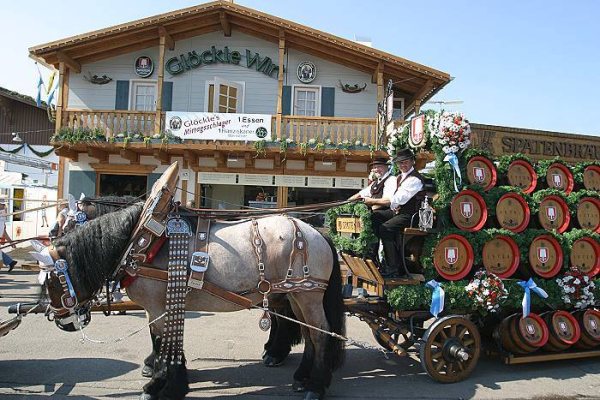
The Glöckle Wirt

Each tent boasts some esoteric, often odd but always cool specialty: There’s The Crossbowman’s Tent, for example; the Glöckle Wirt, filled with oil paintings and antique musical instruments and the Münchner Knödelei, whose mission statement is ‘Preserve and spread the dumpling culture’—thus allowing us to sleep easier knowing that the Germans are making Spätzle instead of 20-mm antiaircraft cannons.

Naturally, the common denominator that joins these pavilions at the hop is beer.  Sure, there’s sekt sparkling wine available, but drinking it is akin to blasphemy. What, you’d drive to Hershey, Pennsylvania to pick up some Jolly Ranchers?

Beneath the canvas, Bier ist Gott.

The Beer Institute

Oktoberfestbiers, as they are called, are a unique breed, usually Märzens, brewed in March, stored in caves over the summer, and top-heavy with malt and alcohol—some a full 2% higher than standard Munich Helles lagers.  But Munich beers they are: The Beer Institute dictates that only beers brewed within the city limits  may be called Oktoberfestbier, and all others must be called ‘Oktoberfest-style’, just as the 1919 Treaty of Versailles required Germany to be re-named the Weimar-style Republic-like Reich.

€9.20 worth

As might be predicted, virtually all these toasty, nut-brown, yeasty-rich Oktoberfestbiers come from the München Big Six: Löwenbräu, Hofbräuhaus, Augustinerbräu, Paulaner, Hacker-Pschorr and Spaten.  The first three are currently under indictment from the Interpunktion-Erhaltungs-Liga von München (Punctuation Conservation League of Munich) to stop the overharvesting of umlauts, so legal fees are probably the reason that the price for a Maß (1 liter stein) of these beers is steadily increasing.  In 2001 the average price of a Maß was around six and a half Euros—this year, it was €9.20.

The Most Wonderful Time of the Beer

So, back to Septemberfest.  As nostalgic a date as October 12, 1810 is to those maudlin Münchners, autumn weather in Bavaria can be a touch squirrely, so the 16 – 18 day festival ends on the first Sunday in October, meaning that it’s held mostly in September.

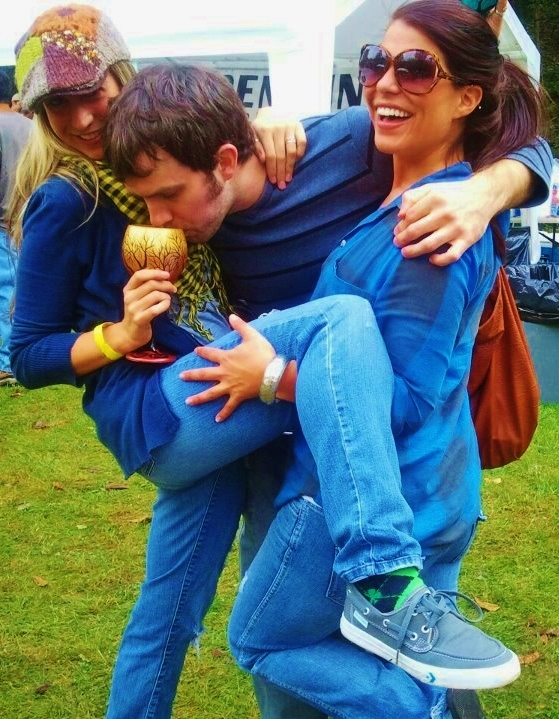
My personal Novemberfest—for those interested—will be held on the Kassel Fairgrounds in my basement in about ten seconds so I can write tasting notes.  If you even superficially resemble the Fräuleins in the adjoining photo, admittance is free.  If not, you are required to provide several crockpots and chafing dishes filled with Leberspätzlesuppe, Nürnberger Bratwurst mit Sauerkraut and Semmelschmarrn mit Zwetschgenkompott along with a kegger of Franziskaner Weißbier and an experienced Oompah band. Oh, and a double cheese with green olives pizza, O.C.?

Hey, cut me some slack—I know that the last word is spelled wrong, but damn it, we just ran out of ‘K’s’.

Maybe bring some of those, too.


Tasting Notes:

Note on the notes: These beer/ales have zero to do with Oktoberfest, and everything to do with Novemberfest—they are big, bold brews that don’t need any of that late-September girly Indian Summer crap.  They want roaring fireplaces, blizzards out the wazoo and Jack Frost ripping off your nose. 

The first two are Bavarian, the third comes from North Rhine-Westphalia.

Mahrs Bräu Der Weisse Bock, around $7/500ml:  Big and boozy, this one pounds the ABV scales at 7.2%.  Weisse bock is a style that’s quickly developing a fan base—it shows the sweet raisin, citrus, tart cherry and apple of wheat beers with the caramel-honey malt of bock with its underlying cocoa and coffee bitterness.  Ultra-smooth with almost Champagne-like carbonation; bubbles stir up some sediment, giving the brew a murky character perfect for autumn.

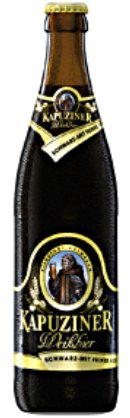
Kapuziner Schwarz-Weizen Ale, about $3.50/500ml:  Stout beers have been phenominally successful here in the States, thanks in no small part to the Guinness advertising powerhouse, but it hasn’t really spilled over to German Schwarz (black) ales.  It should.  This ale broods with a bitter roasted coffee bean intensity that’s mellowed by pretty notes of pumpkin pie spice and the tang of orange rind.  The head is thick, khaki and loaded with visible bubbles rather than froth; the mouthfeel tag-teams between astringency and brown sugar sweetness.  It finishes too abruptly to be a world-class player, but at the price, the brew is a bargain.

Uerige Doppelsticke Altbier, around $6.50/11.2 oz:  The color of dark amber maple syrup, Doppelsticke weighs in at an awe inspiring 8.5% alcohol—and it’s priced to match.  But the buzz factor seems nicely balanced by a massive, malt-driven palate filled with mocha, pine needles, cooking chocolate and winter spices followed up by a bit of cherry and a strong, extremely long-lasting finish initially reminiscent of grapefruit rind, followed by notes of fresh hops.  Incidentally, Doppelsticke means ‘double secret’ in the Bavarian Bairisch dialect—so if you ask what’s in it, the Uerige folks may have to pull a Hansel and Gretel’s witch on you, and that, my friend, will be that.

Posted in BEER, GERMANY | Tagged , , , , , , , | Leave a comment

Ghost Pines Chardonnay: Did Thirty-Five French Generations Get It Wrong?

I begin with a short and doubtlessly dull philippic on vineyard designated wines.  And all you smarty-pants enophiles who already know this stuff are encouraged to go back to The Marriage Plot or Unbroken or whatever the hell you’re reading these days.

The Upside of Monkdom

For the rest of you, the tale begins near the end of the Middle Ages—somewhere around 1300—when scholarly types first started to appreciate the differences in various Burgundian wines based on which vineyard was producing them.  Monks—who tended to bogart literacy in those days—took it upon themselves to map out holdings and land parcels and note the lots that were dispensing the best wines.  Most of their findings were confirmed by Denis Morelot in 1831, and although his opus La Vigne et le Vin en Côte d’Or didn’t make past a single edition (a reprint finally appeared in 2009), many of the top vineyards listed therein are still on top today and command the highest bottle prices.

The Hocus-Pocus of Locus

The reason, of course, is the omnipresent-in-wine-harangues but frequently misunderstood concept of terroir.  Defining it (beyond ‘an expression of place’) is like defining ‘irony’—examples work far better than words.  Burgundy is France’s most terroir-conscious appellation—possibly, the most site-psycho wine ward in the world.  Why?  First, it’s a consequence of Burgundy’s size.  All told, the AOC from which the noblest wines on earth geyser forth is a mere 25 miles long by a mile and a half wide, and, thanks to 1804 inheritance laws put into play by Napoleon, most of the family-owned vineyards have been divided and subdivided until a single small vineyard may have scores of owners, some of which might cultivate only a single row of vines.  Le Montrachet, the ne plus ultra of chardonnay, is less than twenty acres total and serves 18 masters—Domaine de la Romanée-Conti, whose Montrachet commands upwards of $4000 a bottle, owns a paltry acre and a half.  The result of all this is that precisely where your Burgundian parcel is located—on an ideal site midway up a slope facing southeast or in the flat, poorly-drained valleys below—makes all the difference.

"Call me a cab." Okay, you're a cab.

Another factor that determines the signature flavors of your situation is  air temperature, which in Burgundy is just barely where it needs to be to grow grapes.  And not just any grapes, either: Cabernet sauvignon, Bordeaux’s heat-seeking valedictorian, wouldn’t last a season in the Côte d’Or.  So, microclimate based on a thousand interwoven factors is frequently the difference between a Grand Cru and a Village.  Likewise in Germany, where the viticulture envelope is pushed to its limit, ripeness is key to a wine’s classification.  Only in exceptional vintages from vineyards with ideal exposures can grapes ripen to the point where they can wear labels that make them coveted and collectable.

A third reason why a specific vineyard name on a label may be considered a guarantee of breeding is soil—a key element of terroir, right up there with geography and climate. (The root of terroir, of course, is terre—‘earth’).  Despite its relatively small size, Burgundy is composed of over 400 different soil types ranging from chalky limestone to shallow compacted clay, each of which has a marked effect on a wine’s profile.  French vignerons have noticed that vines planted in blocks encrusted with chalk are healthier and the wines are deeper and more complex, so it’s not surprising that the greatest names in Burgundy and Champagne come from fiefs that sit above limestone outcroppings.

And these soils do not, for the most part, meld gradually together—they change abruptly, often within the space of a few feet.  This explains in part the haywire pricing variations between Burgundies.  Stand, for example, among the trellises of Bienvenues-Batard-Montrachet, a Grand Cru which sells for around $300 a bottle, and look toward Puligny-Montrachet, only a hop-scotch skip away, which sells for $50.  It’s all down to dirt—and nowhere in the wine world is there a better exemplar: Soil is to Beaune what oil is to the U.A.E.

In the Mosel, where the magic word is Sonnenschein, the best bottlings come from vineyards containing blue-gray slate which collects heat during the day and radiates it back to the soil during the night.  By contrast, nearby Rhein’s soil contains high concentrations of quartz, loess, sand and loam, and produces wine with a distinctly different character.


Anything You Can Do, I Can Do Later

The United States was a bit slow on the single-vineyard uptake.  The first California winery to fuse the name of a specific block of grapes with the winery’s name was Heitz Cellar Martha’s Vineyard in 1966.  It provided not only a unique, appellation-defining sense of terroir (Heitz has a distinct minty flavor, said to come from the eucalyptus trees that surround the vineyard), but also a sense of pride as Joe Heitz, seller of the cellar, realized that he was sitting on what would be considered in France a premier cru vineyard—not to mention that the unusual labeling  became a talking point which helped nudge the fledgling enterprise onto the world stage.  (Heitz Cellar Martha’s Vineyard currently sells for around $150, but if you’re so inspired, there are still bottles of that magical ’66 vintage available for about ten times as much.)

Martha's Vineyard: The Wampanoag called it 'Noepe', but what the hell did they know about wine?

Enlivened by the success of what was, to some extent, a gimmick, Chateau St. Jean tagged their 1975 chardonnay ‘Robert Young Vineyards’ and it was off to the races.  Such proud partnerships between grower and winemaker soon became the whip, with some vineyards—Bella Oaks and Herb Lamb, for example—becoming more famous than the wineries themselves.  In fact, Martha’s Vineyard became such a beloved brand among affluent Americans that an upscale island off Cape Cod ripped off the name.

Federal regulations require that if an American wine is called ‘Single Vineyard’ (SV), 95% of its grapes must come from one delimited vineyard.  The TTB must have plenty of Praetorian Guardsmen in the field, since in 1966, when Joe Heitz went for the gusto, there were 424 bonded wineries operating in the entire United States while today, in California alone, there are 3,364.

And more and more of them are hopping aboard the SV bandwagon.

Michael Eddy

So, Who’s Been Slashing The Tires On That SV Bandwagon?

Michael Eddy, winemaker at Ghost Pines, that’s who.

Now, it’s one thing to opt out of the single vineyard program—even to quietly pooh-pooh its theoretics.  But Eddy eschews even as broad a label as Napa or Sonoma, opting instead to buy grapes anywhere in the state he wants, and is perfectly content to wear broad, non-informational ‘California’ as an AVA.

He’s more than content, actually.  He brags about it:  “As a winemaker, I’m pretty lucky.  I’m not bound by a single appellation or vineyard, so I have a lot of freedom when it comes to choosing grapes…”

Okay.  Now, I’m pretty certain that each time Joseph Drouhin collects $2,339 for a 3-liter of Le Montrachet Marquis De Laguiche his first thought is not, ‘Damn, I wish I wasn’t bound by a single vineyard’, but there are some valid reasons for winemakers to consider the cons as well as the pros before diving in headlong to what has, for some, become a branding nightmare.

Regrets?  There’ve been a few.

The primary concern, of course, is that whenever you partner up with someone with the intention of developing a product, you’ve got to be optimistic about the future—let it be full of harmony, bliss and greenbacks.  However, even though a given winery—say, Domaine Jacktard—labels a wine ‘Dingledouche Vineyard’ and dutifully uses 95% Dingledouche fruit, it has no proprietary ownership of the name ‘Dingledouche’, which belongs to the grower.  So, when the grape-buying contract ends, there’s always the chance that the Dingledouche faction will choose not to re-up, or will raise prices beyond what Domaine Jacktard can spend.  So, after all the sweat that went into advertising, pavement-pounding and begging reviews from weenies like me, there’s no equity—and Domaine Jacktard is left with a popular brand name it can no longer use.  Dream over.

There are some SV worries on the consumer front as well.  You generally pay more—sometimes a lot more—for wines wearing a vineyard designation, but you’re willing to do so because you have an academic interest in why a 2007 Zinfandel from Ravenswood’s ‘Barricia Vineyard’ sells for $24 a bottle while an ‘05 Ravenswood ‘Belloni’ commands upward of $850.  If you shell out for the latter, you expect—and have the right to expect—a genuine understanding of what Belloni had going for it in 2005.

And yet, without research on your part, simply imagining that a vineyard listing guarantees a soulful reflection of an identifiable terroir is probably a romantic pipe dream.

As Michael Eddy phrases it, “Vineyards don’t know where the county lines are.”

Microclimate in action

People own vineyards for all sorts of reasons—egos, Last Wills and Testaments, love of the earth, more money than sense, etc.—but I assume that one of the least common reasons for farming grapes is a grower’s absolute conviction that every vine on the property is living in the precise climat as every other vine.  If you, like me, come from Hardiness Zone 6, you’ll notice that patches of snow remain on the lawn until late April or even May while the rest of it melts in March—meaning, of course, that these small areas are living in a microclimate quite different from the rest of the grass.  Likewise, in vineyards where one block of grapes may be a hundred acres distant from another, elevations, drainages, soil types and exposures—hence, terroirs—can be as different those from a completely different appellations.  And yet, no TTB regulation covers this loophole, and all grapes from the entire vineyard, no matter how different in ripeness and quality, can make up a wine labeled ‘Single Vineyard’.

And Michael Eddy’s reasons for releasing Ghost Pines Chardonnay, ‘Winemaker’s Blend’, 2010, incorporating fruit that’s 60% Sonoma, 18% Monterey and 22% Napa?

None of the above.

Eddy says, “”You may find an incredible vineyard site next to a marginal one in the same AVA. For me, it’s about ignoring the traditional boundaries and finding those great sites that let us express pure varietal character in the bottle.”

In other words, he’s just not all that enamored over terroir specifics.  Far from being the sacrilege that this attitude would be in Beaune, it reflects a very back-to-the-basics California focus on fruit—the reason why American wines are listed by grape names while the French ballyhoo location names.  Eddy believes—and has believed through stints at Trefethen Family Vineyards, Beaulieu Vineyard and Rodney Strong Vineyards—that carefully chosen blocks from multiple AVA’s can ultimately reflect the purest nature of the beast, whether the soil is volcanic, sedimentary or granitic.

Of course, the ultimate test of his hypothesis happens after the cork is popped, and tasting notes follow.  I will say that I found Eddy’s 2010 Ghost Pine to be a marvelously textured and multi-dimensional chardonnay, though at .46 g/100ml of residual sugar, nearly Spätlese sweet. A natural pH of 3.54, however, offers a nice foil.

But that’s dweebese, and if your browser does not support a Geek/English translator, you’ll have to judge Ghost Pine’s haunting complexity for yourself.

Today is Sunday, and since a lot of stores won’t sell wine on Sunday, you may have to wait until tomorrow–Halloween– to pick up your bottle of Michael Eddy Munster’s Ghost wine.

And that, class, is an example of irony.

Tasting Notes:

Ghost Pines Chardonnay, Winemaker’s Blend, 2010, about $20: Nose presents a many-layered impression beginning with Green Apple Jolly Rancher and a light oak-honey nip followed by the distinct scent of mandarin orange.  Mouthfeel is almost viscous, with evocative tones of frankincense along with spicy peach, apricot and apple, everything shored up with a pleasant acidity that balances the sweet citrus of the mid-palate.  A token hint of oaky bitterness exists on the finish.  Eddy’s wine undergoes malolactic fermentation to mellow the vintage’s higher than normal acidity, and it provides a nice creaminess throughout.

Posted in CALIFORNIA, Chardonnay | Tagged , , , , , | Leave a comment