So Ya Wanna Be a French Wine Scholar?


Woo hoo! If there were any presses left in the journalism industry, I’d hold ‘em!  I’ve been invited to enroll in an online French Wine Scholar program!


My homies, especially the ones who repair large pieces of manufacturing equipment, already think that I’m a bit of a wanker because of my interest in Alsatian gewürztraminer and my inability to name a single starter on the Detroit Pistons.  Do you suppose that the ol’ gang at  Doyle’s Tavern might develop some newfangled respect if I announced that I was officially a French Wine Scholar—three words which, other than ‘french fries’, have never before been used in their presence?


Chaa, rite…


Therefore, to avoid further embarrassment, the program will henceforth be referred to as the FWSP.


FWSP, Pros and Cons:


Here’s what I, or you, can expect to receive for our $285:


‘An eight-month online program that puts wine study into a measurable, meaningful format designed for maximum retention of content’.  OK, kids, nap-time’s over, put away your mats and blankies.


Here’s what we won’t get:


  1. A certificate
  2. Wine


The program pushers are quick to point out that if you want said certificate, which may or may not end up doused with Doyle’s Tavern draft Labatt’s as it’s being snobbishly displayed, there’s an additional fee of $270.  And that ‘tasting experience must be gained independently’.


Now, Rick Hamilton and broken two-thousand ton Ube extrusion presses aside, my wine interest is based on two primary premises: 1) I like the taste.  2) I like the effects.  All the esoteric background noise, the sommelier sermons and lieu-dit lectures, are mere place-holders meant to fill up awkward silences between glasses.  Don’t get me wrong, it’s fine to dig the details, especially if a Jeopardy bet rides on Doyle’s wide-screen and the answer is ‘malbec’.  And when you are shopping for overpriced wine, it helps if you know your Basque from a hole in the barrel.


But developing genuine wine smarts is far more hands-and-nose-on than a book excursion; otherwise, you could become a pro basketball player by reading training manuals.

No judges here; to each his own and to own his each: If you got the equity, the inclination and the eight months, the FWSP might well be worth it.  On the other hand, here are  a couple alternative ways to spend the gate fee:


  • Six and a half bottles of 2006 Alain Hudelot-Noellat Clos de Vougeot
  • Two double magnums of 2007 Château Léoville Barton
  • A one way plane ticket to Bordeaux on Lufthansa.
  • An eight-minute overview of French wine plus a backrub and a bag of Doritos from this wine columnist.


Which do I recommend you opt for, the eight-month harangue or the eight-month hangover?


You don’t have to be a French Wine Scholar to guess.


IF YOU INSIST:


http://www.frenchwinesociety.org/site.php?page=events&id=298&ver=pro


or contact the French Wine Society by phone at 202-466-0808 or by email at dc@frenchwinesociety.org


Posted in GENERAL | 2 Comments

Flavored Vodka: Commie Cocktails Come of Age

Flavored vodkas are the beverage industry’s trendiest tsunami, right?  The hottest thing to hit the bar scene in years?  The creation of market-savvy distillers looking for a specific niche—a tipple that ‘defines’ what it means to be young, hip and uptown in 2011?

As they say in Mother Russia,  vodka’s storied birthplace:  ja and nyet.

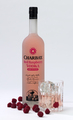
According to Jennie Meador, brand director for Finlandia’s roster of flavored vodkas, “This category has simply exploded over the past few years.  Today, it represents more than 20% of all vodka consumption, up three percent in only three years.  And with the introduction of products, like Wild Berry Fusion, I can’t see that trend slowing down.  We’re watching multiple markets, trying to mirror the sort of flavors that the public is after.”

If you’re a trend watcher, she appears to be right on the money.  Aquafina, for example, has released Wild Berry FlavorSplash water, Clinique Colour Surge Lipstick #21 is wild berry; Wildberry schnapps can be found on countless bar shelves, Skittles has whipped up wild berry candy and even Windex makes a berry-scented glass cleaner, which not be stored near the liquor cabinet if your bartender is near-sighted.

One of the charms of flavored vodkas is that it’s very Marxist.  It makes no class distinction, appealing equally to elite drinkers as well as to the young and the low-income restless. Carl Gerych, who has tended bar at The Lark Restaurant in West Bloomfield, Michigan, for more than twenty-five years, is amazed at the popularity of flavored vodka among the upscale crowd:  “Stoli Raspberry on the rocks is popular throughout the summer, and in the winter, we’ve got a big following for one of my cold-weather concoctions: mandarin orange vodka with orange pekoe tea.”

For Mephisto’s Pub mixologist Jenna Schaefer, who frequently caters to a goth and hipster clientele, flavored vodka mixed with a variety of fruit juices are the rage.  “But the younger group are starting to discover cocktails thanks to flavored vodkas.  I recently created a ‘bubblegum martini’ by mixing vanilla and raspberry vodka with a splash of Jones’ Blue Bubblegum soda—garnished (of course) with gumballs.”

At the same time, despite its 21st century appeal, flavored vodka has been popular for hundreds of years, basically since the spirit’s origin back in the 14th or 15th century.  That’s partly because unadulterated vodka is, by definition, both flavorless and colorless and is referred to in legal terms as a ‘neutral’ spirit.  In fact, U.S. government regulations require that vodka have “no distinctive character, aroma, taste, or color.”  The name ‘vodka’ itself is a Russian diminutive of that most neutral of drinks, ‘water’.

And of course, short of a quest for a quick buzz, drinking neutral spirits gets boring pretty quickly.  So traditionally, various fruits and herbs have been added to liven up the party.  In northern Europe, popular accessories have included fruits like apricot, black currant and cherry along with exotic eyebrow-raising infusions as horseradish, buffalo grass and St. John’s wort—which sound like they’d turn as many stomachs the night before as the morning after.

In days gone by, the United States was slow to hop on vodka’s bandwagon, due partly to the influence of the bomb-wielding.  It’s a safe bet that in 1945, not one adult American in a thousand had ever even tasted vodka; in 2009, you’d be hard pressed to find a thousand who haven’t.  Genuine acceptance of the stuff didn’t occur until the 1950’s, when a cocktail called the Moscow Mule (an odd blend of vodka, lime juice and ginger beer served in a copper mug) took the nation by storm, and became the most popular libation in a country both terrified and intrigued by the Soviet Union.

If you’ve ever tasted a Moscow Mule, the fact that anyone ever ordered a second one is a riddle wrapped in a mystery inside an enigma.

And in fact, the craze was short-lived.  Vodka had by then established a firm foothold with the drinking public, because unlike Stateside liquors (whiskey and it’s Kentucky cousin, bourbon), vodka was extremely versatile as a cocktail mixer.

Enter today’s crop of flavored vodkas.  Throughout the 1970’s, vodka’s commercial push was for distinctive brands, and names like Absolut, Stolichnaya and Smirnoff (whose Detroit distillery closed in 2000) became for-a-few-pennies-more ‘call drinks’ in bars throughout the country.

But, in searching for additional market share, producers began to experiment with flavor-infused vodkas.  Absolut released Peppar in 1986, which proved so popular as a bloody mary base that Absolut Citron followed almost immediately.  The other premium players saw the handwriting on the wall (and the bartender’s chalkboard), and today, the varieties available put Baskin-Robbins and Heinz to shame, with dozens of varieties  .

Says bartender Sasha LeClerc of Royal Oak’s Goodnight Gracie Cigar & Spirit,  “The popularity of martinis these days has really allowed us to experiment with drink recipes… We try to use all of the vodka flavors.”

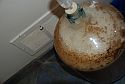
Her bar is dominated by a massive Dr. Frankenstein-like jar in which homemade pineapple vodka macerates and the drink menu features dozens of flavored vodka drinks including her favorite, the Clockwork Orange—a blend of orange flavored vodka, triple sec, sour mix and orange juice.  On the other side of town, Robusto’s in Grosse Pointe raises the bar (so to speak) on choices, with 185 martinis featured on the menu:  virtually all of them use flavored vodka as a base ingredient.

What’s next on the designer-vodka fashion plate?   Finlandia’s Jennie Meador promises big things: “When we look at what’s going on with current tastes, we connect with specific nuances in flavors.  Tastes are becoming more sophisticated.”

Van Gogh has released an espresso flavored vodka, which would have landed its namesake on his ear if he’d had one.  Hangar One does a wild raspberry that should be labeled Hangover Won.  There’s Cucumber by Crop (crap) and Pumpkin Pie by Modern Spirits, which takes the edge off another Detroit Lions loss on Thanksgiving.

Thanks to vodka’s chameleon-like attributes, almost anything goes.   Accordingly, with Asian flavors just now hitting store shelves, can chameleon-flavored vodka be far behind?

RECIPES:

WILD BERRY CAIPIROSKA (courtesy of Finlandia’s Jennie Meador)

 2 oz. wild berry vodka

2 oz. sweet and sour mix

4 fresh raspberries

4 fresh blueberries

2 fresh lime wedges

1 teaspoon sugar

Muddle berries and lime wedges with sugar in a short highball glass.  Fill glass with crushed ice and add wild berry vodka and sweet and sour mix.  Shake and pour back into glass.

 A CLOCKWORK ORANGE (courtesy Goodnite Gracie’s)

 2 oz. orange vodka

1 oz. triple sec

dash orange juice

crushed ice

powdered sugar (for glass rim)

slice of orange

Rim the glass with slice of orange, dip in powdered sugar.

Combine remaining ingredients in a cocktail shaker with crushed ice, gently shake and strain into cocktail glass.  Garnish with orange slice. Wear your jockstrap on the outside of your pants, listen to the glorious Ninth, and drink.

KEY LIME PIE  (courtesy Dearborn’s Double Olive)

2 oz. vanilla vodka

1 oz.  pineapple juice

splash of Rose’s Lime juice

Wedge of lime

Pour first three ingredients into a cocktail shaker half-filled with ice cubes. Shake well, and strain into a chilled cocktail glass. Garnish with a lime wedge.

RASPBERRY COSMOPOLITAN (courtesy of Royal Oak’s Goodnite Gracie) 

2 oz. raspberry flavored vodka

1 oz. Cointreau

1 oz. Rose’s lime juice

splash of cranberry juice

crushed ice

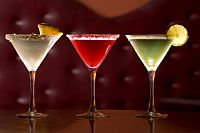
Combine the vodka, Cointreau, cranberry juice, lime juice and crushed ice in a cocktail shaker. Gently shake and strain into a cocktail glass. Garnish with a twist of lime.

Posted in Vodka | Leave a comment

Wine Writer Sends Woodson To The Woodshed,Or Is It The Other Way Around?

Number Two is Number One

What can I tell you about Charles Woodson that you don’t already know?

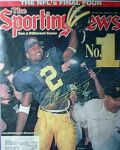
That in 1997 he joined Tom Harmon and Desmond Howard as the third U of M  player to win a Heisman Trophy, receiving more points that year than Peyton Manning?  You knew that.  How about,  that November, thanks to a 37-yard reception that resulted in Michigan’s only offensive touchdown of the game, the Wolverines beat the subhuman troglodytes of Ohio State.  And that in 1998, Woodson led the team to a national championship?

You knew all that, too, right?

And you also knew that there are no hard feelings in Detroit that he didn’t wind up wearing Honolulu Blue and Perennial Loser Silver.  We want better things for our Heisman heroes.  The Lions have sucked since the day I was born, and seeing Woodson reach new heights as an Oakland Raider and even as  a rival Green Bay Packer is a better alternative than watching his career implode like Barry Sanders or Charlie Rogers or [fill in the blank].

It’s like seeing your disadvantaged kid dodge a bullet and earn his PhD from MIT.

Anything else? Oh yeah, Charles Woodson owns a winery in Napa.  That, like me, you probably didn’t know.

And, I’m ashamed to admit that for a guy named Christian, my reaction to that news was decisively un-Christian.  To wit:

Hey, Poochie: Stick to gridirons and get the hell off my wine cloud.

If it’s physically possible to roll one’s eyes viscerally, I just did it.  Embarrassing, to say the least.  But seriously, introspection is good medicine.  Ergo: My refusal to embrace Charles Woodson as a winery owner while respecting him as an athlete comes from one of four personal character flaws.  1) Because I’m creatively provincial, and he’s a cornerback, not a vintner.  2) Because maybe I’m intrinsically a bigot: maybe I see him as an uppity black kid from Fremont, Ohio trying to play in the lily-white Napa major leagues. 3) Because I got no return call for the interview I’d hoped for and I’m behaving like a petty prick. 4) Something else entirely.

The Professor

Government Warning: (1) Wine writer is about to name-drop.

First, I have nothing against pro sports guys become pro wine guys.  In fact, I spent two weeks in Russia with former Red Wing Igor Larionov, drinking his wine along with countless other nefarious, mind-altering fluids.  I love The Professor’s wine portfolio  and have been raving about his Slap Shot Shiraz for years . And I don’t even like hockey that much—football, on the other hand, I love.  So, I move on.

Government Warning: (2) Wine writer is about to claim socially-responsible, magnanimous white-guy liberalism.

Maybe I do harbor some idiotic sense that wine has not really been accepted by the black community, and maybe that’s why I joined the African American Tasters Guild as (locally) the only white member.  Maybe I’m a guilt-ridden, closet-prejudiced peckerwood that overcompensates to atone for real and imagined racial sins. But in that case, the Woodson story would be right up my alley.  So, on I move.

Stupidest NFA rule ever…

Potentially, I got the no-call-back snub from the winery’s PR folks due to league rules.  In its inimitable wisdom, the NFA is preventing Woodson from endorsing the wine himself because of some weird alcohol policy.  So if I’m in a pique of peevishness over being ignored by promoters of a product I’m trying to promote, it’s likely none of Woodson’s doing.

And by the way, anti-alcohol-promotion NFL hypocrites: The worst thing about your Super Bowl are the endless, unfunny beer ads.

So it’s gotta be 4)…

Something about Lizzie McGuire making music videos rubs me the same kind of wrong, like Hilary Duff is saying, ‘Oh, singing is what I really wanted to do with my life, only in the meantime, Disney gave me a TV show because I’m just so hot.’  Musical careers parlayed out of acting careers are generally a waste of mental real estate for those of us subjected to the same via gym widescreens, mall muzak loops, or children who are such delinquents that they refuse to turn off the TV when Hilary comes on (unless Duff’s in the buff, which hasn’t happened yet).  Likewise, local-football-star-makes-really-really-good who buys a winery, then claims to be a sudden cabernet connoisseur doesn’t quite ring true—even though it probably is.  When said wannabe winemaker does not actually produce the product, but merely signs the bottle, expecting that somehow, it’s a value-add, I have issues.

Quote from Woodson: “TwentyFour is a wine of giving back and paying forward…” 

Giving?  Nobody at TwentyFour is giving anybody anything.  The wine costs $150 a bottle, and that’s if you’re willing to settle for a printed Woodson autograph—if you want a real one, the charge is $250 per.

Paying forward, maybe—I’ve now got a wine note to go with my monthly mortgage.

And the wine?  Old pal, wine shop owner and Michigan fan Jim Lufty allowed me to sample. It’s  sublime, and I’m not given to an ‘s’ word to describe many wines, unless it’s the one with four letters in it.  TwentyFour busts with power;  a rich, chocolate and cherry nose charges forward with multiple layers of sweet tannins,  multi-faceted mineral notes,  a firm juicy fruit backbone and a mocha finish that goes well into overtime.   If there was a Jim Thorpe award for cabernets, this one would be on the short list.

Of course, for that kind of cash, it had better be.

Charles and GustavoHow much wine could a Woodson sign if a Woodson could sign wine?

Remains to be seen; of the 2006 release of TwentyFour, winemaker Gustavo Gonzalez contended with a wet winter and a wetter spring and produced only 348 cases.  Woodson could John Hancock the whole vintage in an afternoon.

Don’t misunderstand:

In 1998, nobody on planet Earth deserved to raise that ‘We’re Number One’ finger more than Charles C. Woodson.  I just hope that in 2010, at a hundred fifty a pop for his latest triumph, he’s not raising a different finger at us recession-ravished Michigan dingalings who aren’t quite in his contract league.

Posted in Cab/Merlot, CALIFORNIA | Leave a comment

KAVA VS. CAVA

When it comes to enjoying life’s amenities—dancing to romancing, canoodling to cuisining, beach lounging to buzz-copping—the people of the South Pacific have a whole different frame of reference.

For Polynesians, kicking back and pounding a few may not refer to Jaeger bombs or Jell-O shots, and when they gather for a sedate, convivial and traditional confab it’s generally not over a flight of Napa cabernets.

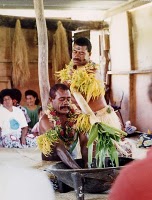
Instead, as they have for the past 3000 years, Pacific Islanders often gather to consume bowls of a strange psychotropic grog called kava. Produced from the roots of the piper methysticum (translated literally as ‘intoxicating pepper shrub’), kava contains psychoactive compounds called kavalactones that, when taken in moderate doses, produce a sense of well-being, a spacey sort of social ability and an overall loosening of inhibitions. Imbibers want to talk and often do so to the point of repetition, which may be why the drink is alternatively known as ‘kava kava’.

The Captain's goose gets cooked

In the years prior to Captain Cook’s arrival (late 1700’s), alcohol was virtually unknown through most of the atolls and archipelagos that make up the Pacific Island chain, and even today, very little of the hard stuff is actually produced there. Imports are pricey and other than the mashed-fruit  home-brew known as hopi, liquor tippling is a fairly new phenomenon in the South Pacific. It’s currently on the rise, especially among the younger crowd, but statistics support the idea that kava is still the chug of choice.  In Fiji, for example, 80% of men report having drunk kava within the past 30 days, whereas less than 40% of them report drinking alcohol within the past year—with 84%  of women claiming never to have tried so much as a sip of beer. In Kiribati, more than half the men and 93% of women call themselves teetotalers, with kava forming an  indispensible part of botaki celebrations—the cornerstone of their lives. Even in American Samoa, where there’s considerably more California dreamin’ going on, local preferences still weigh heavily in favor of the ritual root.

These stats also reveal a very old-world chauvinism behind kava consumption: kava is, by and large, a masculine game. Whether in social circles, religious rites or at kalapus (Tongan kava clubs), women are generally called upon to perform the labor-intensive kava preparation, but are rarely invited to join the subsequent guzzle-fest.

In years past, almost exclusively, this prep work was ‘out of the mouths of babes’ as sweet-breathed virgins were coerced to chew (yeah, chew) the fibrous kava root into soft pulp, which they then spat into palm fronds.  Captain Cook was said to have been utterly repulsed by the process—and this is a guy to whom salt pork and moldy hard tack were diet staples.

Though some islanders continue to employ méthode mastication  (human saliva is said to release more kavalactones from the root, resulting in a stronger drink) it’s safe to assume that commercially-available, powdered kava root is drool-free.

Meanwhile, back in Spain…

Nearly every cork dork has heard that the French monk Dom Perignon is credited with having popularized Champagne but few realize that the original charge of this eighteenth century cleric was to get rid of the bubbles, since they were seen as a flaw. His famous line, ‘I’m tasting the stars!’ (echoed by back-stage groupies ever since), gestated a whole new species of wine.

In the northeast of Spain, a similar product has been produced since 1872, when Josep Raventós Fatjó of the Codorníu  estate decided to give the French méthode champenoise a try. So favorably was his result received by the locals that he began to dig earthen cellars (‘cava’ is Spanish for cave) and produce more.

Today, Codorníu  is the world’s largest producer of bottle-fermented sparkling wine.

Like kava, wine has been a sacred and ritualized beverage for millennia; it’s the core of the Christian Eucharist and indispensible to the ordinance of Holy Communion. Catholicism in particular is filled with rites and dogma related to this tasty sacrament, and just as they do in kava klatches, the Church’s masculine hierarchy may close ranks when they imbibe it, especially on Sunday. Laymen may also close ranks when they imbibe it, especially on Superbowl Sunday.

The King of Tonga

Johnny Lunchbucket

KAVA VS. CAVA: Separated by thousands of miles of sea and soil, culture and convention, these homonymic intoxicants exist together in a sort of lockstep within mankind’s drive to chase away the blues of sobriety. These days, thanks to the internet, kava is as readily available to Johnny Lunchbucket from Peoria as it is to the King of Tonga. With cava,  vice versa.

So how do the two stack up? Compare?  Contrast? You the consumer must be the ultimate arbiter.

First, presume that the standard spreadsheet used in wine evaluation is out the window; kava would hardly survive the first three categories: clarity, color and aroma.

Typical notes of these first-impression characteristics might go like this:

Cava, Clarity: Crystal clear with a slight but bright flash of brass behind delicate, pinprick bubbles.

Kava Klarity might be closer to: Impenetrably opaque, lusterless and as fuliginous as freshly-pumped septic-field sewage.

Advantage, cava. On to color:

Cava, Color: Translucent pearly tones behind a fine lemony-gold backdrop, everything shimmering with effervescence.

Kava, Kolor: Dysentery-in-a-diaper dun fading to irritable-bowel-syndrome brown with flecks of dirty root fiber distributed throughout. The venerable bottoms-up, “ Here’s mud in your eye,” is far better suited to kava than cava.

Advantage, cava.

Next…? Ah, aroma, the  volatile and olfactometric hallmark of wine appreciation.

Cava: Nine months on the lees prior to degorging allows a creamy citrus bouquet to evolve; a rich hint of warm brioche emerges from Y5 yeast strains used in secondary fermentation.

Kava:  Smells like a big wet hole in the backyard.

Game, set, match; right?

Well, we haven’t gotten to taste yet.

Sump Pump

I think that even the most ardent kavo-fanatic will confess that as a beverage, kava ranks somewhere between sump-pump residue and flat, luke-warm root beer. Yet, lest they undersell, they’re quick to grandstand the first category in the cava/kava sip-off where the peppery Polynesian plonk might just have an edge: mouthfeel.

When you drink kava, a pair of kavalactones, kavain and dihydrokavain, cause the immediate contraction of blood vessels in your mouth and tongue, leading to a gum-numbing effect similar to that of a certain illegal Columbian alkaloid—at least as once described by my girlfriend’s cousin’s best friend’s aunt and not (your Honor) from personal experience.

Second, there’s effects. Not to downplay the loopy, goofy impairment of a wine high, kava’s buzz is much more cerebral.  Sloppy declarations of buddy-love are replaced by a sort of otherworldly sensitivity toward others. Depending on how much you drink, kava will leave you anesthetized and enveloped, swimming through a delicious sea of calm; you’ll experience a combination of mental alertness and a profound sense of bonhomie not unlike the effects of a certain rave pill as once described by a neighbor’s sister’s co-worker’s uncle.

Finally, we arrive at the one area where kava has such an edge that it nearly blows cava out of the fermenting vessel:  The morning after.

With wine, all those pejorative terms used with kava—toxic sludge, sewage effluent, stool samples—affix themselves to those brain cells not killed in the cava deluge and set up Camp Dysphoria inside your skull for most of the subsequent day. The only plus is that you’ve forgotten how big an ass you made of yourself while inebriated.

Kava will allow you to perform that craniotomy unaffected

With kava, the following morning will find you incontestably unaffected.  Run a marathon, perform a craniotomy, skydive from a weather balloon, no issue. Kava wears off in a few hours and leaves nothing behind but a rank odor in your coffee mug.

So in the end, it’s a tie.  No sudden death overtime. You choose; Polynesia vs. Poly-amnesia, Catalonia vs. Catatonia. Each has cultural precedence and a laudable history; each is capable, in its own unique fashion, of vaulting you far beyond the yawn of non-altered consciousness.

A KAVA/CAVA SAMPLER:

Codorníu Cava Brut Anna de Codorníu, Catalonia, n/v, around $13: Yeasty and refreshing, filled with medium sized bubbles and a full, apple-custard palate complimenting notes of honey and lemon.

Can Vandrell Cava Brut Reserva, Penedès, Spain, n/v, about $21: Pale gold with a nice corona; aromas of crianza including ripe pineapple, creamy citrus, lavender and a touch of anise.

Juve y Camps Cava Brut Rosé, Catalonia, n/v,  around $16: 100% pinot noir, this strawberry-pink sparkler offers whiffs of cherry, warm bread and rose petals.  Fine bubbles and a long, creamy finish.

Kona Kava Farm, Hawaii, about $15 (1/2 lb.): Called ‘Awa in Hawaiian, the root was very finely ground, making a homogenous chocolate-milk colored drink.  Creamy mouthfeel but with dandelion-green bitterness.

Nakamal At Home Tongan Kava, $19 (1/2 lb): Free shipping is the deal-sealer here; the kava is roughly shredded with shards of bark in it, but very potent. Smells of frankincense and that paste you used to eat in Kindergarten.

Kava Kauai, Vanuatu, $22 (1/2 lb.):  The photo of aging hippies on the web site says it all; strong, bitter, slight sassafras nose. Creeper kava, with effects similar to sitting in a hotbox inhaling, but not smoking.

Posted in GENERAL, Penedès | Leave a comment

A Bud By Any Other Name Would Smell Like Sweat

Name changes in California are as common as wildfires, killer bees and foreclosures, and most are done as savvy career moves.  Hence, Archibald Leach became Cary Grant, Issur Danielovitch Demsky became Kirk Douglas, Prince became ‘The Artist Formerly Known As Talented’ and Declan Aloysius McManus became Elvis Costello, which is actually not an improvement.

No surprise that wineries are getting into the act.

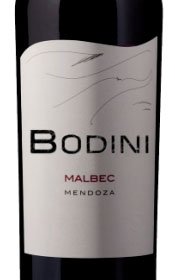
Thus, when Sausalito-based Vine Connection announced that they were renaming and rebranding Budini Wines, one expected an explanation that made sense; one that would fix something perceived to be broken and move the miniscule Argentine producer into a profit-saturated cash cow.

Alas.

The sole reason for the name change is because the first three letters of Budini are the same first three letter of a fairly well known brand of American beer.  Yes, gentle readers, this is a true story—I swear it upon the grave of every single evicted Californian or stung-to-death Left Coast Apis mellifera scutellata victim.  Apparently, the brain trust at Vine Connection saw inevitable confusions arising in the minds of hooch-seeking consumers and fully-preventable domestic squabbles erupting when Johnny Lunch bucket comes home from work to find that while shopping for his daily domestic twelve-pack, his wife has accidentally purchased a bottle of South American malbec—an easy enough mistake to make, granted.

To avoid such absent-minded folly, VC (no, not Vietcong, silly) opted to swap out the old name for an entirely new one.

Henceforth and in perpetuum ratus (Latin legalese), ‘Budini’ will be known as ‘Bodini’.

And, in what can only be termed a stroke of marketing genius, Vine Connection even turned the new name into an acronym:  ‘Built On Dreams of Individuals Not Institutions’.

So let’s talk individuals.  Remember how Johnny Carson used to reminisce about his first mail-order magician’s kit and how he used to play county fairs billed as ‘The Great Carsoni’?  Somehow, whereas Budini never made me think of Budweiser beer, Bodini immediately conjures up an image of my most influential childhood hero, my monochromatic mentor, Jethro Bodine.

Jethro was a helix short of Slinky, no doubt; a number of shots over intellect par, but he did not allow this, nor his sixth grade education, to stymie his ambition, horniness, arrogance or pomposity.  If you’ll recall, he finished secretarial school in a single day, was at various times a movie producer, a brain surgeon, a street car conductor and a double-naught spy, meanwhile nailing as many chicks as possible.

No doubt, the next time I sip a cereal bowl filled with Bodini malbec, I will be subliminally but irresistibly obligated to download all 274 episodes of The Beverly Hillbillies and watch them ad nauseum (more Latin legalese).

Vine Connection, I implore you.  Is this a good thing?

Not only that, but if this name-change thing catches fire—and fads, like rich people’s houses, tend to do so in California—you may soon see moniker-mutations in such popular wine brands as Pabst Blue Ribbini, Old Milwaukini, Miller Litini and The Great Coorsoni.

And that would require way too much thinking for us alcohol-addled wine critics who can barely keep track of the four or five bottles our profession requires us to swig per day.

I am suggesting to customer and retailer alike, fight back!  This is one trend that needs to be nipped in the Bud.


* In an odd but related news item, entomologists at U of C, Riverside have announced that they are changing the name ‘killer bees’ forthwith, because (you guessed it)  the word ‘bee’ might prove a conflict of interest with Budweiser, which also begins with a ‘b’.  Henceforth, these deadly, aggressive, quick-breeding flying furballs will be known as ‘Killer Goebel’s Draft-Style Lagers’, as this domain name has apparently opened up.

Posted in BEER, Malbec | 2 Comments

Why is This Michigan Red Singing the Blues?

The red wine grape that’s proving a breath of fresh air to windswept  Leelanau Peninsula has a big problem:

Not only have you never heard of it, once you have heard of it, you probably can’t pronounce it, and once you can pronounce it, you feel too silly to order it.

Imagine sidling up to the bar and asking for a  glass of blaufränkisch?  Or even worse, trying its alternate name, lembeger—indelibly associated with that bacteria-laden, evil-smelling cheese from Little Rascal reruns.

Meanwhile, this intriguing, late-ripening varietal smells perfectly splendid—like boysenberries, cherry jam and pumpkin pie spices.  It’s widely planted in Eastern Europe and traces its roots back to the Tenth Century.  In Leelanau, its pedigree is pure Twenty-

Adam Satchwell

First Century, and as far as I can tell, it’s only being produced commercially by two vineyards:  Circa Estate and Shady Lane Cellars.

Over a luscious, unctuous, viscous glass of the same, I discussed the name issue with Adam Satchwell, Shady Lane’s winemaker, and I was impressed with his simple solution:

 ‘Blue Franc’… 

Back in the Seventies, nobody except those with discerning palates or self-respect had any issue ordering ‘Blue Nun’, right?  Blue Franc has a tent in that particular cognomen camp—a cute, catchy name that doesn’t sound like it’s going to smell like Whoopi Goldberg’s toenails when you uncork it.

Unfortunately, it’s illegal.  Turns out that ‘Blue Franc’ was trademarked by Jed Steele, the renowned Lake County winemaker who honed his chops at Kendall-Jackson via production of one million cases per year.  He’s currently producing a yummy, jammy blaufränkisch under his own Shooting Star label and he calls it ‘Blue Franc’.
He’s got it, he’s gonna keep it, and you’ll get blue balls waiting for permission to use it. 

Such an immoveable slab of steele might have proven an insurmountable force except for one happy coincidence:

Jed Steele is Adam Satchwell’s uncle. 

Even so, there was considerable hemming and hawing and presumably, some Thanksgiving-Dinner-silent-treatments before Uncle Jed finally decided to allow his footstep-following nephew to use the precious Blue Franc moniker.  The fact that he finally gave in is testimonial to the fact that blood is thicker than wine, and that lemberger grapes by any other name still smell like Whoopi Goldberg’s boysenberries.

By the way, Uncle Jed:  Lawyers from U.S. Steel just called and from now on, you’re gonna have to call yourself Jed Iron Alloy With A Variable Carbon Content.

Which leaves Circa Estate holding the ‘blaufränkisch’ bag with a single hand…

Luckily, that hand belongs to Margaret Bell, Circa’s dynamic winemaker.  Together with her husband David, they shifted their souls from Chicago to Leelanau several years ago, and, being the last couple in Chicago that actually had souls, not a moment too soon,.  On an abandoned fifty-acre farm, the Bells have hand-carved a designation winery, a Napa North or a Tuscany Way, Way West, with state of the art equipment nestling behind a picture window and a picture-perfect view of the acreage outside the real one.

They’re currently producing five wines: a cab franc (jeez, Uncle Jed, is that one public domain?), a pinot grigio, a chardonnay, a hybrid blend called Improvisation and the 100% blaufränkisch which—ta-da—they’re calling ‘Requisite’  instead of blaufränkisch or Blue Franc or Blue Moon or Vida Blue.

The name works because the wine is indeed requisite for fans of spicy Michigan red wine with tamed acidity, and in fact, so is Shady Lane’s Blue Franc, but I won’t say it’s requisite for fear of lawsuits.

By the way, both go perfectly well with limburger cheese.

And by the other way, Uncle Jed:  those crazy lawyers just called back and Wilford Brimley wants his face back.


Tasting Notes:

Shady Lane Cellars ‘Blue Franc’, Leelanau Peninsula, 2008, about $22:  Evolved and expansive with a provocative cinnamon and blackberry scented nose; the mid-palate is soft and silky with pronounced acidity balanced by creamy tannins.   Characteristic spices range from black pepper to clove with some chocolate and toast in the background.

Circa Estate ‘Requisite’, Leelanau Peninsula, 2008, about $22: Brilliant ruby-red with a seductively perfumed bouquet of mulberry, cherry and pie spice; hints of American oak are restrained in favor of black fruits, especially brambly blackberry and Traverse City cherry.  The wine’s got a future, and is just beginning to take on secondary characteristics of cocoa and coffee.


Posted in Michigan | Leave a comment

Beer Making: So Easy, Even a Ten-Year-Old Can Do It

Call it a disclaimer, a de-limiter, a formal liability butt-coverer, but I really don’t advocate ten-year-olds drinking anything stronger than near-beer.  By which, of course, I mean nothing.

Beer making? That’s a different kettle of wort.

In our family, the ritual of beer brewing goes back generations, and I fully expect it to be passed along to the next.  The changing of sugars into alcohol is a living, breathing science experiment that’s gentle and fascinating, historically significant and results something that’s far more cool than a baking soda volcano.

Locally, I get my beer making supplies at Wine Barrel Plus in Livonia (734-522-WINE).  You can pick up the kit and kaboodle on line at www.winebarrel.com but then you wouldn’t get the chance to hobnob with knowledgeable owner Mark George who can steer you toward—or away from—the stuff you think you want.

For a first timer, that requires the outlay of some cash for the basic set-up, which will run around sixty dollars, including a glass carboy, air locks, siphon, tubing and a functional bottle capper.  If you have Mr. Science blood, you may want all kinds of geekometers to test temperature and specific gravity, etc., but if you proceed correctly, cleaning everything with diluted bleach (or preferably, sulpher-based sterilizer) and minding that your brew ferments and ages at room temp or cooler, you won’t need to track these details: Everything will work out in the end.

Ingredients to brew four gallons should run in the neighborhood of thirty more dollars; from that you’ll get about forty twelve ounce beers.  This will cover canned malt extract, powdered dried malt, hops (if your malt extract is un-hopped), brewer’s yeast, sulpher-based sterilizer, priming sugar (for the bubbles), bottle caps.  There are now as many beer styles available for home brewing as there are on the party store shelves, from stout to lambic to the weak Mexican stuff you have to put a lime in to make it drinkable.  To each his own.

Clearly, do-it-yourself brewing is not necessarily a cash saver, but then again, few fun hobbies are.  If you decide that this one is for you, you can learn to sprout and mash barley from scratch, grow your own hops, even produce a keg version complete with COcarbonation.

For the entry level brewer, here’s an easy step-by-step demonstrated by an ol’ underage brew master:

On brewing day, Julia likes to get up one half hour before God.

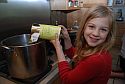
Everything to be used in the beer making process should be bathed in bleach solution (1 TBSP bleach to a gallon of water) and thoroughly rinsed.  Use commercial sterilizer if you prefer—I do, but it costs more.  Bring two gallons of water to a boil in your largest pot, then add one can of malt extract and one pound of dried malt.  For richer beer, add two pounds.  I’ve found that the ickiest home brew is usually the result of a too-dilute final product.  Keep everything well-stirred to avoid scorching.

If you are using un-hopped extract, add the dried hops.  Adjust heat to a low simmer for twenty minutes.  Cool to blood temperature and, using a funnel lined with a spaghetti strainer, pour your ‘wort’ into a sterilized glass carboy.  Top off with tap water to make about four gallons.  Experiment beforehand to find the four gallon mark if you are that retentive/challenged.  Add yeast.  At this point, if you want, you can add to the overall cost by stirring in yeast starter and water hardener (if you use soft water), but for a first-timer, the result of this will not be a blatant improvement.

Put on an air lock filled with sanitizer and place in a reasonably warm spot.  If it’s winter and you don’t live on the equator, try an area near a heat vent.  After twenty-four hours, you’ll see some fermentation begin, and after three days, the bubbling should be ferocious.  At that point, I move the carboy to a cooler spot in my basement, where it continues to ferment for about three weeks.

On bottling day, I run my bottles through the dishwasher minus the soap.  If you don’t have sufficient empty bottles left over from the weekend, most liquor stores will sell you empties for the price of the deposit.  Only thing, make sure they are spotlessly clean and residue free, or you’ll regret it when slimy alien cultures appear in the bottle.

Siphon the fermented beer into another carboy or a five gallon plastic Home Depot-style bucket (my preference).  Heat two or three cups of the beer over low heat with a cup of corn sugar (in a pinch, ordinary sugar should work) and stir into the siphoned beer.  This is to prime the stuff for the secondary fermentation inside the bottle which will carbonate the brew and give it the frothy head we’ve all come to love.

Using the same siphon set-up, fill each bottle to about an inch of the top.

Cap.  This takes a bit of practice, and remember, the more you spend on a capper, the easier this job becomes.

Fight off the devil for at least three weeks before you sample.  This allows ample time for the secondary fermentation to take place and mellows and marries the various beer flavors.  It will, in fact, continue to improve for months.  Of course, for Julia, the sample part is not an option.  A final accessory, a gag, can be found for no cost hanging in the closet.

In my case, the gag had an auxiliary use when Julia’s mother bought her a copy of ‘One Thousand And One Knock-Knock Jokes.’


NEXT:  Science Project:  Turning that old jalopy into a meth lab

Posted in BEER | Leave a comment

Barefoot Fetish: Bargain bubbles from a Bustling Babe

I didn’t even realize I had a foot fetish until I met Jennifer Wall, winemaker at Barefoot Bubbly.  It was a sober, professional, business-card-exchanging encounter at some tasting, and suddenly, the idea of shoeless Jen up to her kneecaps in a vat of squishy moscato grapes made my heart go all ragdoll.

Too much info?  I’ll stick to technical spec sheets forthwith—pinky-toe promise.

Muscat Love

Moscato—or muscat to those who prefer unlyrical, unpoetic, rodent-sounding grape names—is one of the most underappreciated varietals on the market.  And good thing, too—as a result, it tends to be inexpensive, and dollar for dollar, scent molecule for scent molecule,  flavonoid for flavonoid, the most seductive and aromatic wines you’ll unscrew, uncork or disgorge.  Pronounced perfumes of dried apricots and fresh peaches mingle with honeysuckle and orange peel, and on the palate, the flavors are luscious without being cloying.  Apparently, I’m not the first wine writer to so gush; muscat is the oldest known grape variety on the planet.  The Greeks wrote about it, the Romans drooled over it and it was the wine served at the funeral of King Midas, who was, apparently, not just some Disney character.

It’s also a grape that lends itself easily to a secondary fermentation, often the ‘Charmat’ bulk method, but occasionally the more labor intensive méthode champenoise.  Reputation-wise, Asti Spumante has been pretty much beaten up over the years, and a lot of this Piedmontese lowbrow chugger juice has been forgettable froth—but not all, and with tightened regulations, not lately.  There’s a presumption made by plenty of people that because a wine is simple and sweet, it’s flawed.

Naturally, these anal-retentive tools should get their noses out of the air and back inside the wine tulip where they belong.

Jen Wall’s version of Asti is called Barefoot Bubbly Moscato Spumante, which she unabashedly labels as ‘Champagne,’ despite convention which suggests that this hallowed term be reserved for wine from the region of Champagne only, as in France (and much of Europe), by law, it is.

But barefoot people defy convention, this is documented fact.  Huck Finn helped a slave escape from slavery—that wasn’t real conventional.  The Incredible Hulk (quite unconventional) did not wear shoes, not even sometimes.  Neither did Fred, Wilma, Barney or Betty, who might be conventional today, but were hardly conventional in one million BC.  Did I forget to mention Measha Brueggergosman?  Look her up, I have a column to write.  Suffice to say, all are famous, unconventional, barefoot historical figures who I am certain would call sparkling wine Champagne without a hiccup.

Anyway, Barefoot Bubbly Moscato Spumante showcases all the stone fruit and flowers  forecasted above, plus some nice, subtle spices—ginger especially.  It’s light and non-pretentious, slightly sweet and makes a lovely dessert wine, especially alongside fresh fruit.

Brut Force

Jen Wall’s stab at traditional Champagne flavors comes in the form of Brut Cuvée and Extra Dry, neither of which are made in the painfully time-consuming méthode champenoise, but rather in the bulk, stainless-steel-tanks-under-pressure method which can take as little as ninety days from harvest to bottle.  Some grapes—prosecco, for example, for whom the process was invented—benefit from this schema—but with chardonnay, from which the Extra Dry is made, better overall results are had using the old-school technique.  Charmat sparklers tend to produce larger, less-long-lasting bubbles which are not really integrated into the wine itself, and in fact, both Barefoot Brut and Extra Dry know from tiny bubbles only when Jen Wall cranks up Don Ho on the boom-box.

On the other hand (foot), these wines retail for around ten dollars, so if you’re expecting the moon, invest in NASA.  Extra Dry is slightly sweet—again with the unconvention—and Brut is dry.  Each shows reasonable acidity, some yeasty Granny Smith apple notes and an underscore of minerality to indicate that the fruit was chosen with some circumspection.  Whatever corners were trimmed to keep these bottles priced to move, it appears that grape quality was spared the financier’s axe.

So you wind up with wedding wine; sparklers you can buy in bulk and serve in quantity, and most folks won’t dress you down for not serving something pricier—it isn’t Andre Peach Passion ($5), it isn’t Minsk Sparkling Wine Factory Sovetskoye Zolotoye ($6 or 186 rubles), and the label has a playful logo of a bare footprint just above the equally playful assertion that the wine is actually Champagne.  Who’s the wiser?  The French?  They’re know-it-alls anyway.

Plus, with the cash you’ll save, you can afford an extra night in Antigua, an extra dip in the Aquatic Reflexologist’s Watsu pool, a down payment on that TT coupe.

Or God forbid, a pair of shoes.


Posted in CALIFORNIA | Leave a comment

Barefoot Wines For A Shoestring Budget

If you are barefoot right now, it’s for one of two reasons.

Either you’re an earth child who likes a sensual connection to terra firma and the return-to-roots freedom that casting off the trappings of civilization brings you, or you’re too poor to afford shoes.

Either way, have I got the wine for you.

Before I go there, let me say that in a Rorschach sort of free-association test, the notion of walking around barefoot brings to mind two people immediately: Mahatma Gandhi and Huck Finn.  One, of course is Hindu, prohibited from drinking wine and dead, and the other is not of legal age and fictional.

So, why recommend a white called Barefoot?  To which demographic am I pitching?

Suffice to say, wine people have a thing about feet.  It’s likely tied to the fact that genuine hand-crafted wine is made by foot: crushing grapes is the primal proletariat nexus, after all—mechanics are a commercial necessity, but like sending emails as opposed to actually having conversations, they’re not small-scale effective and a lot less cozy.

This foot fetish may be subconcious on the part of us wine people but it’s present nonetheless.

No? 

Consider Barefoot Cellars from California, Thousand Foot Pinot Noir from the Russian River, Left Foot Charley here in Michigan and Chateau Lafite in France.

Barefoot Cellars puts its best foot forward…

Thinking on my feet, I requested that winemaker Jennifer Wall to send me a picture of her bare feet to illustrate this piece, but after the above paragraph referencing fetishes, I’m sure the cops will show up at my door before the .jpegs.  As the accompanying photo indicates, she’s a leg up in the face department as well.  (The other shots depicts a barefoot me crushing garage syrah in the day when hair played a more prominent a lifestyle role than kids—the other is my daughter crushing syrah this past season).

Jen Wall’s winery tenure follows in the footsteps of Davis Bynum (big boots to fill), who introduced Barefoot in 1965 as a low-priced alternative to his premium line, which then as now you had to be pretty well-heeled to afford.

Barefoot developed a cult following—due in part to the kitchy footprint logo—soon outselling its pricer cousin.  Even so, Bynum decided the brand was out of step with his hoity-toity mission statement, and sold the winery in 1986.  Michael Houlihan and Bonnie Harvey jumped in with both feet, and in 1995, Wall got her own juice-stained foot in the door.  Since then, the brand has grown in volume and reputation; Barefoot Cellars has snagged more 2500 awards over the years and no, this is not a typo.  The winery is equally lauded for its charitable work with such barefoot-friendly causes as the Beach Rescue Project and the AVP—the Association of Volleyball Professions—a sport with which Californians are head over heels in love.

Price, however, is key to the Barefoot footprint…

At under $7 a bottle, nearly any expense account can foot a Barefoot bill.  For this nominal cash outlay you can expect a foot-loose, fancy-free patio wine; summery, simple, supple and occasionally sweet, something with which to kick up your heels.  None of the sixteen selections in Wall’s current catalogue can go toe to toe with pricier varietal, but the best—Barefoot Bubbly Brut Cuvée and sauvignon blanc for example—are hardly out of step with them.

Two factors allow this fancy pricing footwork:

First, the winery is owned by Gallo, and thus has prodigious buying power among the grape cartels.  Second, the wines are frequently released as ‘non-vintage’, where juice from lousy years (which for inexpensive wines often means excellent years, since that’s when grape prices go up) is blended with juice held back from value vintages.

Neither influence should give you cold feet: they’re not necessarily quality indicators, but merely a marketing strategy intended to keep the penury-pipeline filled with a sea of drinkable affordables.  In the end, Barefoot wines are reliable, viable and imminently buyable.

And, hey—if the shoe fits, wear it.

Tasting notes:

Barefoot Cellars Sauvignon Blanc, California, NV, about $7:  Cloudy Bay won’t be shaking in their boots over this one, but with it, me and Jen Wall got off on the right foot.  It’s crisp, unpretentious and contains enough citrus and grass to hint at how beguiling this varietal can be even in a basic incarnation.  Tickled with grapefruit, herb and zip, it’s well-made sauvignon blanc—bare boned as well as bare footed.

Barefoot Cellars Pinot Grigio, California, NV, about $7:  PG is as PG does, and Wall’s crisp, apple-tinged swallow is lucid and transparent; it offers entry-level whiffs of almond and cantaloupe with some mineral character in the finish.

Barefoot Cellars Moscato, California, NV, about $7:  A good white with which non-wine people can get their feet wet, so long as they don’t mind some sugar crystals around their ankles.  Honeydew and honeysuckle on the nose, peach on the palate and a quick stop; it’s modest moscato, but toes the varietal line. A nice offering when you’re invited to brunch—you may not be able to show up barefoot, but your wine can.

Posted in CALIFORNIA | Leave a comment

Back-To-School Wines

Worth every wad

According to Henry Wadsworth Longfellow, one of the most celebrated of the ‘Fireside Poets’ and among the first American whose works were genuinely considered to be on a par with the brilliant bards of Britain:

‘Sweet April! Many a thought is wedded unto thee’

Screw him.  And what kind of lame name is ‘Wadsworth’ anyway?

Among those of us who have evolved to greater plateaus of consciousness than ‘poetry’ and who have harnessed space, the winds, the tides and gravitation, September rules.

‘Sweet September. Many a pre-noon bottle of wine is drained because of thee.’

And I’m not talking about the merry bacchanalia that goes on around the crushing vat as the first truckloads of grapes come in from the vineyard—I’m talking about that most glorious of seasons when the whiney, bored, heat-stroked, ill-tempered children finally go back to school, thus freeing up the day for non-stop wine consumption without having to stop mid-swig to make somebody a grilled friggin cheese sandwich.

As such, I am making some recommendations for wines that can be enjoyed with equal pleasure from 7:21 AM to 2:46 PM—wines which pair well with bacon and eggs, Rice Krispies, Cash Cab reruns, Call of Duty: Black Ops on your son’s X-Box 360 which he has been hogging all summer, Three Stooges on Netflix, and all those naughty internet sites—you know how to find them, you rascal, you.

These are wines you should feel no need to share with friends, except possibly the hot single chick next door who comes home from the gym around noon; these are wines you can drink over ice and not have your wine buddies sniff and groan, and most importantly, these are wines which are affordably priced, meaning that they can be purchased in bulk without worrying too much about the bank balance.

Lips that touch liquor will never touch mine

School House Winery, ‘Prom Night’ Cabernet Sauvignon, Ohio, (NV), around $17: Wonder how hard is was for School House to trademark the name ‘Prom Night’ for a cabernet, since nobody who goes to proms is of legal age. Oh yeah, this is Ohio—no doubt the BATF locals were asleep at the wheel; that or there are plenty of 21-year-olds still in high school.  On the whole, ‘Prom Night’ is not a bad little red—a lot of folks don’t realize that Ohio was at one time the biggest wine producer in the USA.  On the other hand, ‘Prom Night’ is made from juice imported from Chile, and contains the expected black fruit and roasted coffee aromatics in somewhat muted doses.  Not sure if it is suitable for the prom—as I recall, my date responded pretty well to watermelon schnapps.

Burrell School Winery, ‘Teacher’s Pet’ Estate Chardonnay, Santa Cruz Mountains, 2007, around $20:  Remember when hooking up was known as ‘petting’?  And remember Miss Donahue from eighth grade remedial math…?  Some teachers may pet, but not this one.  But, already I digress.  Miss D and me never wound up on a beach in Puerto Vallarta, but this competent chardonnay contains enough tropical fruit—mango, pineapple and kiwi—that I can close my eyes, sip and imagine that we did.

Lazy Days Winery, Viognier, Virginia, 2009, about $18: I’m too lazy to review this wine.

Burrell School Winery, ‘Detention’ Zinfandel, Amador County, 2007, around $30:  Sweet detention! Many an extra hour of imbibing has been enjoyed because of thee.  So your kid’s a juvie—so were you and you turned out just fine.  And by ‘fine’, of course, I mean ‘perfectly dreadful’, but at least you can show up at PTA meetings with zinfandel on your breath and nobody is surprised.  Amador County is arguably zin central, thus this wine is worth the few extra pennies—and by ‘few’, of course, I mean ‘several thousand’—that you’ll pay compared to the other selections here.

Liberty School Winery, Chardonnay, Central Coast, 2009, about $12:  Liberty is right—for me, once I hear that short yellow bus pull away.  For twelve bucks, this wine is a bargain—soft, luscious, filled with Granny Smith apple and citrus notes—especially orange and lime.

Barossa Class, ‘Scholar’ Chardonnay, Barossa Valley, 2007, around $15: So named because the grapes are picked by students, who I hear come even cheaper than illegals.  Not that I am against using a little child labor—whatever it takes to keep a gem like ‘Scholar’—rated 90 by at least one source, and splendid with peach and pineapple and hazelnut—under $13.

Posted in GENERAL | Leave a comment