The Bluto Blutarsky Guide To Wine Appreciation

On the surface I have nothing against microwaved ramen noodles, downloading music illegally, wearing hoodies with school logos or any of the other inexplicably wacked-out things things that college kids do, but I see no reason why they should have all the fun while getting binge drunk.

For them, getting plastered means partying at a cool off-campus schwag-shack equipped with mattresses, porn posters, a mega-minibar, a combo pool table/air hockey/foosball table, an aquarium filled with dead guppies, a kegerator and a 103-inch flat-screen TV worth more than the entire block.

For me to cop a reasonable buzz, I must don the dreaded ‘business casual’, show up at a clip joint and spend twenty minutes acting like I dig people I’d rather smack with a Louisville Slugger, then listen to some self-absorbed, weird-accented vigneron yabber for an hour about ullage, soil structures, acetaldehydes, moustille and stuck fermentation. And finally—just as I’m thinking that the only thing in the world more depressing than this would be a tranny handjob in the Meatpacking District—I’m allowed to sample fifty pretty famous wines.

And for this privilege?  My only obligation is to spit it all out into a communal bucket and write down reams of notes.

Fortunately, over the years I’ve discovered that if you only spit half of it out and swallow the rest, nobody is the wiser.  And I assure you, my grasshopper, fifty half-glasses of wine is nothing to sneeze at.

Et voilà; je suis ivre.

But, Other Than Robbing A Liquor Store, Isn’t There An Easier Way?

Of course. If you can’t beat those dysfunctional Animal House dipsos, why not join ‘em?
I belong to several wine groups and we gather monthly to taste various varietals, vintages and viticultural regions. When I hold these tastings at my house, I encourage the group to gack into spittoons, because I don’t want to get sued when one of my guests plows into a minivan full of soccer tots on the drive home.  But, since we rotate locales, when we taste wine elsewhere, I’ve devised a few innovative games to make wine tasting more challenging, more exhilarating, more convivial and a whole lot less educational.

In other words, the full fit-shaced monty:

‘Jura Judge Judy’

Equipment Required:

  • Several cases of Domaine de L’Octavin ‘Cremant du Jura Blanc de Blanc, Arbois
  • DVD filled with Judge Judy episodes

Game Play:

While the maid opens the wine and fills several hundred tulips, have the butler put on the first episode of Judge Judy.  Then:

  • Take a drink if Judge Judy says something so blatantly anti-male that you assume the only reason she hasn’t been debarred is because the court needs more lesbians.
  • Take a drink and scream, “Hints of hazelnut and morello cherry over a light pettilance with a toasty brioche finish” every time some dead-beat boyfriend sues and wins against his smokin’ hot, apple-assed girlfriend.
  • Take a drink every time a negro defendant adjusts his package.
  • Take two drinks if a negro defendant and Burt adjust their packages at the same time.
  • Take a drink every time Judge Judy inadvertently slips in a Yiddish invective like ‘lechen mein loche’ or ‘kish mein touchess’.
  • Finish all the wine every time a plaintiff, upon being told to stop chewing gum, gets so pissed that he leaps over the bar and beats Judge Judy to death with her own gavel.


‘Up The Loire River, Down The Rhône’

Equipment Required:

  • Plenty of Domaine de Bellivière Coteaux du Loir ‘Hommage à Louis Derré’ 2004 and Cuilleron Condrieu La Petite Côte 2004, with a back-up bottle or two of  Vidal-Fleury Muscat de Beaumes de Venise 2000 in case things really get rockin’!
  • A deck of cards.

Game Play:

Preparation for this game is half the fun!
Herge people

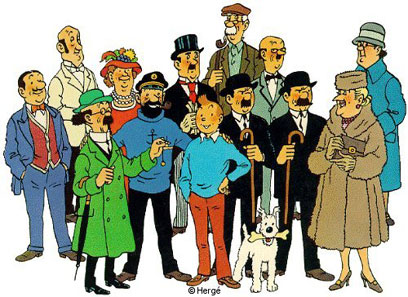
Every wine group has at least one pompous asshole as a member who looks like something out a Herge cartoon, whose clothes are basically a cry for help and who the rest of the gang secretly wishes would contract leprosy and die.

This is the geeterhead you leave out of the all-important ‘pre-game’ meeting.  First, you stack the deck, because it is important that the Mayor of New Dork lose the opening round, which, unbeknownst to him, will be the only round you play.

Let’s get started!

  • Choose a dealer, making sure it’s not the intended victim, then deal out one card, face down, to each of the group.  When the cards are revealed, everybody looks in horror at Dr. Dingledouche and says, in unison, “You lose!”
  • Penalty for losing, it’s revealed, is to take the rest of the deck  and go around the neighborhood trying to sneak a card inside each house without anyone waking up.
  • As the remaining wine group waits for the alarms, shotgun blasts and police sirens, they sit around guzzling and chortling—confident that their nemesis, Herr Dweebmeister, will be going ‘Up The River’ for a long time… and it ain’t gonna be the Loire.

‘Nebbiolo Ebola Bowl, or Name That Disease’

I belong to one tasting group where, of eight members, I’m the only one without an advanced medical degree.  I’m also the only one who knows shit about wine.

Doctors love to buy expensive wine, mostly because it shows that they can afford it; but in truth, beyond being able to name a few window dressers and a handful of top vintages, they’re pretty much in the wine world’s Special Olympics.  Which is the only reason they allowed me into the group: As a reality check in case somebody raises a really tough wine question.  Of course, that’s simultaneously insulting and flattering, but my own personal, nasty little secret is that doctors intimidate me almost as much as intelligent women.

So, for this group specifically, I designed the Nebbiolo Ebola Bowl.

Equipment Required:
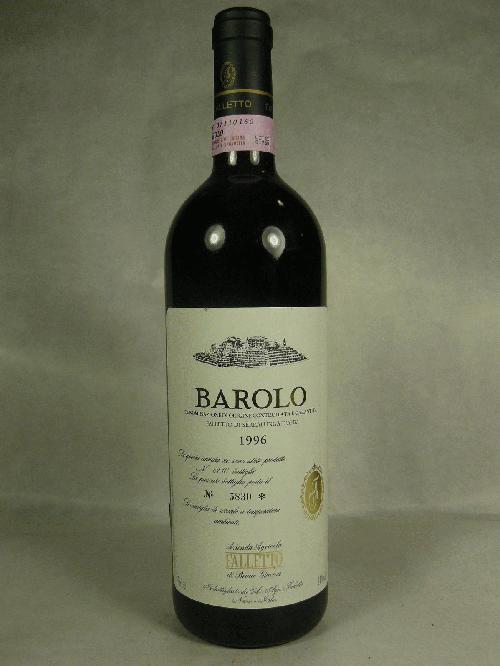
  • Boatloads of Bruno Giacosa Barolo ‘Falletto’ 1996, Pio Cesare Barbaresco 2001, Antoniolo Gattinara Osso San Grato 2007 and anything else I can convince these megalomaniacal Mengeles to drag up from their multimillion dollar wine cellars.
  • A television with a DVD player.

Game Play:
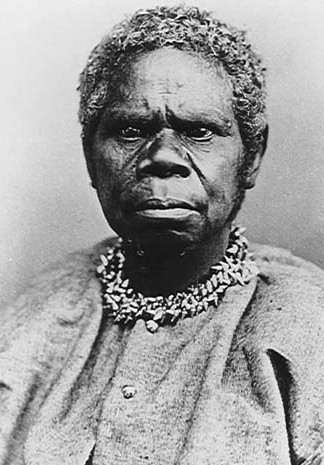
Over the years I have collected some rather ‘sick’ (pun intended) videos showing thousands of dying, disease-ridden losers from tiny villages in countries so remote that slavery is still legal.

  • I have the illegal-immigrant servants slip this disc into the DVD player—(as a side note, did you know that DVD stands for Dissociated Vertical Deviation, which sounds very disease-like in itself)—and then set up the wine.
  • As each tortured and moribund savage comes on the screen, the doctors loudly shout out what epidemic they think he or she has contracted.  Whoever replies first with the correct answer gets to drink.
  • Every once in a while, I shout out my guess, which is always “Ebola!” and the doctors greet my lame misdiagnosis with a condescending snort as if I am their court jester or grinder monkey.
  • Continue until all the wine is gone, or all the doctors are dead, since in truth, prior to the game I have burglarized the Centers for Disease Control and Prevention in Druid Hills, Georgia and stolen actual endothelial Zaire ebola virus cells, which I’ve placed in each doctor’s wine glass.

As it happens: Good career move.  I can reform the group with a bevy of hot, non-threatening and unintelligent women (who also look to me as a sort of wine swami), and now, I can accurately identify the clinical signs of terminal ebola infection.

Posted in GENERAL | Tagged , | Leave a comment

Bonga Is Bonkers, But That Doesn’t Degrade Cascade

Bonga is bonkers, for sure.

I can say that because I consider myself a pretty serious runner—I do a minimum of five miles a day, at 5 AM, 365 days a year (right, I took yesterday off: God’s gift to shin-splints comes but once in four years). And I know that the sight of me slip-sliding through pre-dawn blizzards must cause a lot of eye-rolling among passing motorists.

Eye-rolling comes from the winemaker at Cascade Winery too, but for different reasons.  Roger Bonga thinks I’m a wussy.

Roger once ran a marathon with these strapped to his back.

The 36-year-old, 35-time triathlon participant (35 triathlons is not a misprint) considers these mind-boggling tests of athletic prowess to be tough, but hardly the pinnacle of insanity.  At the outset of our interview, I asked him what was the craziest event he’s ever run.  Turns out it’s The Western States Endurance Run, between Squaw Valley, California and Auburn, California: A hundred mile run where the temperature frequently exceeds 100 degrees.

Not sure about you, but I whine about driving a hundred miles in that kind of heat.  Although, in fairness, this was a trail run, so Roger didn’t have to deal with any mocking motorists like I do.

The wuss.

A Second Successful Run: Cascade Winery

Somehow, between all that running, biking and swimming, Bonga managed to become an equally bonkers winemaker.  The dude produces jalapeño wine for the love of God—so potent that slugging a bottle makes the WS 100 run feel like the fifty yard dash—he wears a gas mask while making it.

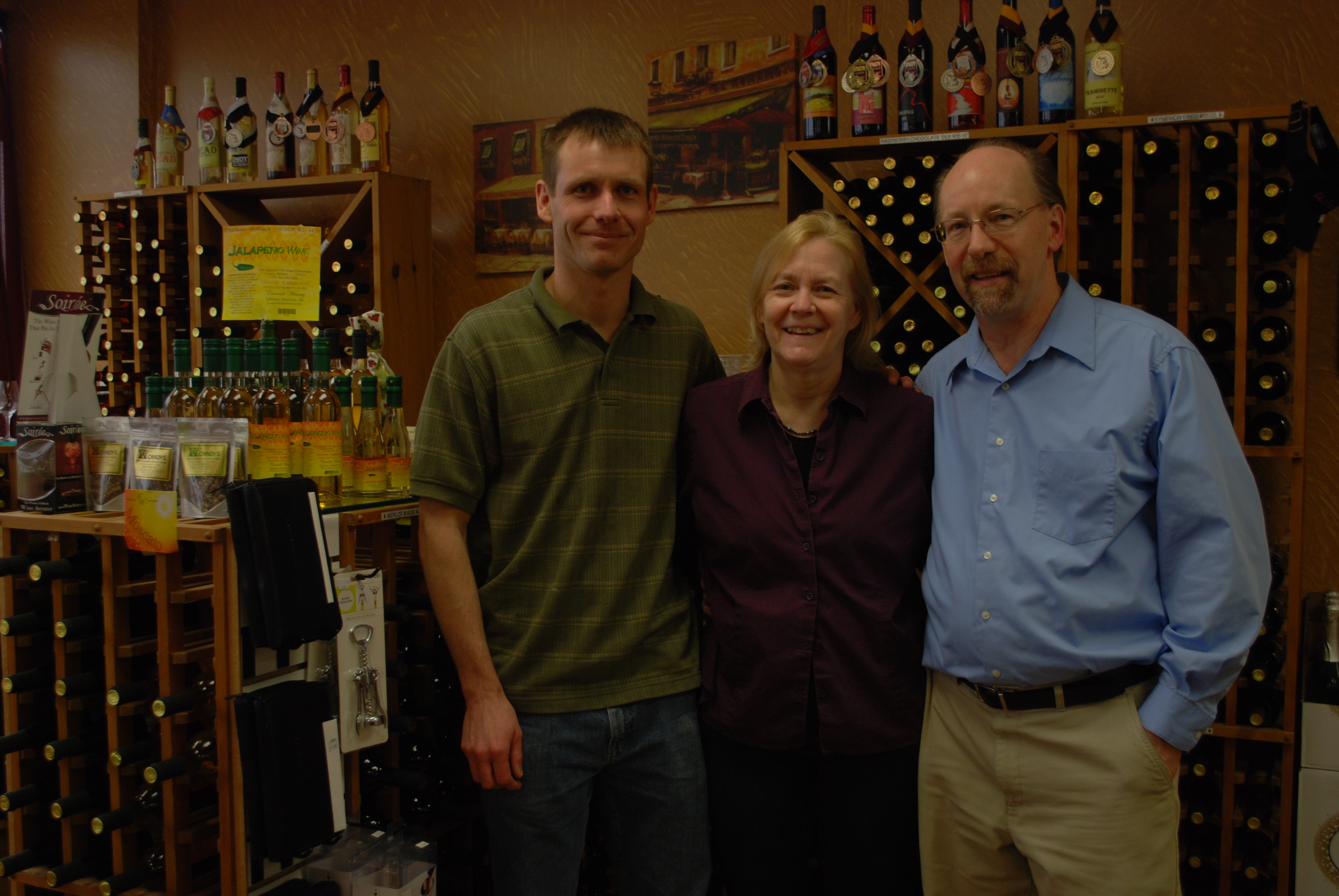
Roger, Rose and Bob

Cascade Winery is a 2500 case annual operation run out of an industrial park building on the outskirts of Grand Rapids.  Opened nine years ago by Roger’s parents, Bob and Rose Bonga, their mission statement, then as now, (other than to turn a basement hobby into a career-founding business) is to produce purely Michigan wines.

And they’re close.

“The legal standard for using the appellation ‘Michigan’ on the label is that 80% of the grapes have to be from our state,” says Roger.  “Here at Cascade, we use a minimum of 90% Michigan, and our merlot, along with all of our whites, are made from 100% Michigan fruit.”

Speaking of Michigan fruit, to kick off his portfolio, his collection of fruit wines is impressive; there’s nine of them, including a luscious, ruby red Michigan cranberry wine—a type of produce that most Michigan locovores didn’t even know we grew.  Personally, I happen to be a sucker for fruit wine, and as far as I’m concerned, nobody does it better than Mitten makers.  Roger’s pear is peachy and his peach would pair perfectly with pear torte.  I’d suggest that his apple wine is the apple of my high, but then you’d just roll your eyes at another stupid joke.

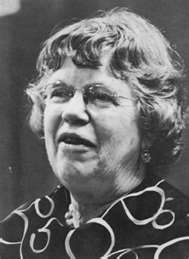
Lips that touch Maggie's will never touch mine.

And then there’s the mead.  Most folks would sooner put Margaret Mead near their lips than honey mead, but they should give Roger’s Orange Spice and Wild Black Raspberry meads a shot. Both are softly complicated wines, redolent with sweet summer fruit and honey.  Currently, he’s trying to find a source for honey made from buckwheat flowers, too (and call it, perhaps, ‘Honey Bunches of Oat’?), but that—like the company’s expansion—is something he and his folks are looking for down the road.

Roger also makes  something called Raspberry Chocolate Silk wine that’s to curl up and die over, and by golly, there’s that crazy jalapeño wine—guaranteed to grow hair on your eyelids.

*

Tasting Notes:

The following notes pertain to but a few of Bonga’s huge roster of traditional grape wines.  If there’s a single common denominator that runs through nearly all of  them—a quality that genuinely surprised me—it’s the fact that most display sensational aromatics.  Something that I assure you, not all Michigan wines do.

Cascade Winery, Traminette, Michigan, 2010, around $14:  A cross between Joannes Seyve and gewurtztraminer, traminette is a hardy, cold-weather white that’s both vigorous and productive, but (in my opinion) rarely produces wine of any great distinction.  This one is an exception, favoring a dynamic, unmistakable gewurtz profile: Lychee, orange blossom and lime.

Cascade Winery, Riesling, Michigan, 2009, around $11: A fine fusion of delicacy and depth, this lightly sweet wine shows pine and petrol on the nose, citrus flavors and a nice wet Petoskey stone (inside joke) finish.

Cascade Winery, Delaware, Michigan, 2009, around $12:  An underrated varietal among snoots, real wine people appreciate that native American delaware can produce rich, cherry-cast gems saturated with wild strawberry and alluring floral overtones, and very little of the characteristic Labrusca ‘foxiness’.  This one, from grapes grown in Coloma, Michigan, has everything that classic Missouri delawares have.

Cascade Winery, Cabernet Franc, Michigan, 2008, around $12:  I’ve always been at odds with wine critics that insisted that in Michigan ,‘our’ grape is riesling.  I’ve yet to taste one that truly blew me out of the tub.  Cab franc?  Now we’re whistling 21st Century Breakdown.  For the price, Bonga’s cab franc is nearly impossible to beat: Bricky in color, juicy with plum, chocolate and liquid licorice, it shows a distinctly Midwest profile; slight bell-pepper acidity that I happen to prefer over some of the overripe California examples.

Cascade Winery, Sangiovese/Merlot, Michigan, NV, around $16:  At sixteen bucks, this is Bonga’s priciest pick, and I think it’s his best.  Fully ripe, and showing equal allegiance to both varietals, it boasts savory smells of Montmorency cherry, Damson plum, and is packed with red-fruit flavors and a distinct mahogany finish.

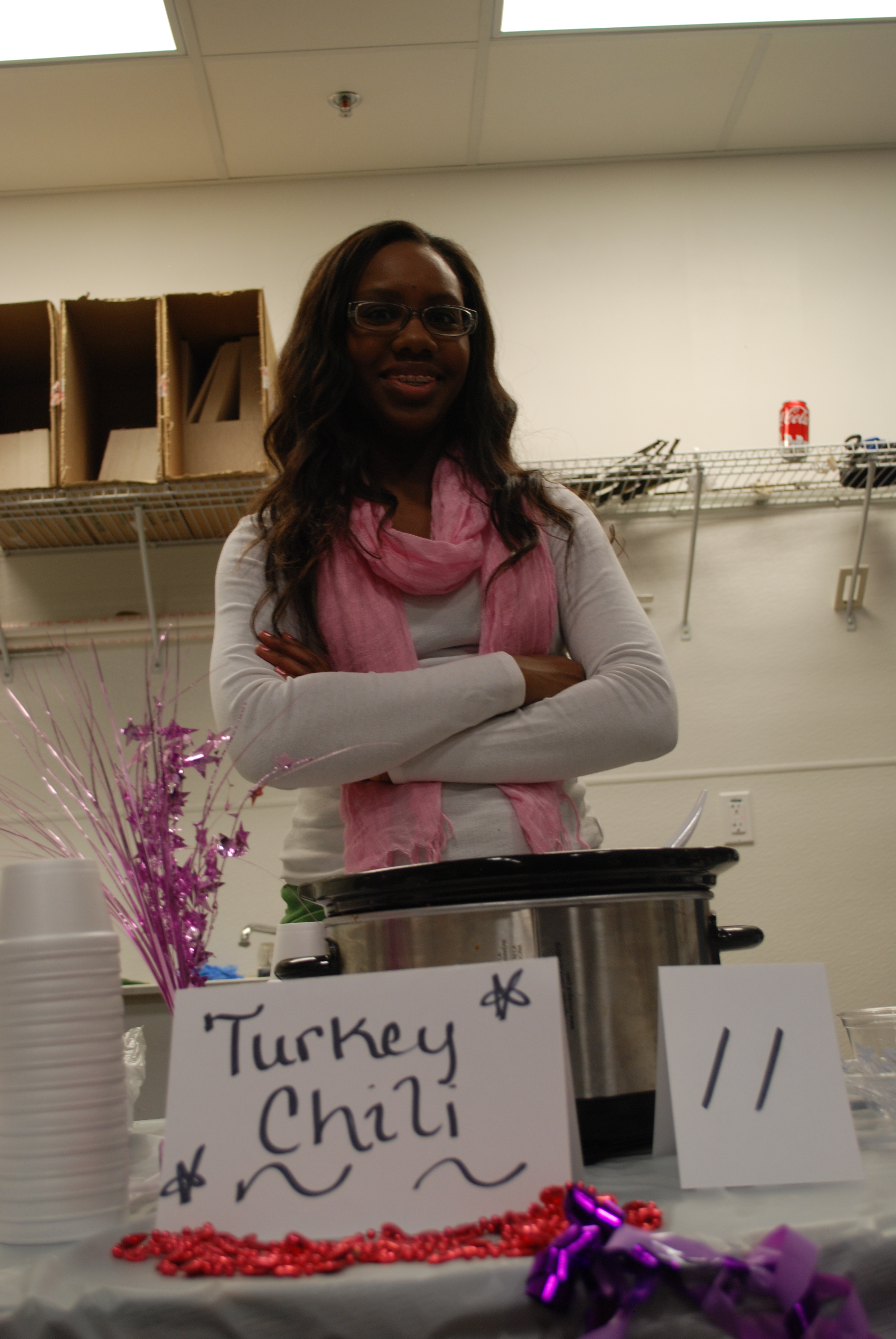
Kidding about the chili cook-off. Kira Washington was one of the winners.

*

Running into Roger was a treat, as was tasting his wares—but a sad wake-up call to me that I’m far better at running my mouth that at running races.

And, in fact, he ultimately excused himself to ‘go to a chili cook-off’, to which I rolled my eyes and figured, ‘Su-u-u-re’.  After some of the questions I peppered him with, wherever the heck he actually went, I’m sure he’s still running hard.

http://cascadecellars.com/

Posted in Michigan, MIDWEST | Tagged , , , | Leave a comment

Destroy All Monsters: ‘Hell, No, I Won’t Go! I Won’t Die For Mon-San-To!’

They’ll be hungry in Hungary if this keeps up.

The landlocked land of the Legényes (Dracula’s favorite dance) has taken the biotech bull by the horns and, in a start-up campaign to bleed Monsanto dry, has boldly ploughed under more than a thousand acres of GMO corn.  The rest of Europe is not expected to follow suit because they have no use for the plethora of bull’s blood that resulted—Hungary, of course, used it to make Egri Bikavér.

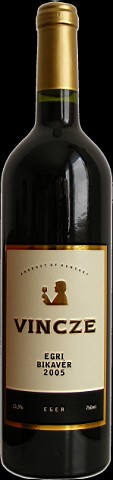
Meaning ‘Bull’s Blood of Eger (a city in Northern Hungary), the famous wine is actually hemoglobin-free, and made (like Châteauneuf-du-Pape) from a blend of up to 13 grapes.  Some of these are familiar to New Worlders (pinot noir, syrah, cabernet sauvignon) while some are very Eastern European: Kadarka, kékfrankos, bíborkadarka and kékoportó.  The wine is a testosterone-laden bombshell, rich with black fruits and troglodytic tannins, often aggressively acidic and generally, worthy of its name.

Monsanto, meanwhile, was named for the father-in-law of the founder and from the outset produced far more bullshit than bull’s blood.  Imagine sporting a Monsanto business card and giving prospective clients a rundown of your company’s product history: Saccharine (linked to bladder cancer in lab rats), sulphuric acid (used by Jeffrey Dahmer to dissolve murder victims), DDT (a cause of diabetes), Agent Orange (linked to birth defects in Vietcong children and other living things), PCB (causes liver damage), Bt Cotton (every 30 minutes, an Indian farmer commits suicide due to debts caused by this product not producing as promised—this is not a typo.)

And This Isn’t Even What’s Pissing The Hunkies Off 

Hungary is one of six EU nations to have banned genetically modified seeds, and the Orwellian-sounding Deputy State Secretary of the Ministry of Rural Development apparently stumbled across some no-no’s grow-growing during a random corn check. Corn checks are the Magyar equivalent of DUI roadblocks, although the Ministry of Rural Intoxication has those too in order to make sure that the citizens are blasted on Egri Bikavér and not Sangre de Toro, since it’s the only thing the country produces beside goulash and Gabors.

Oh, and they grow corn.  Unmodified corn, thanks to the jackbooted government corndogs, even though maize itself is genetically modified grass, and even though the European Commission Directorate-General for Research and Innovation reported in 2010: “The main conclusion to be drawn from the efforts of more than 130 research projects covering a period of more than 25 years of research and involving more than 500 independent research groups, is that GMOs are not more risky than conventional plant breeding technologies.”

Or, in streetspeak:  ‘Safe’.

L.: Dr. Mercola. R.: Dr. Acula

Don’t get me wrong, I’m not waving Monsanto’s gonfalon, and no, I don’t have a business card with my name and theirs in flagrante delicto.  I am, however, amused that groups who generally support small farmers are heralding the systematic destruction of their fields by Big Brother as some sort of bold Slavic stance against juggernaut technology.  Planetsave, for example, chuckles, ‘This looks like it’s going to be another slap in the face for Monsanto.’ (http://s.tt/12TaC), while the self-described ‘health guru’ Dr. Mercola—utterly missing the point that the fields were ravaged not because the GM corn was a health hazard, but because the seeds were illegal—snits, ‘Should be a major wake-up call to anyone in the United States and elsewhere who believes GM crops are harmless.’  (mercola.com).

What they fail to mention is that when the Hungarian crops were destroyed, it was too late in the season to replant, and that the compensation the farmers would normally be paid for the government’s pillagery will instead go to the creditors of the seed company that sold them the GM corn to begin with—apparently without informing them what it was—because the company is in bankruptcy.  So, the final score is Hungarian Ecofriendly P.R., 1 and Hungarian Peasants, 0. 

Monsanto, of course, won’t be affected since the seeds had already been paid for, and it shouldn’t hurt future sales much since they’re illegal anyway.

L.: Françoistein. R.: Hungarian peasants.

And what about the February 13, 2012 court ruling holding Monsanto liable for neurological damage caused to French farmer Paul François after he breathed Lasso herbicide while cleaning equipment—even though the warning label clearly states that a multitude of health risks have been associated with inhaling the crap?

Personally, I question the competence of Monsanto’s lawyers.  I mean, how do you lose a case to someone whose main symptom is memory loss?  Isn’t your opening statement, “Mr. François, are you sure that you did not know perfectly well the risks in using this product and have simply forgotten that you did??”

Pineau de Charentes

Anyway, Paully Frank claims total disability and intends to retire at age 47 on Monsanto’s nickel.  Bully for him—he’s from Charente in Western France, home to the lovely intoxicant Pineau des Charentes, a sweet, non-sanguineous mistelle made by blending lightly fermented wine with Cognac and aged for a minimum of 18 months.  Pineau production sounds like an ideal second career for the memory-challenged bumpkin since legend insists that the apéritif was invented by a winemaker who accidentally added grape must to a barrel into which he’d forgotten that he had already poured Cognac.

One hopes that François will find a different location to store his bull’s blood.

Posted in HUNGARY | Tagged , , , | Leave a comment

‘A Cask Of Amontillado’ For My Funky Valentine

Thinking pink?  Or, red instead?  The usual Valentine wine line?

This year, consider considering outside the Whitman Sampler® box.

The 'It Couple' of 1975

Of course, most columns written about this over-written-about subject will lean toward recommending wines that pair well with chocolate, and not just because of Ogden Nash’s old saw about ‘candy is dandy, liquor is quicker, but roofies are goofy’: There’s genuine chemistry behind every magical union, from Adam and Eve to Tammy Faye and Jimmy to John Hinckley and Jodie Foster—and when it comes to food and wine, chocolate finds its soulmate as readily as chicken.

The version labeled semi-sweet, with less sugar and more cocoa butter than sweet chocolate, is known in France as couverture  but this isn’t the holiday to go halves on anything.   Should you make an overture after giving her couverture, I guarantee the chocolate won’t be the only thing that missing some sugar.  However, if you figure out how to get beyond that, a lovely foil with semi-sweet chocolate is an unusual fortified apéritif from the AOC Banyuls—a tiny French region bordering Spain in the Catalan Pyrenees.  Banyuls is Port-sweet, but not as high in alcohol, typically topping out at around 16% ABV.  Made from blend of some, but not necessarily all, grenache noir, grenache gris, grenache blanc and carignan, Banyuls is plump and dulcet with chocolatey notes spun with candied cherries and a nice dose of nuttiness—which she will have to share if she’s giving up anything after you gave her cooking chocolate.

Milk chocolate, a nineteenth century Swiss innovation, owes its richness in part to milk solids and milk fats, which may be in higher percentages than chocolate, especially in the United States, where only 10% of the product is required to be chocolate ‘liquor’—the by-product of fermented, crushed and roasted cacao seeds.  Milder, fattier-tasting and sweeter than couverture,  this is a good spot to wedge in a sparkling wine.  Banfi’s Rosa Regale (around $16) is a rare, rich red; redolent of roses and raspberries, it’s made from the Piedmont grape brachetto and shows both sugar and acid to compliment the creaminess of the chocolate.

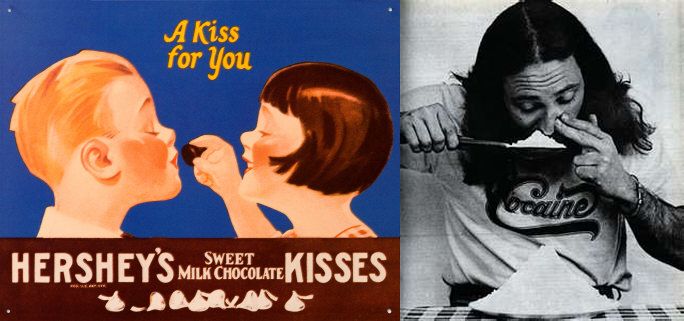
Dark chocolate is the bean dreamer’s most concentrated fantasy, with FDA legal minimums set at 18% cocoa butter, 14% fat-free cocoa and 35% cocoa solids, making it the crack of confections—to a Hershey Kiss what mainlining pharmaceutical-grade cocaine is to a cup of decaf.  It requires a wine of sufficient gusto to match.  Popular palaver proposes that the high tannin in a young, robust zinfandel or malbec brings out chocolate’s subtle fruit notes, but personally, I’m not a major fan of pitting super-dry red wines against super-rich chocolates.  Still, on the chemical pallet, the unctuous cocoa butter cuts through the parch in the same way that the marbling on a steak does; my issue is the sweetness.  I prefer to perch a puissant Port beside a truly decadent chocolate-based dessert; something in the special occasion range like Warre’s Vintage, 2007, an elegant, velvety Port that at $60 is about the same price-per-pound as that Lismore-footed dish of Pierre Marcolini Truffe Brésilienne—praline-dressed ganache wrapped in caramelized almonds.

Telling Little White Truths

After all is said, I’m guilty-pleasure sucker for mellow, buttery white chocolate.  As a kid, we always wound up with white bunnies in the Easter basket, and white seems a color more suited to the approach-of-spring—even now, in mid-February.  I’ve found that chocoholics divide into camps, with purists sniffing at the notion that ‘white’ and ‘chocolate’ can be uttered in the same sentence without committing blasphemy.  I’m convinced, though, that what they’re sniffing at ain’t an albino Amedei Bar Toscano Bianco.

“I have a dream that I will one day live in a nation where chocolate is not judged by the color of it solids but by the content of its cocoa butter.”

Such anti-white reverse racism likely stems from the USDA’s former definition of white chocolate which claimed that it wasn’t even ‘chocolate’ since it contained no cocoa—sort of duh considering that if it did, it wouldn’t be white.  This troglodyte characterization also ignored an inconvenient truth: That white chocolate contains more cocoa butter than any other chocolate category, as well as a minimum of 20% cocoa fat that is not required for its darker-skinned brothers.  Probably the only reason that us white supremacists did not march on Washington in 1963 to demand equality in Chocolate Rights is that, unlike couverture,  white chocolate does not contain any of psychoactive stimulants like theobromine or caffeine that would have gotten us off our lazy asses.  Our emancipation day came in 2003, when the USDA finally forced our integration into the College of Chocolatology.

And I’m all over a wine pairing like white on rice… and not saké.  Probably the best achromatic chocolate on the market is again from the Brussels chocolatier Pierre Marcolini:  Truffe Champagne made from creamy Champagne ganache and dusted with confectioner’s sugar, and selling for around $9 per ounce, and is perfectly comfortable mating with a 1995 Fleury Doux Champagne, selling for around $3 per ounce.

Pedro Ximénez, that is.

But this pairing is champagne/champagne specific—with most white chocolate, my favorite paramour is a demi-sec Pedro Ximénez grape-based Amontillado.  Any sherry primer can fill you in on the basics, such as https://intoxreport.com/2011/08/25/339/ but the Cliff’s note version of Amontillado is that it is a complex, aged sherry fortified after moving through the first solera, then further aged and oxidized in a second solera. As a result it has a much deeper color than fino sherry, but is not as dark as an oloroso.  Its rich, nutty, buttery dried-fruit nummy-numminess is a wonderful balance to white chocolate.

In popular conception, of course, this luscious liquid is most associated with that spooky short story about the jester in the dungeon—so, in honor of the master, the sherry, Valentine’s Day and my precious first wife, who I haven’t seen since around 1998, I have written a tribute poem to Edgar Allen Poe and The Cask of Amontillado.

My Funky Valentine,  By Montresor Kassel

I couldn’t stand that clown at all,

So I sealed her in the wall.

Now, because her corpse grows rotten,

She is gone, but not forgotten.

In pace requiescat!

Posted in GENERAL, PAIRING WINE AND FOOD | Tagged , , | Leave a comment

Satan’s Vodka: Was Reagan Right About ‘The Evil Empire’?

Real men don’t drink vodka.

How do I know this?  Primarily from the score.  Cold War = We won.  Communism vs. Capitalism = We won.  Space Race = We won.  Any James Bond novel = We won.

I know, James Bond did drink the occasional Vesper containing vodka, but 007 wasn’t really American, and his Socialist slip tended to show when he was trying to diddle distressed damsels.

‘Wipe your forehead, Your Excellency. The pigeons are relentless.’

Back at the Rancho del Cielo, President Reagan’s favorite grog was scotch, followed closely by gin and orange juice, which is (granted) sort of a girly drink, but suffice it to say there was no Stoli on his wetbar.  And note that when the great Chivas-chugging Ronaldus Magnus told Gorbachev to ‘tear down this wall’, he did not use any metrosexual obligeries like ‘please’.

And what did Birth-Mark-Head do?  He tore the sucker down and drowned his sorrow in multiple Moscow Mules.

Yuri Gagarin in a prototype space helmet

Oddly, prior to around 1960, not one American in a hundred had ever even tasted vodka.  All that started to change around the time that Yuri Gagarin became the first human to orbit the earth, four years after Sputnik 1 became the first man-made satellite to orbit the earth, and the NASA poindexters began to glance skyward and say, ‘Whoa!  What are those goddamn Rooskie ratfinks eating for breakfast??’

Turned out it was vodka, followed by vodka for lunch and vodka for dinner, punctuated by frequent vodka breaks throughout the work day.  Americans found a sudden obsession to keep up with the Joneskys.

As a result, the Sixties saw vodka rise in the roster of what the swank Yank drank.   Whereas the 1950’s housewife may have had a single Commie cocktail in her arsenal—vodka and ginger-ale—the Mad Men era saw an explosion of designer ideas:  The Bloody Mary, the Screwdriver, the Vodka Gimlet and the irrepressible White Russian.

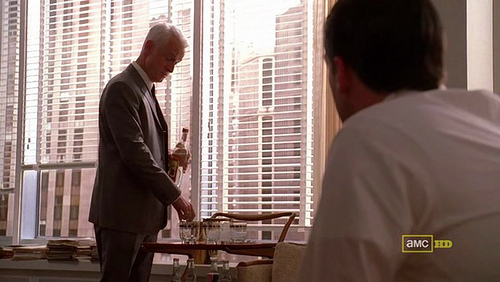
Still, it was more of a grudge match than a Russian Revolution, and Don Draper kept his bottle of vodka handy for Roger Sterling’s drop in and tune out meetings—Draper’s drink of choice was the all-American Old Fashioned: Angostura bitters, sweet Vermouth and Canadian Club.

Real Men Don’t Sup Spud Sap…

…But if we did, it would have to be something akin to 100,000 Scovilles Naga Chilli Vodka, a new fire water (literally) from Master of Malt.

Scovilles, you recall, are the ‘units’ used by organoleptomotrists to measure how hot a chili is, quantifying the heat-producing chemical capsaicin by measuring how many times a pepper must be diluted by its own mass of water until the heat settles down.  On the Scoville scale, green peppers come it at zero and pure capsaicin comes in at 15 million.  By contrast, Justin Bieber sits at a negative 10,000 Scovilles and Scarlett Johansson is 15,000,001.

However, since we are talking about blistery-tongue machismo, let me be perfectly clear: I have always considered the whole Scoville thing sort of wimpy.  Not the concept—that’s plenty butch for a testosterone-erupting wine critic like me—but the idea that the scale was invented by a pharmacist (crackerhonky profession) called Dr. (not—his degree was honorary) Wilbur (geeky name) Scoville (Rambo-ville would have been far, far better) never settled in with me as being sufficiently badass.

No matter, we’ll play the cards we’re dealt.

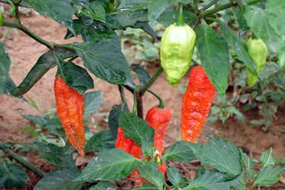
As measured by the mock doc, the world’s hottest pepper (as of 2007) was the naga jolokia, tipping the scales at over a million Scovilles.  For perspective, this twenty times hotter than Dave’s Insanity Sauce, 400 times hotter than Tabasco Sauce, and setting afire the distant heliopause compared to the almost embarrassingly mild-manner jalapeño, which scarcely charts at 5000 Scovilles.  The naga jolokia—also called bih jolokia, or ‘poison pepper’, was born in Bangladesh but developed to its most hellacious potential in Dorset, England by Michael and Joy Michaud.  The original version was rated at 855,000 S.U. by India’s Defense Research Laboratory (figure, if your pepper is being studied by a war department, you’re probably treading dangerous ground) and later at 1,041,427 S.U. by a company called Frontal Agritech, which is not, apparently, a company in search of alternate methods to performing frontal lobotomies.

$12,500 worth of barley and wood

There are probably plenty of reasons why Master of Malt—a Kent-based purveyor of single malt whiskeys—went into the business of marketing a vodka so stupidly hot that its logo is a skull and crossbones and carries a horrific warning label (which I will get to directly)—but I can’t think of one.  I’m equally flummoxed by their flagship portfolio product: A special-edition Speyside whiskey to commemorate the recent 60th anniversary of Queen Elizabeth II’s coronation.  For just over $12,000 you’ll receive just under a fifth of 60-year old scotch from Glen Grant—but lest you feel this is a touch ‘extravagant’, consider that the bottle comes packaged in a  space-age container hand-crafted from an all-natural composite of xylem fiber, which is strong in tension, embedded in a matrix of lignin to resist compression.

My Glen Grant 60 Queen Elizabeth II discombobulation did not arise from the box, the bottle or the bounty—it was the tasting notes, which read, ‘Rich malt, an appley freshness which belies its age…’ and which I read as: ‘You just spent twelve thousand dollars on a sixty-year-old scotch that doesn’t taste like a sixty-year-old scotch…’

Danger, Will Robinson: This Ain’t Absolut

At 80 proof, 100,000 Scovilles Naga Chilli Vodka is standard strength for most vodkas sold in the United States, and as such, contains the usual governmental nonsense warning pregnant women about consumption of alcohol and the related dangers of birth defects—and nothing about consumption of alcohol and getting pregnant in the first place.  In addition, the Naga label offers a nonsensical (because it’s not legally binding) lists of ‘agreements’ that the purchaser acknowledges—including the understanding that the product is so hot that it will zap the capillaries in your papillaries; that should you light your face on fire with it, it’s your own, and not Malt’s fault; and my favorite—that you were neither blotto nor insane when you bought the bottle—when I can’t really imagine any other conditions that would cause you to do so.

Such an ominous, if obvious marketing ploy is cute; reminiscent of the ambulances they used to park in front of movie theaters in the Fifties when a horror film premiered—just in case somebody was frightened into requiring one.

Some Like It… 

“I’m the boss” …Oh, no, that’s the Judge Judy game.

So, how hot is it?  Certainly, you’re not going to do shooters with it, except that you probably will.  Of course, you won’t make bets with your soggy and shitfaced companions as to who can down the most—up until the time that you do.  And naturally, you will not invent silly drinking games involving chugging a shot every time you see Ally McBeal’s feet.  See, that show was canceled in 2002: Get with the current program and go with Kaley Cuoco’s feet.

Paul Rozin

In truth, the product is pure novelty, hot on the heels of what University of Pennsylvania food psychologist Paul Rozin calls ‘the benign masochism of the American palate’.  Whether it’s due to the endorphin-release that chili is said to promote, or the thrill-rush that heat-o-holics need, where (like roller-coasters), the level that’s best is just below what’s intolerable, chili is the second most craved flavor in the United States after chocolate.

I can’t say for sure if Naga Chilli Vodka measures up to the full 100,000 Scovilles, but however it weighs in, it’s a potent potable that proved its promise to pickle my pecker.

**

100,000 Scovilles Naga Chilli Vodka is available for around $50 a bottle at:

http://www.masterofmalt.com/vodka/100000-scovilles-naga-chilli-vodka/

Posted in Vodka | Tagged , , , , | Leave a comment

What’s In A Name, Other Than ‘Insane Fornicating Testicles’? Ask The Chinese…

What is the deal with Chinese people and wine, anyway?  In 2011, Commieville wine sales rose by 20%–most of it intended for the gullets of the PRC’s upwardly-mobile millions—and meanwhile, Chinese investors have kicked the price of Bordeaux futures through the roof ($70,000 was ponied up for a case of 2009 Lafite before it was even bottled), begun to buy up Australia (‘Every vineyard buyer that I have on my books right now is Chinese, every one,’ says Hunter Valley estate agent Cain Beckett) and now, they want to tell Chileans what to name their pinot noir.

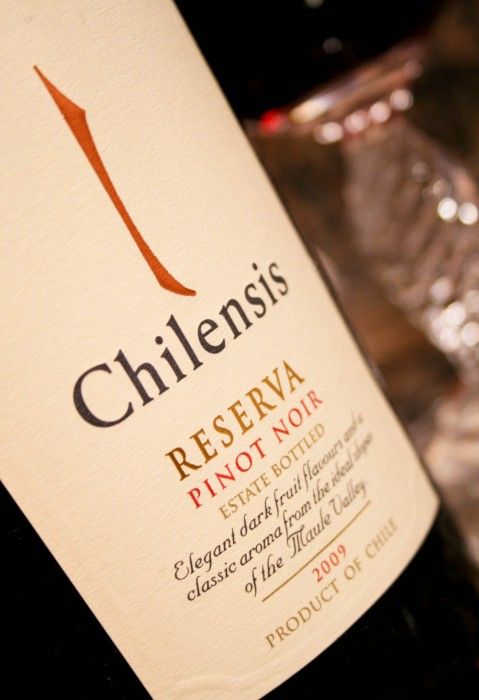
According to certain Hong Kongers, Maule Valley winemaker Via’s recent insufferable Sino sin was the decision to market  reserve pinot noir as Chilensis’, a word reported to mean ‘Fucking Nuts’  in Cantonese.  What’s less clear is if ‘nuts’ refers to scrotum stuffers, squirrelly snackadoodles or sanity suspects, though the first word is pretty easy to interpret.

This story has been given a lot of airplay, but little of it from Cantonese people, who might explain that the actual offensive phrase is ‘chilensin’, and that ‘Chilensis’ causes no more Chinese chagrin than if an American was to see a wine called ‘Funking Nits’.

What is not in question is that, over the past few days, publicity around the weirdly-named wine has caused its  price to skyrocket faster than a case of 2009 Lafite at a Chinese auction.  Turns out that the marketing ploy was a smart one after all, which may or may not explain the quid pro quo spirit of winemakers in China’s Xinjiang region, who have now released a merlot called ‘Go Splooge All Over Your Number-One Forefather, You Smelly Spic’ specifically for the Chilean market.

'Gimme some sugar, Lech'

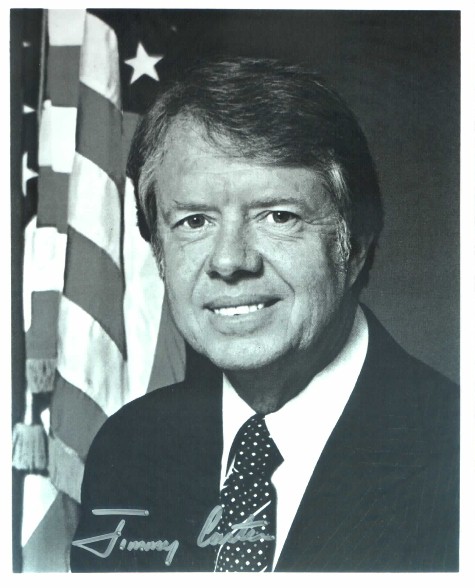
In future, this tale may be further tailored to suit the requisites of urban folklore–and the horrors inherent in slipshod language research.  If you’re old enough to remember Jimmy Carter, you may recall Polandgate, when his translator used the wrong verb to announce that President Carter ‘loves the Polish people’, saying instead, ‘President Carter sexually desires the Polish people.’

I’d laugh, but I made the same gaffe in Mexico when I told a friend that her sleepy five-year-old daughter looked like she was ‘ready for bed’, accidentally using the Spanish slang phrase for ‘she looks old enough to have sex’.

And yes, if you must know, that’s exactly where this scar came from.

Legend has it that Pepsi’s Taiwanese ‘Pepsi Brings You Back To Life’ campaign wound up as ‘Pepsi Brings Your Ancestors Back From The Grave’—for which they had to issue a special label warning: ‘Make sure you hit the brain…’

Always the competitor, Coca-Cola then launched its soft drink using the Chinese phonetic name Kekou-Kela, which, depending on dialect, means ‘Bite the tadpole’ or ‘Female horse stuffed with wax’.  Don’t know about you, but personally, given the choice of Coca-Cola, mare or frog spawn, I’m going tadpole.

In Arabic, The Jolly Green Giant translates to The Intimidating Green Ogre and in Hànyǔ, Kentucky Fried Chicken’s slogan ‘Finger-lickin’ good’ comes out as ‘KFC makes you eat your own fingers’

…And best of all, when Gerber began selling baby food in Africa, they used their iconic baby picture logo, unaware that (since most rural Africans can’t read) companies routinely put a picture of the jar’s contents on the label—and interestingly, Gerber quickly became Uganda’s top-selling brand.

Renamed the 'Chevy Will Too Go'

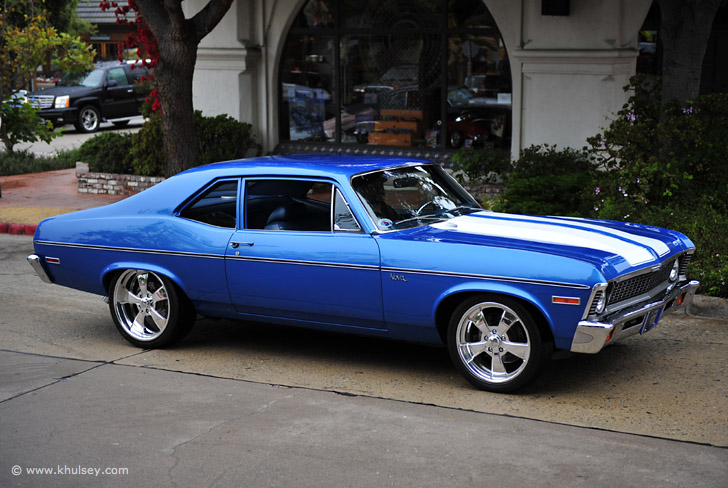
How much truth there is to these stories I can’t say, but I can debunk one of the classics based on my above-referenced experience in the Mexican auto industry.  My co-workers used to get a kick out of the fact that Americans truly believe that the Chevy Nova didn’t sell well in Mexico because ‘no va’ in Spanish is ‘won’t go’.  Never mind that ‘no va’ and ‘nova’ are two different words with two different pronunciations, and forget that Mexicans wouldn’t ‘get’ the ‘won’t go’ concept since they say ‘no functiona’ or ‘no manejar’ (won’t work or won’t drive).  The real trump is that Chevy almost invariably uses different branding for vehicle lines in other countries, and in Mexico, Nova was called the Caribe—and it sold very well.

But then again, why let the facts get in the way of a perfectly good story?  I’d be happy to tell you that Caribe’s direct English translation is  ‘An Overpriced Hunk Of Soon-To-Be-Rusted-Beyond-Drivability Shit Made By Line Workers On Heroin’, and we could chuckle about it over a few glasses of Fucking Nuts. 

Posted in CHILE, GENERAL | Tagged , , , | 25 Comments

Could Kramer Be Lamer? WTF, WS?

If you imagine that the following response to a recent Matt Kramer column in Wine Spectator is less about Matt muddlement and more about some lingering humiliation over WS’s refusal to publish a piece I wrote about Swiss wine, you couldn’t be more wrong.

That was Decanter.  And yeah, I’m still pissed.

Hugh Johnson/Not Hugh Johnson

Anyway, Kramer, who is sometimes spectacular as a Spectator speculator, was once described by Mike Steinberger (Slate) as, ‘the most un-American of all America’s wine writers;’ the left-handedst compliment that I—or The House Committee on Un-American Activities—have ever heard.

Furthermore, Hugh Johnson calls him, ‘an intellectual guerrilla among wine writers,’ while I, in turn, call Hugh Johnson ‘a guy whose  name sounds like he should have been a porn star’.

Kramer/Kramer

Wikipedia panegyrics aside, in his recent article ‘Wine’s Three Biggest Lies’, aspiring to ‘debunk a few of the great wine lies you’ve heard before,’ Kramer couldn’t be wronger.  Of his three wine ‘lies’, two are about as far from being lies as is the statement “More than four people on the entire planet even noticed M.I.A.’s un-American middle finger until some Born-Again dangalang brought it up,” and the third statement is one that I’ve never heard used at all, even by aliens—who incidentally, also missed the hand gesture.

Now, since Kramer has been a wine critic since I was in high school, (which may explain why he’s running out of ideas) let me tread lightly in sincere deference to his credentials.  Like Mom used to say about that pesky Jehovah’s Witness in the Target suit that kept knocking on our door: “He means well.”

Is This A Kramer Disclaimer?

Not at all—ergo, my shot at debunking some of the clunkier funk in his debunkery.

1)  You’re Not Happy, You Just Think You Are.  Okay, so the actual ‘lie’ he mentioned was,  ‘If You Like It, It Is Good’.  In fact, I have never heard this said specifically, but what I’ve heard is ‘Drink what you like,’ as a means to take the intimidation factor out of pairing ‘perfect’ wines with given courses—apparently, Mr. Kramer would prefer the phrase as, ‘Drink what you like, even though what you like sucks and you’re probably better off with beer anyway.’

Hot/Not Hot

People like Matt want to be the arbiter of what’s ‘good’ and ‘not good’, what’s ‘hot’ and  ‘not hot’, because that’s precisely how they justify their paychecks.  And indeed, as a long-time reviewer of wine, beer and other perks of civilization, I would (with my dying breath) like to further along the concept that I am smart enough to  save you from yourself—but since this is a column about ‘honesty’, I cannot.  You see, as someone who has studied wine for his entire adult life, I may well ‘like’ a given wine for different reasons than a casual wine-drinker ‘likes’ her after-work glass of merlot, and what I think is ‘good’ may be based on my understanding of an archetype for what that region, varietal or style is supposed to represent than any ultimate sensual enjoyment of the product.

Kramer makes my point by opining: ‘Believe me, if you like the soft, round lushness characteristic of La Morra you’re going to mark down the more austere, harder-edged Barolos of the Castiglione Falletto zone.’

In other words, if you prefer a soft and lush wine over an austere and hard-edged wine, you’re wrong.

Interesting, considering that Wine Spectator described Rocche Costamagna di La Morra, 1990 as ‘Crisp in texture, featuring a rich layer of black cherry and berry flavor, beautifully defined and spicy around the edges.’

That’s not good?

The nature of ‘good’, of course, has been a mosh pit for philosophers since man first devised the word; there’s relative good, whereby something is good because people say it is good (La Morra Barolo) and there’s economic good, a.k.a. ‘value’, for which people will give up money (La Morra Barolo, $60).  And then there’s absolute good—something that is good in and of itself, regardless of opinion.  Apparently, Matt Kramer considers austere, hard-edged 2000 Bruno Giacosa Barolo Rocche de Falletto Castiglione to be absolute good, even though WS’s 100-point opinion of the wine has helped drive the price up to $225.

Euclid: Heap/Not Heap?

There’s a philosophical paradox dating from the time of Euclid in the 4th Century BCE and arising from ‘vague predicates’.  Called sorites, or ‘the paradox of the heap’, it argues that if a heap of sand is composed of one million grains, you could begin to remove them one and a time, and if there was a point where you could specify that the heap was no longer a heap, you’d have to qualify specifically when that happened.  If not, you’d continue to remove grains until there was only one left and it would still be a heap.  And even if you removed that final grain—and on into negative numbers—it must still be referred to as ‘a heap’.

This paradox can be reconstructed using a variety of predicates, but since this is a column about wine, let’s use that one:  If Barolos of the Castiglione Falletto are good regardless of whether or not you like them, you should therefore be able to remove specific qualities of goodness, one by one, until the wine becomes ‘not good’.  I challenge Mr. Kramer to state specifically when a Barolo passes over that murky threshold, and if he cannot, he’s embroiled himself in the Italian Paradox—a paradox even more paradoxical than the French one.

I suppose I need not wonder what Kramer’s opinion is regarding the absolute goodness of Gallo Hearty Burgundy; correct, Matt?  And yet, by the most basic and classical philosophical definition, something is good if it important or valuable.

In between dealing with Jehovah’s Witnesses, Mom and me used to sit in the kitchen and yakkety yak over a jug of this sweetish, simple swill, which she happened to like—far be it from me to suggest that there was something essentially wrong with her palate.  She’s been gone more than two decades, but every time I get so much as a whiff of this wine, I can exhume more memories and images than all of Proust’s silly teacakes combined.

If Kramer wants to tell me that this wine is anything but but important and valuable, I have a ‘good’ for him:  Good fucking riddance.

2)  Price Tells You About Quality.  Right.  Since no one on this end has been smoking belyando spruce, we understand that price doesn’t guarantee quality, but the suggestion that price doesn’t ‘tell you about’ quality is absurd, and Kramer knows it.  Why?  Because he writes for a publication whose ‘perfect’100-point wines rarely costs less than a hundred dollars per bottle, as this random sampling confirms:  Avignonesi Vin Santo, 1990, about $130; Bryant Family Cabernet Sauvignon Napa Valley, 1996, around $500; Chateau Doisy Daene Sauternes L’Extravagant, 2001, about $250.

Plus, you can bet your sweet glass that any wine-rating wine writer worth his vault carefully follows fluctuations in wine prices following a particularly high Robert Parker Jr. score, because prices for wines he scores above 94 points tend to skyrocket.

3) Vintages Don’t Matter Anymore.  Seriously, I’m poleaxed.  Who says that?  Nobody that I know and certainly not Wine Spectator, whose highly popular Annual Vintage Chart scores the harvest season in each of 54 wine regions, using the same point scale they use to rate individual wines.  The print version comes with handy instructions like ‘fold on dotted line’ and ‘cut on solid line’ so that you can carry it in your wallet as a wine-buying, wine-drinking, know-it-all reference chart.

For even quicker access, there’s now a WS iTunes Vintage Chart App to flash in the face of anyone, anywhere, who at any time dares to claim: ‘Vintages don’t matter anymore.’

The ability to smugly bark back, ‘Fine, so you take the 87-point 1998 Médocs and Pessac Léognans and leave the hundred-point 2005s to me’ should be well worth a $50 WS subscription, don’t you think?

Drink/Don’t Drink

A fun side-note to this vintage chart is that it also pretends to proffer sage recommendations on whether or not each one of your cellared age-worthy gems are yet ready to be consumed—yet, of 47 French chart entries, from Burgundy to Loire to Sauternes, 66% read ‘Drink Or Hold’—the kind of quality advice which I’m willing to offer you for free.

An undeniable truism, of course, is that in the world of improved technology, wine regions once thought too dry to grow vinifera grapes (though otherwise perfectly suitable), are now able to produce great seas of grape, many of which remain pretty consistent regardless of vintage due to the particular climate where they’re grown; parts of Washington, Australia and Eastern Europe come to mind.  In most of the classical wine producing regions of Western Europe, however—Burgundy, Bordeaux, the Rhein and Northern Italy for example, vintages are ballyhooed today as much as they were in Thomas Jefferson’s time.

Read/Don’t Read

As for Matt Kramer, a quick web search brings up dozens of columns he’s written favoring one vintage over another, so he must assume that within his perceived world of vintage value scoffers, lying liars either haven’t heard of him, don’t read him or really don’t give an ish what he writes.

The category into which I fit is ‘none of the above’.  I read and enjoy Matt Kramer’s column, especially on those occasions when it actually makes sense.

In fact, next month I’m hoping for something on Swiss wine.

Posted in GENERAL | Tagged , | 2 Comments

Don’t Gack Into That Morning-After Super Bowl: Bytox Is ‘Hangover B-12 Gone’

For those who awoke this morning with Belichick-quality blues, unable to quite recall last night, here’s the play-by-play:

First Quarter:

15:00: Stephen Gostkowski kicks off to the NYG 2. Jerrel Jernigan returns for 21 yards to the NYG 23 and is tackled by Antwaun Molden.

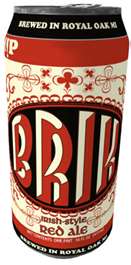
…I really couldn’t care less who wins this stupid game, but since it makes no sense to stay up late watching it without making so much as a cursory bet, I place $20 on the underdogs—Crybrady already has too many Superbowl rings.  My opening drive is a six-pack of Brik, a malty, citrusy Irish Red Ale from Royal Oak, MI—one of my alma maters.

9:00:  Tom Brady throws an incomplete pass to the middle. Penalty: Intentional Grounding on New England (Tom Brady) -6 yards. Safety.  NYG 2, NE, 0.

3:29: Eli Manning passes up the middle to Victor Cruz for 2 yards and a touchdown.  NYG 8, NE 0.

3:24 Lawrence Tyne’s extra point is good.  NYG 9, NE 0.

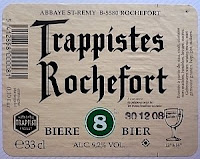
Brik is gone; potty break while I open a couple of ‘Holy Grail’ brews instead of sitting through commercials that are trying way, way too hard to be hilarious.  Hey guys: beer-fetching dogs and babies talking like grownups has been done to death.  On the other hand, Belgique beauty Trappistes Rochefort 8 is a style which has not been done enough—creamy, foamy and filled with fig, dried citrus flavors and yeasty spices like cinnamon and and clove.  Another moiety of malty monkish moonshine is Chimay Triple.  A pale, wheaty ale with cottony carbonation and a lemon pepper finish, it’s got an almost wine-like sweetness—muscato, if I was to get specific.

Second Quarter:

13:52 Stephen Gostkowski’s 29 yard field goal attempt is good. NYG 9, NE 3.

0:15: Tom Brady’s pass to the left to Danny Woodhead for 4 yards and a touchdown.  NYG 9, NE 9.

0:08: Stephen Gostkowski’s extra point is good.  NYG 9, NE 10.

HALFTIME:

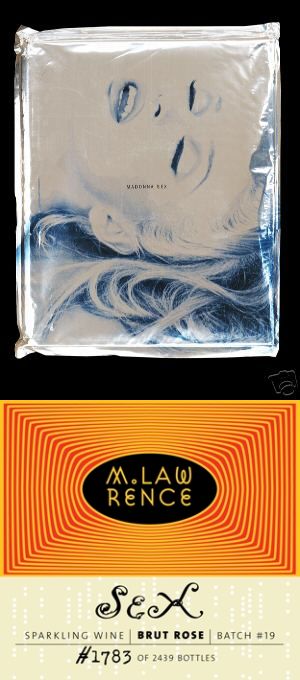
Madonna’s wardrobe refuses to malfunction. No worries: I turn instead to her 1992 magnum opus ‘Sex’—a systematic treatise that is to coffee-table  schlock what  Xenophon’s ‘Oeconomicus’ is to Socratic dialogue.  Meanwhile, I pop the cork on a magnum of M. Lawrence’s  opus, also appropriately named ‘Sex’, and savor each sparkling swig while noting that Madonna has only slightly less body hair than Larry Mawby.

Madonna’s Botox® lips remind me that I to forgot to put on my Bytox™ strips. These all-natural, so-called ‘hangover-prevention’ patches are touted to deliver depleted  vitamins and nutrients to the limbic systems of self-abusers. We shall see, Pilgrim.

Third Quarter:

11:25: Tom Brady passes to the left to Aaron Hernandez for 12 yards and a touchdown.  NYG 9, NE 16

The Doppelbock is gone, and it’s not looking good for my double sawbuck, either—is the fix in?  Brady needs a shave, but this looks like a points shave.  Say it isn’t so, Elijah…  This calls for your namesake, Elijah Craig 12 Year Old Kentucky Straight Bourbon Whiskey.  And plenty of it.

11:20: Stephen Gostkowski’s extra point is good.  NYG 9, NE 17.

6:47: Lawrence Tynes’s 38 yard field goal attempt is good.  NYG 12, NE 17.

0:40:  Lawrence Tynes’s 33 yard field goal attempt is good.  NYG 15, NE 17.

One man’s whimper is another man’s simper

Fourth Quarter:

1:04 Ahmad Bradshaw rush up the middle for 6 yards for a touchdown.  Point after good.

FINAL: NYG 21, NE 17.

Okay, all’s well that ends well.  I’m using my twenty bones to pick up  a fifth of Everclear 151 proof grain alcohol to kill any rogue pathogens that might have entered my body via the trans-dermal Bytox patch.  Last thing I remember, the patch is still firmly dermal.

MAÑANA:

Normally, after a night of drink-induced frivolity (or as we Detroiters say, ‘alcomaholism’), my first waking sensation is one of utter personal disgust in which anything I might have done the day before, no matter how heroic, selfless or noble—like forcing my way into a burning Children’s Hospital and carrying tons of helpless toddlers to safety (and I’d have to be pretty seriously wasted to do that)—seems totally narcissistic and rude.

With the patch, the hospital scenario does not feel egomaniacal in the slightest—just stupid.

And my head does not feel like it has been pulverized by a passing troupe of mud bogging monster trucks either, but rather, like it’s been used as a t-ball tee by a group of slightly-challenged kindergartners.  Nor does my stomach feel like somebody has been spoon-feeding me kitty litter, but more like I ate a couple of liverwurst canapés that have been sitting in the sun for a few days.

The young lady with the Bytox patch is not as attractive as she seems–you’re drunk.

It is, apparently, the result of the myriad B-Complex vitamins contained within the Bytox patch, everything up the B ladder from B1 to B12 with a little E,D, A and K tossed in for good measure, and to make sure that trendapoids sit up and take notice, 20 mg of acai.

Final analysis, the product may not have totally eliminated the symptoms, but it did meliorate what would have been a raunchy wake-up call.

I might suggest some formulaic additions—leave out the acai in favor of Vitamin X (Xanax) and my favorite member of the B-complex family, Vitamin Beam—but of course, that would sort of make me a Monday morning quarterback, wouldn’t it?

Posted in BEER, GENERAL | Tagged , , , , , | Leave a comment

A Triumphant Triumvirate That Trumped A Troop of Trifling Tricksters: Ronn Wiegand, Gerard Basset And Doug Frost

Wiegand, Basset and Frost

What do Ronn Wiegand, Gerard Basset, Doug Frost have in common?

Well, if you’re a cork dork, you already know, and if you’re not, you don’t care.

Digression: I know a guy with both a law degree and a medical degree, and sometimes I stare at him and marvel at the fact that half of him is smarter than all of me.  Still, after a shared evening of immoderate imbery when I sideswipe some sober sap, I get great personal satisfaction in introducing him to the victim: “This is my nasty, but highly-successful attorney, and speaking of nasty, if you need to stop bleeding from that nasty intracranial hemorrhage, he can probably help with that, too.’

Were I to be driving Ronn, Gerard or Doug home, the best I could come up with would be: ‘Sorry about the fractured skull and all, but did you know that of the 82 permitted varieties of Port grapes, only 30 are actually recommended by the Method of Punctuation of the Plots of Land of Vineyards of the Region of Douro?

The Master of Wine program and it’s gruesomely grueling qualification exam first found life in 1953 when 21 candidates sat down to write five theory papers and three practical papers on wine—the business end, the science side and the relevant issues of the day.  Only six passed.  Now, you might conclude that such a dismal failure rate was due to a lack of foresight among these initial candidates, but no—less than three hundred others have qualified since, and at a smaller percentage rate than passed the first.

Why?  Because it’s friggin’ difficult, that’s why.  The current test consists of a four-day masochistic mental and mouthful marathon administered by the London-based Institute of Masters of Wine during which slaughterable sheep (75 of them in 2011, of which 11 passed—this year’s exam is June 6 – 9) prepare  four three-hour question papers and participate in three 2 ½ hour blind tastings and, should they pass, are required to write a ten thousand word dissertation based on original research.

Wearing an ‘MW’ after your name is a remarkable consummation of study, skill-sharpening and simple savvy, no question—and some of the coolest people in the biz have earned this bragging rights.  Some of the biggest peckerheads in the biz have too—but that’s a different story.  The point is, to demonstrate the level of OCD level required to secure a spot where you’re even allowed to take the exam is pretty intimidating.

And pretty expensive. The IMW requires that you first qualify, then enroll in  a two year, guided ‘self study’ program to prepare for the finals, and this will set you back around $5000—$2,200 alone for a four-day seminar introducing the program.  And then there’s buying the study wines, which I can’t see being less than a few thousand more.

That said, should you FUBAR one of the first two sections, you can ante up and try again.  Fair to say, hardly anybody gets to the dissertation stage on the first try, and those that do are near legend.

The exam, therefore, becomes to wine geeks what a triathlon is to athletic overachievers—something that only alpha personalities even consider considering.  Says Anne Pickett, an (unsuccessful) MW candidate: “This is one of those esoteric things you just decide to do to better yourself. If you pass, great. If not, at least you tried.”

How hard is it?  In 2005, two-thirds of those who sat one or both parts of the two-part exam failed to pass even one part, and with an almost Faustian glee, the IMW states that its test is ‘the hardest test of knowledge and ability in the world of wine’.

And compared to the ‘other’ celebrated wine pro credential, the Master Sommelier certification?

Ronn Wiegand pronounces, “…Master of Wine is vastly more difficult, and I would emphasize ‘vastly’ by a factor of three.”

Albert Winestein

A Title Only Albert Winestein Could Love…

So, non-mathematicians, what that means in layman terms is that if Master of Wine is literally impossible to pass, Master Sommelier is figuratively impossible to pass.  The chief difference between the two is that the The Court of Master Sommeliers, testing three levels of sommelierhood, is primarily concerned with standards of beverage knowledge, social skills and proper restaurant service—and somewhat less with the wine ‘business’ (except for running a solvent wine program) or instant viticulture recall.  Oddly, I think, a knowledge of Havana cigars is required, which in the United States are illegal.

Candidates at the Sommelier second level are required to prove three years of wine service, and five years for the third.  Going-for-the-brass-ringers must pass a $525 introductory course and the two ‘middle’ courses at $325 and $995 before the court will gracefully accept another $900 to allow you to sit for ne plus ultra Master Sommelier exam, even though your chances of failing it are somewhere around 90%.

For the ten percenters—and worldwide, that stacks up to a scant 160 individuals—there is the promise of prestige, awe and speaking engagements, but I think that in order to cash in, chutzpah is as vital as the diploma.

Again: What Do Ronn Wiegand, Gerard Basset, Doug Frost Have in Common?

They are the only three human beings in the solar system—potentially in the entire cosmos—to have passed both the Master of Wine and the Master Sommelier exam.

Like that of my hotshot buddy Dr. Ambulance-Chaser, M.D., P.L.L.C., Q.U.A.C.K., this is a truly unfathomable accomplishment, akin to winning the Van Cliburn Piano Competition after carrying your Kuhn-Bösendorfer Grand to the top of Mt. Everest.

So, What’s The Problem Then?

Only this:  There are three of them.

Who’s Number One?

I am an American, and Americans have hated ties ever since we charlie foxtrotted the Korean War—they exist only so that boxing promoters can make money.  Ties are idiotic: Like, everyone has a favorite Stooge, a favorite Dog Night, a favorite Beatle (oh, yeah—only two left), and frankly, as a Catholic, if I’m forced to choose?  I’m going with the Holy Ghost.

So, like they do in sports, I’m proposing a Sudden Death Overtime Wine Certification program in order to crown one—and only one—of these chumps ‘champ’.

Devised by yours truly, it consists of a single question which I will pose (against my business sense) absolutely for free.  Gentlemen, start your crusher/destemmers…

‘How many sub-atomic particles are contained in an average merlot pip?’

Whoever answers first gets the distinction of tacking a new title—named for moi—after MS and MW:

MSG: Master of Sour Grapes. 

Posted in GENERAL | Tagged , , , , , | Leave a comment

Mr. Natural Wine Sez: ‘YOU’RE The Right Tool For The Job, You Tool’

'Keep on Trocken!' (Hep Rhein rheference)

Unlike most wine columnists, I never get ‘writer’s block’.  Au contraire, I deny that the phenomenon—whereby people who can’t think of anything to say go ahead and say it anyway—even exists.

Oh, sure, sometimes our personal muses get all PMSsy, sometimes we’re in the middle of a sentence and realize, ‘Not only does this make no sense, but I’ve already said the same thing several times before,’ and occasionally, we are unable to string two words together due to a hangover caused by the very product we’re tasked to review.

And yet, the solution has always seemed to me as accessible as a Castello del Poggio Moscato d’Asti and boils down down this:

‘See what other columnists with writer’s block are coming up with and copy off of them.’

Eric Asimov

Today is no exception.  This morning I read an article by New York Times critic Eric Asimov entitled ‘Wines Worth A Taste, But Not The Vitriol’, which I instantly picked up on in the hope that ‘vitriol’ is some chemical additive that would cause a scandal like the one in 1986 where antifreeze was accidentally added to dolcetto.  OK, so it turns out that vitriol is actually N.Y. Timesese for ‘vituperation’ (which I also had to look up) and not something poisonous like sulphuric acid.

Even so, another column idea cropped up during Asimov’s very first sentence:

ROBERT M. PARKER JR., the powerful wine critic, called it “one of the major scams being foisted on wine consumers.”

I was intending to call my piece ‘Look Who’s Calling The Kettle Black’.

But then I read further, and realized that the genuine gist of the article concerned ‘natural’ wines, that newish and trendy category describing wine made the way people made wine before it needed newish and trendy categories.  In other words, wine that has not been surreptitiously shaped at any point during its life cycle, from field (chemical fertilizers, mechanical harvesters) to fermentation floor (reverse osmosis, spinning cone, cryoextraction) to  bottle (added sulfites).

Oak juice

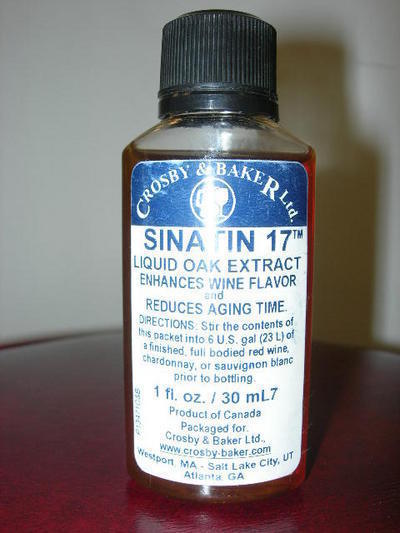
Not all winemakers howl from the same hymnal when defining ‘natural’ wine, but it might be fair to suggest that the Aristotelian archetype is grown in an organic or biodynamic vineyard, dry-farmed without a Monsanto crutch, hand-picked and fermented without chaptalization or citric acid, aged without Sinatin 17 oak juice and bottled without sulfites.  Based on this, any profile of a natural wine contains more don’t than dos, but in general, is intended to restore wine to primeval purity and focus on the expression of terroir rather than the intervention of Dow.

This all sounds good on paper, but winds up a bit like the neocons saying, ‘Let’s return America to the ideals and standards upon which it was founded—right after we stole it from the Indians.’

RPJ

Hence, the vitriol.  What yanks Robert Parker Jr.’s chain is that there are no government regulations determining the hoops through which you must jump to call your wine ‘natural’ nor any concrete definitions of what ‘natural’ actually means—as illustrated by my clumsy characterization above.  In other words, it’s an advertising buzz term meant to suggest that there is something inherently more wholesome about the product than something from (to use the California Wine Institute’s 500,000 case criterion) a large, commercial, mass-production wine corporation—like say, Cupcake,  ironically among the top selling wines at Whole Foods.

But does ‘wholesome’ translate into ‘more delicious’?  I suppose if you’ve ever eaten a rice cake or a plate of boiled tofu from Whole Foods, you can answer that question.  See, one problem with ‘natural’ wine is that the focus is necessarily on technique, whereas ‘unnatural’ vintners may be more concerned with the quality of their end result.  Mr. Jr. points out that his pet producers are mostly small French domaines making less than 5000 cases annually, and nearly all would fit into the colloquial interpretation of ‘natural’ by any rational definition.

Indeed, these boutique estates, like Domaine Gallety in the miniscule Southern Rhône appellation Côtes-du-Vivarais and Domaine Léon Boesch in Alsace make wine without additives or color enzymes, and only enough sulphur to prevent spoilage.  And say what you want about Robert Parker Jr., you can generally be assured that a wine he recommends is—under a pre-understood set of Parker preferences—pretty tasty.

One person who does indeed say what she wants about RPJ is Alice Feiring—and not only does she say it, she writes books about how much she hates him: The Battle for Wine and Love: Or How I Saved the World from Parkerization. 

Go Ask Alice... Over and over and over.

Not surprisingly, Feiring—a well-respected wine journalist who probably never gets really wasted, asked on dates, hung over, or suffers from writer’s block—does not feel that natural wine is consumer fraud at all; rather, she thinks that ‘New World’ wine is the real scam, and refers to it as overblown, over-alcoholed, over-oaked and overpriced.  And not to over-do it, over-manipulated.  Recently, she has been getting a lot of positive press for her latest evangelizing effort, Naked Wine, which Amazon claims,  ‘peers into the nooks and crannies of today’s exciting, new (but centuries-old) world of natural wine’.

Admittedly, I have not peered into Ms. Feiring’s nooks and have scrupulously avoided her crannies, but I have seen her photograph, and I can assure you, if you were to attend a tasting with her, you’d be grateful that the wine was the naked one.

And then there’s loudmouth Rhône producer Michel Chapoutier, who considers ‘natural’ wine neither scamtious nor scrumptious, and uses a word which may have lost something in the Babelfish French/English translation: ‘Connerie’.  Since he’s obviously not suggesting that natural wine tastes like Sean, he may have meant ‘chicanery’ or, like Decanter Magazine’s Andrew Jefford dubs it, ‘charlatanry’—but in any case, Chapoutier calls natural winemakers ‘hippies’, thereby using a word which has not been used in half a century in the same sentence as he uses a word which has never been used at all.

So, What Are We To Conclude From All This Vile Venom, Vituperation and Virulence? 

Absolutely nothing.  ‘Natural’ wine is as fictitious a term as is  ‘connerie’ or ‘Reserve’ on the label, and so, there is no real way to judge if such wines are better, worse or exactly the same as their competitors.  One vintner’s ‘natural’ may in fact be another vintner’s ‘manipulated’.

What I do conclude is that this column will garner hate mail excoriating me for suggesting that Alice needs a looking glass, that Michel is a silly little Frenchman with his head up his glass and that Parker Jr. is neither god nor devil, but an opinionated critic like us all.

'I'm Jonesing for juice, Jesus.'

Doubtless, I will be told that I will never, ever win a spot on the coveted and recently-released ‘100 Most Influential People In The Wine Industry’—a scenario so depressing that I’m tempted to chugalug a gallon of vitriol-laced Kool-Aid.

Without the enzymes or oak juice, of course—it’s healthier that way.

Posted in GENERAL | Tagged , , , , | Leave a comment