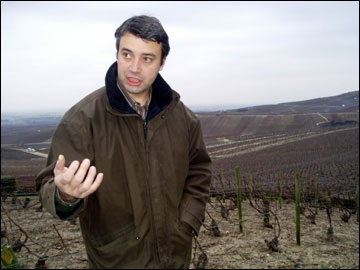
Rafael Alonso: Digging The Indigenous In Tierra de Léon

mapAmerica drinks more, Italy makes more and France sells more, but nobody grows more wine grapes than Spain. In fact, based on 2012 stats, about 15% of all the world’s acres planted to wine vines can be found in that bulbous stub of land that dangles at the bottom of Europe like a saddlebag and pokes into the Atlantic like the bow of a supertanker.

And they’ve been doing it for quite a while now, too.  Wine’s origin in Spain is gauged not by historians but by archaeologists—by all accounts, Spanish vines were planted before the first pyramid went up in Giza; before Noah was so much as a gleam in his old man’s eye.
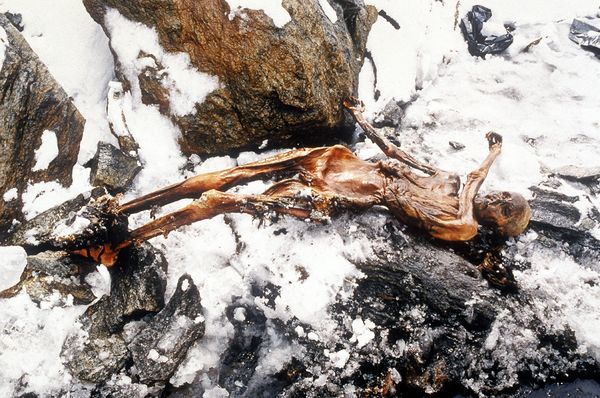
Ötzi the Ice Man

Ötzi the Ice Man

That places it between 4000 and 3000 BCE, around the same time that numbers were invented and Ötzi the Ice Man was crossing the Alps.

It stands to reason that such a history of grape cultivation resulted in countless varieties being introduced, countless varieties being developed, and—perhaps most interesting—varieties that were there all along.

Of all outposts within the vinosphere, Spain is (arguably) home to the widest array of seductive and savory indigenous grapes. Every time I try to do a deep dive into what’s new in Spanish wine, I keep winding up on a pathway of what’s old, unique and hitherto (to me) unknown.

Prieto Picudo

Prieto Picudo

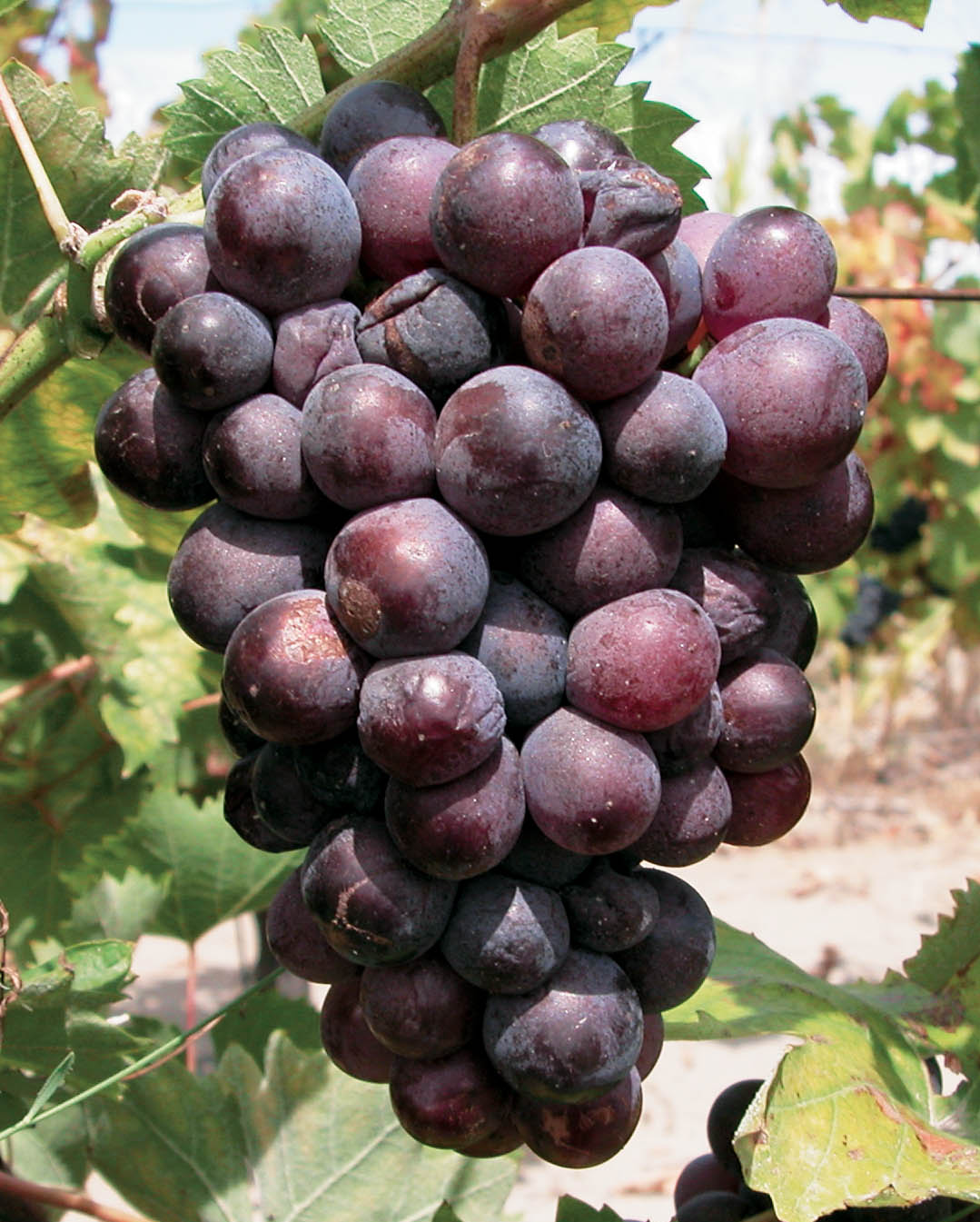
Take Prieto Picudo, a haunting, black-skinned grape native to Léon, a province in western Spain, just above Portugal. The variety has been a standard here for centuries, but it wasn’t until 2007 that Tierra de Léon was given its own DO status.  Denominación de Origen, of course, is a regulatory classification system similar to French AOCs and American AVAs.

“The Sun is Our Enemy”

So, from this spanking new appellation, callow as a barrel sample, I tried an ancient varietal nurtured to splendor by a newish winemaker from an oldish estate.

Clear as unfiltered Port?  Hijos de Rafael Alonso is an asentamiento near Valdevimbre—a wine community with a population of around a thousand.  The winery has been around since 1949, a mere drop in the wine bucket of history, but the third generation of Rafael Alonso is now nudging the estate into the 21st century; as he says on his site, “Spanish wine is changing at a rapid pace and it’s required that we put a maximum emphasis on quality.  I replanted the vineyards and moved to modern farming techniques while maintaining an immovable banner in celebration of Prieto Picudo.”

Picudo weevil

Picudo weevil

Except that the web site, translated directly from Spanish, doesn’t say ‘Prieto Picudo’.  It says ‘Tight Weevil.’  I took a time-out to do a little etymological (as well as entomological) research, and it turns out that prieto can indeed be translated as ‘tight’ and a picudo is, in fact, a type of weevil.

Tierra de Léon is very hot and very dry, with less rainfall in an average year than Napa gets in a drought year, and at a relatively high elevation between two and three thousand feet, vines may suffer from too much exposure (up to 2,700 hours of sunshine annually), leading Alonso to quip, “The sun is our enemy.”

Still, I’m thinking that Google Translate might be a foe even more formidable to his fortunes.
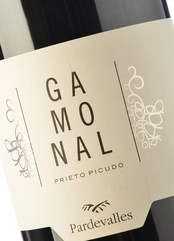
gamonal labelThat said, Pardevalles (Hijos de Rafael Alonso) Prieto Picudo ‘Gamonal’ 2012, is a wine of such startling singularity that a noseful actually painted a mind’s eye image of a cool forest heavy with wild brambleberries; blackberries, boysenberries, etc.  Snuggling beneath those fruit scents is a whiff of smoke and pepper and a palate which leads with sweet fruit, settles into a many-layered, silken-textured integration of truffle, anise, succulent black raspberry and toasty oak.

albarin bottleA sister to ‘Gamonal’—named for a local flower with absolutely no connection to the wine—is Pardevalles Albarín Blanco 2013, a white wine that is every bit as complex and luscious, although on another flavor chart altogether.  Albarín, you may be surprised to note (I was) has nothing to do with the Albariño of nearby Galicia; the similarity in the name is likely due only to the color of the grapes, both with a root in the Latin word for ‘white’, albus. This is a varietal also native to Tierra de Léon, and the Alonsos grow nearly 2/3 of it.  The wine opens with a strata of distinct, separate fruit aromas, beginning with sweet lime and becoming tropical with mango before an explosive peach profile takes over.  This carries through in the mouth with a cornucopia of stone fruits with a touch of mint, everything shored by bracing tartness and a long, leesy finish.  The wine sees no oak, and shows a beautiful purity; pristine, lean and very ripe and offers a refreshing, extremely light and all-natural sparkle, what the French call pétillant wines, the Germans spritzig and the Italian frizzante.

I’m sure the Spanish have a word for it too, but after ‘tight weevil’, I think I’ll opt out of learning what it is.

Posted in Uncategorized | Tagged , , , | 1 Comment

‘Garagista’ = Pretentious; ‘Garrigue’, Not

There but for the grace of God and self-respect go I.

There but for the grace of God and self-respect go I.

When I taste wine, I tend to verbalize a lot.  I say things that may wind up in my tasting notes, but at the moment may sound like disjointed babble coming from a mentally-unhinged street person.

And not just any mentally-unhinged street person, but one who is also a pretentious twat.

Today’s wine exercise is about two words which came up earlier in the world of viniferous self-speak twatdom, one of which shouldn’t be pretentious but is (garagista), and another which should be pretentious but isn’t (garrigue).

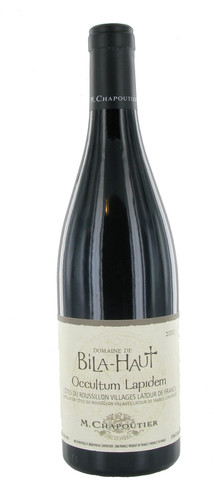
labelThe wine under consideration was Occultum Lapidem 2013, a marvelously-named Côtes du Roussillon Villages, which means (like ‘Villages’ wine from other AOCs with that sub-appellation) that this wine adheres to a stricter rule-regimen and comes from specific real estate within the larger Côtes du Roussillon. In this case, the wine is a blend of Carignan, Syrah, Mourvèdre, Grenache and Lladoner and begins life in select vineyards on the slopes of the Agry River valley.

The wine is fierce and forward, and somebody mentioned a stylistic resemblance to a ‘garagista’ wine. The original garagistas were from Bordeaux and made small-batch wines that tended to be less austere and wood-heavy than the classic Château labels; they were fruitier and easier to imbibe when young.  Such a bang-up job have these young turks done with their terroir-defying vins de garage, or ‘garage wines’ that the term ‘garagista’ began to be applied somewhat indiscriminately to anybody making rule-free wine on a minuscule scale (as inside their garages), whether or not said potable wound up being particularly drinkable. ‘Garagista’ took on a certain rebel-yell edge and a caché  not dissimilar to—and likely as a result of—the garage bands of the Sixties and Seventies that morphed into punk music.  Thus, calling someone (or yourself) a ‘garagista’ gives you an air of counter-culture hepness, as though you are tuned into hardcore street vibes that your average wine taster can hardly so much as dream about.

Pretense by the truckload

Pretense by the truckload

Since in the majority of cases that’s nonsense, randomly tossing about the term ‘garagista wine’ (which this one didn’t resemble anyway) makes you a pretentious twat.

Not so ‘garrigue’.  This is a wine descriptor that I have only heard French people use.  And not just any French people, but primarily those French people who grew up in Southern France wine cultures and have, since childhood, been indoctrinated in subtle flavors and obscure scents that most of us Yanks don’t discover until we are losing our hair.

pepper1I love these kind of French people because they are (in general) so not pretentious about this innate side of their life’s experience. That they can pull these elusive descriptors so easily from the vinological ether is as impressive to me as is (to them) my ability to instantaneously sing entire jingles verbatim from 70’s TV commercials, like “I’m a pepper, he’s a pepper, she’s a pepper, wouldn’t you like to be a pepper too?”.

Garrigue in Rousillon

Garrigue in Rousillon

‘Garrigue’ is an essence word; it describes a variety of of dried, herbal tastes that arise in certain Mediterranean wines, especially those of Provence and Cataluña. It is a note that does not refer to a single, distinct aroma, but rather a type of aroma—something dry, rich, dusty and distinctly herbal, a potpourri not necessarily from Grandma’s linen drawer, but from the broad coast of Southern France, especially in late autumn.  Botanically, this includes the array of lime-tolerant plants that grow along the Mediterranean seaboard; juniper, thyme, sage and lavender, etc.

Occultum Lapidem is Chapoutier selection; Michel Chapoutier, you’ll recall, is that loudmouthed l’il biodynamicist from Hermitage who makes some really spectacular wines on his own, and has a superhuman knack for sniffing out value wines throughout Southern France.

Occultum Lapidem 2010 75clOccult Lapidem, from Domaine de Bila-Haut, is one such example.

The wine offers an aromatic blast of bouncy berry notes backed with an earthy spice and the slight bite of coffee beans. It shows sweet red fruit up front, but settles into a multi-layered panoply of stone, berries, a bit of anise, and culminating in what I first (pretentiously) labeled as ‘tobacco leaf’.

Why pretentiously?  Because I don’t think I’ve ever seen a tobacco leaf let alone taken a whiff of one—it’s one of those show-off descriptors that I read somewhere and was trying to reverse-engineer cigarette tobacco smells back to what it might have smelled like in leaf form.

Which is really pretty silly when you think about it.

Fortunately, salvation came in the form of  Todd  Abrams, who—it must be noted—was not the ‘garagista’ dude. He said, ‘garrigue’.

bouquet_garni_16x9And it all came together like the final twist of the Rubik Cube—what I was tasting was that precise, imprecise elusivity found in such wines; a combination of savory herbs, scrubby undergrowth and wild fields all drawn together like the cord around a bouquet garni.

Tasting it again was ‘garrigue unmasked’; the word now becomes like the old psychology maxim: ‘It may be stating the obvious, but it may not be obvious until it’s stated.’

Now, if you want to hear some genuine pretentious twattery, ask me more about psychology.

Posted in FRANCE, Provence | Tagged , | Leave a comment

Experiment Proves Foie Gras Is Not Torture

Raging-BullI fell in love with ‘method art’ when I first saw DeNiro play Jake LaMotta in Raging Bull.  As you recall, the Oscar-winner gained several hundred pounds to portray the boxer in his later years, eschewing the sort of pillow-with-straps effect that Oprah and Mariah Carey rely on, adding authenticity to his performance and shaming those of us whose ‘dedication’ to our discipline is made of stuff less stern.

In fact, DeNiro has already been signed to film Raging Bull II, which follows LaMotta’s story after he croaks, a role for which DeNiro intends to commit suicide.

"You dating?"

“You dating?”

As a result, I have lost all respect for journalists who make hifalutin claims like ‘drugs are bad for you’ without first giving up their careers and families and living for several years turning tricks in the back seats of Dodge Darts.  Likewise, a pussy pox on tightrope walkers who string nets beneath them; also seat belts on Formula One drivers and skydivers who use parachutes.

Foie-gras-production-in-F-007Thus, in honor of California’s recent repeal of its ban on foie gras, a.k.a. diseased bird liver processed to resemble Friskees® Classic Rodent Paté, I set out to write a thoughtful piece on the relative cruelty (or lack thereof) in its production.  It occurred to me that, in the spirit of Constantin Stanislavski (the great Communist theater director), rather than interviewing the usual passel of pusillanimous panda-pandering PETA (an anagram of paté) pansies, I should go to the source and find out for myself.

get smartAnd I don’t mean lurking around behind the scenes at some godforsaken goose farm in the Périgord—pretty much the Abu Ghraib of foie gras production—and snapping some clandestine shots with my Don Adams-quality miniature spy-camera.  No, like my hero Bobby Milk and my other hero, that guy who put on several hundred pounds to portray himself in Super Size Me, I decided to do an investigative-style self-experiment and subject myself, like Morgan Spurlock did with McDonald’s meals, to the daily regimen of a foie gras goose.

The Experiment…

Ex-Capt. Andar Abfungott

Ex-Capt. Andar Abfungott

In a combination of total disregard for, willful distortion of and general ignorance regarding basic scientific methods, I hired a personal trainer in the person of disgraced Army Reserve Spec. Andar Abfungott who was convicted in 2005 on five counts of assault, conspiracy and name-calling in connection with the beating and humiliation of detainees at Gitmo.

I shared with him the ‘rules’:

For four weeks, I would be confined in semidarkness and consume my usual diet of high-gluten, high-starch, high-fat Purina® Writers Chow softened with Five O’Clock vodka.

Then, for the next 21 days, I would be held in a small wooden box and be subjected to gavage—every day, up to 20 pounds of quinoa and puréed Peruvian stink badger fat would be forced down my throat by means of an auger in a feeding tube liberally lubricated with Heaven Hill bourbon.

bashara dungeonOn December 1, 2014, I began the experiment in the privacy of my secret Bashara-designed bondage dungeon where I required ex-Captain Abfungott to refer to me as ‘Master Chris’ while he subjected me to humiliating strappado hanging and abused me with a phosphorescent tube.  After five days, I had gained fifteen pounds, mostly in the form of scar tissue.

gospelEver the professional, my trainer had learned through hacked Facebook comments that I profess no religious affiliation, and throughout that month made steady, derogatory comments about atheism and sometimes pretended to be God, forcing me to sing Gospel music under threat of further punishment.

Once the gavage phase began, the verbal abuse became focused on my rapid weight gain.  ‘Tubby, tubby two-by-four, can’t get through the bathroom door,’ was the ex-Captain’s particular favorite, and the jingle was often accompanied by long periods during which he played accordion versions of cowboy songs and frontier ballads.

After ten days, the music switched to an endless loop of Arnold Schönberg dodecaphonic compositions, including the unlistenable Variations for Orchestra, Op. 31.

“All parents damage their children. It cannot be helped. Youth, like pristine glass, absorbs the prints of its handlers."

“All parents damage their children. It cannot be helped. Youth, like pristine glass, absorbs the prints of its handlers.”

During this time, while whiling away the minutes between feedings, my trainer read aloud from a Mitch Albom anthology of  inspirational sayings.

Finally, on the last day of gavage, January 19, 2015, my liver was biopsied by a surgeon brought in by an unexpected contingent of CIA operatives.  The result was, over 21 days, my liver had ballooned to the size of a plyometric fitness ball, weighed forty pounds and was worth approximately €90,000 on the Euronext Paris foie gras exchange.

In fact, in order to prevent them from shooting me in the head and selling it to the French, I agreed to sign a waiver insisting that what I had undergone at the hands of ex-Captain Abfungott was not torture but political rehabilitation and social restoration.

bigbrotherAnd I agreed to write a column admitting that any of my previous denunciations of foie gras were the product of my diseased psyche.  I had proven that foie gras production is not torture.

But that’s alright.  In fact, everything is all right; the struggle is finished.  I have won the victory over myself and I love Big Brother.

Although, by God, I still hate Mitch Albom. Bring on the waterboard.

Posted in GENERAL | Tagged , , | Leave a comment

The Reign of Rhône; Long Live GSM

With apologies to Tennyson, in Spring, a young man’s fancy may turn to thoughts of love, but in mid-January, we’re still pretty much in lockstep with the revelries of Southern Rhône.

Southern Rhône vineyard

Southern Rhône vineyard

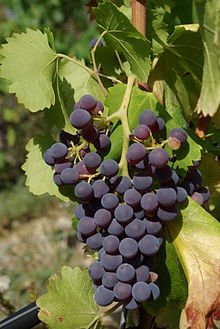
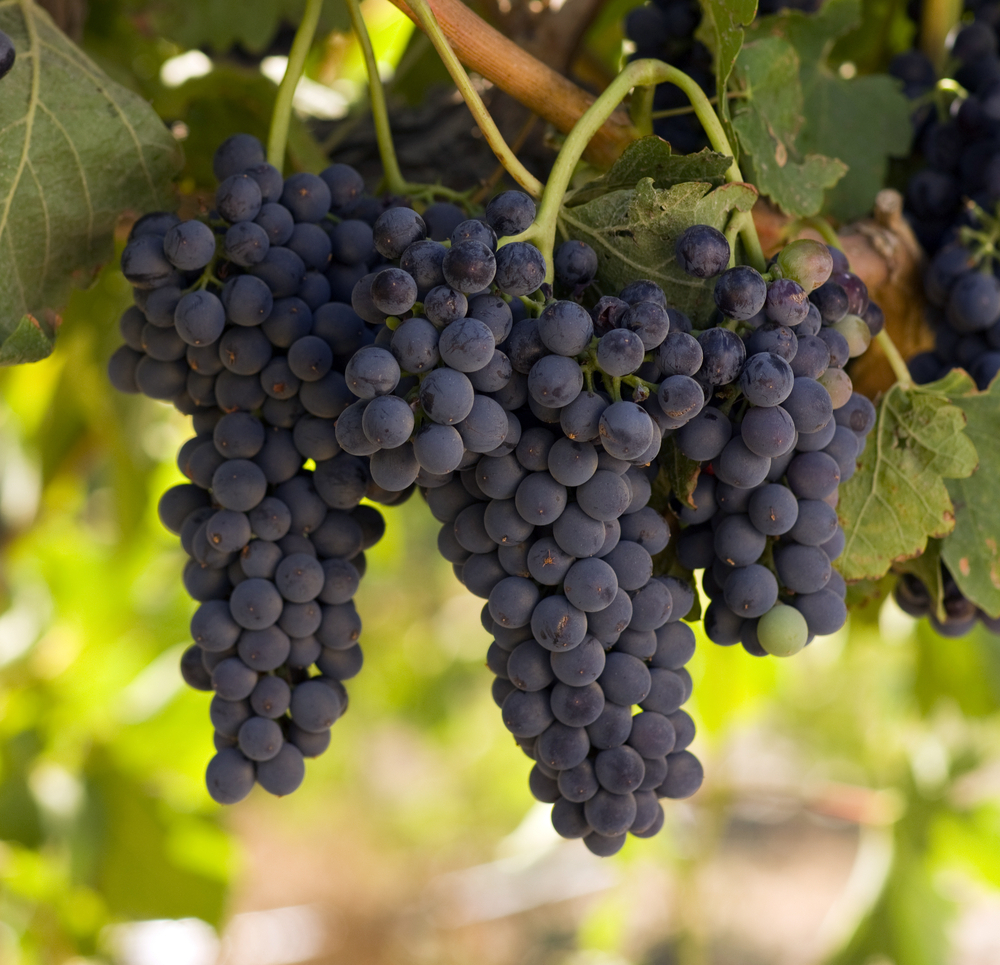
No wine I can bring to mind better says ‘chin up, ye winter weary with cabin fever’ than a toasty-ripe swig of cheer from Avignon,  the point upon which the Southern Rhône pivots. Unlike the north, where Syrah wears an exclusive crown, in the south, wine grapes sort of cluster together in vinous bonhomie and work together for the common good.  These may any of a score of varietals—Châteauneuf-du-Pape allows ten red and nine white—depending on the individual AOC.  Many of the grapes, of course, are also-rans; the Big Three (often identified by the acronym GSM, especially in Australian versions of Rhône) are Grenache, Syrah and Mourvèdre.

Each grape spreads its  special sparkle o’er the splurge:

Grenache

Grenache

Grenache brings a keg of jammy sugars to the party; it’s a fleshy, sun-worshiping grape that fills the profile with red fruit flavors  like red currants, raspberries and cherries, occasionally with a whiff of menthol and licorice.  Its potency often belies its light, ruby red color, hence…

Mourvèdre, which provides an inkwell to a wine’s color base; a dark plum color which is echoed in the rich, dark plum taste.  Mourvèdre is responsible for some carnal notes as well—leather, gaminess, roasted meat.

Syrah

Syrah

Syrah is the grounding grape that tames Mourvèdre beast and hauls the loftiest ideals of Grenache back to earth—an earth that is often warm with forest notes and brooding with brambles and berries.  It provides structure and sense, anchoring its stablemates with firm tannin and an acidic backbone.

I had an opportunity to contrast a number of reasonably-priced Southern Rhônes with an aim toward warming the cockles, not breaking the bank.

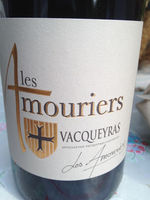
Domaines de Amouriers ‘Signature’, VacqueyrasDomaines de Amouriers ‘Signature’, Vacqueyras, 2011 ($26): Somewhat basic, with vanilla, flowers and boysenberry in the bouquet and a moderately fresh and spicy middle-mouth. Vacqueyras sits along the banks of the River Ouvèze and produces wines that, while not blockbusters, may be described as ‘pleasant’.  This is good example of that, without ambition to be overly elegant, but delivering solid fruit and minerality.

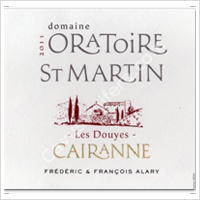
Domaine de l’Oratoire St, Martin ‘Les Douyes’Domaine de l’Oratoire St, Martin ‘Les Douyes’, Côtes du Rhône, 2011 ($29):  A sharp and distinctive blast of mulberry rises from the glass, carefully mingled with a lighter, leathery savoriness.  It’s followed by a ripe, smoky-rich palate that is still a little wood heavy, having been aged for 18 months en foudre and bottled without filtration—a striking bitterness comes through at the end and hangs around for a bit.

Domaine Biscarelle Châteauneuf-du-PapeEddie Feraud Châteauneuf-du-Pape, 2011 ($49): The wine remains taut; the nose is restrained, offering small scents of blackberry and pepper.  It shows better in the foreground, with a complex and textured set of flavors—coffee, spice, raspberry and tar—but does an abrupt  turnover to broad tannins that still show the harshness of youth.

Domaine Biscarelle Châteauneuf-du-Pape, 2011 ($50): Bright and forward, the wine is from a fairly young estate, only founded in 1984.  Grenache heavy, with Cinsault and Terret Noir along with the usual suspects, it offers a spicy blast of iodine in the nose and a pronounced, refreshing acidity, leading into an aggressive palate, rich in black fruits and earthy tonality, leading to a snap of oak at the finish.

And The Winner Is…

Tramp,  Can Grau Vell, Catalunya, 2012 ($40)

tramp2Irony of ironies, the GSM blend that raised its head above all Southern Rhône contenders was a monumental Spanish wine from a minuscule producer—a wine with the unlikely, unlovely name of Tramp and a picture of a stray dog on the label.

The Catalan eye-opener is made by Jordi Castellvi in little Can Grau Vell, a winery situated on less than eight acres near the town of Hostalets de Pierola at the foot of the Montserrat mountains.  Castellvi plants five varietals; beside the Big Three of Rhône , he raises Cabernet Sauvignon and Marselan, a varietal better known in Languedoc.  These are blended into Tramp, named for a mutt that wandered through the vineyard and took sanctuary within Castellvi’s picturesque villa.  It is a beautifully crafted, amazingly vivid wine, displaying an intense nose of violets, tarry plum, blackberry with a distinct mineral lift; the palate echoes the depth of the aroma and adds additional structure with chocolaty, spicy finish.

Jordi Castellvi

Jordi Castellvi

I hesitate to offer further praise simply because I was fortunate to try this wine and the likelihood that you’ll find a bottle are fairly slim—less than 600 cases were made.  But it represents the luscious style of wonderful wines coming from some of these upstart Catalonians a few hundred miles south of Avignon.

Is the reign of Rhône under siege?  To me, some of the old standbys are tasting a bit tired, a touch rough around the stylistic edges.  If Castellvi’s wares are an example of the direction the fascinating appellation of Catalunya—known primarily for the unique sparkling wine Cava—is taking with GSM, I think they’ve got a shot at some serious glory.

Posted in Uncategorized | Tagged , , , , | Leave a comment

As A Wine Critic, William Shatner Makes A Good Starship Captain

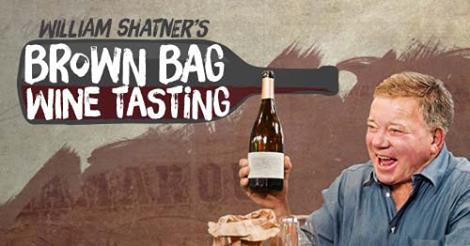
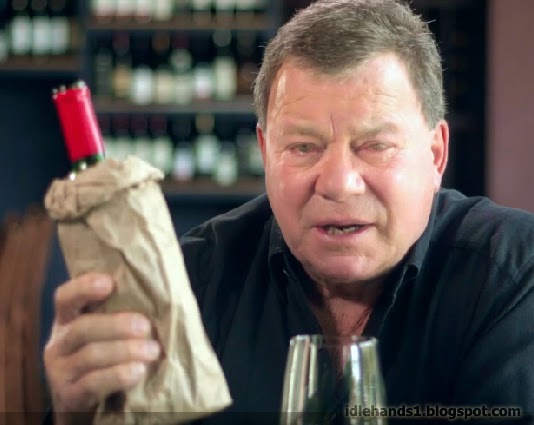
brown bag it logoI was recently introduced to William Shatner’s foray into what we can only hope is the corpulent old hambone’s final frontier: ‘Brown Bag’—a bizarre wine tasting show featuring people who don’t know anything about wine interacting with a host who doesn’t either.

Then again, as a colloquial expression, ‘brown bag’ does not promise great wine insight, but rather, is a phrase used to describe the sack in which you hide a bottle you are ashamed to be seen with.  It may be a metaphor for a culmination of Shatner’s career, but it is not reflective of the  stuff tasted on the show, which are generally wines of pretty high caliber.

Better days

Better days

Lest this come across as Shatner bashing, let me say up front that he is not only my favorite Starfleet captain, he’s the only one—all the other Slim Shadys are just imitating.  But, just as I wouldn’t want Jancis Robinson to slither into a polyester ‘n’ Velcro jumpsuit and take command of the bridge, neither do I want James Tiberius Kirk sticking his rheumy eyes and third-stage-alcoholic schnozz into her area of command.

It’s a better galactic coordinate when some Slim Shadys simply fail to go there, boldly or otherwise.

"Maybe if you changed seats it wouldn't be so red, James."

“Maybe if you changed seats it wouldn’t be so red, James.”

The format of the show (actually more of a podcast) has Shatner jawboning with so-called ‘celebrities’—although the red-carpet superstars may include the manager of a breakfast-all-day restaurant and some woman who auctioned off an afternoon with Shatner, then had her husband outbid everyone else—as they taste a wine from a paper bag and wax naïvely about it.  Depending on the taster’s level of experience, this may or may not include inanities like, “The wine takes itself too seriously,” (James Reddick, Motorcycle Enthusiast) and “It’s egg-suberant,” (Blaise Supulveda, Eggslut Manager) and “We don’t care about the nose,” (William Shatner, Host).

However, the most WTF? part of the show is its wine scoring schematics, which may be said (by any corporeal, energy-metabolizing species in the Alpha Quadrant) to be highly illogical.

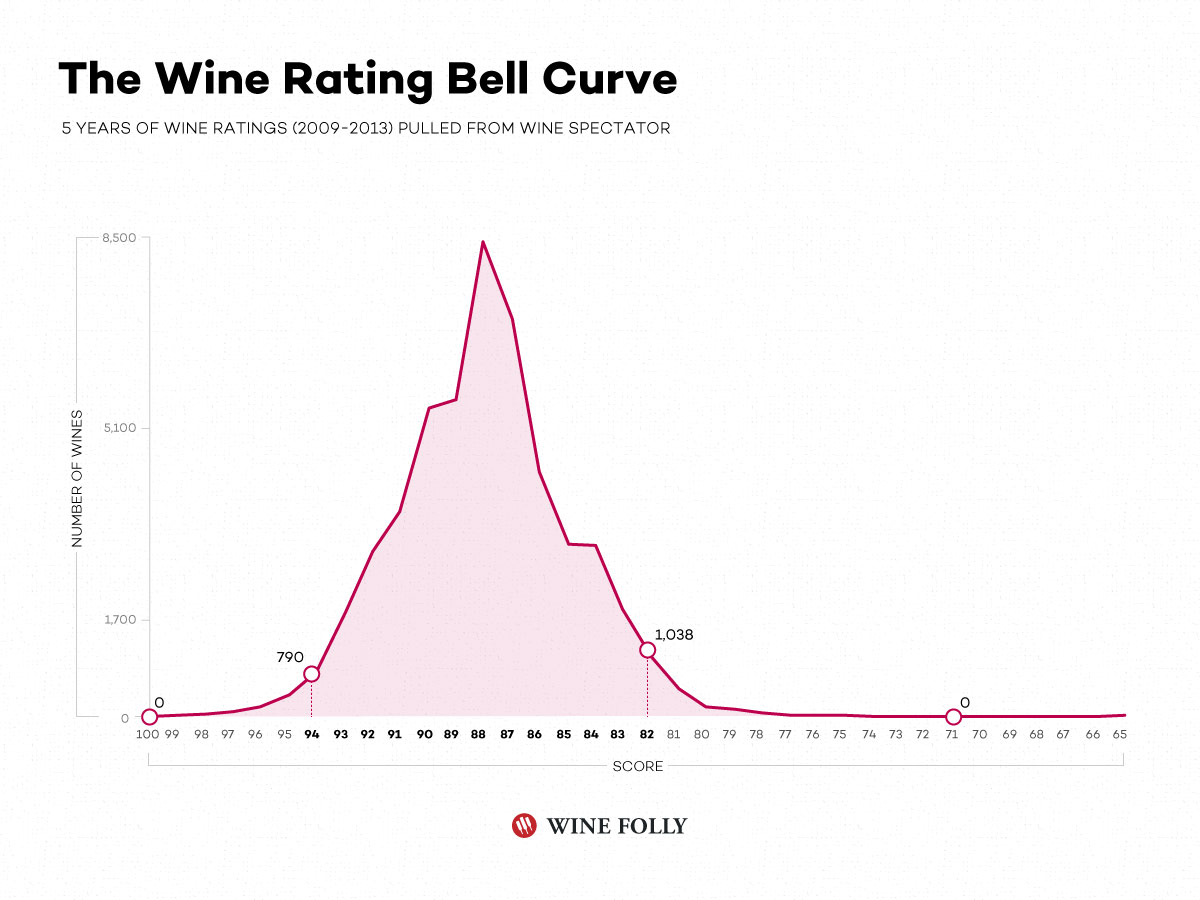
belll curveWines are scored on a ten point scale. So far so good.  But that scale runs from 85 – 95, which is where most of Wine Spectator and Wine Enthusiast wines score, granted, but that’s only because that scale runs to a hundred. And even then, the ‘100-point’ scale sucks Syrah sediment because it doesn’t really start at zero—the lowest score I ever recall seeing was a 70, and that virtually never happens, meaning that in the most charitable analysis imaginable, Wine Spectator and Wine Enthusiast and countless other wannabe critics use a 30-point scale.

But suppose you ultimately feel comfortable counting no higher than the number of fingers you have? Fine; but even then, the choice of scoring between 85 and 95 is ludicrously random despite it being the ‘sweet spot’ that most drinkable wine falls in. Why? Because in that ten-point spread, giving a wine an 85 would correspond to a Wine Enthusiast 70 (which actually is a ‘1’) and bestowing a 95 is the same as awarding a wine 100 points. And if that’s not what it means, then what the hell does it mean?

Dude, I’ll make it simple: A 10-point scale should run from one to ten. Not only is that Spock-smart, it’s also a scale that has proved perfectly adequate for emergency room physicians in gauging your pain level prior to removing the Tribble from your sphincter.

I'll have whatever the host is having.

I’ll have whatever the host is having.

Each ‘Brown Bag’ episode ends with playful banter between Shatner and guest which may or may not include Bill’s personal assessment and in which he may or may not be high on some intoxicant or other, but certainly looks as if he is.  And he may or may not agree with his guest’s opinion.  One time when he did agree was during the episode where music historian Robert Greenburg tried some Hunt Cellars Viognier and pronounced the wine ‘a little too sweet’.  Shatner echoed the sentiment.

Unfortunately for them both, the wine is  bone dry, which may give you an idea of the quality of the information you are likely to take home from the show, brown-bagged or otherwise.

Shatner will always be Kirk to me, or at least, that mad-cow lawyer from Boston Legal.  I’m afraid I will have to relegate ‘Brown Bag’ to the circle of hell just above Priceline commercials and his excruciating interpretive recitations of ‘Mr. Tambourine Man’.

In other words, will the real Slim Shady please drink up, shut up, and sit the f*ck down.

Posted in GENERAL | Tagged | Leave a comment

Corsica: Napoleon’s Vinous Dreamscape

If you took the eno-expertise of France and blended it with the climate of the Italian Riviera and stirred in the heritage of Greece, you might  suppose that you’d just created vine Valhalla—a test tube appellation with Goldilocks conditions where everything is just right.

Not quite.

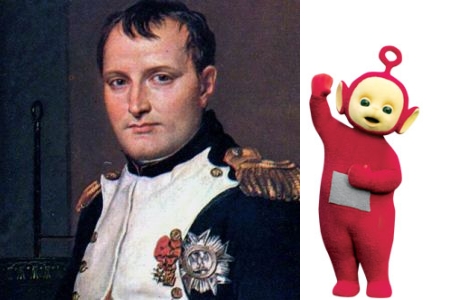
Clipboard telCorsica, an island off the coast of Italy, began producing wine half a century before Christ was born, when Phocaean traders from Anatolia planted vines in Aléria on Corsica’s western shore.  The island was sold to France in 1768, a year before the birth of history’s most famous Corsican—Napoleon Bonaparte.  Ironically, under his empire, the island was virtually ignored and it appears to have devolved into a sort primitive, feudal community that made Cosa Nostra-ruled Sicily seem like Teletubbyland.

corsica map LPThat may be an exaggeration, but between 1821 and 1852, 4,200 murders were reported in Corsica; the number that were handled via family vendetta is unknown. Throughout this period, and extending well into the twentieth century, the primary grape planted throughout the island was Sciacarello, a variety generally used as a blender (once vital in Chianti).  As a stand-alone, it produces a simple, strawberry perfumed wine that rarely reaches any depth of sophistication.  As such, the wines of Corsica, despite all the previously mentioned stars aligning, have not planted many flags of glory.

As a land mass, Corsica looks like someone’s left foot with all the toes amputated except the big one.  It’s pointing directly at Liguria, one of Italy’s smallest and most rugged and least renowned wine regions, but that’s a story for another day.  Although separated by ninety miles from the Italian mainland, Corsica was dealt a double whammy in the late 1900’s as phylloxera devastated vines as the indigenous population began to emigrate in huge numbers. It wasn’t until the Algerian War of Independence (1954 to 1962) attracted a reverse wave of immigrants in the ‘50s who began to revitalize the Corsican wine industry.

Sciaccarello

Sciaccarello

But that industry was primarily Corsican wine for Corsican people, and a whole lot of it. The rest was used to top off Europe’s infamous ‘wine lake’; a glut of mass-produced wine from warm climates like Languedoc-Roussillon, Castile-La Mancha, Apulia—and Corsica.  Over the past few decades, these regions have loosed so much plonk on the European continent that prices have plummeted and there has traditionally been so much left over that the EU paid subsidies to turn it into industrial alcohol.

In the later years of the twentieth century, some of the subsidies began to be handed out to growers willing to reduce the numbers of vines they tended, and in Corsica, by 2003, that resulted in 17,300 vine acres being uprooted.  Combined with modern techniques like temperature-controlled fermentation, the quality-over-quantity mindset has begun to take hold.

Cutlass-wielding Abbatucci

Cutlass-wielding Abbatucci

Abbatucci is a name you see everywhere in Corsica’s capital city of Ajaccio—there have been lauded Abbatuccis making Corsican waves since the French Revolution.

These days, it’s Jean-Charles Abbatucci who is raising the flag of revolution throughout the wine world, leading the charge with his portfolio of exclusive gems made almost exclusively from rare Corsican varietals, some of which he actually saved from extinction.  Today, his largely man-made ecosystem, comprising about 170 acres, includes terraced groves of olive trees, dry-farmed vineyards, no pesticides, and the unique (and ostensibly, unproven) technique of blasting the grapes with recordings of Corsican folk songs, both in the field and in the winery.

To lovers of native varieties, though, Abbatucci’s wines can be a double whammy.  First, there are hardly any of them available in the United States and the really exemplary ones are very expensive… triple digits in some markets.

labelI consider myself extraordinarily lucky to have been able to sample one of only 2000 bottles of Domaine Comte Abbatucci Ajaccio Cuvée Collection ‘Ministre Impérial at a shop where it retails for around a hundred dollars a bottle.  This strange brew, a blend of Morescola, Morescono, Aleatico, Cacajolo-Nero, Montanaccia, Sciaccarello and Niellucio. A gold medal if you’ve heard of any of these grapes; the brass ring if you’re familiar with all of them.  Niellucio is another name for Sangiovese, but the rest are—as far as I can determine—indigenous cultivars which Abbatucci’s father collected from mountain growers in the early 1960s.

The resulting wine takes on contours unlike virtually any wine I can bring to mine—with a single, odd exception.  It took me a brain-racking moment to recall the organoleptic checklist of certain Norton-based wines from Missouri. In seasons where the grapes fully ripen, there is an exotic combination of flower perfumes and exotic berry spice that mingles; it is the very elusiveness of identification that held my interest until memory dished up the strange variety—a Vitis aestivalis.  Meanwhile, the wine unfolds with a creamy, red berry palate filled with wild raspberry and red currant in the foreground.

David Shildknecht

David Shildknecht

Yet David Shildknecht of Wine Advocate—a dude who overwrites even more shamelessly than yours truly—speaks of this wine’s “virtually endless finish.”   In fact, the one drawback to the wine I noted was the quick fading of the fruit; delightful and exuberant up front, but dropping off quickly, as though lopped in two by a Corsican cutlass.  The finish was indeed long, but composed primarily of wood; a flat, neutral, popsicle-stickiness.  I am assured that Shildknecht was reviewing the same wine, but I couldn’t find a vintage on the label—only a cork with a 2010 stamp, which is what I’m trusting.

It’s an interesting mind game, though.  Nobody who writes in efflorescent bombasticisms as ‘a kaleidoscopically interactive, saliva-inducingly saline, uncannily energetic wine’ is a tasting tenderfoot and nobody who works for Parker is a piker, so how did we come to such diametrically opposite conclusions about a wine’s conclusion?

I’ll leave you to draw your own conclusion.

It would be best if you simply tried the wine on your own and decided who you should trust in future: A highly literate pro who holds a respected position on one of the world’s most influential and widely read wine forums…

Or Shildknecht?

Posted in FRANCE | Tagged , | 1 Comment

Je Suis Plein De Merde

The tragedy at the Charlie Hebdo office in Paris has been fuel for reflection for a lot of people who write smarmy shit for a living.  It’s also proven useful First Amendment fodder for people who would never consider mocking a man’s religion or a woman’s faith but, like Voltaire, claim that they would defend to the death your right to do so.

je-suis-charlie-800x495These may or may not be people who would actually miss a meal for your right to do so (let alone die for it), and I’ll bet that most Americans had to look up ‘je suis’ before attaching their names to memes claiming that they were Charlie.

Which, of course, they aren’t.

Fun_Funder_thumb-640x0I’m not Charlie either, so I thought better of adopting the slogan, although in ways I am probably closer to being Charlie than you are, having spent a decade writing incendiary tripe for a satirical rag called Fun Magazine where I managed, at various times, to offend dogmatists of many stripes. Which is cool, except that in the process I also offended a lot of excellent people. I once did a one-line joke that so angered the gay community that they protested outside our office and called our advertisers demanding that they pull their ads (which many did); I wrote a ludicrous bit making ludicrous jokes about a jumbo jet that crashed in Detroit in 1987, and it so hurt the sister of one of the victims that she wrote me a long, expressive and beautiful letter that so eloquently dissed the lameness of my piece that to this day I remain somewhat humbled and ashamed.

But do you know what? She didn’t shoot me, and against the odds, she is today one of my tight friends.

Je ne suis pas Charlie.

Yesterday, I posed an honest hypothetical, which was also an honest rhetorical hypothetical because I already knew the answer.  It went like this:

“If—incensed over their protests at the funerals of soldiers—a couple of vets broke into Westboro Baptist Church and opened fire, I am sure we would all call it a tragedy.

But I’m not sure how many of us would post status updates saying ‘Je Suis Westboro’.

Pastor Fred Phelps pictured in 1998As I expected, a lot of the people who responded missed the point entirely and used the statement to express their personal disgust at Westboro’s anti-gay, over-the-top demonstrations and insisted that, because the intent of this hysterical gang of publicity-seeking Bible-thumpers is not ‘satire’, somehow, defending to the death their right to say ‘God hates fags’ in public does not rank quite as high on the bucket list of Charlie Hebdo’s free speech zealots.

Why not?

You tell me; but I suspect it is because if we are honest with ourselves, we’ll admit—me included—that we are passionate about freedom of the kind of speech we agree with (in the case of Charlie Hebdo’s juvenile nonsense, rubbing the collective oversized Muslim nose in their own fundamentalism) but are less self-righteously vocal when, say, pro-jihadist Muslims make crude jokes about the attacks of 9/11.

Clipboard brianIn fact, CNN host Brian Stelter nearly popped a capillary when radical cleric Anjam Choudary did exactly that on Reliable Sources last August.  Choudary responded to Stelter’s outrage over his joke with this:

“If you had a sense of humor, you would have laughed at that. You shouldn’t take any of these things that seriously. If you want to make it a big deal, then do so, but it makes you look much more shallow, really.”

Stelter reacted by throwing another hissy fit that ended the interview.  Needless to say, we are still waiting for all those ‘Je suis Anjam Choudary’ memes.

botswanaAs free-press writers focusing on wine rather than bad jokes, our dogmatically-held mantra is that ‘everybody should drink more wine’.  Wine as a social beverage, wine as a contemplative tongue-loosener, wine as a prize at the end of a hard-earned day, wine to accompany each of the three squares we somehow believe, as Americans, are our sovereign birthright even though 80% of humanity is lucky to get even one.

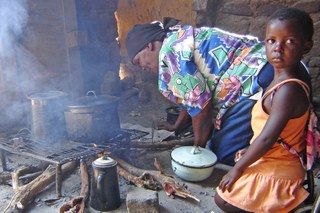
We may be Charlie, but very few of us claim to be four-year-old Sadiya eating sheep lungs in a concrete shed in Botswana.

To that end, we should embrace any wine that cheap enough and mass-produced enough and, frankly, good enough, to serve as that all-day, every-day tipple—that is, if we really believed our own mission statement.  Je suis Two Buck Chuck. Instead we spend an inordinate amount of time creaming over labels that cost more than Botswana’s GNP and pause only long enough to remind everyone that we are firmly committed to the principals of Liberté, Égalité, Fraternité.

I am assuming that if she had the wherewithal to consider our hypocrisy, little Sadiya would laugh so hard she’d choke on her sheep lungs.

hebdo coverUnknown is how she will react one day if she sees a copy of Charlie Hebdo’s cover portraying her father—an ordinary hardworking, give-us-this-day-our-daily-sheep-lung Muslim—as a gay man embroiled in a slobbery French kiss with the late editor Stéphane Charbonnier.  However, the point is probably moot since she has a one-in-five chance of dying before her fifth birthday anyway.

She may not note that the social media community is ready to become meme-ically militant over Charbonnier’s death, but over her own, not so much. But I note it, and I am just as guilty of cherry-picking noble causes as you are.  Thus, humbled and ashamed as I was reading Lisa’s letter in 1987, there is a slogan that I’m prepared to embrace: In general,

‘Je suis plein de merde’.

And I’ll defend to the death your right to admit that, more than likely, you are too.

Posted in GENERAL | Tagged , , | 2 Comments

Bourgogne Passetoutgrain: Gamey Gamay

Pinot Noir doesn’t need my stamp-of-approval of course, but Gamay is a groovy grape that occasionally wears a stamp-of-ignominy because of Beaujolais Nouveau—which I also like—and which, in any case, is as absurd as dissing Zinfandel because of Sutter Home.

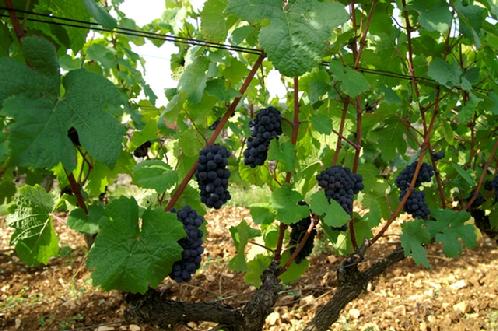
Gamay in Passetoutgrain

Gamay in Passetoutgrain

Passetoutgrain, sometimes written with a hyphen after the ‘Passe’ and another one after the ‘tout’, is an interesting Burgundian appellation in that it not location-centric and may cover all of the AOC ‘Bourgogne’. This includes the communes of Côte d’Or, Rhône (not the wine region Rhône), Saône-et-Loire (not the wine region Loire) and Yonne.  But, since it is an appellation defined by grape varieties, one of which is Gamay, the bulk of it comes from areas in the Côte Challonaise, where red wines may be spicy and relatively inexpensive, like the Pinot Noirs of Rully and Mercurey.

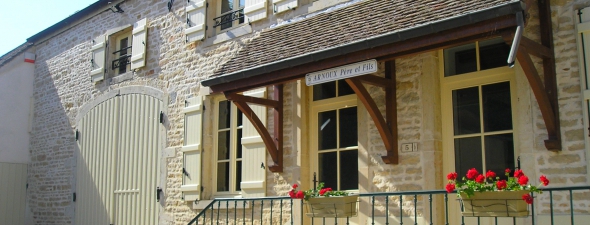
Domaine Arnoux Père et Fils

Domaine Arnoux Père et Fils

Created in 1937, Passetoutgrain means ‘All Grapes Pass’, and indeed, there is little separation of varieties at harvest.  But there must be some, since the rules of the game say that to wear the name Passetoutgrain the wine must contain more that 30% Pinot Noir, more than 15% Gamay with the rest made up of Chardonnay, Pinot Blanc and Pinot Gris in any quantity totaling less than 15%.  The resulting hodgepodge, if vinified with circumspection, equals a beautifully rustic, everyday wine that is suited to casual consumption without pedantics; no requisite mention of lieu-dits and two-acre-parcels that often accompany wines from Burgundy, the most coveted real estate in France.

peasantsAnd that pretty much describes Domaine Arnoux Bourgogne Passetoutgrain, 2011.  A touch older than ideal, the wine nonetheless shows more complexity than might be expected from a like-priced Beaujolais (around $16), opening with a carbonic whiff of cranberry juice and fresh tart cherries, leading into deeper, chewy scents of dry, earth and leather, and then even deeper to roasted meat. It’s sharply acidic and slightly smoky, filled with immediate flavors that emphasize the fruit in the nose (kirsch as well) and less of the savory fleshiness. The wine shows satisfactory, medium length on the palate and seems suited to a family of intrepid, Pre-Revolution subsistence workers hunched in a peaty hovel supping thistles, salt fish and beans and raising a cup of the meal’s highlight:

Peasant wine.


Posted in Burgundy, BY VARIETAL, FRANCE, Gamay, Gamay, Uncategorized | Tagged , | Leave a comment

Droning On About Smith-Madrone

New-Year-inNothing like new friends and new wines to introduce the New Year along with the anticipation of making new enemies over our old opinions on wine, eh?

Although I am sure my pal Julie Ann Kodmur will not unpal me over my opinions of the triumvirate of tasty treats she sent me from Smith-Madrone: Three thumbs up.

Spring Mountain District

Spring Mountain District

The selections represent three unique vintages, offering a cross-section of both fruit and fruition in the tiny Napa appellation of  Spring Mountain District. Nestled into the eastern slopes of the Mayacamas Mountains at elevations as high as 2,600 feet, the region is home to around 30 wineries offering the quintessence of mountain-grown wines. That is, cooler temperatures and longer hang times result in cleaner, acid-driven wines packed with ripe but nimble flavors; they may be cleaner in profile than valley wines and, in good vintages, showcase the ‘red’ contours of red wine grapes, cherry and raspberry, while in white varietals, melon and stone fruits predominate.

Smith brothers

Smith brothers

Smith-Madrone is named for the brothers Smith (Stu and Charles) and the Madrone trees that cohabitate with them on the 34 acres they grow on hillsides that may reach 30% grades. Eastern slopes are reserved for Riesling, southern and western exposures for Cabernet Sauvignon and northern slopes for Chardonnay. The vines are dry-farmed, meaning that the roots struggle to find water and thus, penetrate deeper and through varied soil strata, often resulting in nuanced wine with greater complexity. Vines aged 25 years or more can also produce multi-layered wine with sensory dimensions beyond the reach of their younger counterparts.  And it shows in the Smith-Madrone portfolio, drawn from vines up to forty years old.

20112011 was somewhat wet and dreary, with long rains in April and May delaying bloom on some vines and disrupting fruit set on others.  This set the stage for a smaller-than-average harvest.  Diligent vineyard managers opened up the leaf canopies to allow maximum sunlight to reach the clusters, and a long warm summer salvaged the vintage, leading to some intense wines of great depth.

2012 was an ideal year for Spring Mountain, with ample rainfall during the winter and a dry early spring. The growing season, while cool, offered no real climate exaggerations until a heat spike just before harvest, but that settled down and allowed a longer, more leisurely final ripening.  The heat inversion that plays a vital role above the valley fogs allowed for a slow accumulation of grape sugars and extended the time the grapes were able to develop the riper flavor nuances.

2012If possible, vintners were even more satisfied with 2013 than the previous year, with each development phase of a vine’s yearly cycle occurring in an orderly and predicable fashion. According to Tom Ferrell, Executive Director, Spring Mountain District Association, “Winemakers are never perfectly content with any vintage; there is always something they would change. But this year I was hard-pressed to draw anything from Spring Mountain District winemakers other than praise for the fruit the vintage handed them.”

Try the following as an introduction to the nuances of vintage and the alpine amplitude of Smith-Madrone’s wines. They are wines that define the region, from a winery that is not only on top of Spring Mountain, but also, on top of their game.

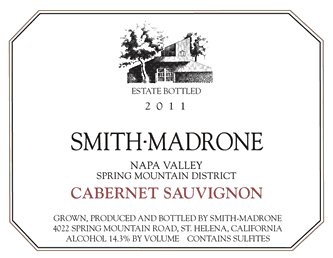
cabSmith-Madrone Cabernet Sauvignon, Spring Mountain District, 2011 ($48)

Brisk perfectly-ripe red and black berries in the nose, neither jammy nor stewed.  The juicy perfume is shored by dry-leaf tobacco notes and a bit of wood smoke.  Eager but adolescent, the wine has its dominant acids up front and its mouth-coating tannins holding up the rear, but the fruit—though lively and restless—is too solidly framed by both.  These are traits that fade with time, and will doubtlessly lead to an integration of the whole, at which point, I predict a silken, voluptuous wine that expresses harmony in this indispensable trio of cab components.

Smith-Madrone Chardonnay, Spring Mountain District (Napa), 2012

The wine opens with a blast of lemon custard, vanilla and honey, leading to concentrated blend of peach and and citrus acid framed by malo cream.  This is an exquisite Napa chardonnay with a textbook California unctuousness balanced by cool-climate crispness—a wine that take cues from Burgundy, but signs it with an expression of pure, New World clarity.

rieslingSmith-Madrone Riesling, Spring Mountain District, 2013

A commendable representation of Riesling in California, albeit with restrained aromatics. There’s a touch of sulfur in the foreground, but it quickly dissipates into light aromas of peach syrup and almond. In the mouth, these sappy stone fruit flavors flesh out and become an expansive fruit bowl of sweet melon and apricot with clear mineral tones and tart grapefruit in the end.  Acidity is fresh and corralled by sweetness, and the wine offers an advanced course in Rheingau-styled Rieslings in a climate where only impassioned winemakers succeed.

Posted in CALIFORNIA, Spring Mountain District | Tagged , , | Leave a comment

Life’s A Bubble: Sparkling New Thoughts, Fizzy New Year

In the week before Christmas and New Year’s, it is customary to write a column about Champagne and related species.  And doing what is expected, occasionally a thorn in the paw of creativity, also keeps us focused in this time of hedonistic overload, when corks fly merrily and cheer is synonymous with alcoholic indulgence and the only reason you have a job in 2015 was that your boss was too drunk at the holiday gathering to remember what it was you said about his wife that made him want to fire you in the first place.

Thus, a little discipline is in order.

And thus, the stolid tale of three sparkling wines.

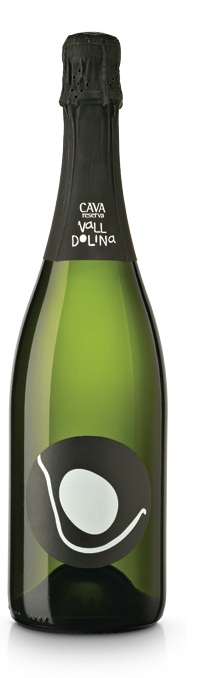
VallDolina Cava Reserva

Americans don’t drink enough Cava, and that which they do drink tends to be the stuff you find at 7-11 between the Monster Energy and 40-ounce malt liquors.  If this was your introduction to Spanish méthode traditionnelle and you opted to pull the plug on future experimentation, you are to be forgiven: It’s as if your first dating experience was dinner and a movie with Lorena Bobbitt.

Catalan vines

Catalan vines

Nearly all of world’s Cava comes from Catalonia in Spain’s extreme northeast; in fact, the word ‘cava’ is Catalan, a language that in vocabulary, pronunciation and grammar is said to be closer to French than Spanish. It’s the official tongue of Andorra, and in any case, ‘cava’ means cave. It was adopted by Catalan winemakers in 1970 to distinguish the product from Champagne, which must, by law, come from the eponymous region of northern France.

Like the language, Cava is a different beverage. The Holy Trinity of Champagne are Chardonnay, Pinot Noir and Pinot Meunier; in Cava, it’s Macabeo, Xarel-lo, and Parellada. Tasting notes in either category are as varied as the price tags, but in general—to my senses—Cava’s profile runs toward richer, baked apple flavors and Mandarin orange, and the earthier, croissant-like sweetness of yeast and butter—when experienced together, reminiscent of a fruit turnover.  Champagne may seem more elegant up front, with crisper citrus notes, fresh apple in the nose and finer toast scents.  Exceptions, of course, abound.

Garraf-Massif.10The Garraf Massif is a Catalan mountain range, and from its calcareous slopes come some of the world’s finest Cavas. Like chalky Champagne, these lime-rich, easy-draining soils are loaded with the remains of marine micro-organisms which may also act as a reservoir, providing the vines water even during drought. Such soils are said to impart a certain mineral quality to the wines they produce, and however much this can be disputed by geologists, the clean, slate-like quality in Garraf Cava cannot.

Considered one of the finest winemakers in Penedès (where the Cava DO is located) Raimon Badell of Cellar Masia Can Tutusaus produced organic Cava since 1998, adhering to the European Directive 2092/91.  This nod toward an ecological future does not diminish Badell’s time-honored practice of manual disgorging without freezing the sediment, an arduous tradition requiring a special expertise.

valldolinaVallDolina—a name that refers to the valleys that bisect the Garraf mountains—contains, beside the three primary grapes of the region, a small percentage of Chardonnay to add structure and ‘vinosity’—a buzzword that, like ‘minerality’,  is hard to pin down.

Four years on the lees leaves an impression much easier to define: The wine opens with a full-flavored nose of apple custard and toasted brioche, leading into a palate balancing crispiness with cream. The acids are bright and omnipresent from beginning to end, tempered with nuttiness and dried apricot notes that may, in part, result from Cava’s climate, warmer than Champagne, allowing for the development of phenologically riper grapes.  Plus, the years the wine spends sur lee allow for the emergence of complex autolytic compounds that heal too-aggressive acidity and provide the characteristic pastry and honey flavors.

The clear VallDolina advantage, of course, is price. At $18, this Cava Reserva, a robust and exquisite sparkling wine that can rival Champagnes—and even other high-end Cavas—costing three times as much.

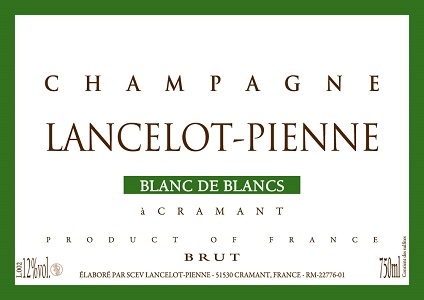
Lancelot-Pienne Brut Blanc de Blancs à Cramant, NV

You say Crémant, I say Cramant—but let’s not call the whole thing off just yet.  Crémant, of course, is a wine word used to describe sparkling wines with a bit less fizz, and may also refer to sparkling wines made outside of Champagne and from varieties other than those legally permitted in that region. Cramant is a place—a commune in the  Côte des Blancs sub region of Champagne. Thus, all Cramant is Champagne, but not all Champagne is Crémant.

On to the wine:

Tlance labelhe estate of Lancelot-Pienne’s history traces back 120 years when Jean-Baptiste Lancelot, then a vigneron for Mumm, put in the first of what is now 20 acres of vines.  His son, Jean, took the reins after World War II and began produce his own cuvées. The third generation of Lancelot married into the Champagne family Pienne, and in 1967, the vineyards of both houses came into common ownership.  Since then, the estate has produced wine exclusively from its own estate, releasing a tiny yearly average of 700 cases.

Gilles Lancelot

Gilles Lancelot

Gilles Lancelot has been the knight in charge since 2005, and the Blanc de Blanc—a 100% Chardonnay cuvée—comes from plots Grands Crus villages of the Côte des Blancs.  These vineyards enjoy an optimal southeast exposure and are on steep gradients to maximize sunlight. About 80% of the base wine is vintage, with the remainder being steel-aged wine stored under a Solera system, blending freshness and finesse with complexity and richness.

Lancelot-Pienne

Lancelot-Pienne

Indeed, the wine shows a strikingly metaphorical nose, one suited to a Blanc de Blanc—everything I inhale is redolent of white stuff.  White truffles, white peaches, pears, white stones.  It’s followed by silken-textured mouthfeel filled with toasty, biscuity notes (white ones), an almost crystallized honey expression and a good show of textbook Cramant minerality.  At around $40 a bottle, it is at an equivalent price point of the house blends which by their breeding—though meant to reflect a consistent style—tend to be generic and somewhat limited in complexity. Lancelot-Pienne Brut Blanc de Blancs à Cramant, by contrast, is filled with depth and lyrical character.

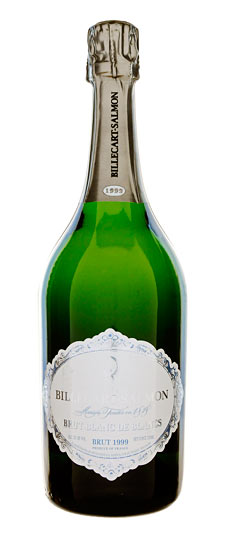
Billecart-Salmon Blanc de Blanc Brut, 1999

With a beautiful vintage Champagne from a respected estate (not to mention a $160 price tag), I did what bubble purists might consider sacrilege: I blew it off for twenty-four hours after opening it.

The immediacy inherent in sparkling wine is part of its legacy, especially during this gimme, gimme season.  Corks are popped and the wine is poured so quickly that frothy run-off is part of the tradition; Champagne screams ‘now’, and the quick dissipation of the sparkle is science of which there are not many ways around. Nor are there many reasons to want one: Champagne is for festive moments, shared celebrations, and five skinny flutes is about all you’ll get out of a bottle in the first place.

L.: Wrong R.: Right

L.: Wrong
R.: Right

Except that flutes are all wrong, especially for a pricier Champagne.  Trust me, if you don’t care about the sensory nuance that aged vintage Champagne brings—and plenty of arriviste Champagne fans don’t—save yourself the do-re-mi and go for the label’s standard $40 non-vintage bottling.

Mousse is a must, but an excess of theatrical lace tends to mask the wealth of aromatics that are vintage Champagne’s real calling card; rising carbon dioxide may showcase citrus and yeasty tones, but it doesn’t encourage the release of subtle esters, ethers and aldehydes; that happens when wine mixes with oxygen, and that’s the reason we swirl it in the glass.

And, of course, swirling a flute is a futile and messy endeavor, which is one of the reasons it is a silly choice for a Champagne glass.  Flutes focus the bubbles while denying the bouquet sufficient space to expand.  Wine should be a faithful messenger of the soil, and the soils of Champagne are so connected to its glory that to mute them is, to me, a far greater sin than giving them time to open up: Even the twenty-four hours I waited.

This time lapse was certainly at the expense of the lion’s share of the froth mane, but (a nod to the quality of the winemaking) not all of it.  It created a wine in the style alluded to above:  Crémant.

Billecart-Salmon Blanc de Blanc Brut bottleNot entirely the experience that the esteemed estate in Mareuil-sur-Ay may have intended, but I can, perhaps, be forgiven if I point out some of the deeper mysteries that revealed themselves in the wine when the fizz settled and the wine was given leisure to unzip itself:

The wine leads with a savory whiff of rich, buttery strudel—the dénouement of eleven years on the lees; the earthen crust gives rise to poached pear and waxy lemon peel with light undertones of ginger.  The thickness—and this is not a pejorative—of the fruit is revealed with a tamed effervescence, showing a succulent array of apple peel, lemon chiffon, toasted almond and spice, finishing with a long, sensuous, bracing minerality and an acid spark.

You may not want to leave an entire bottle in the cooler overnight, but I suggest you save a single glass and try it the following day.  See if you agree that there are dimensions to this delightful beverage–depths to be plumbed—that are often overlooked for the sake of instant gratification.

Posted in Champagne | Tagged , | Leave a comment