Natalie Scotto: Reeling in the Leviathan

A few interesting things become obvious after a short conversation with Natalie Scotto.  First, she doesn’t operate on Scotto Time, that unique World Clock zone where everything is red-shifted forward ten or twenty or thirty minutes to fit rapid-fire schedule changes.  Setting a meeting time with Natalie is different:  If you say 11 AM, she’s there en punto, every time.
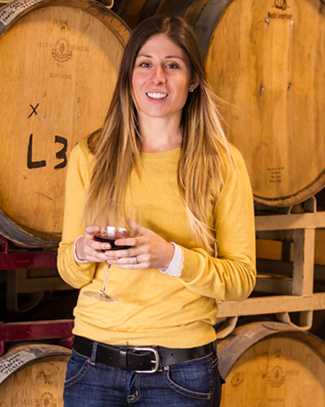
nataliescottoAlso, as a generally calm and introspective woman in an occasionally old-school Italian family overloaded with focused, jitterbug males, she is a unique puzzle piece that nonetheless fits in securely—her talents are a beautiful and strategic counterpoint to theirs.

Third, her legal name is Natalie Woods, which as a name comes with more baggage than a family of hyper-male Scotto brothers—she called her company ‘J. Woods Beverage Group’, explaining that her middle name, Jean, is a “J” name, and that to her, ‘J. Woods’ is sort of gender neutral and professional-sounding.  And to an extent, I agree:  ‘J. Woods Beverage Group’ conjures up (to me) an image of a professional dude in a Jos. A. Bank wool suit sitting at a polished desk dotting his i’s and crossing his t’s.  ‘Natalie Woods Beverage Group’ makes me think of cute little Susie Walker sitting on Santa’s lap, then growing up to be a bombastic beauty—in plural form.

Natalie Scotto-Woods is all that and more, and certainly no less.  Number four in the Scotto birth order, she was the second one to join the family business, and even that happened, quite literally, by accident.  Her father had a disagreement with a staircase, and the staircase won: She ended up as his driver throughout the healing process.  “I felt like a gangster’s driver,” she laughs.  “I never knew exactly where we were going or why, and I figured I was just there to push the gas pedal.”

But if you learn the hard way (like I did) that driving anywhere in California means long sojourns in backed-up traffic, you also know that prolonged automotive clots generally results in long conversations.  Over a number of congested afternoon, stuck on one of Northern California’s arteries, Natalie learned an awful lot about the blood flowing though her own arteries—her family, her history, and of particular interest to her, what her father actually did for a living.

“It sounds strange,” she admits, “But when I was growing up, I really was never sure what my dad did.  I knew that it had to do with wine, but he had strange hours, worked out of our home office a lot and went off on trips. My friends all had fathers with more, sort of ‘definable’ professions…”

In fairness to A2, a lot of Natalie’s childhood took place during a time when he was either out of the house or consulting for other wineries; his hand was in many pies as he scrambled to establish the substructure of a company that his children would ultimately help expand, Natalie included.  Her harpoon in that particular leviathan seems to have been forged in traffic, jam by jam, as she shuttled the wounded warrior between his various meetings.  The upshot was a clearer—but by no means complete—view of what her role would be in the remarkable family dynasty, the great vinous behemoth that, whether or not the Scottos admit it, exists… and with growing proportions.

Natalie’s was a baptism by fire. Or technically, by marriage.  Her oldest brother Anthony got married and Natalie was called upon to do some temp work in the office while he was on an extended honeymoon—a sort of all-inclusive job without a description or formal introduction wherein she fielded phone calls from people making offers she couldn’t even understand, let alone refuse.  At first, it scared the sh*t out of her when people called and wanted to cut deals, sell this, buy that—she was a stranger in a strange land, but through the sheer weight of responsibility, she did not remain one for long.  She handled the calls she could, negotiated when it made sense, solicited input from A2 when it didn’t, learned the lexicon, figured out how to handle invoices and gradually, meticulously, began to get a handle on precisely what it was her father did for a living.

“It wasn’t a cookie-cutter job, that’s for sure,” Natalie shares.  “Nothing you can stamp with a paragraph on a resumé.  At the time, I didn’t figure I was cut out for that sort of lifestyle—I had just spent four years at UC Santa Barbara studying sociology and education, and I was sort of geared up for precisely a cookie-cutter profession, like teaching.  My professors were pushing me toward grad school, and that’s pretty much where I saw  my future.  What working in the wine industry entails is a life without routine.  And I like routine.”

But, in her mind, she owed her father a term of repayment: Thanks to him, she’d graduated college debt free and had spent a summer in Italy on the family dime.  So, she took on the paper-pushing duties and the chauffeur duties, and by the time A3 returned from his honeymoon, she had begun to see a missing denominator in the Scotto equation:

Distribution, especially in Northern California.

logoAn essential to any winery’s formula is accessibility of product, and with the expanding portfolio of labels for which Scotto Family Cellars was responsible, getting shelf space and store placement was becoming an imperative.  Making wine involves a certain amount of throwing caution to the wind, but selling that wine is a whole different ball game: You’ve got to harness that wind and convince customers sitting inside life’s stadium that they want to drink it.  That involves a unique skill set, and two years ago, when her father and brother approached her to build a distribution network in Northern California, in part to cushion her family’s brands and in part because they sensed she would be good at it.

Before she agreed, however, she had a trio of non-negotiable conditions:
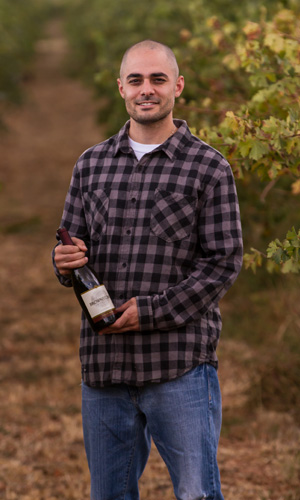
Michael Scotto

Michael Scotto

First, the company had to be based on a commercially sound business plan; second, it had to encompass a roster of like-minded people, both as clients and as representatives, which in brief means that integrity is bigger than the dollar.  And the third condition was but a monoword synopsis of Condition #2, a concept understood by Italian gangster drivers and Italian wine people alike:  ‘Honor’.

So with those contract riders in place, her family purchased a distribution company called Eagle Rock, and while maintaining her role at Scotto Cellars managing exports, compliance and wine and cider tasting event planning, Natalie agreed to take the reins, renaming it after herself—sort of.

Quality Scotto Time…

I sat down with Natalie at eleven en punto inside the upstairs all-purpose room at the Scotto’s Cluff Avenue winery in Lodi.  We rapped for a long time about the whole state of affairs, her family, her job, her outlook, her future.  She is a Scotto in every sense of the word, displaying the charm, energy and humility that I read as characteristic of the clan.

When I hung around with the eldest Scotto scion, Anthony III, I was struck with the paternal attitude he adopted when dealing with his siblings; that might be a natural birthright of primogeniture, and I found it touching.  But, equally touching is Natalie’s perhaps unconscious maternal predisposition that bubbles to the surface when she discusses her brothers—she looks out for them, scraps with them, does not suffer much backseat nonsense that might cause her to pull the car over to the side of the road.

Not that the true family matriarch, dear Gracie Scotto—who held down the fort through A2’s many masterpieces and missteps—is anything less than all encompassing as a mother figure; the short time I was able to spend with her was glorious.  She is, in every sense of her name, grace.  Every Scotto, including A2, acknowledges her role as the true hero of the Scotto story.

But Natalie possesses that grace as well, wrapped inside the front of a shrewd businesswoman—probably shrewder than she originally gave herself credit for.  She’d have made a good teacher, too, and God protect the student that thought he could slip something by her.  She has shows uncanny insight into her family’s individual fortitudes and foibles, perks and quirks, pluses and pockmarks and she rattled off a summation of her brothers with dead fire accuracy.

Anthony Scotto III

Anthony Scotto III

Number One Son Anthony, she notes, is a true visionalist.  A hyper-energy salesman that would have made a sensational history teacher, (much as I thought that she would have). “He’s got a brain wired for sales,” she maintains.  “And all the lateral thinking skills that requires.  I’ve never seen anybody who can be in so many places at the same time, not even my dad.  But with him, it’s organized and disciplined chaos.  He’s really a phenomenal leader because he teaches by example, not by lecture.”

Of Paul, the brother she claims is most like her in an approach to the wine industry, she say, “Paul is fun—he’s approachable and authentic, but highly technical.  He does nothing without research.  You find something you need for a dollar, I guarantee that Paul will find it for 99¢.
Paul Scotto

Paul Scotto

But, with these respects paid, she owns an ephemeral sort of attachment to her brother Michael perhaps unmatched in the others: “We’re closest in age and went through a lot of the same things at home; we had the same friends growing up and we both have—to some extent—a ‘go with the flow’ attitude.  With Michael, that’s a feature of hard work; he’s there, where he needs to be, every day without fail.  He’s the go-to guy—box sizes, bottle weights, that sort of stuff.  Paul is the technical whiz, but Michael takes care of the details.”

For her father, Natalie reserves the review that is the most poignant, and the one that may reflects most upon her own character: “I used to hear him in the morning, up ridiculously early, loud music playing, and I never really gave him credit for the depth of his knowledge—how his environment was perfectly suited to his performance.  Which is almost always superb. I remember him trying to bring in some sea containers of wine from Argentina and I kicked and screamed, thinking he was out of his mind.  Thinking back on it, I think he might have been testing me, seeing how I would react to such a risky move; anyway, I don’t think we wound up with that wine so on some level, he must have agreed with me.”

the Patriarch, Anthony Scotto II

the Patriarch, Anthony Scotto II

Her loyalty to the cause, however, both genetic and professional, is perhaps better illustrated by her reaction when we discussed the years that her father was gone, when there was no heavy metal at five in the morning, no long stints in the home office, no mentor riding shotgun and talking genealogy during traffic jam.  It was tough on all the kids, she says, but on her and Michael especially, because they were still at home and had to field the inquiries.  Tough on Grace, of course, but in the end, she had the adult perspective that might have been still beyond the kids.  And Grace forgave him, quicker, perhaps, than he has forgiven himself.

Has Natalie?  “He’s human, we all make mistakes.  He’s admitted his and he’s apologized I accept it, and we move forward.”

The true test, I figured, was to press my luck and the propriety and the situation’s delicacy and and ask her if she’d forgive her own husband Josh—a great dude who fits into the family seamlessly—for the same transgression.   And she doesn’t miss a beat: “Of course,” she says.  “And I told him so.”

See, to me, that’s class squared.  That’s grace under pressure.  Or better: That’s behaving with honor even when those around you, those you love the most, do not.  And the ability—the inclination—to do this becomes the test of any true teacher, whether in a class room or a board room:  Leading by example.
Posted in Lodi | Tagged , , | Leave a comment

PB&J’s Ultimate FUBAR: Aske Not, Want Not

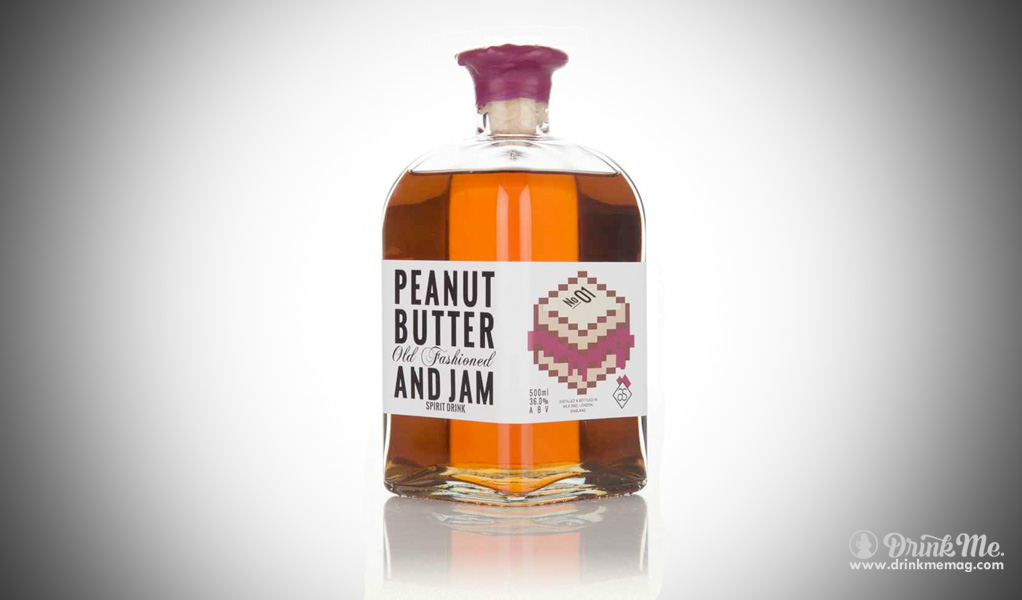
bottleFor reasons to be revealed later (or not), Mme KGP has filed the social media equivalent of a restraining order, which probably means she is forbidden from reading my demure disquisitions on the subject of spirits.

Whether or not this exile is self-imposed is immaterial—she is the Belle of Bourbon, the Mash Mama, and should she read of the abomination being thrust upon us by Aske Stephenson—Peanut Butter & Jam Bourbon—well, that would pretty much seal the deal…

If KGP wasn’t already dead to me, she’d die.

Aske Me No Question, I’ll Pour You No Rye

Aske Stephenson is some cockamamie ‘innovation arm’ of an equally puerile pile of poppycockery called Fluid Movement, which is a cock-and-bull ‘beverage consultancy’ that describes its raison d’être as providing ‘experiential drinking experiences to their clients, the likes of which had never been seen before.’

Mallards-Framed-Photographic-Print-9498I believe that in order to provide such likes-of-which idiosyncrasies, the duo of Thomas Aske and Tristan Stephenson have devised a foolproof technique.  They have stripped their sleek London office of all the polished wood furniture, all the pictures of mallard ducks on ponds, all the distracting trappings of efficiency like desks and computers and golf clubs and have set up on one wall a chart listing every liquor on earth and next to it, a chart listing every food on earth, and from that point, it’s just a matter of throwing darts.

‘PB&J in a Cocktail’ is the result of one such dart-storming session, and although I confess to not having sampled it personally, I am going to guess it tastes pretty much like the peanut butter and jelly mixed with bourbon that I whipped up in my streamlined, mallard-and-pond painting-free kitchen, which tasted exactly like peanut butter and jelly mixed with bourbon.

The invention of the PB&J in a Cocktail

The invention of the PB&J in a Cocktail

Granted, I had to leave out the ‘pink Himalayan sea salt’ that the cocktail’s brochure mentions as a key blending ingredient, primarily because I am a straight man and didn’t have any on hand, which may or mayn’t explains why my version of the ‘PB&J in a Cocktail’ sucked the socks off a Schwabian swineherd.

Speaking of Schwabian swineherds, Schwäbische Zervelatwurst & Sauerkraut Cocktail is another experience the likes of which the A/S clientele has never seen before—just in case someone is taking notes.

I could make up a hundred more cocktails using the mental dartboard I have set up within the expansive real estate inside my neocortex just below the mallard and pond painting, but instead, I’ll make up three more, then add a genuine cocktail from the idea guys at Fluid Movement and have you try to pick out the real one…

Cigar & Coffee Manhattan

Salt Shrimp & Cocktail Sauce Bloody Mary

Chestnuts Roasted By An Open Fire Old Fashioned

Fructose & Concrete Frappé

Okay, so I got bored at the end.  The real one is the first one.  Way to go,  Aske and Stephenson:  A drink that tastes like a cup of coffee somebody put a cigar out in.  Was this an A list idea, or a hangover idea?

Don’t Aske, Don’t Tell

'Name your poison.'

‘Name your poison.’

For the life of me, I can’t understand why anyone not a bartender would want to call themselves a beverage consultant, but suspending that disbelief, I suppose if I did call myself one I would figure that anything, no matter how outlandish and unpalatable-sounding, would count as ‘innovative’.  Even then, it would defy reason to think that anyone would actually spend cash money to drink stuff reaching this level of idiocy.

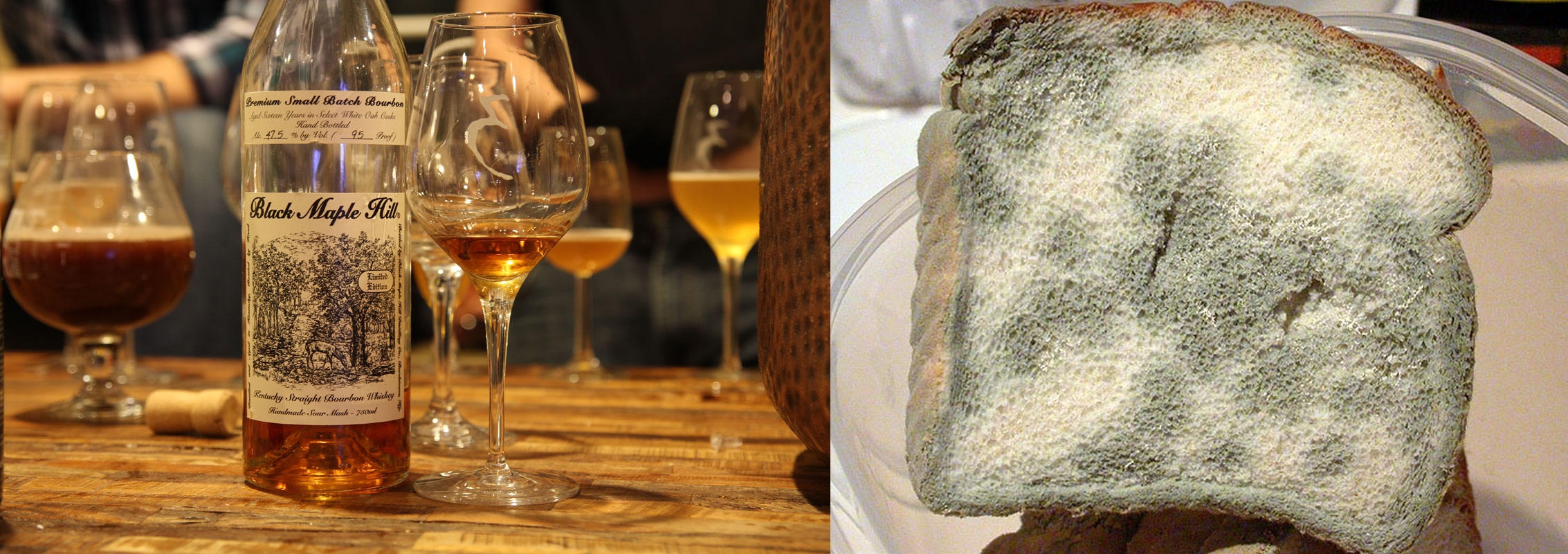
Can you imagine conversing with the aforementioned bartender and saying, “No, I am not interested in a Black Maple Hill 16-Year-Old Small Batch, but do you happen to have anything that tastes like the desperation sandwiches my boring mother used to stuff in my lunchbox when I was in the third grade?”

Clipboard sveetAnother genuine item from the A/S portfolio is the ‘Flat White Russian’ which makes me think of little Aliya Mustafina from the 2012 Olympics, who I should not be thinking about at all.  In any case, that ground is not innovative, the quintessential jailbait cocktail already having been covered in the Shirley Temple.

Ultimately, the sheer absurdity of trying to mix anything at all with bourbon except pure, clear branch water (preferably from a creek beneath the distillery) defies reason, and is, I am here to inform you, unwholesome, unconscionable and un-American.  So, leave it to a couple of sniveling, hoity-toity limeys to go messing with our supreme spirit and call it ‘innovation’.

You know what’s real innovation, y’all red-coated, Spotted Dick-eating, non-rhotic-spouting, ‘maths’-saying sons of bitches?

orderThe Declaration of Friggin Independence, that’s what.

The good news is that as long as Mssrs TA and TS keep dreaming up nightmarish drink combinations, it’s one less idea I have to come up with on my own.  Stupid cocktails and stupid mock tales mix, and this is something that Mme KGP  and I can discuss once the restraining order is lifted.

Maybe she’ll even let me buy her a Mallard & Pond Water.


Posted in Bourbon, LIQUOR | Tagged , | Leave a comment

GoFundMe; Ma Vaffanculo

If I am bombarded with another vow of poverty from some hack wanting me to send him free money to pay for a wine book he hasn’t written yet, I may commit Harry Karis.

Seppuku

I’m just wild about Harry…

This ancient method of ritual suicide is performed by inserting a serpent’s tooth into your pants and disemboweling your wallet.  It’s part of the Author’s Code of Honor that permits us only to accept payment for literary works after it has been written or if a publisher offers it as an advance against sales.

I like ritual.  I especially like ritual intended to protest members of my community, wine book writers, for bringing shame to our fellowship.  If this sacred mission requires me to spill innocent ink, so be it.

Preaching plonk to the peasants

Preaching plonk to the peasants

Having spent years funding my own wine books in the belief that I am on a divine mission from God, and that are rewards are guaranteed in the next life if not in this one, I take it as my sovereign duty to expose the industry’s false prophets—those who pretend to spread the Gospel According to Grape as part of some ‘ministry’, but who are actually only in it for the dough re mi.

Think of me as your personal  Thích Quảng Đức—that whacked-out Vietnamese Mahayana Buddhist monk who set himself on fire in 1963 to protest the American puppet government in Saigon.  I am all four Kent State students rolled into one; I am raising a juice-stained fist for Purple Power. I am Matthew—the handsome Apostle—declaring wine’s glory among the nations, and let me tell you from my heart, disciples: I believe GoFundMe wine book projects are a sign of the close of ages, and this may be your last chance to repent before the end of times.

Thích Quảng ĐứcI hate to be reduced to using potty mouth to preach a hymn, but for fuck’s sake, people: Aren’t there already enough fucking wine books on the fucking shelves without encouraging somebody to write one that even publishers—whose job it is to evaluate viable projects—don’t want?

How Much???

So, Harry Karis—a British wine dude who will henceforth and hitherto be referred to by his real name, 切腹 —pronounced ‘Seppuku’ according to some Japanese babe I know—has launched a crowdfunding self-charity campaign on some idiotic platform called ‘Fundovino’.  He wants to write an entire volume about Grenache, rationalizing the need for such a book with this Fundovino introduction: “It’s weird that when talking to even so-called knowledgeable wine lovers how many do not know that Grenache is the main grape variety in Châteauneuf-du-Pape…”

ClipboardApart from the sentence’s abominable structure, I can see why the situation strikes Karis as weird: According to amazon.com, he has already written four books about Châteauneuf-du-Pape, so if these so-called knowledgeable wine lovers haven’t gotten the memo yet, I’m not sure how he figures another book will help—the so-called knowledgeable wine lovers are apparently not reading him in the first place.

Well, potential publishers are correct if they assume that not many people want to read a book about a single kind of grape.  I know this because I am currently writing a book about a single kind of grape—Norton—and I happen to sense instinctively that nobody wants to read it.  Am I wrong?  Since I want to write it anyway—the Norton story is fascinating, under-reported, and worthy of a closer look—I accept that it is my literary obligation to whet your whistle via lagniappes—i.e., freebies.  I rely on an ancient ritual known as snippets and smidgens, morsels and sample chapters in the belief I can make Norton interesting enough to hook you into its story without needing to hold up a sign on a freeway onramp.

vaI release sample chapters on my web site, which is also self-funded, advertising-free, and does not come with a fee for subscribers, nor would I have the slightest respect for you if it did come with a fee and you paid it.

To that, as the guidos say, Ma vaffanculo’.

In fact, in the core of my being, I feel no temptation to ask you—a potential reading public—to give me a hundred fifty thousand dollars to write ‘Norton Wine: Walking Off To Look For America’.

$150 k? That’s Very Scary, Harry…

Scary indeed, and not a typo either:  In order to write his Grenache opus, Mr. Ritual Embowelment claims that he needs €133,000, which at this frozen instant of monetary exchange equals $148,000 barrel-head cash.  One fifty, large.  And what will your palm-crossing silver finance?  Harry’s travels to the lovely, temperate south of France, his photographer’s travels to the lovely, temperate south of France, his editor, his spell checker and his ‘overhead’—which, by the way, if it’s not travel and business expenses, what is it?

SAMSUNG DIGITAL CAMERA

Can’t you just use this one?

My personal favorite is the $3300 that Scary Harry needs for ‘cartography’.  I’m not sure what the going rate for cartographers is these days, and am willing to defer to craigslist, but since the south of France was mapped in the 16th century, I am thinking this is what those of us who turn in expense reports call ‘padding’.

In defense of Master Belly-Ripper’s master plan, however, if one should decide to hop on board the Oblation Express and palm him some alms, there are several benefit strata to count on that extend beyond the basic feel-good fuzzy you’ll get knowing you did your part to save the world’s last map-maker.

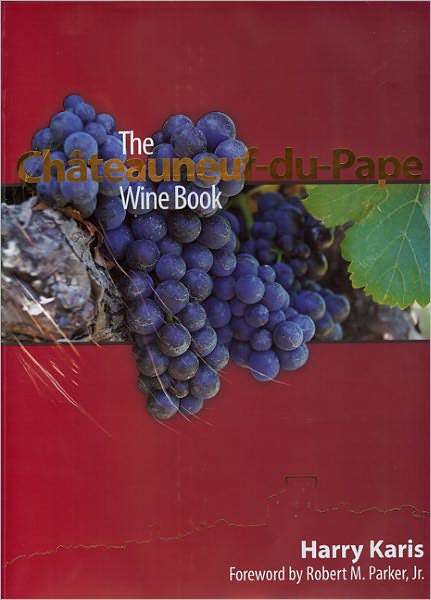
For an entry-level contribution of $22, you’ll receive a downloadable version of Karis’ last book about Grenache, ‘The Chateauneuf-du-Pape Wine Book’, which is probably better than a free copy of his other last book about Grenache, ‘The Chateauneuf-du-Pape Wine Guide’, which only gets two out of five stars on Amazon and includes a customer review reading, ‘Worst book design I ever encountered. I hope the paper is recyclable,’ which just plumb, dad-gum mean.

Cdp wine book coverFor a hundred dollars, you’ll be rewarded with a copy of ‘Grenache’, which will ultimately sell for around $80,  which is a net loss of $20, and you will have to wait until the book is released in 2018, hoping you don’t die in the meantime.  Frankly, for sheer return-on-investment, I feel that a two-star book in the hand is worth a potential five-star book in the bush, especially since it hasn’t been written yet.

For  $400, you shall be wined and dined in Paso Robles, CA, at a dinner and seminar hosted by Señor Seppuku, and you will also get a free copy of the grape book, postage included.  Of course, you still have to get yourself to Paso Robles—your donation may pay his travel expenses, but it doesn’t pay yours.  And, just playing devil’s advocate here, since you are going to the dinner anyway, why doesn’t Karis save the postage and simply hand you the book when you get there?

Finally, the American Express Centurion level, the rarified atmosphere of the exclusive, ne plus ultra circle of sponsorship, the $1000 Emperor’s suite nets you 25 copies of the book.

So, there’s your strategy, people-who-want-to-make-an-investment-but-don’ t-care-to-read-a-whole-book-about-Grenache-let-alone-the-same-one-25-times.  Our dear friends at amazon.com claim that used copies of ‘The Chateauneuf-du-Pape Wine Book’  are going for $79, so if you hand over a thousand dollars now, you may be able to turn that into nearly two thousand dollars on Amazon in two short years.

That’s a R.O.I. of 100%, and if Bernie Madoff had known Harry Karis, he’d be a free man today.

Here’s How Real Men Write Wine Books…

Mind you, I am not here to tootle my own horn, but if I was, and intended to panhandle $150 k so you could hear the horn before I’d even learned my scales, you might assume that I had the biggest set of stones since they built Easter Island.

Stugatz!!

Stugatz!!

I don’t and I’m not.

Instead, I’ll tell you how real men go about writing wine books:

First, we choose a topic that we haven’t already covered in our last four wine books.  You know, just to mix it up a bit and keep it real.

Loup garou

Loup garou

Then we rent a car on our own nickel and drive to wherever it is we want to write about.  If we go in the summer, we sleep outdoors, under the stars, in vineyards, and if it tarantula mating season (‘A Rite of Paso’, 2013) we try not to make sounds like a girl tarantula.  If it is the middle of winter, we throw down a sleeping bag inside an abandoned shack on state land (‘Heart & Soil’, 2014) and pray we don’t get eaten by Wendigo or loup garou or whatever haunts Northern Michigan forests.  If it rains for a week, we sleep in our cars (‘Walking Off To Look For America’, 2016), and when we’re back at our silly little desk, dry and warm again, we write pretty words about interesting experiences, beholden to nobody, nobody required in advance of publication and nobody looking at their watch waiting for swag or pelf.  We write honest books on a shoestring.  We break a sweat.

"Let me read to you from my latest tome..."

“Let me read to you from my latest tome…”

They may not be showroom glossies with which you can dress up a book store window—they’re meant to be read, not admired.  They don’t cost eighty bucks, either; new or used.  They don’t rely on seamless, panoramic photographs or hefty stock or dust jackets.  They rely on real stories with real heart and real soul, muscle and sinew—far more than any mooched junket to Vaucluse can bring to the coffee table.

Want me to prove it?  Loan me your harikaris tanto—I’ll eviscerate a chapter, spill its guts and show you.

Or better yet, look it up on line: It’s free.


Posted in GENERAL | Tagged | Leave a comment

Banksy’s Identity Revealed: He’s Andy Borowitz in Tenth Grade

Not really. But sometimes, don’t we all wish that this juggernaut pop culture train could be wrapped up in yesterday’s New Yorker and stored on a shelf of puerile simplicity, much as Banksy and Andy try to do?

Robin Gunnigham

Robin Gunnigham

Earlier this week, a coterie of braniacs at London’s Queen Mary University discovered Banksy’s identity by using geographic profiling.

They outed him; he is Robin Gunningham.

I was profoundly disillusioned, mind you—especially once I found out Robin Gunningham is not the son of Marion Ross and that Banksy doesn’t have a friend called Fonzie.  If you are going to unmask Batman, make sure he turns out to be a really cool altruistic billionaire operating from some dark caverns of psychosis, not some pudgy middle-class kid who never outgrew prep school and has made a career out of being Thomas Kinkade for street people.
Which is who the Dark Tagger, the Anti-Establishment Crusader, the Valorous Vandal, winds up being.  ‘Look, up in the sky: It’s a bird!  It’s a plane!  It’s… another Pleasant Valley Sunday.’

Banksy at Prep School

Banksy at Prep School

Oh, well.  Meanwhile, for reasons that have proven to be an even harder task than finding Banksy, it’s impossible to explain why the New Yorker—a publication with a reputation for decent writing and sophisticated social commentary—continues to reprint the same Andy Borowitz column over and over again, with only a few words swapped out in the hope that we don’t notice.

Like Banksy, Borowitz is a sophomoric expositor of modernity attempting to tap into all those sophomoric emotions that surged through our veins when we were, in fact sophomores.  Since most sophomores manage to dodge reading anything longer than ‘Old Man and the Sea’ by buying Cliff’s Notes or Classic Comics versions of assignments, I will offer you a neatly truncated summary of the worldview contained within every… single… epiphany… that the Doofus Duo of Team Trite has foisted upon us.

Borowitz: Americans are stupid, except me.  Ha ha.

Banksy: People are evil, except me.  Boo hoo.

Yes, it is florid teenager hyperbole, and yes we all went through this phase in high school, and yes, most of us matured beyond it by the time we graduated from college, and no, we do not need to be continuously barraged with the transparently obvious, especially since every offering by either one comes with a all-you-can-stomach side-dish of ‘Do you get it?  Do you get it?’

Make no mistake, gentlemen:  We get it.

And we have gotten it since Ms. Atkins’ ‘Creative Writing’, third period, right after Biology.

Enough About Me.  Let’s Talk About You…

Love IsSo, suppose you—my long-suffering and deeply hallowed reader—happen to love these two snugglemuffins, almost as much as you do Winnie and Eeyore and those precious ‘Love is…’ posters from the 1970s.  Let’s imagine that you find their brand of humor less shallow than moi, and that you have a soft gonadal spot that needs to be filled over and over and over and over with reminders that a) Trump is a douchenozzle and b) mega-corporations care more for themselves than they do for the human race.

Do do you know what else that probably means?  It means, more than likely, that you also genuflect before that other altar of guffaws whose disproportionate popularity I cannot, for the life of me, grok:

Single panel New Yorker cartoons.

coverThere are entire websites devoted to single panel New Yorker cartoons; big books are filled with them, fan clubs are devoted to them, contests are regularly entered to ‘fill in the caption’ beneath a blank, predictable, crackerjack-prize drawing, adding to a cosmos of New Yorker humor flat-liners.

Yet, such ‘observations on life’ continue (and methinks, will continue to continue) to pepper New Yorker pages like puddles of Pollock paint on a random, unfunny canvas.

On the other hand, if you (and God bless your sheltered little soul if this be thee) have no idea what I am talking about regarding any of this, I will now present examples of each, offering a brief, explanatory breakdown of the tee-hee quotient; then I’ll leave it to you to titter tremulously, chortle merrily, laugh outrageously, hemorrhage uncontrollably as your sides split, or simply roll your eyes and move on.*

* This is part of my ‘Idiotic Humor For Idiots’ series for which I fully expect to be sued by the publisher of those ‘[Fill in the blank] For Idiots’ books.

CHAPTER ONE: ANDY BOROWITZ

borowitz-670 ‘Trump Relieved that KKK Support Did Not Hurt Him in Alabama’

“March 1, 2016: Republican front-runner Donald Trump said on Tuesday night that he was “tremendously relieved” that the recent controversy linking him to the Ku Klux Klan had apparently not hurt him with voters in Alablah, blah, blah, blah blah….

Interpretation:  See, Donald did not immediately distance himself from the endorsement of former Klansman David Duke, so wouldn’t be a rib-tickler if Andy pretended that Trump won a state where everybody knows that everybody belongs to the K.K.K. and hates black people—except probably the 1,250,000 black people, more than a quarter of the population—who live in Alabama?  I mean, it would be funny, wouldn’t it?

‘Trump’s Plan to Randomly Shoot People Lacks Details, Random Shooters Say’

Funny, funny Donnie

Funny, funny Donnie

“Jan. 23, 2106: One day after Donald Trump claimed that he could shoot people on New York’s Fifth Avenue and not lose support, a leading member of the random-shooting community complained that the billionaire’s random-shooting plan lacks specifics blah, blah, blah, blah…”

Interpretation:  We should re-name Andy ‘Silly Willie’ for his two-for-the-price-of-one joke. Imagine finding a way to (on one hand) make wry commentary about ‘social communities’, where we sad-sacks poke, message, Tweet, Buzz, ‘like’, link or circle others of our ilk with common interests, passions, careers or lifestyles and (on the other hand)  America’s legendary love of murdering ourselves with firearms, which makes us the laughingstock of the rest of the world, up to, but not including, the moment the rest of the world needs us for some more free money.

You go, Silly Willy! You go, rest of the world!

CHAPTER TWO:  BANKSY

…or should I say ‘Mr. Robin Gunningham’?  Here is one of Banksy’s tours de force…

aa

Interpretation:  This is a stencil of a bad guy throwing a Molotov Cocktail, but instead of an explosive device, Banksy has substituted a bouquet of flowers.  He means, like, wouldn’t it be cool if terrorists threw tulips instead of TNT?  A concept so revolutionary that nobody on the planet has thought of it before, at least not since eight trillion Flower Children did in 1969.

Girl-and-a-Soldier-by-Banksy

Interpretation:  Oh, now, here’s a switch, huh?  It isn’t the big burly army man frisking the cute pinafored missy like happens in real life all the time, but the little girl frisking him.  The only thing that could make this juxtaposition zanier is if Benny Hill music was playing while you look at it and maybe a naked nine-year-old Vietnamese girl in the backgound was lighting an American war correspondent on fire.

Like this, although, not quite like this:

banksy-napalm-print

Anyway, back to Banksy.

enjoy your lie

Interpretation:  Read it first with—and then without the ‘F’!  You’ll see.  It isn’t really a ‘life’ you’ve been leading; it’s more like a ‘lie’!

A lie perpetrated by everything that bleeding-hearts like Banksy despise:  Fast food, war, big business, Manifest Destiny and most of all, Banksy knock-offs.

CHAPTER THREE: NEW YORKER CARTOONS

bookBoth Banksy and Borowitz have developed built-in clot-support (like Trump has) who would not abandon these yucksters if they—like Trump—opened fire in Manhattan or started beheading journalists (like me) on YouTube.  The distinction these groupies draw between people like Banksy speaking his mind and people like Donald Trump speaking his mind is simple:  Concur, it is a greasy orgy of adoration; disagree and it is a free-for-all mock-fest.

The cartoonist whose work appears in the New Yorker is not so lucky.  He (and New Yorker cartoonists are overwhelmingly male) has no ready-made fan base.  He relies on a bored reader glancing at his panel, and to get there, he has compete for page real estate with dozens—nay, hundreds and probably thousands—of other cartoonists.

Thus, to win that valuable corner beneath an excruciatingly dull profile of Yahoo’s CEO and a mind-numbingly overwritten go-nowhere short story, he has to be topical and sardonic and abstractly cerebral, and a word to the wise: It helps if your cartoon joke can combine not one, not two, but three values held sacred by the typical New Yorker subscriber.

Which means, it has to be a joke aimed at someone who is well-off, but hardly bulletproof in the face of recessions, adventurous—but not with hobbies that are overly strenuous or particularly dangerous—susceptible to trends, but still able to poke gentle fun at them, and above all, Caucasian.

A rare Negro in a NYer cartoon.

A rare Negro in a NYer cartoon.

This may seem to be a obscene sentiment, but if you do a random sampling of New Yorker cartoons, you’ll find that they are almost all about wealthy white people engaging in some situation or conversation that twenty or thirty years ago would have made no sense.  Granted, it is hard to draw cartoons of black people because you’re never sure if you’ve crossed the line to a racist caricature, and simply shading a white person cartoon figure to make him or her look African American is sort of ludicrous.  But that’s  exactly what cartoonists do when a token black person is inserted into a panel among the honkies, or if the joke happens to be about black people to begin with.  Wealthy black people who are adventurous and susceptible to trends, mind you.

So, this cartoon totally fits the New Yorker paradigm:

new yorker yoga

Interpretation:  Get it?  Get it?  For the sake of comedy, I will extrapolate: This difficult-looking yoga pose is named ‘Sūrya namaskāra Dhánuśvānāsana Upaviṣṭha’ which translates to ‘Forward-facing wealthy white man who has suffered some economic setback over the past year and has had a lot of extra time to work on his relatively safe hobby of yoga, and now can do something really, really hard.’

Get it now?

So, now I figure I’ve done my part and I call upon any of you, my numinous confederates, my sanctified intimates, my bosom buddies, and especially those of you who really do like New Yorker cartoons, to explain this one to me.  It has no caption; is it supposed to?  It has Negro people in it—is it supposed to?

This is exactly the way it appears in Google images and brother, I don’t get it!!

negro cartoon

Message me if you can figure this thing out:  I’m on my way downtown to out Banksy’s Detroit-based brother, Cracksy Headsky.


Posted in GENERAL | Tagged , , | Leave a comment

‘Acquiesce’ Means ‘Accept Without Protest’

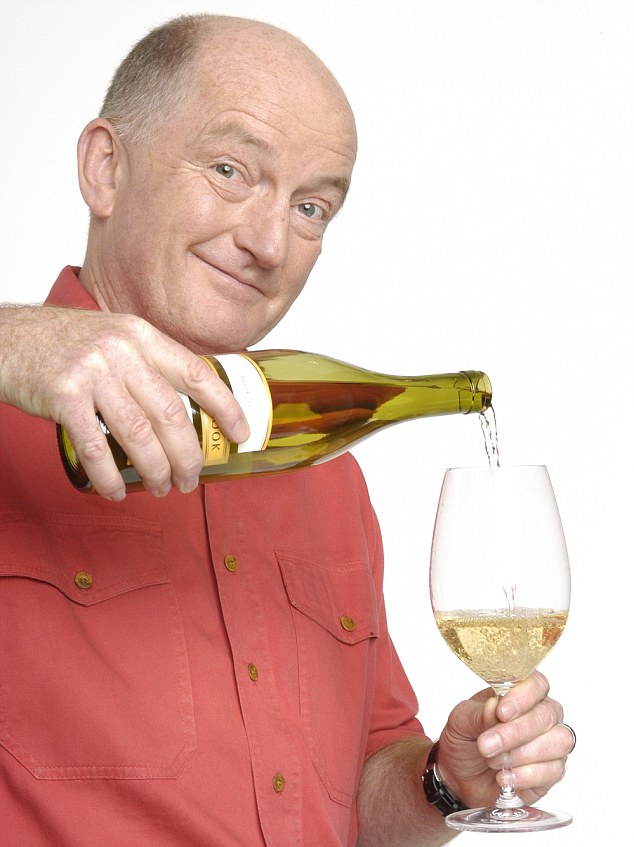
Oz Clarke

Oz Clarke

Hi-falutin’ British wine journalists know something about wine; I think we can all acquiesce to that observation.  Likewise, we accept without protest the statement that Lodi has built a reputation on  juicy, boldly flavored Zinfandel and soft, rich Cabernet Sauvignon—in fact, Lodi crushes more of each than Napa and Sonoma  combined.

So what does one do when a famous British wine journalist rolls into town and announces that Lodi is better suited for white varietals than for Cabernet Sauvignon?

If you are Sue Tipton, you acquiesce.

Not that she wasn’t already well down the acquiescence turnpike before Oz Clarke showed up: Her favorite wine (other than her own) has always been white Châteauneuf-du-Pape and when she began planting vineyards in and around Acquiesce, she wanted to duplicate it—the original incarnation being, in her words, ‘a bit spendy’.

Sue Tipton and her vines

Sue Tipton and her vines

This is the Irish talking; she’s a County Cork-American who made it to California after following a meandering path from northwest Chicago to Kalamazoo, Michigan (where Concord vines on her property wound up in Welch’s grape jelly).  From there, the road less traveled went to Sweden, then to Castlerock, Colorado, then to Dallas, Texas and then to Portland, Oregon where she discovered how exuberant wine at seven dollars a bottle could be.  That was in the mid 1990s, when Willamette Pinot Noir was still in search of a place on the global wine stage and as such, was priced to move—that same bottle of wine today would likely sell for four or five times as much.

Ultimately, her husband’s job—designing revolutionary, automated warehouses for companies like Coca-Cola—brought them to California, and in 2003, they picked up a piece of property on Tretheway Road in Acampo, just northwest of Lodi.  She was initially attracted to the old barn on the site, and then, to the twelve acres of Old Vine Zinfandel—a step up from Concord.  But winemaking was not on her ‘Before I Die…’ list, at least not on a commercial scale.  The Tiptons’ plan was to sell the Zinfandel grapes to local wineries, not vinify it, and that’s what they do to this day. It wasn’t until Sue planted a test plot of Grenache Blanc that did ‘exceptionally well’ that she began to consider that she might be able produce a white wine in the style of the Châteauneuf blends she loves on acres she already owned; wines that grandstand fruit and herb and flowers and spice in a complex cornucopia of lusciousness.

Acquiesce-Winery-webShe planted as many CdP cultivars as as she could find, many from Jason Haas of Paso Robles’ Tablas Creek, who is the go-to dude for these kinds of cuttings.  And she insists that Oz Clarke’s bombastic field trip to Lodi in 2011, during which he pronounced Lodi an ideal climate for the production of white grapes—certainly better than for Bordeaux-style reds—merely confirmed what she already suspected:

In Acquiesce, she had found a little slice of Rhône away from Rhône.
The Clarke pronouncement, outlined in an interview with the local Lodi News-Sentinel (which I quote frequently throughout this book), ran this way:

“In Europe, we get a lot of wine from further south in California, and frankly I don’t like that stuff very much. You get south of Stockton and Modesto and you start saying, “This stuff shouldn’t be made into wine.”

It’s high-yield, but it has a very low flavor. It’s all souped-up, sugared-up pretend wine with a huge marketing budget, and it does California no good whatsoever.

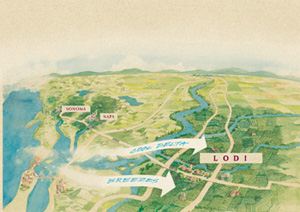
Lodi is different. There is something here. You go 20 or 30 miles south, and you’ve lost it. But it makes absolute sense. You look at the maps with the Delta and the hills and you see how the wind comes through the Carquenez straight and the first place it gets is here. And then it dissipates; south, north or wherever. But once the wind has been here, it’s going to lose its power as it travels on. But you in Lodi have this small area. That’s the great thing about wine; small areas matter. Napa and Carneros aren’t big.”

When grilled about Lodi’s limitations, the wizard called Oz continued:

“Lodi has very sandy loams.  And loam basically means you can’t ripen Bordeaux. You can’t ripen Cabernet; you might ripen Merlot. But you should be making rosé  and looking at white wines.  It’s your place. It’s a place that should not say, “We should do what Napa does,” or, “We should do what Sonoma does.”

“You need to grow more whites, but I think there is too much Chardonnay here. Everyone else makes Chardonnay. You make good Chardonnay, but Clarksburg makes it better.”

It sounds like Oz was preaching to the choir—a choir composed of conductor Sue Tipton and her chorus of Grenache Blanc, Rousanne, Viognier and Picpoul, et al…

Randy Caparoso

Randy Caparoso

And, oh, that Viognier.  Mmm, that Picpoul.  When I stopped by the tasting room at Acquiesce, it was closed: According to the sign out front, Sue had sold all the wine and there was none left.  That’s a good sign type of sign. People interested in tasting her wines, not just talking about her wine, will have to wait until mid-March, when the new vintage comes out.  But I was fortunate enough to be tagging along with local wine legend Randy Caparoso that day, so I got to line jump.

The tasting room is within the old barn that first attracted Sue and her husband to the property; it used to be the storage area for a walnut farm and there is a filled-in pit in the original concrete that once held walnut shells.

boardThere’s a fun chalkboard over the area where we sit—it is titled ‘Before I Die…’ (yeah, Sue’s now a commercial winemaker) and it leaves spaces blank for patrons to write down bucket list wishes.  On the day I was there,  ‘Golf Pebble Beach’ and ‘High-Five Sammy Hagar’ were prominent.

That morning, the headline of the Lodi Sentinel read ‘Napa Pioneer Peter Mondavi Dies’, and since Peter Mondavi was a Lodi grade-schooler before he was a Napa pioneer, I asked Sue if I could write ‘Meet Peter Mondavi’ on her chalkboard, then immediately cross it out.  I thought it would make a good intro photo on the chapter I am now—because of his death while I was in town—sort of obligated to write.

Guess who’s a good sport?

Guess who’s also a world class winemaker?  Without a degree from UC Davis or a resumé that includes multiple apprenticeships in established cellars?  The woman with the grape jelly vines, that’s who—Sue Tipton.

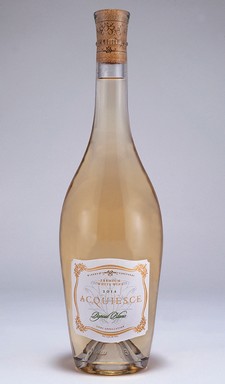
The Acquiesce experience begins on the outside of the bottle, though: It’s a svelte Saverglass original called a ‘Sabine’ and it is designed with feminine flourishes and motile curves—a lot like Sue Tipton.  She uses this shape to house all of her wares which are styled like the Saverglass and her: Rich and tactile, floral and feminine; entities with something to say.

The floral quality of Tipton’s wines, characterized across her entire portfolio, is the result of the sandy loam Oz Clarke spoke of in his Sentinel interview.  This sort of soil drains well and produces softer wines with controlled acidity and pronounced aromatics.  These qualities appear prominently in her Picpoul.

PicpoulBlancPicpoul is an interesting grape–one of the thirteen permitted varietals in white Châteauneuf-du-Pape, used primarily as a blending component, often for its crisp bite.  In these sandy soils, it is capable of—and excels at—being a single varietal showcase.  Directly translated, Picpout means ‘lip stinger’, but in Lodi the acids are held in check. Acquiesce’s 2015 Picpoul shows a rounded, juicy compass of tropical flavors, tangerine to banana and pineapple.  Although Tipton currently cultivates less than a hundred vines, what comes out the business end is a wine to rival any French Picpoul I’ve tried—certainly, the Languedoc estate that produce Picpoul as a stand-alone make steely, mineral-driven wines with considerably less weight.

Acquiesce Viognier (2014) is a closer counterpart to its Northern Rhône paradigm in the tiny appellations of Condrieu—it is plush and fragrant, filled with exotic mango, papaya and grapefruit notes.  The 2015 we opened, having recently been slipped into that stylish Sabine glassware, was dealing with a bit of bottle shock—it was lighter and less beguiling on the nose.

logoBelle Blanc (2104) is her pretty baby, her homage, her tribute to the great estates of  Châteauneuf-du-Pape in the Vaucluse department of southeastern France.  Like these rare and majestic wines, Belle Blanc bursts with fruit and perfume, bright tones of yellow, a sweet, honeyed nose resplendent with lemon and pear; a succulent mouthful that is viscous and creamy and crisp nonetheless.  She has, in effect, created a work of art that might easily be mistaken for its prototype, and without anything more than an excellent palate, an exemplary vineyard and a determination to succeed.

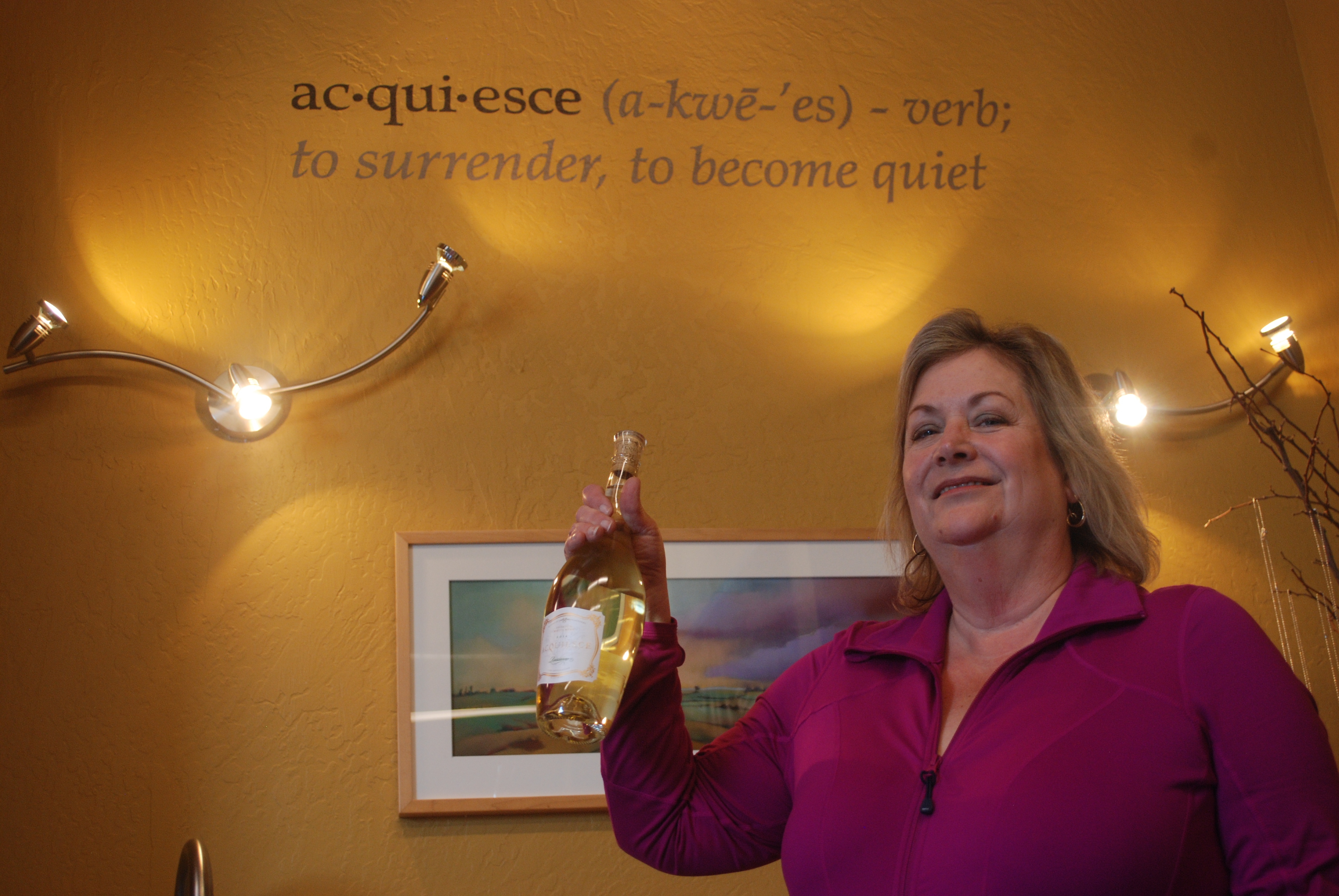
sueOpposite the ‘Before I Die…’ board, there is a dictionary definition of Acquiesce painted high on the wall:  “To surrender; to become quiet…”

Sue Tipton maintains that she and her husband thought of the name long before they thought of the winery—it is from the k.d. lang song, that, as far as I can figure out, is about strange sex.

But that doesn’t matter; here, Acquiesce is about glorious wine, superb pairings with local products (one of Sue Tipton’s most popular tasting room amenities) and fun conversation on the ground floor of the white wine revolution in Lodi.

If you must bring strange sex to the party, write on the wish board.  k.d. will have to show up one of these afternoons.

Posted in Lodi | Tagged , , , , | Leave a comment

10 Ways to Tell if Your Cardiologist Passed Anatomy Class

Scarlett's heart.  How hot is that??

Scarlett’s heart. How hot is that??

That’s a silly headline, isn’t it?  Obviously your cardiologist passed anatomy class.  Cardio surgeons are anatomy people; they walk, talk and breathe anatomy; they bring up ligamentum arteriosums at dinner parties and have sexual dreams involving Scarlett Johansson’s left ventricle.

I obviously erred in naming this piece.  What I should have called it was ’10 Ways to Tell if Your Wine Writer is Out of Ideas’.

But I suppose that would have been equally hyperbolic:  As long as ‘Eater’ publishes articles by Levi Dalton, I will never run out of column fodder.

 In sensu hoc:  Dalton’s recent foray into cognitive desperation with an article entitled ’10 Ways to Tell if Your Sommelier Really Knows Wine’.

Levi, third from left

Levi, third from left

This is a Dalton tutorial aimed at an extremely small percentage of restaurant-goers making up an even more miniscule portion of ‘Eater’s’ even more Lilliputian readership.  To qualify, you need to harbor a quorum of qualities that sets you apart from the average ‘Eater’ patron, of which there are about two dozen.  First, you need to know more about wine than the sommelier you are quizzing, otherwise the test won’t work—you won’t know if he or she passed it—and if you know more than the sommelier, it’s idiotic to employ his or her services in the first place, isn’t it?  Second, you have to want to test your sommelier rather than enjoy a meal with your date and not come off like a snooty, show-off, know-it-all, which does not grease any coital skids, believe me: Most girls find this sort of condescending twinkletwat to be a visceral turnoff.

Yes, I know I wear the mantel of a condescending, snooty, show-off, know-it all twinkletwat from time to time, but there is an important distinction: Whereas the esteemed Mr. Dalton does it at fancy restaurants and pays for the privilege to be a douche, I do it gratis.

eater logoYou May Become ‘Eater’ Reader # Two Dozen and One…

So, rather than quote from the waggish wisenheimer’s wordy wasteland, I will provide a link so that you may do it at your leisure, which I am presuming you have shitloads of, otherwise you wouldn’t be reading this.

http://www.eater.com/drinks/2015/6/3/8723085/10-ways-to-spot-a-really-good-sommelier

Meanwhile, I will summarize Blue-Jean Baby’s ten points upon which you should rate your sommelier’s skillset rather than simply ordering a fucking bottle of wine and paying attention to your date:

somm 11:  Levi supposes that a good sign is if your sommelier ‘responds well to simple questions’.  He may have mistaken wine professionals for people who have recently awoken from prolonged comas or have sustained closed head injuries, which, from reading his columns, I can understand.

2: Levi proposes that sommeliers ‘may not know their own wine list’, and suggests that if a wine steward glances over your shoulder it is a bad sign.  But wine is not the only thing that makes the world go round, is it, Levi?  If it is a male sommelier, he may be trying to gauge the size of your package—the one beneath the wine list you think he’s looking at.  Or in the unlikely case that he is straight, he may be holding phone-shaped hands up to his ear and mouthing to your date, ‘Call me’.

Both of which, granted, are bad signs.

3: ‘Are They Listening To You?’  Nobody else is, Levi, so why should this be a litmus test?

Duck Confit Crostini with Pickled Cherries4: ‘They know the source of their wines.’ Levi theorizes that if a sommelier actually knows the people who made the wine on the list and can discuss the region and ‘details of where they do their work’, she is probably a good sommelier.  I agree, but aren’t these questions better asked if you are hiring a sommelier, not simply looking for a wine recommendation for your Duck Confit Crostini with Pickled Cherries?  Do you dine alone compulsively, Levi, or exclusively with geeks sharing a driving need to know such irritatingly inconsequential minutia?

somm 35: ‘They avoid attributing every wine characteristic to one cause.’  Why should you call upon your sommelier to attribute any wine characteristic to any cause?  It sounds like a conversation better held inside a retail wine shop while killing time waiting for a bus, not while ordering dinner.

Anyway, isn’t your appetizer getting cold?

6: ‘They downsell you.’ Levi predicates sommelier cred on whether or not said somm tries to ‘downsell’ you, which means, ‘sell you a cheaper bottle than you are willing to pay for’.  Levi makes a huge point of assuring us that there are ‘zero other potential reasons’ for a sommelier to downsell you other than some innate ethical duty to make you happy despite pressure from bosses, fellow waiters and wine reps to upsell you.

Of course, he ignores the real reason:  They bought that Maréchal Chorey-les-Beaune on post-off for $220 a case and it’s sixty dollars on the list.

"Levi rules your face off, pass it on."

“Levi rules your face off, pass it on.”

7:  ‘They make you feel knowledgeable about wine.’  The WTF?-iest among Dalton’s strange listicle of WTF?s.  If you aren’t knowledgeable about wine, why would you be waterboarding your sommelier in the first place? And if you are, what black hole in your psychodynamics requires the validation of your knowledge by some stranger in public setting?  If I was your sommelier I’d stand on the table and say, “I forthwith turn my tastevin and Master Sommelierhood over to Levi Dalton, who in terms of wine knowledge makes me look like Boxcar Willie.”

Then I would expect the appropriate gratuity.  Happy now?

8:  ‘They have what is on the list’. Levi hypothesizes that if a wine on a list is not actually in the cellar, the restaurant has problems—among them, the place is in financial trouble and/or the wine is allocated and they aren’t allowed to sell it to you.  All of which is an issue for upper management, not the lowly, beholden somm, so it really shouldn’t be on this list.    I’d have phrased it: ‘They don’t have the wine that the sommelier specifically recommended’.  Safer rock to toss, Dungaree Dalton.

Levi reward9: ‘They care about storage’.  So, now we surmise that after turning the dining experience into a personal test-of-wits between Levi and his wine waiter, he now wanted to bully the poor manager into showing him the wine cellar, presumably during a busy service, where he can whip out his hygrometer and measure humidity?  How about saving everybody grief and simply tasting the wine you ordered, Levi?  If It sucks, send it back.  Problem solved.

10: ‘They remember what you drank last time’.  Ha. Ha ha. Ha ha ha ha hahahahahaahahahahahahah…  Why do I get the impression that Levi ordering a bottle of wine in a restaurant is an experience that neither his persecuted sommelier, his embarrassed date, his mortified friends, and the entire harried wait staff is likely to forget—no matter how hard they try?

cardioSo, back to my cardiologist.  I have one simple question that I ask him/her before my coat is even hung on the rack by the receptionist, who, by the way, has an exceptional rack:

“Fill in the blank: The way to a man’s heart is through his…?”

If they nail it, they’re not the doc for me.


Posted in GENERAL | Tagged , , | Leave a comment

Estate Crush: Negating Negative Space

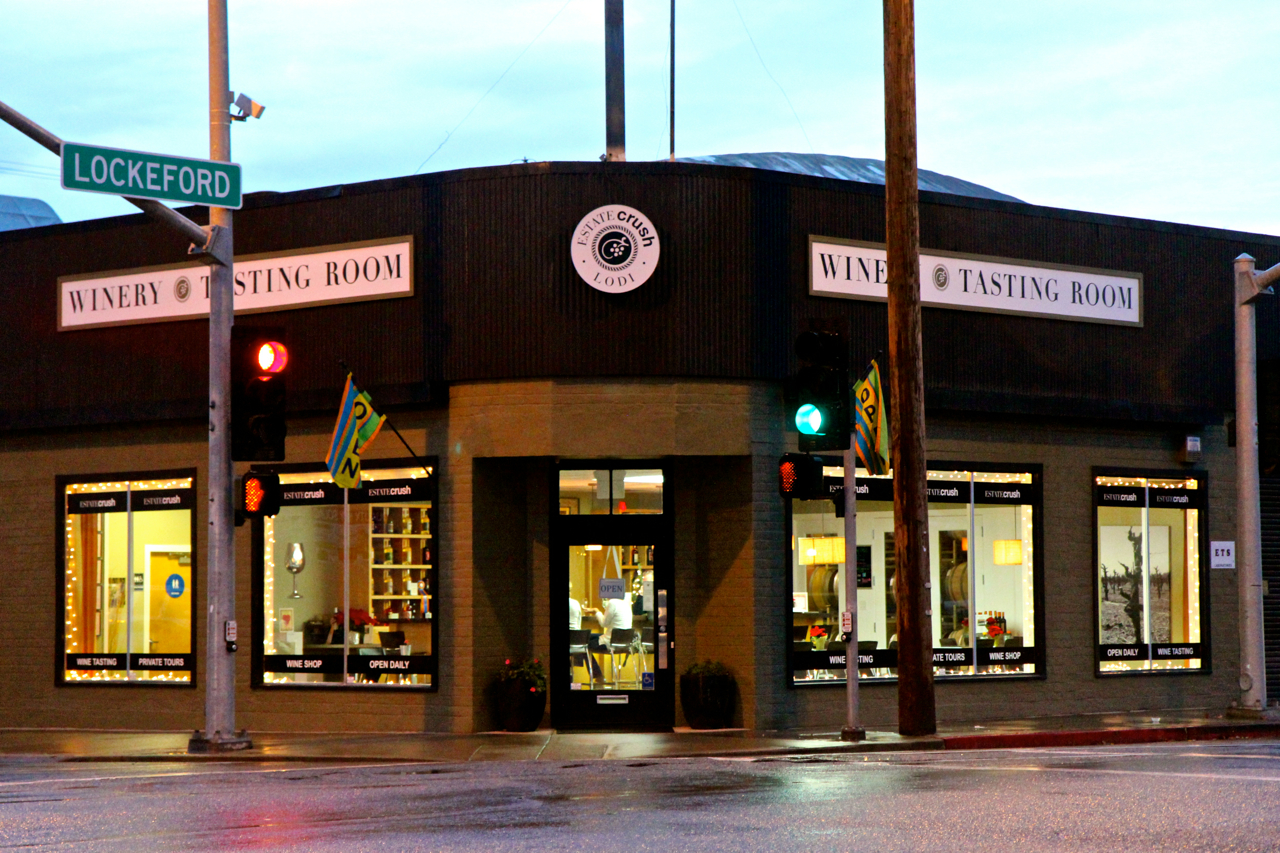
How did a twenty minute interview with Bob Colarossi at Estate Crush in Lodi turn into an hour-long conversation with Vince de la Cruz, a Florida-based rock bassist who lists among his songwriting credits ‘Walking on Sunshine’?

It’s all part of the serendipitous, convoluted labyrinth of wine, women and song.

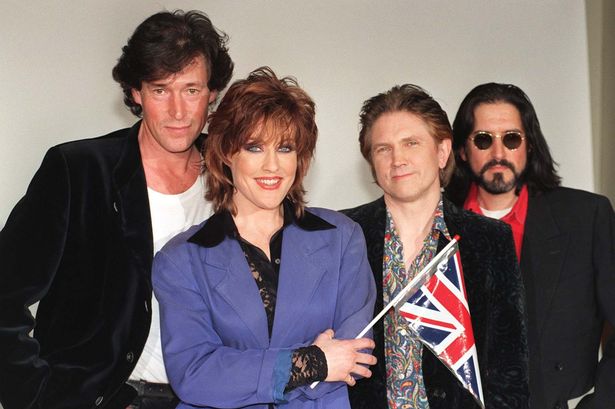
Vince de la Cruz was the only cool-looking Wave

Vince de la Cruz was the only cool-looking Wave

And by women, of course I mean Kimberley Rew and Katrina Elizabeth Leskanich, who along with de la Cruz and Alex Cooper formed the ‘80s rock band Katrina and the Waves. Their monster hit ‘Walking on Sunshine’ wound up as the crown jewel in EMI’s catalog and one of the publishing company’s biggest all-time earners.  Financial returns were in the stratosphere thanks to the numerous commercial deals the song generated, and writing credits, split between band members, wound being a royalty gift that just keeps giving.

As a result, a private wine label (called ‘Walkin on Sunshine,’ to no one’s great surprise) was well within the means of Mr. de la Cruz, but the rather surprising  upshot of various quotes and quotables is that a private label of top-flight Old Vine Zinfandel is remarkably accessible to us all.

So, let’s start with Bob Colarossi, whose venture into Lodi winemaking is as interesting and unlikely as is de la Cruz’s—and nearly as late in life.

Bob Colarossi

Bob Colarossi

Colarossi is a Boston boy who cut his business and marketing teeth in the world of sports; prior to moving to California in 2005 he was president of the Massachusetts Sports Commission and CEO of USA Gymnastics. He played an active role in both the Athens and Sydney Olympics, and if you remember the cute, potent, medal-winning little 2004 women’s team, Colarossi was as responsible for that was Vince de la Cruz for cute, potent, medal-winning little ‘Walking on Sunshine’. 

But Bob has an equal passion for biking, and as a part of the Anschutz Entertainment Group he was instrumental in launching the Amgen Tour of California. Along the way, he fell in love with wine country and after the race was in the can, revving up his marketing brain while looking for a reason to hang around, he recognized an unfilled niche in the growing custom crush industry…

Which I’ll explain as soon as I explain the concept of ‘custom crush’ to anyone outside the industry who actually thinks that every bottle of wine on the market comes from a brick-and-mortar winery.

Typical custom crush house

Typical custom crush house

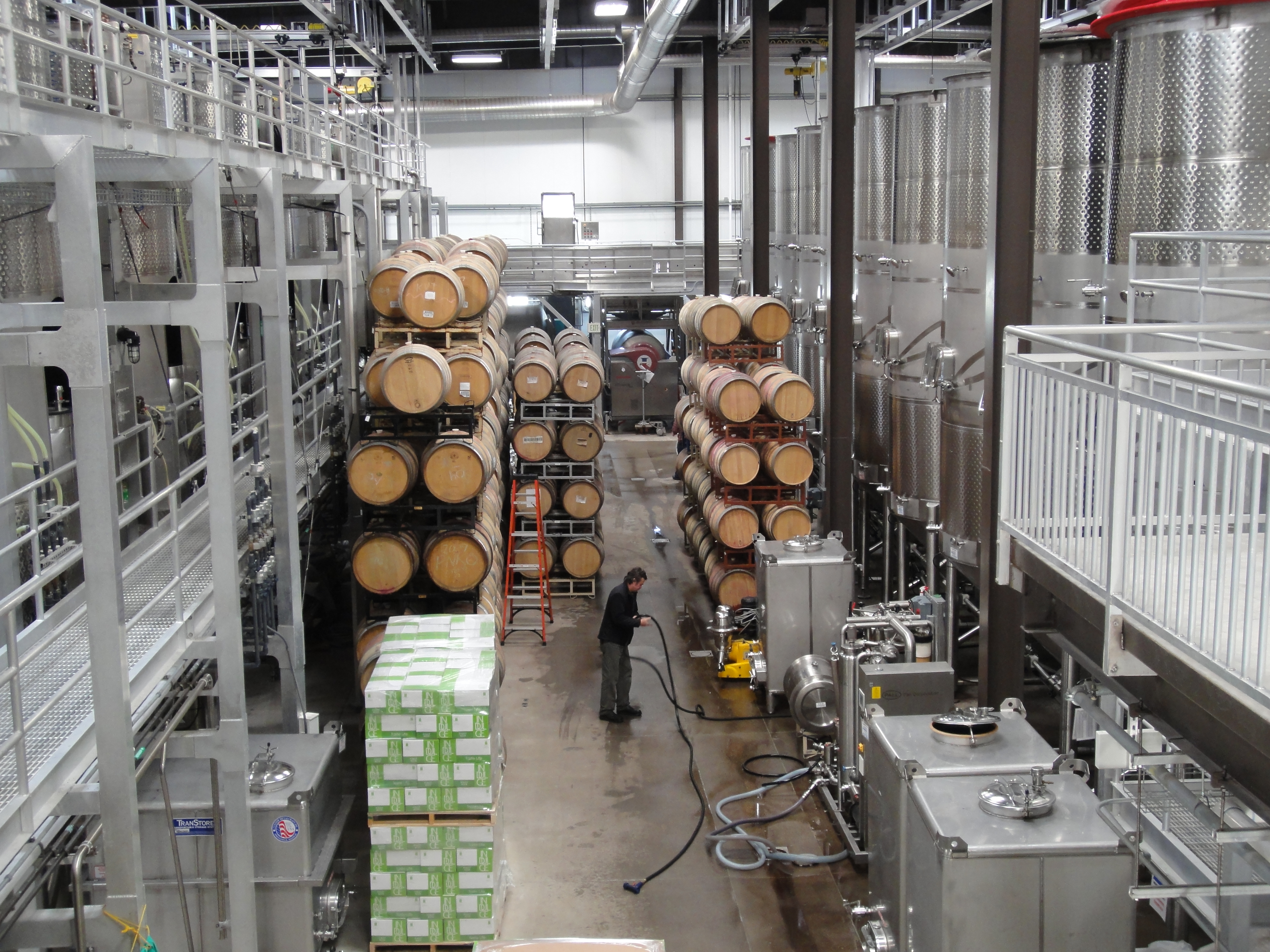
In fact, a surprisingly large number of wines are created, bin to bottle, lot to label, in ‘virtual wineries’ by people hired to do the job under a licensing agreement.  This involves a facility that may or may not be attached to an established winery, but which possesses the equipment necessary to crush, ferment, filter and store wine under your personal label.  The label owner’s primary interest is in marketing the product; he or she may have as much or as little input into the actual viniferous product as they desire.  Some wines are assembled entirely by a consulting winemaker at the crush house, with only cursory direction supplied by the client; in other cases, the client is part of the team who adds his two, three or four cents worth every step of the way.  A crush facility may simply lease equipment to winemakers, who then do everything themselves, but with Estate Crush, insurance prevents much ‘hands on’ assistance with the actual nuts and bolts of the  winemaking process.  But Colarossi engages the customer with gobs of collaboration, from yeast choices to fermentation methods to the sort of oak treatment desired—decisions which are all critical to the quality of the product.

Such facilities are legion throughout California, primarly because they allow someone to enter the wine business with a minimal outlay of cash.  Establishing a physical winery may require an investment of between $5 and $20 million; when you use a crush facility, expenses are minimal and wholly dependent on the quantity and quality of the wine you want to produce.

Which brings us back to Bob and his eureka moment.

estate crushc“There were dozens of one-stop houses already established when I wrote my business plan, but all of them had a five or ten-ton crush minimum.  I saw a huge negative space in the market, a wide opening: Nobody operated a crush house for customers with smaller budgets and who simply wanted to make less wine.”

It was a niche into which Vince de la Cruz fit.  Vince wanted to make a private label primarily—and unabashedly—for bragging rights and personal consumption.

Ten tons of crushed grapes is the equivalent of 600 cases of wine.  In which case, according to Bob, “You’d better make something you like, because if you can’t sell it, you’re going to have to drink it.”

A one-ton crush equals about 60 cases—a much more manageable bottle bundle, whether you want to market it, drink it, or give it away to friends at Christmas with your band’s most famous song emblazoned on the label.

And that was Vince de la Cruz’s ultimate mission.  ‘Walking on Sunshine: The Wine’  is not commercially available, even to fans who proposed to their spouses while considering that syrupy New Wave anthem as ‘our song’.

mens journal“It was something I did for fun,” Vince said. “I went through the process with Bob at Estate Crush after tasting wines in Lodi, tried samples with him and came up with something I thought was ‘me’.”

I know that sounds like a hair-restorer testimonial on some ad of the back of Men’s Journal, but it is pretty much verbatim.  And precisely why Bob Colarossi offered to hook me up with Vince: It was a real-time example of somebody reasonably well-known who had a solid experience with his small-lot services.

Of course, the opportunity to rap with de la Cruz about the current state of rock and roll,  life in the fast lane followed by life in the more laid back lane and John Fogerty’s price tag for a ten-minute phone interview for this book compared to his fee—my honest, open-minded opinion of his new album, ‘Do Your Mind?’

vince coverI didn’t mind, and I did listen, and I would not be plugging it if I didn’t dig it:  The first cut, ‘Livin’ The Dream’ is fun, catchy, musically competent bubblegum, and if we’re honest, we all like tunes in that genre.  ‘Patience’ is slower, moodier—a retro ballad with a nice metal lead riff; ‘The World Is Your Oyster’ is a sort of an echoey, psychedelic ramble through canyons of late ‘60s rock, with another hot lead.  The music is solid, the writing good.  If there’s another ‘Walking on Sunshine’ in there somewhere, it is for cannier listeners than me to unearth.

Meanwhile, back at the crush, I wanted to get some idea of how much somebody might have to lay out for sixty cases of top flight Lodi Old Vine Zinfandel.  Going in, I assumed might be prohibitive for a hack like me without a hit record to shore up the 401(k).

Bob and Alison Colarossi

Bob and Alison Colarossi

So I asked Bob Colarossi to ballpark a quote for me (and you, by default), specifying costs to include the best fruit from a top Lodi vineyard, a shred of logic based on the premise that when all other factors are equal, the quality of the grapes is what determines the quality of the wine. Yet, per-ton grape cost is hardly the top price driver in a bottle of wine—a superb ton of fruit in Lodi might run you $1400, whereas as a ton of no-great-shakes Zinfandel might be half that.  Spread over 60 cases, that means the difference in actual cash outlay is less than a dollar per bottle.

Going for the gusto, in this case, seems like a no-brainer.

What Bob’s brain and those his several on-staff winemaking consultants offer in the initial meeting is full disclosure—a come-to-Jesus explanation of their unique winemaking protocol.  Your job is to outline your goals and budget, the kind of wine you want to produce and why.  From there, fruit sourcing decisions and an achievable timeline can be established.

Once you pull the trigger, Estate Crush keeps precise records of every transaction, including weight of initial delivery of grapes, crushing and destemming, a cold soak of up to 72 hours—a somewhat trendy technique meant to improve color and aromatics—and (at your request) the addition of SO2  to prevent rogue fermentations from beginning.

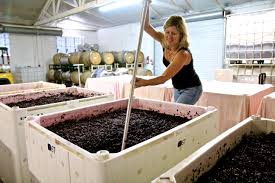
Alison does a punch-down

Alison does a punch-down

The next step is yeast inoculation, acid adjustment and nutrient additions if required (Zinfandel fermentation may ‘stick’, especially if the fruit is extremely ripe) and daily punch-downs to keep things active. After that, your wine will undergo a secondary malolactic fermentation if you so wish; this softens some of the high acidity that Zinfandel is prone to.

Throughout the process, full laboratory analyses are done on-premise, including daily temperature and sugar-level reads until the wine has reached the specified level of sweetness.  It doesn’t matter if you are present in loco or if you, like Vince de la Cruz, are two thousand miles going loco in Florida.  Bob sends you all the pertinent parameters via email, and if you want anything done differently, or adjustments made, they are a mouse-click away.  Everything is customized to your specs.

I had this goddamn song stuck in my head for days...

I had this goddamn song stuck in my head for days…

After fermentation, you may choose to purchase oak barrels for aging, If you go that route, based on a standard quote, your wine rests comfortably for up to ten months wine inside an climate controlled barrel room kept at 58° and 85% humidity.   Additional aging time can be purchased like putting coins in a parking meter; it all depends on your budget and your objective.  If your pockets are deep enough,  I have no doubt that you could hire Vince de la Cruz to sing ‘Walking on Sunshine’ to your barrels while they age and I also have no doubt that Bob Colarossi would be glad for the entertainment.

Meanwhile, since the entire process results in some inevitable evaporation, Bob’s crew tops up your wine every six weeks with leftovers from the original run or from blending wine he keeps at hand.  Here, the words ‘negative space’ come up again:

“A lot of time, a single varietal wine shows some blanks, some negative spaces that we can fill in with blends.  Our goal, at the direction of our clients, is always to improve the wine without shifting away from the varietal’s intended profile.”

Again, if this sounds like a commercial for Estate Crush, I apologize, but it sort of is.  I was genuinely surprised at how reasonable the whole thing turns out to be.  , it all comes out the same:

Figure that the minimum Estate Crush contract is for a ton of fruit; using those aristocratic Old Vine Zinfandel grapes from those lauded Lodi Native vineyards, and factoring in bottles, corks, capsules, the in the purchase of neutral barrels, bottling costs plus bottling supplies and aging finishes  $6.50 to $6.75 per bottle pre-grape, and at $1400 for that precious Zin, a final cost of $8.55 per bottle out the door.

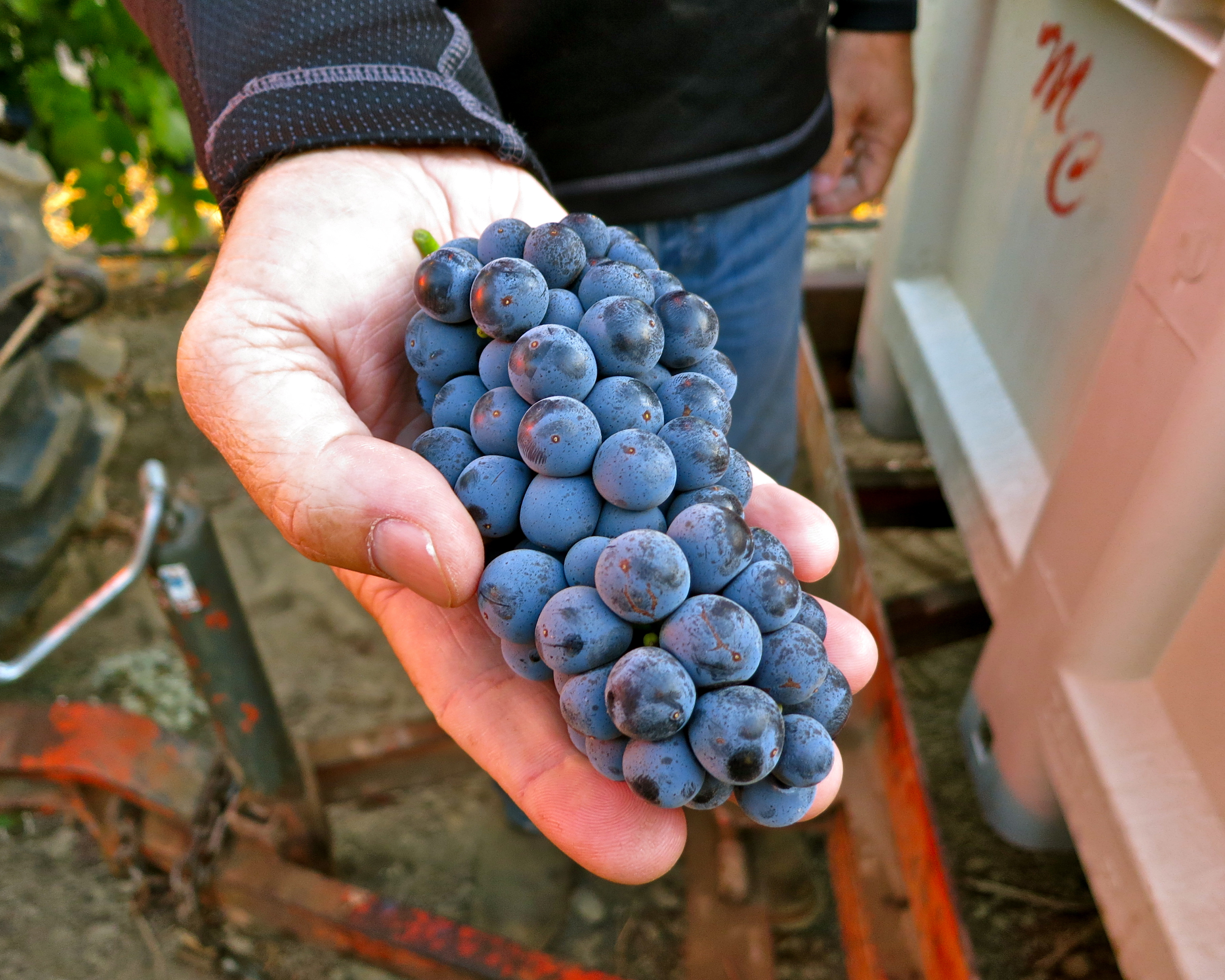
Mike McCay Lodi Native grapes

Mike McCay Lodi Native grapes

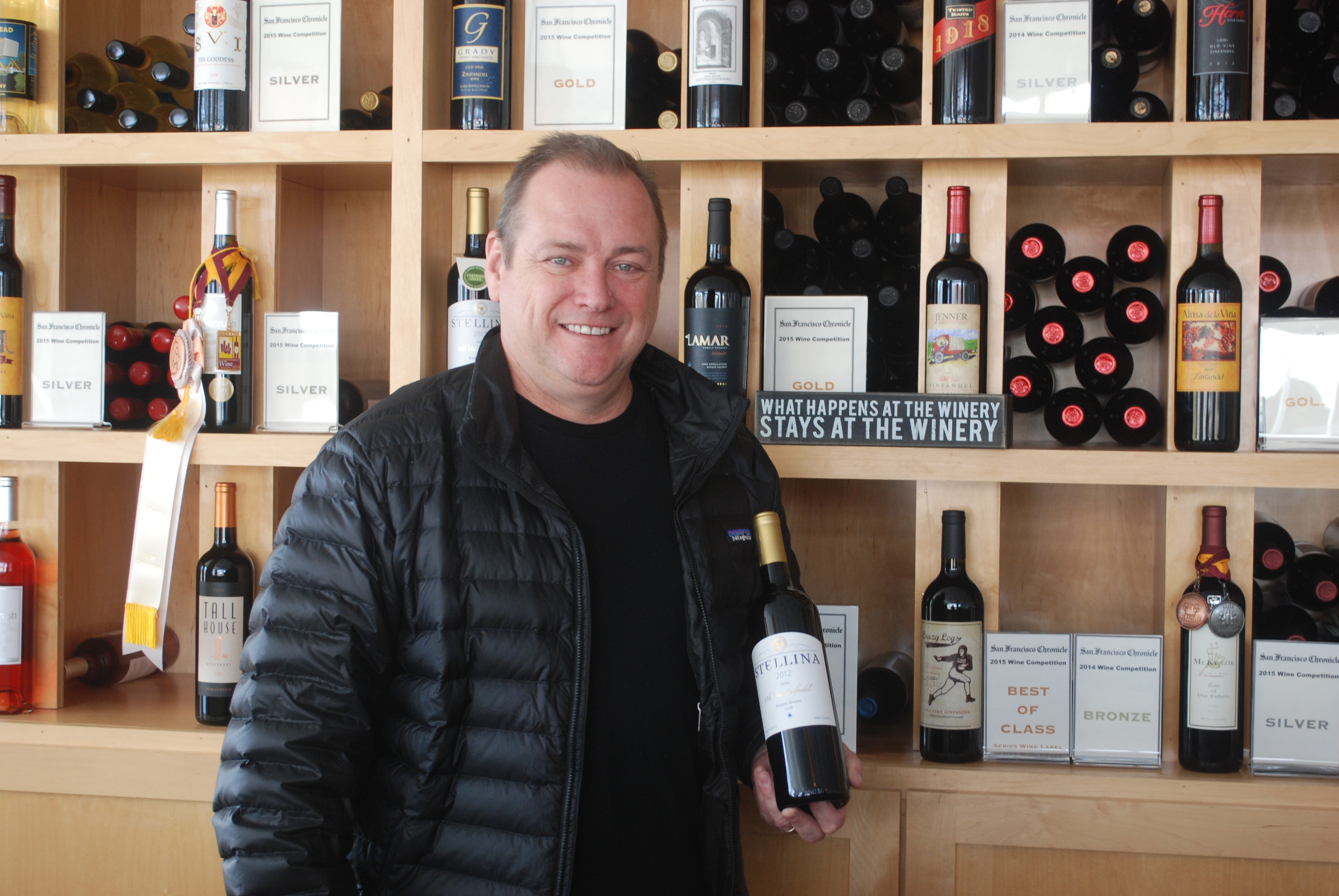
A bottle of Lodi Native Old Zinfandel made by one of the local luminaries like Mike McCay, Layne Montgomery or Ryan Sherman, will set you back around $30, but there is nothing in stone that says it would be any better.  Why?  Because Bob Colarossi has his own prize winning label (Stellina) and he makes a sensational Old Vin Zin.  He comes across as the sort of mentor in wine as he probably was to gymnasts in , and you get the impression that he wouldn’t produce a wine for you that he wasn’t willing to put his own name on.  Along with his wife and business partner Alison, he has created a unique métier for himself, and an extremely attractive outlet for start-up wineries trying to establish brands, wine lovers with a bucket list or rock stars with a lot of fans.

Which is why, as a wannabe, there’s no need to to walk on eggshells during your first vintage and why ‘Walking on Sunshine’s’ Vince de la Cruz thinks Bob Colarossi can walk on water, and why I’m happy to write about a who walks the walk by turning a whole lot negative spaces into a major positive.


Posted in CALIFORNIA, Lodi | Tagged , , , , | Leave a comment

Paul Scotto and a Gleam in His Old Man’s Eye

Last August, I wrote a piece about tasting a slew of sensational ciders with Paul Scotto in a motel room in Corning, New York, and—wannabe stand-up comic that I am—I prefaced it like this:

Paul Scotto

Paul Scotto

‘If the most exciting thing that’s happened to you in a motel room this year has been tasting cider with Paul Scotto, welcome to my world…’

Rimshot, huh?  Tish bang? Except that six months later, where did I end up, dateless, on Valentine’s Day?  Tasting ciders with Paul Scotto in some restaurant in Danville, California.

Suddenly, this thing isn’t so funny anymore.

At least this time Paul brought along his wife, the incomparably lovely Whitney Colli Scotto, who began as a farm girl from Santa Maria who fell for Paul at first site—and vice versa. Now three children into it, she still manages to exude such wholesome farm-girl radiance that the old Arthur Fields song worried about keepin’ down on the farm is much ado about nothing: They’ll do just fine, Art.

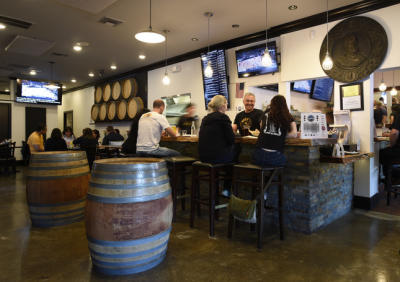
Paul’s younger sister Bianca and his mother Gracie were doing tag-team babysitting that evening so that he and his wife could spend an intimate Valentine’s Day together—just them and me and a table-load of groupies eager to hear the Cider Brothers’ back story and tuck into incarnations of Red Dragon Ciders paired with cutting-edge California cuisine at The Growler Pub in Danville.

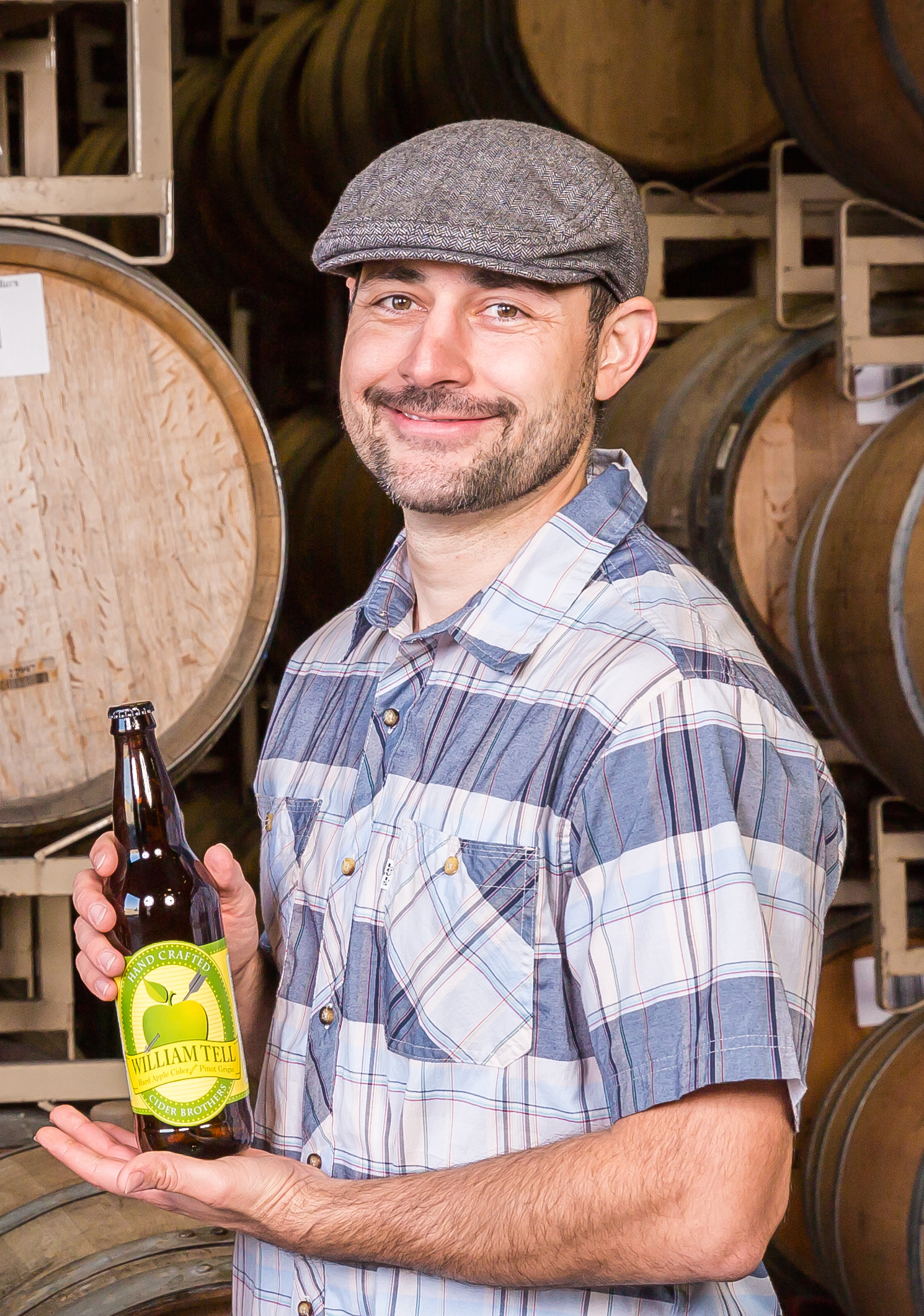
William Tell Cider- Pinot GrigioPrintVersionSpeaking of ‘tuck’, a couple of words on that word should be sufficient:  Paul Scotto’s other cider brand is ‘William Tell’, and he’s launching a campaign to explain the origin of the name—which refers to the legendary Swiss folk hero who shot an apple off his kid’s head.  The campaign is called ‘Who The Hell Was William Tell?’ and as such, the whole marketing department thanks its stars that the dude’s name wasn’t ‘William Tuck’.

Anyway, Growler Pub’s executive chef is a self-described ‘beer girl’ named Rachel Zavala, and when called upon to become a cider girl when planning the Valentine’s Day menu, acquitted herself magnificently. She was kind  enough to explain in culinary detail her food and cider pairing decision, and  I’ll offer some Zavala sound bites related to each course:

Rachel Zavala

Rachel Zavala

“The straight, unflavored dry Red Dragon cider matched well with Asparagus Soup; the floral smoky quality cut through the Parmesan Custard.”

“Ale yeast was used in the cider/Pinot Grigio blend, and this gave it a nutty warmth and a creaminess that I thought went perfectly with Lardo-Wrapped Prawns with Grapefruit Chips and Hazelnut Gremolata.”

“Cherry Cider brought with it a complex, seafood-friendly quality that balanced the Lemon-Rosemary Stuffed Branzino and the dry vanilla notes went nicely with the Steak Diane.”

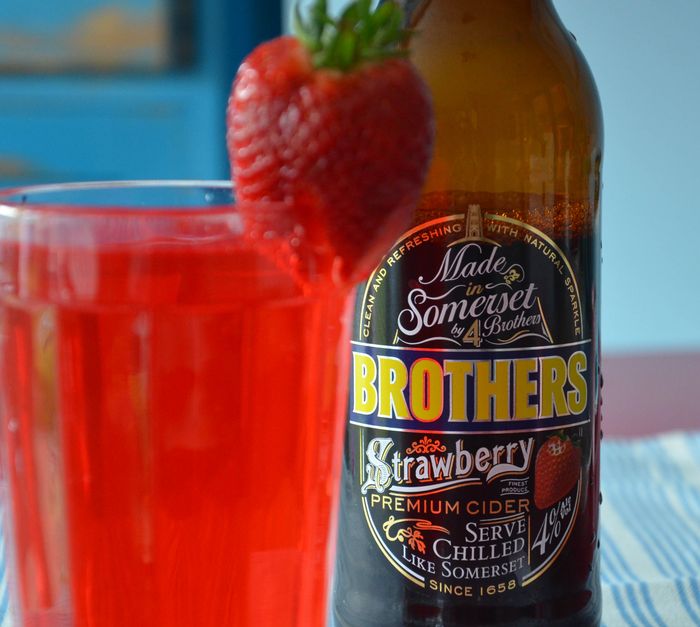
“Finally, the Strawberry cider completed the traditional Valentine’s Day duo of strawberries and chocolate, which is why I paired it with Flourless Chocolate Cake and Caramel Ice Cream.”

The Growler Pub

The Growler Pub

This was an interesting California Dreamin’ experience, and the fact that Chef Rachel announced before and after the meal that it was ‘gluten free’ and the fact that Red Dragon Cider also advertises that it is ‘gluten free’ initially struck me as the same sort of ironic joke that had me in a pub with strangers on Valentine’s Day two thousand miles from home.

Didn’t we all sort of collectively agree that gluten isn’t particularly bad for you unless you are among the 1% of the population with a wheat allergy?  And isn’t beer, the bevvie upon which the Growler builds it fan base pretty gluten-dependent?  As a boy from the grain belt, I was not aware that the anti-gluten movement was still alive and kicking on the Left Coast; I thought the idea that a gluten less lifestyle was healthier had been relegated to the Snopes-heap of busted fad diets.

I’d say, ‘Bring on the barley and pasta’ except that Chef Rachel’s menu was so spectacular that I didn’t miss a gram of gluten anywhere along the trail.

Paul Scotto’s cider may be California-friendly, but his raw material is not from California.  He now bottles and cans so much of it that the Lodi apple orchards  can’t possibly keep up.  He now brings it in by the tanker load from Washington, 5500 gallons at a time.

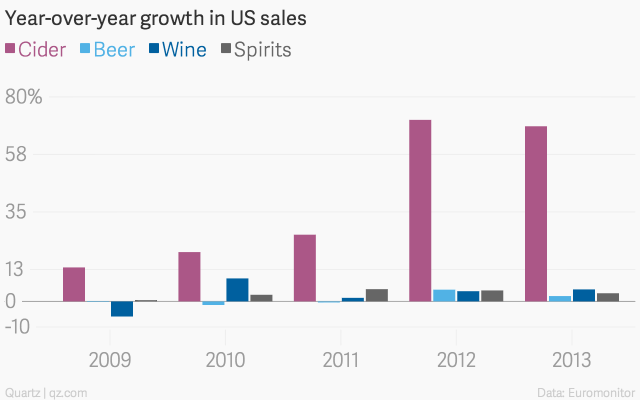
ciderIt was not necessarily an operation intended to grow so quickly and exponentially:  As Paul tells it, it was a mere three years ago that he began to play around with fresh apple juice, sensing that the U.S. market for fermented cider was about to do a post-Sideways Pinot Noir.  In fact, he was right: Cider has represented one of the most WTF? sales trajectories in craft beverage history.  There are as many explanations for that as there are cider buffs, and most of the analyses refer to cider as a gender-neutral beverage, a flavor-of-the-month for trendapoids, a heritage beverage that hearkens us back to our Colonial history. But they all can be consolidated into a single bullet point:

Hard cider is scrumptious—one of the easiest beverages ever concocted for a grownup to love.

Not everybody has instantly climbed aboard the apple cart, and an example involves a respected Napa winemaker whose name I will, with some struggle, avoid mentioning.  He recently dissed a bottle of William Tell Cider (untasted) by likening it to 7-Up with a shot of vodka.  I responded that it’s not particularly sweet, not particularly alcoholic and distinctly un-artificial tasting.  Then I was forced to remind him that Scotto’s cider is not attempting to compete with  the sort of $85 Napa Cabs he makes, and that a lot of $85 Napa Cabs—including a few of his—are severely overpriced.

Nobody can say that William Tell is a rip-off at $9 for 22 oz., at least, not with a straight face.

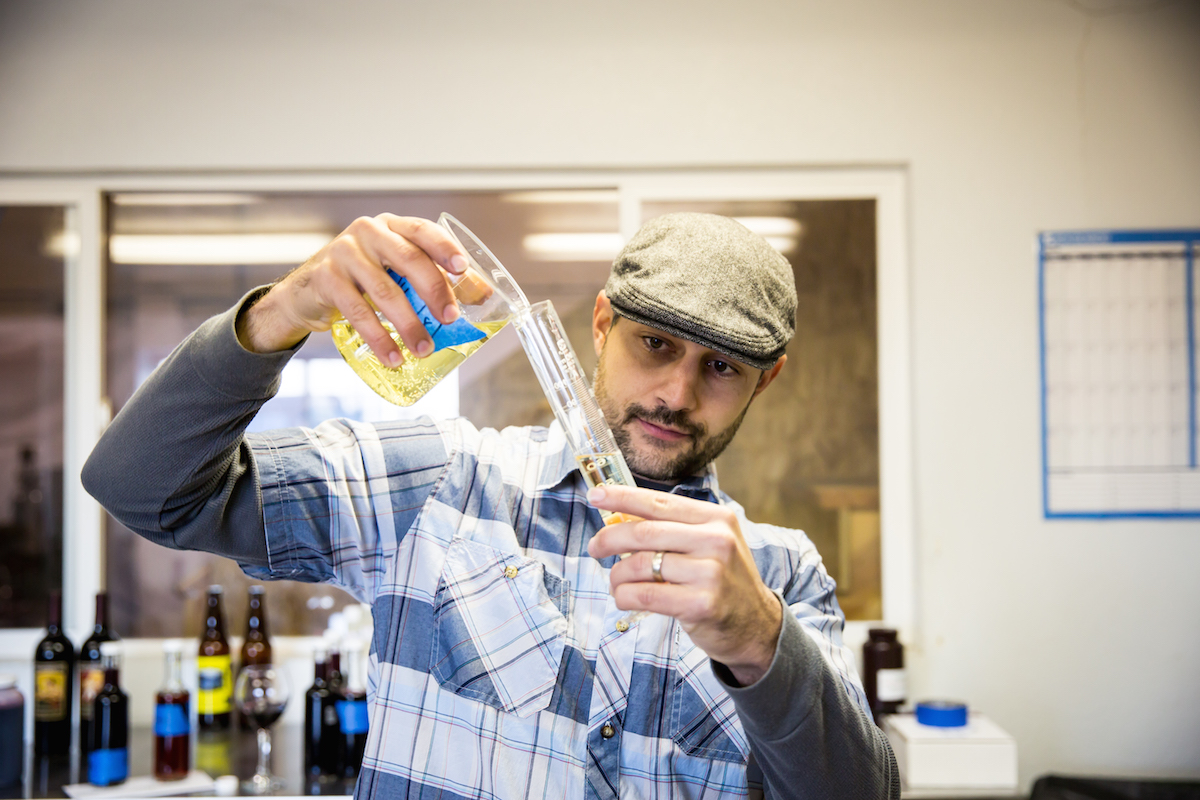
paulThe final cider formula upon which Paul settled took a bit of time, but not as much as you might think: By the time he considered cider, he’d already cut his teeth as Scotto Family Cellar’s vintner, and, as he is the first to admit, cider is an easier beast to tackle.

Big bro Anthony takes credit for the original idea of having Paul craft ‘a refreshing drink lighter than beer, less potent than wine and reliant on a spritz of fizz to appeal to a coed crowd at, say, a weekend cookout’.  If there was any downside of such a brainstorm, Anthony  shrugs: “I’m not sure how many batches he tried, because I nearly burned out tasting the experiments. But in February, 2014, he nailed it. His ciders have the same subtleties and complexities as some of his award-winning wines, and at less than 7% ABV, this something you can drink all afternoon.”

Paul claims that from tanker to bottle he can produce this solid, nuanced, complex product in as little as 23 days, and his experiments now are merely detail adjustments—a yeast strain here, a new flavor there. That said, he is happy to share a few of the more monumental hiccups along his early learning curve, including a failure to account for the high pectin content in fresh apple juice.  “We ran a filtration when the juice first came in, and it clogged the pad within thirty seconds.  So we tried a larger pad.  Same thing.  After two more, I began to rethink the whole thing, but there I was with thousands of gallons of juice…”

paul finalI could walk you through the steps, outlining the transformation of apples to ambrosia, but I won’t.  I pride myself on a certain ability to make dull subjects interesting but this technical silk-purse-out-of sow’s-ear even goes over my head.

Instead, I’ll talk Paul, the artisan Scotto.  The approachable Scotto.  The acute Scott—and although his friends tell me that Whitney is not the first young lady to have been smitten by him over the years, I said ‘acute’, not ‘cute’; I leave it to others to determine that.

He’s a popular Lodi bloke, though—for sure. Paul’s winery’s club membership tops 1400, so many that they had to halt members from bringing friends to a recent tasting, the better to serve those they have.  Paul’s combination of Italian looks, burgeoning self-confidence and ease around a growing fan base have made him something of a local rock star.

A week after Valentine’s Day, his father and I went to visit him at Sera Fina, the Plymouth winery Paul owns and operates along, merely one of  a laundry list of his Scotto Family Cellars and Cider Brothers chores.

During the ride, A2 lathered on some personal history, which will occupy its own chapter, and also some history of Sera Fina Cellars—the bailiwick of this one.

seraIn 2007, Sera Fina began as a gleam in the old man’s eye, which was probably a gleam from one too many mid-day wine tastings; A2 was supposed to be home by 5:00 that afternoon so he could take his wife to a ‘Chicago’ concert and became totally lost in the Amador foothills.  He began to lose his cool, and A2 does not like to lose his cool—it’s a sign of weakness.  So he began to take down phone numbers of any property he passed with a ‘for sale’ sign in front, and later, he made a point to call each one to inquire about financing details.  He didn’t necessarily intend to buy anything, but the idea of an afternoon wasted did not compute in the Scotto worldview, so he made the most of his FUBAR.  Without a follow-up call, the number-taking would have been a waste of time.  And not wasting time is the way that A2 rolls—even while directionally challenged.

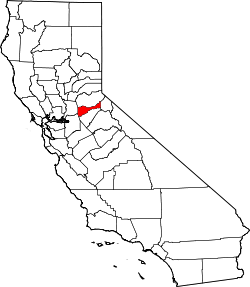
Amador County

Amador County

However, it turned out that one of the properties—the twelfth of twelve on the list as it happened—was an ideal site for a winery.  Ideal frontage, perfect exposure, knock-out view.  A2 had struck gold in Amador County, home of the Kennedy Mine, once the deepest gold mine in the world.

Plymouth, CA, the site’s zip code address and known variously throughout the years as Puckerville, Pokerville,and Poker Camp, is also in the middle of Zinfandel country, and love it or hate it, the umbilical cord between nearby Sutter Creek and Sutter’s Home White Zinfandel is proof positive.

At the time, Paul Scotto was doing remarkably well selling heavy equipment for Sacramento-based Vermeer, living off commissions that before the economic downturn of 2008 were quite commendable.  But, he’d served his hard time in the UC Davis enology program, and he had long dreamed of opening a winery.  For the time being, the Vermeer job was too good to quit; at least until the time his customers began to have an increasingly difficult time financing big ticket purchases.

And the gold in them there hills proved to be the gleam in the old man’s eye: The site of Sera Fina Cellars.

The ground around here actually is sort of gold, but the geology books claim it’s ‘consolidated rhyolitic tuffaceous sediments’, which I don’t have to Google to assume is not what they make best-selling records out of.  There are also bright fields of iron-rich red clay, and others littered with massive boulders that are disconcertingly green.  They’re made of green basaltic rock, fittingly called greenstone, but Zinfandel—the varietal most associated with the appellation–prefers red granite soil.

Interior, Sera Fina

Interior, Sera Fina

Zinfandel was never going to be focus of Sera Fina, and Paul Scotto is as like to vinify it under its Puglian alias Primitivo—the Italian name for the varietal.  The theme of Sera Fina, besides subliminal, Big Brother admonishments to ‘relax’ (on t-shirts, on signs in the tasting room, on web site verbiage; it’s the mission statement) is Paul’s Italian heritage.  ‘Sera fina’  means ‘beautiful evening’, his wine club is called ‘La Famiglia’ and he makes Barbera and Pinot Grigio and Malvasia Bianco, and out behind the tasting room, there’s a sight to warm the heart of the most jaded goombah: A bocce court.

This is the sort of tasting room that should add a neon sign beneath ‘relax’ saying, ‘There are only two kinds of people in the world—Italians and people that wish they were Italian.’

Or maybe that’s better reserved for Al the Wop’s, the strange little tavern in strange little Locke that also occupies its own chapter.

Of course, as a lover of Rhône varietals, Paul’s grab bag wine list includes a nice selection of Viognier, Syrah and a dry Rosé made from the classic GSM blend, Grenache, Syrah and Mourvedre, and with all these fantastic vinous innovations, what does Paul bring out for me to taste?  More cider.  This one is mango, the latest in a string of experiments he is running in tandem with California Concentrate; it’s a bright and refreshing fruity drink—something you might sneak in the privacy of your own home, not something you’d order in a biker bar like Al the Wop’s.

Flavored cider is like flavored anything; a niche reserved for the somewhat faint of heart.  It’s like bubblegum pop—we may all harbor a secret craving for it, but most of us would not ‘fess up to it in society—polite or otherwise.

Unless it was at the 2016 San Francisco Chronicle Wine Competition Public Tasting. If I had no other accolades to heap upon Paul and Michael Scotto’s line of artisan ciders, it was the public’s reaction to their William Tell Hard Cider with Strawberry, winner of their category’s ‘Best of Class’.

I volunteered to pour at the tasting dressed in my Scotto Family Cellars hat, Scotto Family Cellars t-shirt, Scotto Family Cellars cotton zip-front jacket, looking like a NASCAR driver plugging his sponsors or Roger Daltrey on the cover of The Who Sells Out.   Frankly, I don’t feel bound by any sense of journalistic ethic that prevents me from supporting the folks who are putting me up in downtown Lodi; this book is an editorial, not an exposé.

Jogging in San Francisco compared to jogging in Detroit

Jogging in San Francisco compared to jogging in Detroit

That’s why I don’t mind sharing my personal reaction to the shiny happy joggers and bikers and roller-bladers gliding along the northern waterfront between Aquatic Park and the Marina Green; buff, tan, thin and model-gorgeous beautiful people enjoying a balmy 70° Saturday afternoon.  Everybody here seems to assume that just because I am from the winter-ravaged Midwest, where (as the joke goes) the lauded four seasons are almost winter, winter, still winter and the 4th of July, that I must love California in February, where the skies are blue and the temperatures tame.

In fact, there is something profoundly disturbing to me (and my innate sense of up and down) when I see people sunbathing in the middle of winter.  It upsets the equilibrium; it’s like Australians celebrating Halloween in the spring and Christmas in the summer.

What in the world are all these San Franciscans so happy about—did they forget that everything sucks? As a Detroiter beamed down into the middle of Happy Town, I felt like one of those feral children raised by wolves who becomes somebody’s civilizing project. Within a couple of hours I was pining for the jungle and the raw meat of the Motor City.

San Francisco Chronicle Wine Competition Public Tasting

San Francisco Chronicle Wine Competition Public Tasting

At least the thousands of people in attendance at the Chronicle tasting had an excuse for their grins and simpers: Artificial stimulants.  This is the largest public tasting of the largest competition of American wines in the world and it’s held inside what looks like a blimp hangar and patrons paying upwards of a hundred dollars a ticket can sample the best of the six thousand entries from 28 states that competed in this year’s competition.

An endless string booths were set up, where pogues like me—or luminaries like Jim Caudill of Hess Collection—strutted their stuff.

I’ve poured at these sort of events in the past and I know the score—after tasting a hundred or so wines, many of which are high-octane, punch-in-the-head reds or tart, bone-dry whites, your palate feels like Rocky Balboa’s face looked after 15 rounds with Apollo Creed.  So, my little table with its bottles of clean, pure, effervescent apple cider was balm in Gilead, a cool shower after a year-long drought.  It was positioned to prosper, poised to prevail.  But, as I said, having covered these sorts of events in the past, I can state without equivocation that I have never known an individual product with such mass appeal or that could garner such universal ‘wows’ as Scotto’s cider.  In five pouring hours, I did not record a single thumbs down from anybody, man or woman, hipster or oldster, and this included people who claimed they didn’t like hard cider and people who had never heard of the Cider Brothers.

strawnHad it been legal to sell case-loads at the tasting (it wasn’t) I have no doubt the Scotto’s warehouse would currently be empty.

To me, San Francisco Chronicle Wine Competition is the tallest soap box from which the Cider Brothers could advertise—not in script but in sips.  If I pontificate, therefore, it’s from sanguine loft of experience.

And anyway, who needs Al the Wop when you’ve got Paul the Wop and Guido Gold in  Amador County?


Posted in Lodi | Tagged , , , , | 2 Comments

The Creepiest Spot in Lodi

An excerpt from ‘Starstruck in Lodi Again’, set for release in August, 2016…

hotel

Del Rey Hotel, right

It’s one o’clock in the morning and outside the window, the moon is bloated—a pustulant boil in the sky.

When you are just falling asleep, the way the sound of a distant train works is this:  The whistle is as mournful as an owl’s cry, evoking images of other places and other people with destinations beyond familiar horizons; it lulls you into dreamland filled with imagined stories of unique, exotic lives and a nagging, nostalgic melancholy.

Midnight Special, San Francisco to Sacramento Express

San Francisco to Sacramento Express

When you are already asleep, the sound of a train a single block away works like this:  You are jolted awake by the screech of an gargantuan angry beast—an entity bigger than life shrieking with inconceivable wrath at someone or something or no one at all; you are wrenched back to reality with a sense of horror in the pit of your gut and it takes a while before you realize that it is merely the San Joaquin connection, not a Talmudic shedim loosed from the bowels of Hell.

I assume that, given time, circadian rhythms would allow me to ‘get used to it’.  I’m not there yet, which is why I’m wide awake at one in the morning, trying to accomplish something, anything, at my lonely keyboard while glancing over my shoulder at the fat, infernal moon.

I’m inside an old boarding house that has has been around since…  well, nobody knows how long it’s been around.  And believe me, I checked. It used to be called the Del Rey Hotel, and nobody from the Lodi Historical Society had ever heard of it, nor did a Google search turn up a single hit.  There are a couple of old photos on the wall that seem to be from around 1940; they show a somewhat featureless street lined with clunky Chryslers and bulbous Plymouths and a sign for ‘Del Rey Rooms’ opposite the Lodi Theater and Rexall Drugs. Since the Del Rey building is directly across the street from the formerly swank Lodi Hotel, I am assuming that this place must have catered to a run-off crowd that couldn’t afford the luxe, and I am assuming that a boarding house this old has many strange and squirrely stories hiding within it.  People do desperate things inside boarding houses given enough time and booze and sufficient despair, and I felt wicked vibes inside the place from the moment I walked through the door.

What makes it creepier still is that I am the only person in the entire building.

Del Rey hallway

Del Rey hallway

The room on the ground floor is being gutted and refitted as a tasting room for Scotto Family Cellars, the good folks who spirited me across the country to write this book about Lodi.  They stashed me comfortably in the old boarding house above the future tasting outlet—this upper story had already been refitted by a family who once lived up here.

They moved awhile ago, for unknown reasons, and when they left, they took everything with them but the bed where I try to sleep and the desk where I sit when sleep won’t happen. The  only thing thing missing when I wander down the long spooky boarding house hallway at one o’clock in the morning, where eight rooms snake off into their own dark and private microcosms, each door shut tightly and too horror-show to consider opening, is furniture and company.

You feel that the place is waterlogged with stories and that there’s nobody left to tell them.

The real deal

The real deal

So on my last day here, I sought out Janice, a retired volunteer from the Historical Society, and she broke protocol and invited me to the town’s ‘museum’, even though it was supposed to be closed and she was supposed to be at whatever work a person does when they say they are retired.  Janice has lived in Lodi on and off since the 1940s, when the town was a whistle stop with a population of around ten thousand.  I figured if anybody could shed some light on my haunted hotel, it was Janice.

So, what do you do when the place you go to find out about paranormal activity in your century-old boarding house is itself a sprawling, empty, eerie Victorian mansion built in 1900 and named… wait for it… Hill House?  You bound up the boards and knock eagerly at the door like Eleanor Vance did in Shirley Jackson’s iconic 1959 horror novel ‘The Haunting of Hill House’.

haunting of hill coverAs a Hill House caretaker, Janice is diminutive and precious; a small, white-haired historian who was eager to help track down any information on the Del Rey she had in the moldering archives of Lodi’s records, and in fact, she began to pore through volumes of old directories and telephone books while I wandered through period room filled with faded wedding dresses hung on manikins, empty highchairs in forgotten kitchen nooks, spooky porcelain dolls in childrens’ rooms, grinning and vacant, perhaps waiting for the return of daughters who have since grown old and died and are now themselves porcelain-colored bones in Lodi Memorial Park.  Whether the tintype portraits that ring the halls of Hill House are more ghastly than most, I will not speculate, but they  portray sunken-eyed, sober-faced specters whose silent vigil over the empty rooms is reminiscent of the opening lines of Shirley Jackson’s ‘The Haunting of Hill House’:

‘Hill House, not sane, stood by itself against its hills, holding darkness within; it had stood so for eighty years and might stand for eighty more. Within, walls continued upright, bricks met neatly, floors were firm, and doors were sensibly shut; silence lay steadily against the wood and stone of Hill House, and whatever walked there, walked alone.’

There was, it turned out, virtually no mention of the Del Rey Hotel in any of the endless records; it was as if it never existed.  Finally, a single ad turned up in an old Lodi newspaper from 1956 list ‘Del Rey Rooms’ at the address, managed by a woman with the unlikely and unsettling name of Dorothy Rott.

Paranormal investigators at Hill House

Paranormal investigators at Hill House

But if I was unsuccessful in mining for Del Rey background, I did manage to unearth the true motherlode of Lodi’s supernatural face and as it happened, I was standing in the parlor of the very crucible.  Hill House, on 826 Church Street, is haunted.

At least it is if you trust the professionals.  Janice was happy to bring out a clipping from the  Lodi News-Sentinel (the same paper with the Del Rey advertisement) from March 22, 2011 that chronicled the experiences of Kimberley Phillips of Lodi Paranormal Investigators over six post-midnight hours she spent within the house along with video cameras, recorders and EMF meters to detect fluctuations in electro-magnetic energy.

“I was blown away by it,” she told Sentinel reporters.  “I wasn’t expecting anything like this.”

The occurrences over that span of hours—which Phillips described as happening on ‘a stormy night’, itself an anomaly in Lodi—can be measured in varying degrees of inexplicability.   In the master bedroom, the one with the wedding dresses, a man’s voice was heard to utter, “Help me.”  In context of an impending marriage, that is perfectly understandable.  Indeed, a woman’s voice was heard to say, “Try my dress on,” and a child replied, “Why, thank you.  Within the disquieting silence of the doll room, a male voice referred to one of the investigators as ‘an idiot’.

Janice pointing out the face powder

Janice pointing out the face powder

The corresponding secretary of Lodi’s Historical Judy Halstead was initially skeptical, but having been the chaperone for the late night séance, she changed her tune.  “A couple of things happened that made my jaw drop,” she said.

Among them, and one that the docent Janice mentioned, involved a small container of face powder sealed within an acrylic display case.  Halstead bore witness to Kimberley Phillips discovery of a small pile of the powder that had appeared without explanation beneath the case following the camp-out.

I couldn’t track down Kimberley Phillips, even using a Ouija Board, but I did manage to find a guy named Tom Presler who runs a parallel universe of paranormal investigations, and although he had not been involved in the Hill House spook-fest, he did point out something that I guarantee most Lodi residents are not aware of:

Lodi, even before the town had been incorporated, and even before Steven Spielberg was born, was the site of the world’s first Close Encounter of the Third Kind.

Fifty years before Roswell, in the November 19, 1896 edition of the Stockton Daily Mail, Colonel H.G. Shaw reported having seen a landed spacecraft near the Mokelumne River from which a trio of aliens emerged.  In his words:

Colonel H.G. Shaw

Colonel H.G. Shaw

“…They resembled humans in many respects, but still they were not like anything I had ever seen. They were nearly or quite seven feet high and very slender. We were somewhat startled, as you may readily imagine, and the first impulse was to drive on. The horse, however, refused to budge, and when we saw that we were being regarded more with an air of curiosity than anything else, we concluded to get out and investigate. I asked where they were from. They seemed not to understand me, but began – well, “warbling” expresses it better than talking. Their remarks, if such you would call them, were addressed to each other, and sounded like a monotonous chant, inclined to be guttural. I saw it was no use to attempt a conversation, so I satisfied myself with watching and examining them. They seemed to take great interest in ourselves, the horse and buggy, and scrutinized everything very carefully…”

He also offered this as verification:

“Were it not for the fact that I was not alone when I witnessed the strange sight I would never have mentioned it at all. I went out to Lodi in company with Camille Spooner, a young man recently arrived from Nevada.”

The real Colonel H.G. Shaw was the officer portrayed by Matthew Broderick in ‘Glory’.

Spacecraft illustration from SF Bee

Spacecraft illustration from SF Bee

Tom Presler also directed me to a copy of the San Francsico Bee from the day before, November 18, 1896, in which residents reported seeing mysterious lights in the sky at an estimated 1,000-foot elevation.  Some witnesses reported the sound of singing as the craft passed overhead and a man named E.L. Lowrey claimed that he heard a voice from the craft issuing commands to increase elevation.  San Francisco is a hundred miles from Lodi, and by conventional means of locomotion, excluding high speed rail or flying saucer, there was a day’s travel time between the two cities.  The likelihood of statistical coincidence for these two juxtaposed accounts I leave to math majors.

Beyond his work in the paranormal,Presler is the founding father of the Lodi Zombie Walk, now in its eighth consecutive year.  On the Saturday before Halloween, hundreds of undead wannabes from all over Northern California dress up in rags and prosthetics and take over downtown and various participating wineries in a city-wide stumble rumble.

zombie walkIf possible, on October 29th of this year, I’d like to bring the whole thing around full circle and have the Zombie Walk stop at the Lodi Memorial Garden and see if anyone can summon the spirits of Nellie Hill and Dorothy Rott.  They left behind some loose ends and it’s high time they tied them up, if for no reason other than posthumous posterity.

Shirley Jackson’s ghosts may walk alone, but with Presler’s gang, there is no reason why Lodi ghosts should have to.


Posted in Lodi | Tagged , , , , , | 5 Comments

Mike McCay, the Real McCoy

Mike McCay is on a treasure hunt to rival the most passionate pirate, the most corybantic Conquistador, the most frenzied ‘49er.  For a Mike strike, where the gold is closer to scarlet purple, he doesn’t need to cross any bounding mains or monstrous mountains, but he does have to wade through a pretty wide expanse of Lodi grape juice in order to track it down.

Mike McKay and art

Mike McCay and art

At the end of every one of McCay’s rainbows there’s a pot filled with something he can transform into enological gold:  Grapes from small, isolated vineyards scattered throughout Lodi wine country, occasionally neglected but more often producing fine juice that gets lost amid the production sea that major players like Gallo and Constellation suck up annually.  Frequently, this ignoble fate has been the result of land passing through families, where generations of patriarchs were content to have a regular, reliable customer for the produce every year.

These days, some of the sons and daughters have recognized that there might be a better market in small-lot productions and labels that sell for more that a fistful of dollars at Big Box outlets.

According to Mike McCay, who has already identified many of them, there are untold others out there, furtively flourishing, surreptitiously setting,  privately producing superb wine grapes, often right beneath the noses of the most observant geek from the Lodi Native project.

Mike McCay is a cornerstone of that group, which is dedicated to the proposition that all vineyards are not created equal, and I’ll refer to it again shortly.

lodi climateI’m not sure I’ve ever been in a wine region where there is such a dramatic fault line between the viticultural generations, but that’s probably because I’ve never before been in a wine region quite like Lodi.  It’s the bread basket of California wine, producing a quarter of all the wine grapes in the state, but it also has a remarkably quality-friendly climate, with the sort of diurnal temperature shifts required to produce fully ripened grapes while safeguarding vital acidity. As such, the old guard growers had one commercial mindset while their spawn, in many cases, has another.

The American wine revolution (where our wines began to compete on the global stage) straddled that generational shift like the Colossus of Rhodes; one foot in the old world and the other in the new.

 Tasting room, exterior


Tasting room, exterior

McCay is a pretty rugged example of the new.

He dragged himself out of a sick bed to hook up with me inside his tasting room, which happens to be about as unlovely a  location, at least from the outside—inside a warehouse backed up in an industrial park off E. Turner—as you could imagine.  But the sort of expansive-yet-cozy interior they’ve eked out here, staffed by bright, pretty young women and ringed with nominally decent artwork for sale, saves the day.  Toss in the spectacular range of wines produced in barrel quantities and relying exclusively on native yeasts while focusing on the ‘trueness’ of winemaking, and you’ve got a home-run like the one that broke the Louisville Slugger that McCay—a lifelong Giants fan—displays above the juice cooler.

Tasting room, interior

Tasting room, interior

I’ve met a few winemakers in Lodi whose original life’s mission was to make wine, but I’ve met more than a few whose primal mission wasn’t.  McCay is in the second category—he studied Marine Biology in UC Santa Barbara and soon decided that as far as primal missions go, taking plankton samples inside a mini-sub at midnight didn’t have much to recommend it either.  So he bought ten acres of Lodi land in 1994, farmed it to wine grapes successfully (farming something unsuccessfully in Lodi is something you have to work at), and began to vinify for himself in old milk vats.  He also had a chemistry background, which helped him come to terms with the treasure trove of vineyard sites throughout the region.

“I make wine in a style that I like, not necessarily to flood the market,” he says.  “If I do it that way, I can maintain the passion for my product.  It’s a lot easier to sell stuff you like.”

“Look around,” he continues, indicating the somewhat primitive ambience.  “I don’t court throngs of visitors; people come here to seek them out.  I don’t need sales reps—restaurants call me.”

DD40 Birthday Drinks at The Press ClubNo brag, ma’am—just fact.  McCay Cellars wines can be found in some of the trendiest restaurants in California, like Quince in San Francisco, Biba’s in Sacramento and Nobu in Malibu.  These tend to be sommelier-friendly wines; wines that are clean and bracing, an honest exposé of the fruit.  His batch sizes are miniscule—he produces about 4500 cases annually, but 20 to 25 different wines.  His reds are intense—big without being muscular, assertive without being aggressive, opulent without being gilded.

But the whites were the real show-stoppers for me, because—silly boy—I didn’t yet realize that the Lodi terroir is so superbly suited for producing  layered, silken, spicy whites that when the French delegations come to town, they’re shocked that Lodi does not produce more of them.

Vinter/growers like Mike McCay are trying to edge the needle over.  For him, there are two periods during each vintage that he rates as monumentally more important than any of the others: The January prune and veraison, when he begins to drop fruit to determine ultimate yields per vine.

“If that’s not handled correctly, problems turn up later that the winery can’t fix.  When I buy grapes from other vineyards, I try to bring the growers over to my side early, even when they think I’m nuts, being wasteful.  I tell them I’ll pay them for eight tons an acre, then make them drop fruit so that they only produce three.  But that’s key.  Do a good job in the vineyard, and the wines will take care of themselves.”

muscat I could (and did) rave about his exotically tropical and floral Viognier, but I stopped the presses over his Muscat, 2013.  It’s rare to see anyone outside the Grands Crus of Alsace attempt—let alone nail—a dry style of this sometimes overly-perfumed varietal.  Here, the aromatics were anchored, reined by elegance and a striking herbal nose, with woodruff and lavender hovering above oregano and ginger.  The tones were subtle, but luscious, with honey and lychee and the somewhat passé descriptor ‘muskiness’, which is actually sort of a perfumed and earthy spice, a hallmark of the grape.

This emerged as my personal favorite of the whites, but the red are a toss-up of superlatives.  All are deliberately extracted to the point that you take notice, but not to the point where you’re knocked down.  Cinsaut, Carignan, Petite Sirah, all from vines that range in age from thirty years old to over a hundred.

But, true to the heritage grape of Lodi, it is in the Zinfandel that Mike McCay sends his enological feelers out across the appellation, currently producing six vineyard-designated Zinfandels, with three more coming next year.  And, in the future, I imagine that he’ll bottle as many labels as unique terroirs his perpetual-motion treasure hunt turns up.

heitzNaming a vineyard on a bottle of American wine is a tradition that post-dates most of these plantings; Heitz Martha’s Vineyard Cabernet Sauvignon was the first, and that didn’t happen until 1966.  As a marketing hook, it has probably been somewhat abused, since the cachet that a winery is aiming for is the suggestion that a named vineyard is a better vineyard, and that’s not always the case.

In the Lodi Native Project’s case,  you can be pretty sure that it is.  These innovative cheerleaders have taken solemn vows on the souls of their progeny to adhere to sensible viticulture and minimalist winemaking techniques, especially, using native yeasts exclusively, oak sparingly and filtering/fining not at all.  It’s a Zinfandel project, but ironically, the focus of the wine, from six growers who are part of the collective, is not on the flavor of the varietal but the flavor of the vineyard.  Five of the growers are in the Mokelumne River sub-appellation, and one is in Clement Hills.

Native sons

Native sons

The press for the Project has been phenomenal, probably because the group’s mission statement includes us little old wine writers: ‘To demonstrate to more sophisticated consumers, media (print and blogosphere…’ and don’t we just sit up and take notice when somebody in the winery sits up and takes notice?(!)

Not much to notice at the McCay tasting room beside the lovely lass with the pour spout and the array of pure, terroir-driven wines that raise the bar for the whole Lodi wine game.  The setting may put the ‘industrial’ back in ‘chic’, but as far as a treasure hunt, I see no reason to look farther.

Let’s drink and leave Mike to do the heavy lifting.


Posted in Lodi | Tagged , , | Leave a comment