Truly Irritating TV Ads: Like, ‘We Will Sell No Wine Before the Check Clears’

I spent two years in adverstising, and short of combat against concealed lunatics on Iwo Jima or being forced to watch another episode of Wizards of Waverly Place with my completely taste-free eleven year old, I can’t imagine a worse experience.

We had a poster in the layout room showing a bunch of brain surgeons in an operating theater.  One of them is saying, “Come on, loosen up; it’s not like it’s advertising…”

Like a battle scar or the lingering taste of spoiled liverwurst, these years left me with a wholly-unwanted  perspicuity toward advertising.  I have this inner compulsion to dissect every ad I see and become preternaturally irritated if I don’t like what dribbles out.  All assurances: I have sought professional help and have been told that the best therapy is to outline precisely what is bothering me.

Hence, some specific  ads I recall over the year, beginning (as my psychiatrist directs) with my earliest childhood memories…
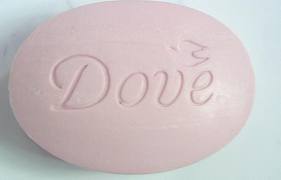
DOVE SOAP : 

Set-up:  Regular soap is dissolved in one sink, Dove is dissolved in another.  Action:  Some dingledork dips a pair of glasses in the sinks, one lens per.  Then she holds up the specs so you can see a disgusting coating of filmy grey scum covering the soap lens while the Dove lens remains crystal clear.  My psychological issue:  How many millions of dollars did Dove spend on an ad campaign to convice rationally intelligent people that washing with hot water and soap actually makes you dirtier?

'Don't hate me because I'm beautiful. Hate me because I'm a dipshit'.

PANTENE:

Set-up:  A hopelessly  luscious teenage morselette blinks toward the camera.  Action:  She says, “Don’t hate me because I’m beautiful…”  My psychological issue:  We don’t—we hate you because you are a narcissitic, petty, pretentious tool and way too full of yourself.  Your beautifulness  is the only thing about you we DON’T hate.

'Believe me, this is going to to hurt you a lot more than it's going to hurt me.'

BAND-AIDS:

Set-up:  Wounded, ultra-precious toddlers cast their Margaret Keane eyes toward the audience. Action:  They sing, “I am stuck on Band-Aids, ‘cause Band-Aid’s stuck on me…” My psychological issue:  Remember being a kid, when the adult world seemed to exist simply to screw with your life?  And what was the worst thing about that ridiculous Band-Aid that Mom insisted on pressing into every cut, scrape, scratch and blister?  It stuck on you!  Peeling it off was physical torture, and thinking about having to peel it off was even worse.  So what does the Band-Aid brain-trust do?  Write a jingle that goes, “I am stuck on Band-Aids, ‘cause when it’s time to take that sucker off, Band-Aids STOPS sticking on me and therefore doesn’t rip off an entire layer of newly-grown skin???” 

Like hell they did.

WINE ADS…

PAUL MASSON:

Citizen Sugar Kane

Set-up:  A bloated Orson Welles, unable to find another chump willing to finance some pompous, boring movie, glares glibly at the viewer with a look that says, ‘I know more than you about every subject on the planet, including the one I am about to drone on about.’ Action: He intones Paul Masson’s ridiculous slogan in a Shakespearean snoot: “We will sell no wine before its time”.  My psychological issue:  Hey, Koolaid (I mean, Mr. Welles):  This is Paul Masson, purveyor of jug plonk from the flat, hot, dry deserts of Central Valley. Before its time???  Good Lord, tubby; this crap began to spoil on the way home from CVS.

CORBETT CANYON:

Set-up:  Who knows? It’s a radio ad.  Action: Every time the voice-over actor says ‘Corbett Canyon’, it echoes… and echoes… and echoes.  My psychological issue:  Over the last ten years, Corbett Canyon has spend $32 million to reduce radio listeners such as myself to quivvering masses of annoyed, bile-sodden jelly—that’s how disturbing that echo is.  Thirty-two million dollars!!  I checked online and a .30-06 centerfire shell shot at my right temple would have only cost Corbett Canyon one dollar and Cabela’s would have given them a free dry-storage box with the purchase. 

Why is this ad so rankling?  Because Corbett Canyon sucks… sucks… sucks…
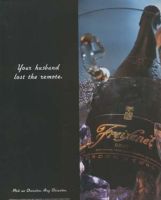
WTF?

FREIXENET:

Set-up:  A print ad showing what I guess is a bottle of Freixenet on ice with the tagline, ‘Your husband lost the remote’.  My psychological issue:  The ad makes me feel stupid because I have no idea what it means.  The husband lost the remote, so he’s  going to be content drinking cheap Spanish wine instead of watching football?  Is that it?  The ad makes me feel stupid because I have no solid idea of how to pronounce ‘Freixenet ‘ .  If I can’t pronounce a hundred dollar bottle of wine, there’s some cosmic justice behind my ignorance.  If I can’t pronounce a nine dollar bottle of 7-11 wine, I must be brain-damaged.   Lastly, I’m always losing the remote, therefore, obviously (according to the ad) I AM stupid and my wife, some slick magazine, and a massive Spanish wine conglomerate are all having a private in-joke at my expense.

Trust me, children; I could go on with this one…
Posted in GENERAL | Tagged , , , , , , | Leave a comment

Biody-scam-ics? I’ll Drink; You Decide

Snow Leopard burger on an earth-friendly, fully biodegradable paper plate

As a disclaimer, yes I do have one of those blue eco-friendly Yuppie Guilt Boxes in my garage into which I dutifully deposit all my empty water bottles—most of which come from the island of Fiji aboard huge, oil-ravenous tankers—and yes, as result I go to bed at night confident that I’ve already done my part to save the planet and can therefore eat Snow Leopard burgers and turn up the heat to ninety.

And yes, with my side of frittered Panda, I drink organic wine in such huge proportions that I’m shocked that global warming hasn’t already been halted—nay, that it hasn’t been reversed to the point that we’re all going to freeze to death unless the rest of you immediately turn your thermostats up to ninety and open your windows.

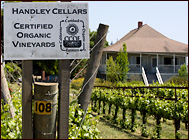
Organic vineyards, as you know, rely on crop rotation, hand cultivation, mulching and soil enrichment (etc.) to embrace a holistic approach to winemaking.  As you may not know, however, legally-blessed ‘organic’ wines need not adhere to any pure holistic practice and nearly all medium to large scale wineries require mechanization (instead of horses) to cultivate, and they are permitted to use a wide range of pesticides, including some (copper-based) that are actually more earth-unfriendly than those that are banned.

Most integrity-focused organic wineries will, on their own merit, use natural as opposed to synthetic supplements in their vineyards; some French houses rely on lutte raisonée, a ‘rational’ approach to such decisions, understanding, for example, that cyanide, nicotine and cocaine are all naturally-occurring chemicals.

So, if not for the good of Mother Earth, are organic wines better for our health?  Do they taste better, or even different?

Quote from the USDA:  No distinctions should be made between organically and non-organically produced products in terms of quality, appearance, or safety.’

Drinking wine stamped ‘organic’ may be the feel-good equivalent of blue recycling boxes, but even so, wine is not a life-sustaining necessity; wine is a luxury.  You don’t have to drink wine, so if you gave it up altogether you wouldn’t even be contributing a plugged-penny’s worth of copper fungicide to the environment.  Of course, that’s you.  Me, I have to drink wine because I’m a wine writer and need my  paycheck so I can afford gas for my Land Rover LR4.

(Kidding on the Land Rover.  Actually, I drive a Civic with so many friggin miles on it that it couldn’t pass an emissions test if whatever God those kwazy Japanese believe in dropped by to tune it up Himself).

In conclusion, earth children, a wine that is certifiable as ‘organic’ may be doing more for its PR than it is for its planet.

The Usual Dynamos

So let’s move on to those touched souls who practice biodynamics—and this includes one of my favorite vintners, Randall Grahm, a winemaker/bon vivant who is as dynamic as his bio suggests.  But stark raving nuts?  Let’s just say that when we refer to him as ‘certifiable’, we’re not talking organics.

So you shouldn’t misunderstand, insanity is a quality inherent to most winemakers or else they’d have stuck out law school.  Yet biodynamic methodology subscribes to such a bizarre set of techniques that most inmates cross to the other side of the asylum when the biodynamic bunch come out to play.

No? Okay, if  I was to list three biodynamic preparations meant to energize compost while aligning the earth-organism with the cosmos, could you guess which one was legitimately biodynamic and which two I made up on the spur of the moment?

  • Yarrow flowers must be fermented in a Red Deer’s urinary bladder before adding to the soil.
  • Oak bark must be fermented in the skull of a domestic animal before adding to the soil.
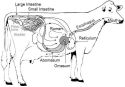
  • Dandelion flowers must be fermented in cow mesentery before adding to the soil.

Wrong, they’re all real—Preparations 502, 505 and 506.  And in case you’re wondering (like I was), cow mesentery is ‘the double layer of peritoneum that suspends the jejunum and the ileum’.  Everything clear, now?  Snow leopards have mesenteries too, but snow leopards are endangered so organic whizbangs avoid using them.

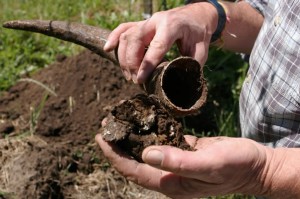
Another tried and untrue biodynamic concept involves filling  a cow’s horn with manure and burying it in the vineyard.

Proponents grasping at organic straws claim that this encourages the growth of beneficial microorganisms;  I claim that I once had a friend who was a perfectly normal guy except that he had to touch his left earlobe every time somebody said the word ‘purple’.   I’m sure if I suggested that he could cure that tic by burying a crap-crammed cow horn in his yard, he’d end up doing just that.

That’s not called sustainable agriculture, it’s called OCD.

On the other hand, OCD may stand for oenological compulsive disorder, and it may mean that if you are so focused on the minutia of vineyard management that you’re scrabbling up dirt at midnight to bury cow entrails, you may be just getting every legitimate detail right too.  That would be one explanation for why, in a blind tasting of ten biodynamic wines vs. ten conventional wines by Fortune Magazine, nine of the winners were cow horn wines.  The overall quality of these products was no doubt the result of meticulous technique, not mysticism.

Still, you can’t argue results.

Rudolf Steiner with some artfully-arranged 'stray hairs'

Nothing Could Be Finer Than To Laugh At Rudolf Steiner in the Morning…

'Rudolf Steiner asked me to stop by and phix your phylloxera problem.'

The biodynamic movement was inspired by Rudolf Steiner (1861-1925), a self-styled ‘social reformer’ who believed in planting according to the phases of the moon, viewing the farm as an self-sustaining organism rather than a sum of parts and in enriching the soil with homeopathic preparation instead of chemical fertilizers which, he taught, can damage the brain.  Above all, his philosophies were grounded in the conviction that nature knows best and science is dangerous.  Much of what he preached, however, has a solid foundation in science and is practiced all over the world by folks who have never heard of him.   Where Steiner and they tend to part company is his professed goal of engaging non-physical beings  (i.e., spooks and fairies, right?) into growing cycles and a belief in made-up factors like ‘dying forces’ and ‘rotten ethers’ that can affect a harvest.

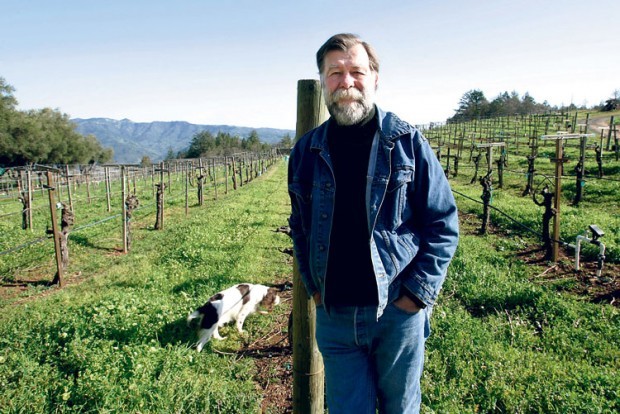
Stu Smith--and no, that dog is not urinating on the riesling vines

This bit of paranormal flim-flam has attracted fringe-element winemakers and led to some resentment from non-bio vintners who feel that there is a growing divisive element between them and their ‘I’m Holisticker Than Thou—Therefore My Wines are Better’ neighbors.  The issue gives Stu Smith of Smith-Madrone Vineyard so much agita that he’s launched a blog entitled ‘Biodynamics is a Hoax—Someone Has To Speak Up’.  Based on credentials alone—Smith is a U.C. Davis Enology and Viticulture graduate while Steiner not only never farmed an acre in his life, he beseeched his followers to provide some empirical evidence to support his theories because he had none for them—I think I’m pitching my pup tent in Smith’s vineyard.

Joe Everyman drives a sensible Buick

Smith quotes Mike Benziger as saying that biodynamics is the Rolls Royce of organic farming’—an odd analogy considering that a Rolls Royce gets 11 miles to the gallon.  Okay, Mike, in noodling over your Rolls Royce imagery, let’s leave behind biodynamics and borrow instead from psychodynamics: I might project upon these ostentatious hunks of tin such descriptors as ‘over-rated’, ‘costs too much’, ‘nothing that requires presence even in the periphery of Joe Everyman’s imagination’.  Back to biodynamics?  Same terms.

Nonetheless, truth be told, I love Randall Grahm’s Bonny Doon Vin Gris, Patianna Sauvignon Blanc, Robert Sinskey Pinot Noir and yes, Mike Benziger’s Carneros Chardonnay—biodynamic and/or organic wines all.

In the end, it’s the wine that seduces me, not the professed morals of the winemakers.  To each his/her own.  Me, I crank my A/C when it’s hot, overload the furnace when it’s cold, and as far as I’m concerned, the whales can save themselves.

Per the above examples, I’m not preaching an avoidance of biodynamic wines by any means.

Compost fodder? You decide.

But if I was, and if I had an organic winery, and if I believed in the sort of ecological integrity that biodynamic winemakers claim motivates them, I’d probably figure I was doing the planet a bigger favor by taking a copy of Rudolf Steiner’s The Philosophy of Spiritual Activity, stuffing it in a cow’s horn and burying it in the yarrow patch at midnight.

Posted in CALIFORNIA, GENERAL | Tagged , , , , , , , , | Leave a comment

Acid in Wine: A Brief and Profoundly Dull Tutorial

As far as I can tell, the only difference between wine and LSD is that one is legal and the other is not.  Oh, and one makes you feel horny and self confident, fun and brimming with bonhomie and the other makes your walls melt and your friends grow bird heads.

CHRIS ONEALOther than that, both contain a chemical known as ‘acid’, which in its most simple definition is a substance which reacts to a base, although in the case of Pittsburgh Pirates pitcher Dock Ellis who threw a no-hitter while tripping on blotter acid, there weren’t any bases to react to.  (In the interest of complying with the 1927 ‘equal-time rule’, Ellis was also a wino, and once got into a fight with a Riverfront Stadium security guard while wielding a half-empty bottle of something we can presume was not a 1961 Hospices de Beaune Emile Chandesais).

Acid also reacts to metals like calcium and police badges and will turn blue litmus paper—and the faces of parole officers—red.

This is fairly mundane knowledge that most seventh grade whizbangs know, and really does no justice to the critical role that acids play in the enjoyment-factor of wine.  Without a specific percentage of tartaric and malic acid as a structural component, wine becomes undrinkable.

Here’s A Science Experiment To Re-Enforce the Point, Courtesy of Little Jacob ‘Pindixter’ Janeway, 7th Grade Earth Science

Pinsy Janeway looking up Dock Ellis’s ERA

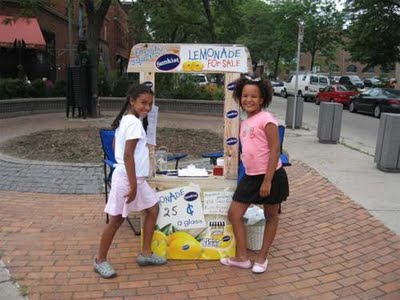
Little Pinsy says, “If life hands you lemons, make lemonade.  And then add a boatload of vodka.”  Wise beyond his years, that one.  Little Pinsy points out that if you mix sugar and water, you wind up with an insipid, cloying, flaccid beverage that only ghetto kids will drink, but if you make a very simple pH adjustment and add lemon juice, you have created a wonderfully refreshing drink that the upper strata of society can enjoy, especially when purchased from ghetto kids with curbside lemonade stands.

Urban entrepreneurship

So it is with wine.  As mentioned, the primary acids in wine grapes are tartaric and malic, with amounts that vary between varietals and depend heavily on where the vineyard is located.  As wine writers often note, ‘Warm days are needed to build up sugars and cool nights are required to preserve the acidity,’ and so they are.  As in Pinsy’s cocktail, an equilibrium of sweet and tart are key to a wine’s perceived sumptuosity.

Both acid and sugar production are natural to a grape’s growth and maturation, but as chemical processes, they’re opposites. For the most part, grapes grown in warmer climates have more sugar and less acid and those from colder regions are higher in acid and sometimes need to be sweetened artificially after crushing.  This technique, called chapatalization, is not permitted in California, but it’s fairly common in the cooler regions of  Europe, and is allowed in Oregon and New York.

Adjusting either sweetness or tartness in a wine must is elementary to winemakers, although it is essentially considered an undesirable, manipulative and unnatural step.  As can be imagined, it involves adding sugar or acid (tartaric usually, but sometimes citric or malic) around the time of primary fermentation.

Too Much Information spec sheet

On to Specifics

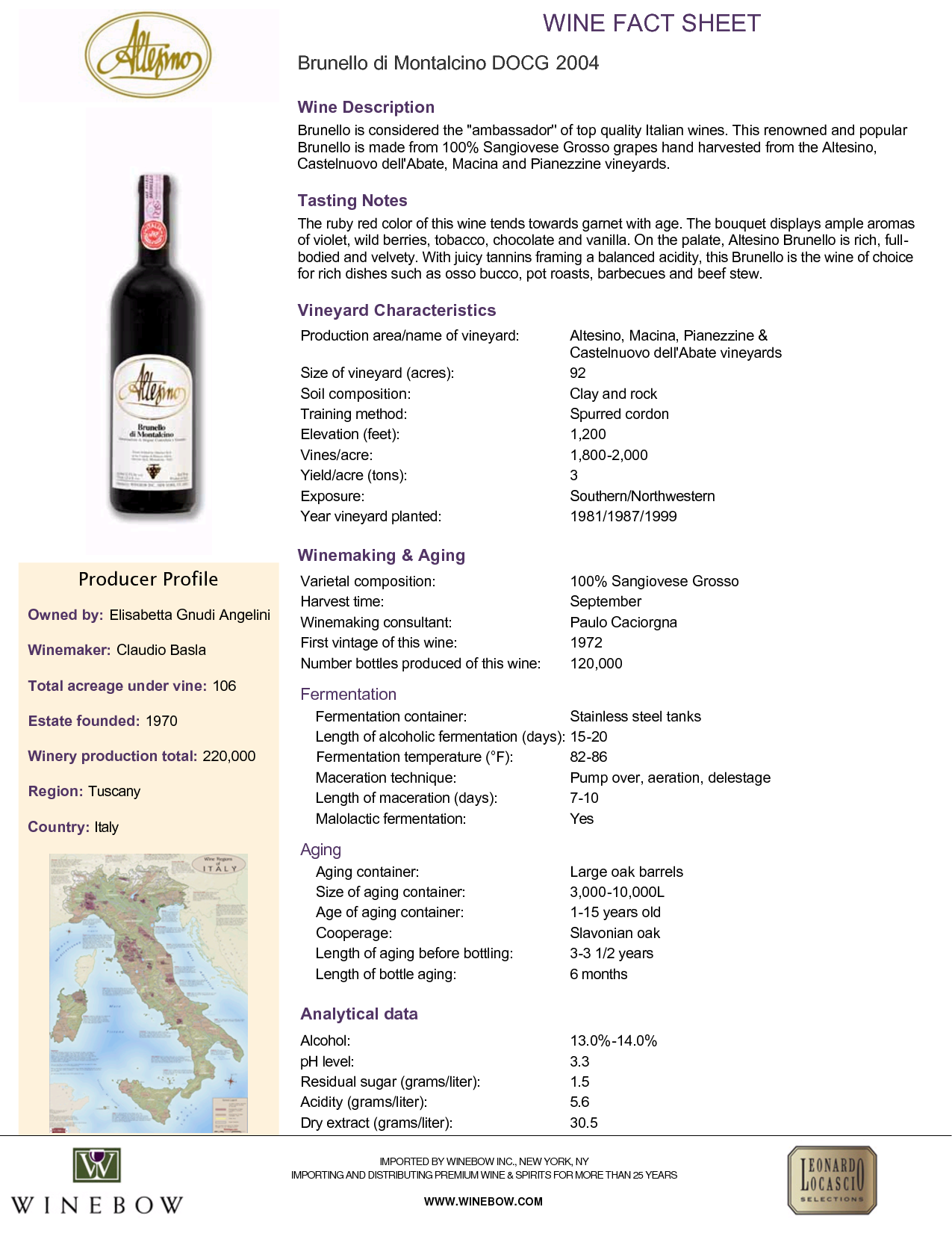
Vintners love loading down their spec sheets with arcane percentages and chemical symbols that most of us don’t understand. It makes them feel all sciencey, like there is something more to their profession than walking around vineyards and watching Mexican people work.  So, below their ‘winemaker notes’ (filled with descriptors we don’t understand either, like creosote, lychee, burnt tar and torrefaction, etc.), you’ll often see line items like Brix at Harvest, Acidity and pH.  Unless you have some mental level-set with which to interpret these tidbits, you probably don’t care if your sangiovese has a pH of 3.56 or 3.49 so long as it doesn’t kick the Pasta Ponza in the coglioni.

Come On, Lucky Number Seven

Alkaline = Base.         Al Kaline = Baseball

For technical reference, pH is the number of free hydrogen ions in a given solution,  where a pH of 7, measured at 77°F, was chosen by some adult version of Pinsy as a neutral kick-off point—water, in other words, has a pH of 7.  The higher the pH number, the more alkaline (not to be confused with Al Kaline, the Detroit Tiger who shone in the 1971 All-Star Game against Dock Ellis) the liquid; the lower the number, the more sour it seems.  The gradients are similar to the Richter Scale in that a solution with a pH of 3 is ten times more acidic that one with a pH of 4.

Wines typically come in at between 2.8pH and 4.2pH, with 3.5 being about ideal for reds, a bit lower for whites.

You’ll also see Total Acidity, or TA listed in a wine’s liner notes, usually given as grams per 100 mL—a calculation which is even farther out in left field than Willie Stargell was during Dock Ellis’s no-hitter—I mean, who knows how much a milliliter is?  More to the point, who cares?  Civilized alcoholics are into gallons and quarts.  Even so, both TA and pH are offered as eno-talking points because, although the result is the same, they look at wine acidity from slightly different angles.  Whereas TA measures the overall acid present in a wine, pH records the strength of that acid.  Most ‘to add or not to add’ questions regarding a wine’s acidity adjustment are made using pH values rather than TA.

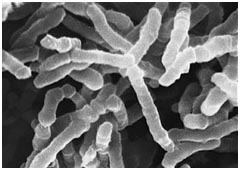
Beauty shot of oenococcus oeni

Malo is a Mellow Fellow

Another word that you can toss around at seventh grade wine tastings to make yourself look smart is malolactic fermentation, sometimes abbreviated to MLF.  In nearly all red wines (exceptions being lightweights like gamay or dolcetto), and whites with pronounced levels of metallic-tasting malic acid (an exception being riesling, where malic works magic), a secondary, ‘softening’ fermentation occurs, either naturally or as a winemaker-induced inoculation. During this conversion process, malic acid is transformed into lactic acid, the stuff that’s in milk and makes it coat the tongue.  The active bacteria that allows this to happen is called oenococcus oeni, and in the plus column, it can take an overly malicky wine, often recognizable by sharp, green apple aromas and tastes, and covert these flavors into something akin to butteriness.  Both profiles are frequently found in chardonnay, and in fact, chardonnay is a varietal where malolactic fermentation is either squelched or encouraged depending on the winemaker’s preferred outcome.  Viognier, a cultivar where a certain creaminess may also be desired, is another malo candidate—the secondary fermentation adds a level of depth, weight and complexity to this already interesting grape.

That said, some vignerons claim that MLF robs a wine of its natural fruit and stylistic  character, so the decision to begin the conversion process is never taken lightly.  Equally, if unprompted malo begins to occur where it isn’t wanted, it can be stopped by the addition of sulphur.

In the end, great wine keeps all of its multi-faceted yin and yang in check and balance.  Like memorizing an endless roster of baseball statistics, the minutia of winemaking is a pain in the kiester to master, but either way, once done, you wind up with a deeper appreciation for the science behind both the swing and the swig.

Posted in Chardonnay, GENERAL, Viognier | Tagged , , , , , , | 1 Comment

Cellar No. 8 ‘Eight’: Stuck Here In Lodi By Choice

One of the effects that alcohol has on the human brain, specifically on the nucleus accumbens, is that it makes you go all silly sappy and irrationally nostalgic.  So when a winery recalls it’s founder and his guiding principles in a wine brand, a brand which reports that it ‘applies time-honored methods and ‘Old World expertise’ to its wines, one can only hope that the gesture is a sincere nod to paternity, longevity and history, and not the product of a management drinking binge.

According to the bottle’s liner notes, Asti Winery, parent company of Cellar No. 8, was founded in 1881 when Italian expat Andrea Sbarboro set up wine shop after immigrating to Northern Sonoma because he was tired of his countrymen telling him he had a girl’s name.  He went on to establish a sprawling, tight-knit community that focused on winemaking—kind of like a gang of reprobate Amish—which ultimately became California’s second most popular tourist trap, right after Disneyland.

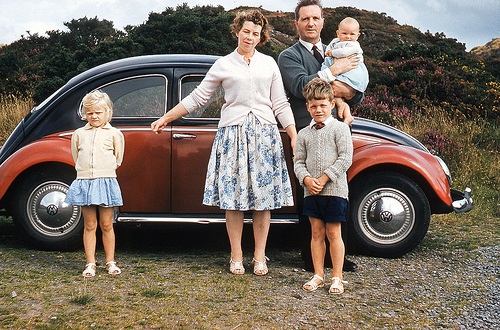
L to R: Sis, Mom, Dad holding a baby we found in a dumpster, 'n' me, Buddy

Sound far-fetched?  Suspicious?  It is.  Not the part about the Old Country theme-park—it was indeed a huge draw in the 1960’s for Mom, Dad, Buddy ‘n’ Sis, and it revolved around Sbarboro’s grandiose mansion which was apparently booby-trapped to play practical jokes on guests who might laugh at his girl’s name.  And not the part about him founding a 1600 acre agricultural colony in Northern Sonoma, either…

It just wasn’t Asti Winery.

Therein Lies the Dichotomy

Another thing that alcohol does to the brain, specifically to the prefrontal cortex (the forehead part that makes celebrities like Al Jardine, Christina Ricci and Steven Wright look like sideshow freaks) is to lower your inhibitions—and often, you’ll admit to embarrassing things you’ve done in the past, if only to get a chuckle out of your drinking buddies.  So, in the midst of its tipsy ballyhooing about a laudable history while sanctifying Andrea Sbarboro’s stubborn refusal to change his name to something butch like Magnus or Slade, it’s odd that nowhere on the label, press release or infomercial does it ‘fess up to the fact that the company changed its own name a few years back.

To Asti.  From Italian Swiss Colony.

Why? 

Well, you know why as well as I do.  Because Italian Swiss Colony is indelibly associated in the minds of consumers with a mass-marketing maelstrom, thanks mostly to lame commercials featuring Glenn Yarbrough jingle-warbling about rosé while some pretty girl with a girly name holds up a bottle simply labeled ‘wine’.  If you remember these ads, you’ll recall that they always ended with the tagline, ‘From that little old winemaker—me!’  

Omar Khayyam: 'I'll take the loaf of bread and the thou; you keep the jug of wine.'

Ah, but it’s market savvy, naturally—even with a three-liter jugful of Italian Swiss Colony White Port in your alimentary canal you wouldn’t want your start-up venture associated with semi-generic, insipidly flabby Central Valley wino-juice—the very reputation that California has spent untold billions trying to make people forget.  It’s kind of like Al Jardine’s campaign to dissociate himself from the Charles Manson song that the Beach Boys recorded in 1969 and why Volkswagen can’t sell any cars in the United States these days—even great ones.

That we get.  But then, if you insist on insisting that Asti Winery ‘honors the traditions’ and ‘pays homage to the history’ of the founding families, you might at least consider respecting what they named themselves and send out a mal occhio to all consultants who advise otherwise.

…I mean, it’s not like ‘Italian Swiss Colony’ is a girl’s name or anything.

Jeff Collins, mid-drone.

Cellar No. 8’s ‘Eight’: A Little More Gobbledygook

There’s a video on YouTube about Asti Winery and their latest release, Cellar No. 8’s ‘Eight’, wherein a buff-looking GM with the wholly masculine name of Jeff Collins drones on about Andrea Sbarboro, but conveniently forgets to mention that he was the father of Italian Swiss Colony Vin Rosé, perhaps because Asti Winery is very varietal-conscious and he’d have to admit that the pink plonk in the plastic pail that my mother used to swig contained a percentage of Thompson seedless grape juice, not known to produce Premier Cru Supérieur whites.  On the other hand, the name Thompson is quite macho, free-associating with Thompson sub-machine guns and Thompson’s cigars, whereas ‘Asti’ makes you think only of Asti Spumante, the quintessential girl swirl.

In the video, Jeff takes us on a tour of the original ISC facility, still in use, and shows us why the new label is called ‘Cellar No. 8’; it’s from, obviously, the winery’s eighth cellar.  ‘Asti’ comes from the nearby town of Asti, named by Andrea Sbarboro after the village in Italy that produces—you guessed it—sudsy Spumante.

Not only was mom a girl, she had an appropriate girl's name.

Recently, to pay homage to themselves, to honor their history and traditions that go back three or four years, they’ve released ‘Eight’.  Evidently, this is not to be linked to the cellar numbered ‘eight’ specifically, but is thus tagged because there are eight different types of Lodi-sourced grapes in it; namely, petite sirah, grenache, mourvedre, syrah, sangiovese, zinfandel, merlot and cabernet sauvignon.  In other words, ‘Eight’ is made from everything left over at the bottom of the refrigerator at the end of crushing season, which is a technique as sappy and irrationally nostalgic as an Italian Swiss Colony commercial, since that’s exactly the way my mother chose ingredients for dinner after polishing off a jug of Vin Rosé.

Again, However, a Bit of a Head Scratcher

‘Eight’ contains 79% petite sirah, which means that by American appellation law, it could have been labeled as a varietal instead of the ‘California Red Wine’ flag it wears.  The other grapes in ‘Eight’ are mere also-rans—the next biggest contributor is grenache at 7%, while merlot, cabernet and zinfandel ante-up less than 1% each.

I can’t say what one-percent merlot brings to a petite sirah party, but my guess is that it’s pretty minimal.

The irony, of course, is that the meteoric rise of quality-focused California wines over the past generation largely spelled doom for jug wine producers—Italian Swiss Colony was among the casualties.  Consumer demand for varietals like petite sirah, not generics like ‘red wine’, has been a primary catalyst for such cataclysmic climate change.

Is this a matter of: ‘You can take the wine out of the jug, but you can’t take the jug out of the…’??

Look at the legs on this 50-year-old Italian Swiss Colony White Port from under the sink.

Tasting Notes:

Cellar No. 8, ‘Eight’, Red Wine, California, 2009, about $10:  Naw, this is anything but jug wine—I’m just pulling the wine’s sturdy, 13.8% alcohol legs.  At this price point, it’s nicely crafted and avoids the excess acidity that often rears up in simpler petite sirahs.  Saturated purple in color, the nose shows jammy blueberry, underbrush and warm road tar; the palate is lush with black cherry and boysenberry and the finish is moderately long and tame in tannins.  I wouldn’t cellar this one, but I could easily drink a jug’s worth.

Posted in CALIFORNIA, Petite Sirah, Sonoma | Tagged , , , , , | 1 Comment

Tête-à-Tête Wine: Pardon their French

For us hard drinkers, the Niagara of ‘easy drinking’ wines on the market is like a kick in the beer nuts.

In general, when the ‘easy drinking’ tag is looped around a product’s neck, it refers to gentle, unassuming buzz water—low-alcohol, no-brain, value-priced wine which usually contains a dollop or two of residual sugar.  Chuck the word ‘fun’ into the ad campaign and it’s time to head for the hills: Preferably, the hills of Côte-Rôtie to pick up a flagon of La Turque—one example of a hard-drinking, hard-thinking man’s wine.

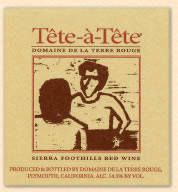
But of course, the exception proves the rule.  Domaine de la Terre Rouge, which specializes in single-site Syrahs from some of the highest altitude vineyards in California, has released their own version of a self-styled ‘fun and easy drinking’ wine.  Tête-à-Tête is a blend of Côte-Rôtie classics (it’s 56% Syrah, 28% Mourvèdre & 16% Grenache), but blended from the estate’s younger vines and barrel lots showing plenty of sweet, forward fruit.  With this particular grape trio, that means lots of dark summer flavors; boysenberry, black cherry, blackberry and currant— the style, say, of a top-end Côtes-du-Rhône Villages.

Going head-to-head with a typical Kroger ‘easy drinking’ wine, Tête-à-Tête is hardly tit for tat.

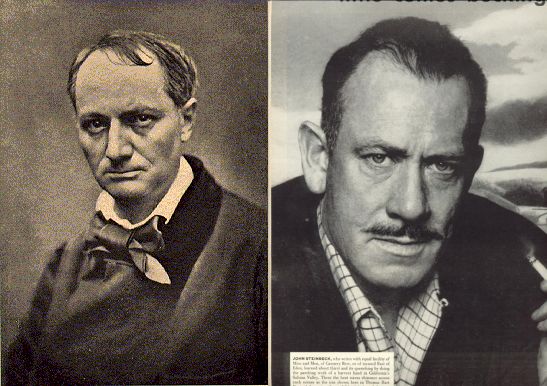
Baudelaire, LEFT; Steinbeck, RIGHT. Clearly not the same person.

Now, a word on de la Terre Rouge owners Bill Easton and Jane O’Riordan. Lovely, all-American folks they are, though for some reason, obsessed with français.  That’s ‘French’ to you and me.   The Domaine (read: winery) is nestled in the Steinbeck (not Baudelaire) approved Sierra foothills southeast of Sacramento (a Spanish word), where the dirt (not the terre) is red (not rouge). 

It gets worse.  According to them, Tête-à-Tête is an assemblage aged in François Frères cooperage which shows off terroir.  They claim to ‘French plow’ their vineyards, whatever that means.  Their website even links Québécois wine reviews in French.

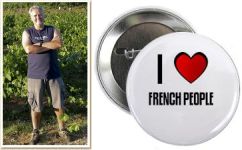
Bill Easton and his favorite button

Geez, Eastons and France—get a chambre already.

It is but a minor tic (and winemakers have plenty of those) from an exciting, progressive winery dedicated to earth-first practices, including a solar powered tasting room and bottles made from ‘cullet’—ground-up, re-used glass (pronounced kull-it, incidentally, not coo-lay).

Maybe that’s it.  Everything is sustainable.  Perhaps all their bon mots are simply recycled words from the cellars of Avignon.  In which case, it’s okay.

Still, a note to the inimical team of Easton/ O’Riordan: Drinking Tête-à-Tête is loads of fun, but learning how to pronounce French?  Not so much.

TASTING NOTES:

Domaine de la Terre Rouge Tête-à-Tête, Sierra Foothills, 2008, about $16:   A big-shouldered red for the price; plush and sumptuous with blood orange on the nose, cherry and blackberry throughout, silky and round mouthfeel without any hard edges.  Syrah adds a pleasant hint of charcoal.

Posted in Sierra Foothills, Syrah/Shiraz | Tagged , , , , | Leave a comment

Château Simard, 1999: The Right Bank’s Right Stuff

If you still find some latent gratification in partying like it’s 1999, at least pour a 1999.

Monsieur Merlot

Along with Pauillac, Margaux and Saint-Julien, Saint-Émilion posted some sexy swallows in the century’s final harvest, and age-wise, they’re coming into their own. Mind you, the vintage was considerably dicier in Graves and parts of the Haut-Médoc due to late rains that cut short the final cabernet ripening and infused the wines with some vegetable notes, but in general, merlot (which is harvested earlier) did well, achieving startling alcohol levels of nearly 14%.

In such years (obviously) it pays to search out wines containing a higher percentage of merlot, and these are most often found among the châteaux of Pomerol and Saint-Émilion in Libournais.  Named for the region’s capital, Libournais is commonly referred to as the ‘Right Bank’ due to its position on the Dordogne river.

Monsieur Vauthier

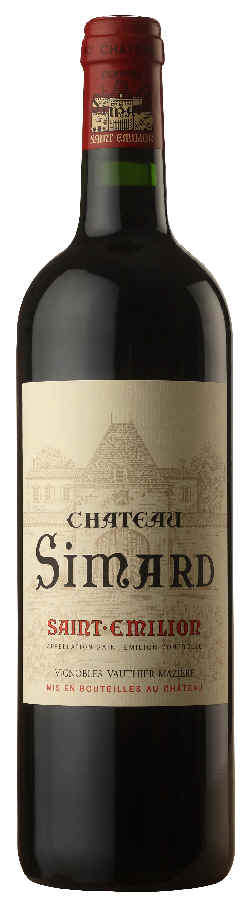
Saint-Émilion’s Château Simard has been a player in the commune since the 17th century, but received a status upgrade in 2008 when it was purchased by Alain Vauthier, owner of the celebrated Château Ausone.  As one of only two estates classified as Premiers Grands Crus Classés A (the other one is Château Cheval Blanc), Château Ausone has embraced its new little brother with scads of sibling support.  Whereas the previous owner (Vauthier’s uncle, Claude ‘Coco’ Mazière) had a singular approach to the business of wine—selling only one vintage at a time, managing all aspects of it with the assistance of a single secretary—Vauthier has already made several vintages available and is at work restoring the property to its erstwhile glory.

Mademoiselle Ladybug

A few things won’t change, of course: Traditionally, Simard has not been released until it sees ten years of bottle age in the winery’s cellars, which is why we are only now seeing the 1999’s (bottled in ‘01) on market shelves.  Whereas Vauthier may confess an ultimate goal of letting loose Simard after four or five basement years, this hasn’t happened yet.  Also, like Uncle Coco, Vauthier is a proponent of the French equivalent to organic farming—lutte raisonnée.  Essentially, the ‘reasoned struggle’ prompts vignerons to use less synthetic fertilizers, pesticides and herbicides in the vineyard, though unlike organic certification here in the States, no government regulators breathe down their necks.  Naturally, that makes the ladybug appearing on labels of such reasonable strugglers somewhat meaningless, and we can only hope that Gallic conscience will out.

Meanwhile, the primary upside of Simard 1999 may be the prix de sortie.  So fantasy-flooded are many Bordeaux buffs that the release price of a given wine does not necessarily reflect its quality, and these prices are known to fluctuate in subsequent years along with market, mood and the ‘must-have’ quotient.  Simard, however, seems to remain pretty constant.

To be able to experience a fully mature, ready-to-rock Grand Cru Saint-Émilion for under $30?  Remarkable.  If you are going to party like its 1999, no harm in proferring like it’s 1959.

Tasting Notes:

Château Simard, Saint-Émilion, 1999, around $28:  The blend is 70% merlot and 30% cabernet franc, both of which varietals had banner years in 1999.  The wine displays the bricky rim of a middle-aged merlot floating below an earthy nose of white truffle, white pepper and currant.  The palate is creamy and appealing with a cultured sense of black fruit, plum and spicy oak.  The presence remains silky and full throughout and finishes with complex, fully-ripened tannins and a distinct, but subtle acidity.

Posted in Merlot, Saint-Émilion | Tagged , , , , , | Leave a comment

Pyrenees Vineyards Refuses To Make a Name For Itself

Little La’Taesha is on the right

First of all, I should not be writing this column.  I have seven children and I am on all counts over the creative kick of naming things.  In fact, my youngest daughter is called  La’Taesha Ayala Tanquenika because I totally used up everything in that ‘What To Name Your White Baby’ book.

Anyway, a press release I received yesterday says:

SUNLAND, Calif. (Sept. 2, 2011) – Leading radio content provider CRN Digital Talk Radio and Pyrenees Vineyards and Cellars are joining together to ask listeners to design the label of CRN’s first ever wine release.

“We are extremely thrilled at the listener response to our ‘Name the Wine’ contest for our first wine release so now we are asking listeners to get creative again and design our new label,” said Michael Horn, CEO and founder of CRN.

More to the point:

The contest, set to begin on Sept. 1, will give the winner a case of the new wine, as well as a framed copy of the wine label and a guest spot on “What’s Cookin’ On Wine: Oregon Report” radio program. The contest closes on Sept. 12 with the winner to be announced on the Sept. 22 show.

Whoa!  Prizes!  Cases of wine!  Photo ops and insta-fame via that national media phenomenon, the Oregon Report, which now boasts more fans, more groupies, more daily listeners than Howard Stern!*

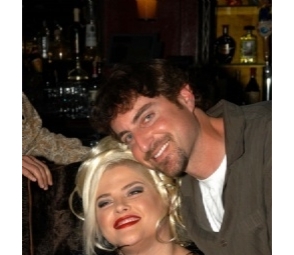
*Anna Nicole Smith’s boyfriend.

…Guess I’m Game To Claim Fame in the Name Game All the Same

But before I get to the wine, I am going to re-name some other things around the vineyard that need attention.  Start with their name.  ‘Pyrenees Vineyard’??  Guys, despite being the consummate pater that I am, I am not trying to be patronizing, but you are located in a trough in Oregon, not in the soaring, snow-capped peaks of Southern Europe where the God-ordained raison d’être is keeping those frog-eating French egotists away from the noble Catalonians.  I’d suggest that you name yourself after your own mountain range, but Calapooya Vineyards sounds vaguely scatological.  On the other hand, if you like that motif, you could change a single letter in the family name, Apodaca.

I think Apod-caca’s Calapooya would garner some press attention.

Otherwise, why not go the humor route like your neighbor to the north, Château Nonchalant? In which case, my entry is either Château-Jam or Châteaumaine Poisoning, though if you go with either one, I suppose you’ll shortly be calling yourselves Château Nonexistent.

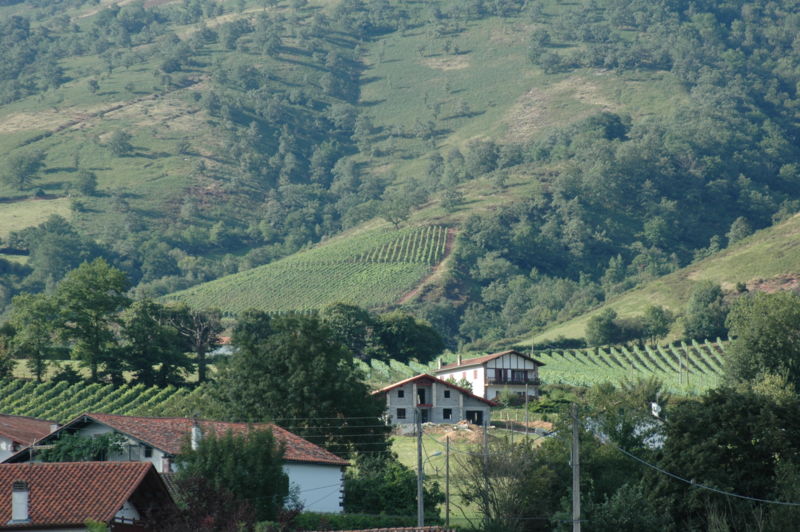
Irouleguy, in the heart of the Pyrenees. The real ones.

Okay, so keep your name.  I do get that the Apodacas have roots in the Basque region of the Spanish Pyrenees, which is their justification for the moniker, but in that case, why don’t they grow any of the traditional Basque grapes like bouchy, fer or txakoli—each of which could use their own name-change. Pyrenees Vineyard relies instead on the usual Oregonian suspects: pinot gris, cab/merlot, gewurtz and riesling, with an upcoming release of pinot noir; the grapes are grown locally in vineyards along the multiple terroirs of the South Umpqua River.

I will now fight the temptation to re-name the Umpqua—it’s what, a tributary of the Oompa Loompa?—and focus on the winery’s tagline, written in that head-scratching Basque language Euskara Batua at the bottom of the ‘About Us’ page:

Ex ardo bizidunik, ez andre bizardunik’.

For the sake of argument, let’s say that my translation is accurate:

Suzanne Goin: A hot chef with a Beard

‘Avoid Champagne and Women With Beards’.

WTF?  Why would that be a winery’s motto, and more importantly, why would you avoid Champagne and women with beards??!  Everyone loves a glass of sparkles, and in gustatory parlance, ‘A Woman With a Beard’ can only mean that she has a James Beard Foundation award and can therefore cook like a brick shithouse.  These peculiar Pyrenean pinot people continue to twist my head.

So, On To The Wine…

Cut to the chase.  I screwed up.  Turns out the wine has ALREADY been named and they just want a label.  Well, so crucify me—nobody told me I was supposed to read a press release all the way through, thank you very much.  Evidently, last month, listener Suzanne Wright of Sebastopol won the ‘Name the Wine’ contest with the name  ‘CRN’s Smooth Talker Bordeaux’.

Seriously?!?  ’CRN’s Smooth Talker Bordeaux’ won??  Jesus, Mary and Joseph—imagine what must have lost.  Frankly, I like the unintelligible Euskara tagline better.

Suzanne Wright: Not so hot

Kassel Shows Some Stones

Therefore, I am going to go out on an artistic-license limb here and disqualify Suzanne.  Why?  Because she has a beard, that’s why.  I will thereupon begin from scratch and name the new wine and design the new label without incorporating the name of the corporate sponsor simply to brown-nose a cheesy radio interview and a free case of wine from such narcissists.  What are they, French?

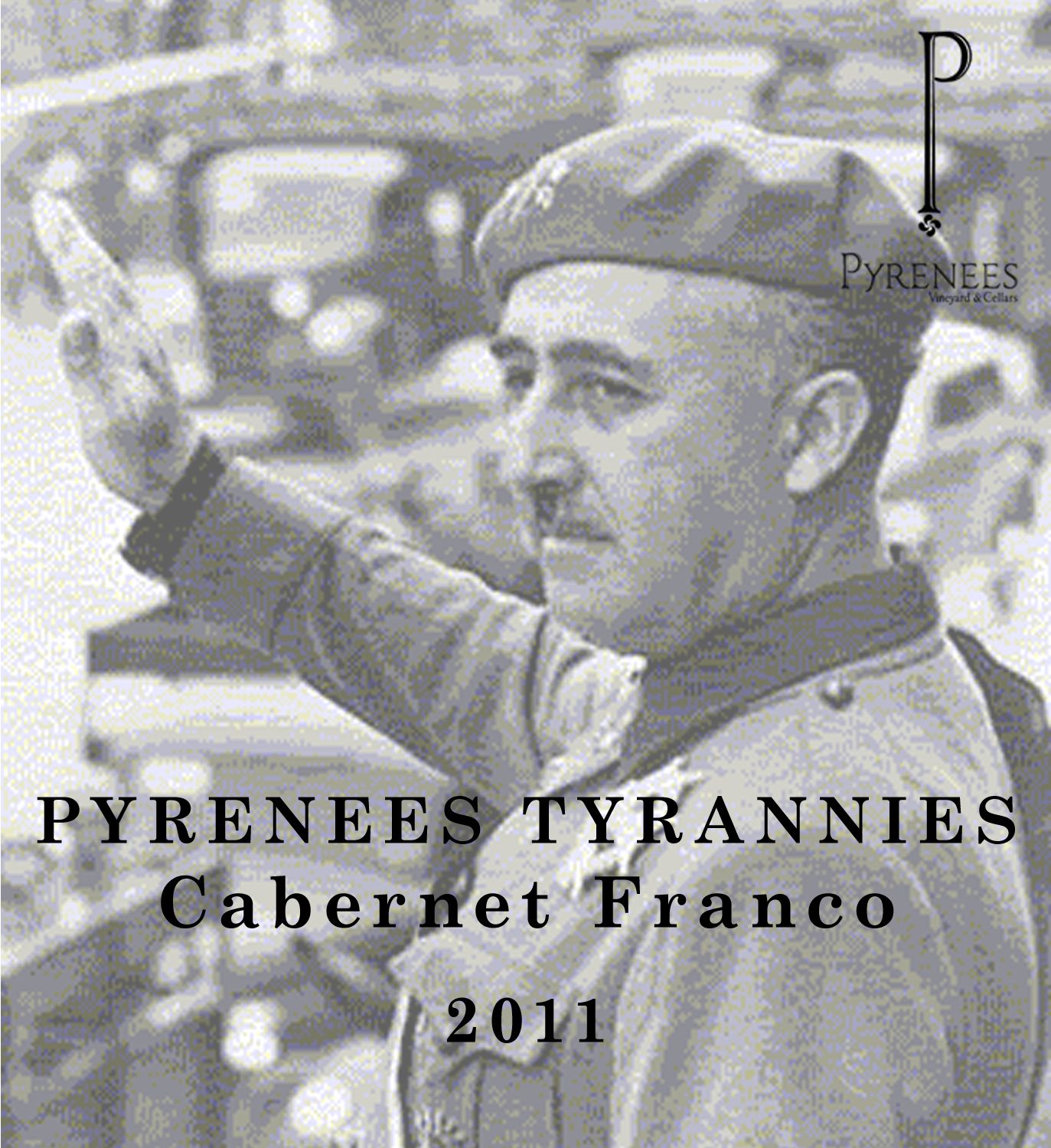
Instead, I will use history, heritage, horse sense and hubris to create the single most significant label that Oregon—and possibly the entire West Coast—has ever dared to slap on a wine bottle.

The Apodacas may be challenged in a sturdy recollection of their Spanish heritage, so I have created for them a label that recalls Spain’s glorious past, commemorates one of her most influential leaders and celebrates a noble vinifera varietal beloved not only in Bordeaux, but also in Irouléguy, a premiere Basquian winemaking region.

Ergo:  (And you can send the prizes c/o Intoxicology Report dot com)

Posted in Cabernet Franc, OREGON | Tagged , , , , | 16 Comments

R. Müller Riesling: Bunny Wine is Never Funny Wine

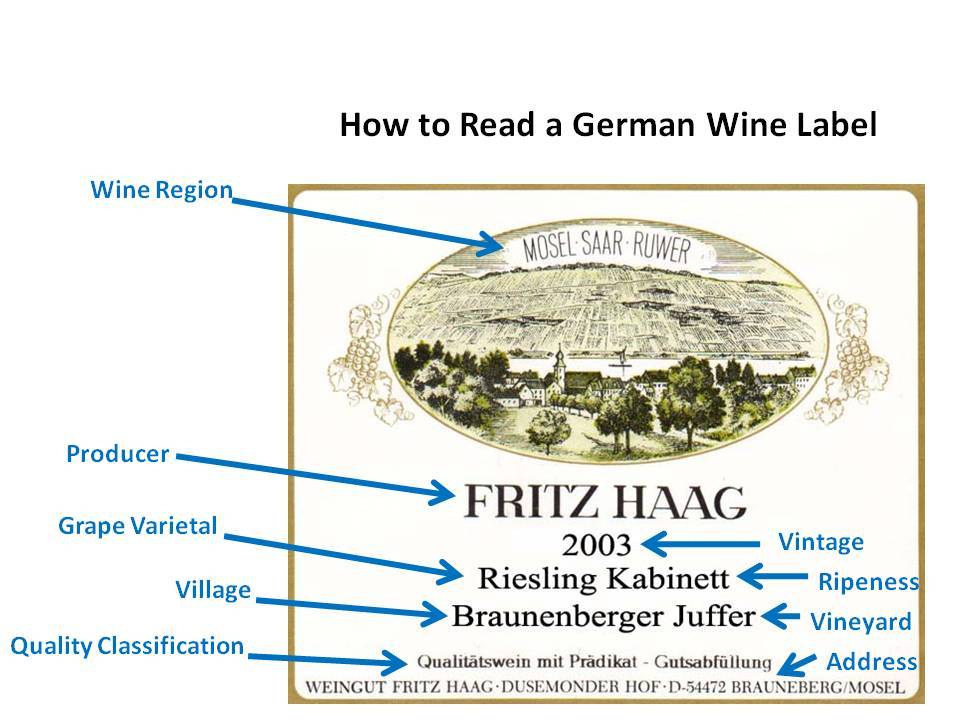
Germans are sticklers for detail.  But you knew that, of course, and possibly did that cute little nose-scrunch thing of yours when looking over the formalities of a German wine label. If you are more familiar with the French AOC system of certification or those randomly placed front label/back label bits of enlightenment that U.S. law requires, a German wine label may seem a little daunting.

Like the Maginot Line, it shouldn’t: Germans love information, lots of information, sometimes too much information for us ‘let’s just pour it and get on with stuff’ Americans, but if you want to know how ripe the grapes were when picked, whether sugar has been added to boost alcohol or the sequential order in which the wine was submitted for testing, it’s all right there in front of you.  Germans like this kind of trivia.

The sort of Brit that Germans despise

(Other things Germans like:  Punctuality, pickled cabbage, Quark cheese upon waking up for work at 4:00 AM, opening every window upon arriving at work at 5:00 AM, socks with sandals, potato noodles big as throw-rugs and dressing like Saturday Night Fever extras without realizing how ridiculous they look.

Things Germans don’t like:  Humor and English people.)

How Prädikatswein Works

In 2007, the traditional German classification system Qualitätswein mit Prädikat (QmP) was renamed Prädikatswein—God knows why—and represents the perceived ‘highest quality’ of German wine.  Designations indicate increasing natural sugar levels in the must, and in ascending order go: Kabinett, Spätlese, Auslese, Beerenauslese, Eiswein and Trockenbeerenauslese.  The wine authorities would have kept going, no doubt, but they finally ran out of letters—even ones with dots over them.

Below this hallowed Hunnish hierarchy are QbA wines, which can be chapatalized (artificially sweetened) in lean years, and a notch further down the totem pole are Landweins, or country wines; the German equivalent of the French vin de pays.  Tafelweins, or table wines, usually pick up last place.

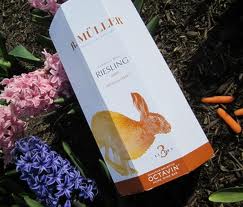
Bunny Wine: A 3-Liter Lagomorph

For a traditional and well-respected Mosel producer, Wine Cellar Rudolf Müller has little to say about itself online: Evidently, the ‘more is more’ labeling philosophy doesn’t carry through to the producer.

Mostly what I want to know why there is an Albrecht Dürer-style bunny hippity-hopping across the logo.  Okay, so both Albrecht and Rudolf share an umlaut (and by the way, why doesn’t umlaut have an umlaut?), but otherwise, I see no association between edgy rieslings and etchy rabbits.  It’s a minor thing, granted, but damn it, those Teutons put everything on the label, and now that I searched for a little cottontail clarification and came up empty, it’s really started to bug me.  (Maybe that’s it: Bugs).

Sorry, Boss, that's not a cloud--it's packaging material.

In any case, the latest release of Müller Bunny Wine arrived courtesy Octavin Home Wine Bar in the form of a three liter self-collapsing bag-in-the-box which allows the wine to remain fresh for up to three weeks—something that an uncorked wine can’t do and something that makes zero difference to me since open wine in my house barely lasts three hours let alone three weeks.  Still, as Octavin points out, their patented premium wine cask reduces packaging waste by 92% and carbon emissions by 55%, which is very environmentally friendly of them, except that when they sent the sample, they swathed it in styrofoam, and we all know that the first thing Jesus is going to say at the Second Coming is, “Where the hell did all this styrofoam come from?”

On To The Rodent Riesling

So, within the Octavin bugs-in-the-box, Rudolf’s riesling is a succulent version of an entry-level Landwein, which means that the grapes were harvested from one of the specific Landwein regions, in this case, Rhein, and must contain a higher percentage of alcohol than German table wine.  One reason that most Americans are not familiar with the term Landwein is that it was only classified in 1982, and also—unlike virtually all other countries, the Germans produce very little Landwein or Tafelwein—less that 5% of their total wine output—and hardly any gets exported.

A cynic

Müller’s did, and it proves to be clean and melony, suggesting honeysuckle on the nose and peaches, green apples and apricots on the palate. It’s classified as halbtrocken, or half-dry, which pessimists might call ‘half-sweet’, except that by law, Landwein is not allowed to be semi-sweet.  Trying to fathom the difference between half-sweet and semi-sweet is probably made them cynics in the first place… especially since R. Müller’s bunny label lists the wine as ‘medium sweet’.  Anyway, the wine finishes dry with a nice mineral bite.

I actually kept a bottle’s worth around for three weeks to see how well the hot-shot package worked, and indeed, it was perfectly drinkable after that time.

The rest of you might not have so much patience and may drink it all (it’s 9.5% alcohol) in a couple sittings.  If you wind up with the morning-after blues from too much bunny wine, I have the perfect cure:

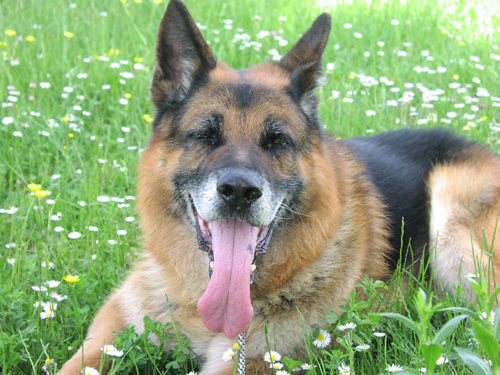
Hare of the dog (preferably, a German Shepherd.)

Posted in GERMANY, Riesling | Tagged , , , , | Leave a comment

Rodney Strong Like Bull, And That’s No Bull

There’s strength in numbers, and if they happen to have dollar signs in front of them, Rodney Strong Vineyards is pulling down some weightlifting gold.  Growing at a pace of 14% a year (compared to 2% for the category according to AC Nielsen), the winery, producing  600,000 cases annually, has maintained a consistent portfolio of sumptuous, value-priced wines throughout its fifty year Sonoma journey.

Rodney Strong

There have been several costume changes throughout that history—an apt enough metaphor, since the late Rodney Strong segued into wine only after a career on Broadway, where he was (apparently) a debonair and well-heeled hoofer.  Strong, who in 1994 claimed, “I will go into retirement when I fall into a fermenting tank of cabernet . . . and my departing hope is that they will say the wine has excellent body,” passed away in 2006 in a less theatrical setting—a Healdsburg convalescent center.

Tom Klein

Prior to that, for decades, Strong had been Sonoma County’s elegant elder spokesman, but he sold his vineyard to Guinness in the early 1970’s, who then sold it to Tom Klein, a San Joaquin Valley farmboy.  Private ownership allowed the focus of Klein and winemaker Rick Sayre (who studied under André  Tchelistcheff)  to remain on fine-spun gems which are, in many ways, benchmarks of Sonoma style.

Three that recently fell my way included the newly released 2009 Chalk Hill Chardonnay, 2009 Reserve Chardonnay from Russian River Valley and the ’05 Alexander Valley Cabernet Sauvignon.  All display the label’s characteristic warmth, opulence and affordability.

For $20, the Chalk Hill chardonnay demonstrates the kind of intensity that Sayre can built into his chardonnay in vintages when dry spring (small clusters) leads to cool summers (firm acids).  French oak fermentation and an 86% malolactic follow-up adds crispy cream to the toasty profile; flavors range from Meyer lemon and pineapple to orange zest and honeysuckle.
A theoretical upgrade, at $35, is the ’08 Russian River Valley Reserve.  West of the Chalk Hill property, the Russian River vineyards were hit by early frosts and a mid-May hot spell, which reduced yields; this particular harvest was picked at night, when temperatures were cooler.  Attractive and fleshy, the wine shows cinnamon, allspice, stone fruit, baked apple and butterscotch—the acid remains vibrant throughout.

Rick Sayre

Alexander Valley and at $30, Sayre is offering in his ’08 cabernet a sumptuous and nicely perfumed wine, aromatic with notes of dill, plum and cedar lead into a cocoa foundation with copious boysenberry, blackberry and plum.  Tannins are supple, courtesy of eighteen months on oak and nicely ripened fruit.  Cellar worthy for a half-decade or so?

If I suggested that Tom Klein and company have invested nearly ninety million dollars in Sonoma grapeland, you might think I’d been nipping at the cooking sherry, but in fact, a thousand acres and state-of-the-art production facilities come with a primo California price-tag.   If it’s passed on to the consumer, it’s pretty well buried in quality.

As for winemaker Sayre, with more than thirty vintages under his belt, he’s still going strong.

Posted in CALIFORNIA, Sonoma | Tagged , , , , | Leave a comment

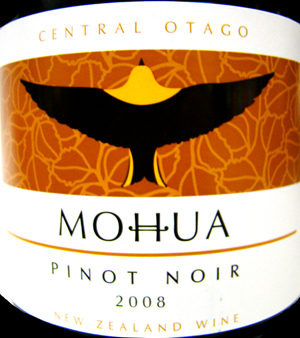
Mohua: Mo’ Value from Central Otago


“Try some Mohua…”

‘Fess up: I’ve worked Detroit restaurants where the response would be, “Try some mo’ whatta?”

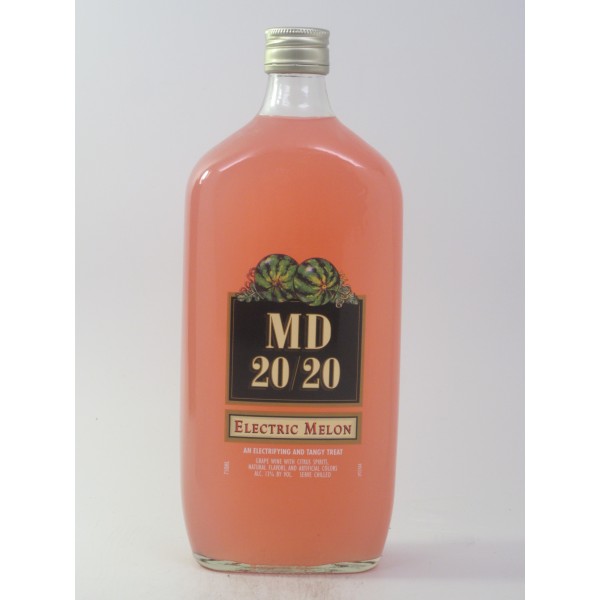
At that point, one of two things would be in order.  Either a tutorial on Central Otago, where the Mohua (pronounced like it sounds, mo-who-ah) label is producing amazing, nuanced wines in a remote, relentlessly rugged region that even penguins find a bit nippy.  That, or I’d make a trip to the wine cellar for the Reserve List—reserved because the wines on it come in internationally significant flavors like Banana Red and Electric Melon and retail at liquor stores for $1.99—though being a typical sommelier, I’d mark them up to $40.

Opting For the Former…

Central Otaga—central because it is in the middle of Otago in New Zealand’s South Island—is the world’s most southerly wine growing region.  Summers there are dry-za-bone arid and ferociously hot while winter temperatures dip seriously into negatives.

One of Central Otago’s landmarks is called Mt. Difficulty—‘nuff said?

In such a climate, the heartiest vines kvetch and kwibble—and pinot noir?  Most wine-wise folks consider pinot noir to be the Maria Callas of grapes—temperamental, coddle-hungry and full of silly contract riders.

Jancis 'No, My Name Is Not A Typo' Robinson

And yet, Central Otago is an unblushing pinot noir success story.   In fact, according to Master of Wine Jancis Robinson:  “Many believe that [Central Otago] is where the pinot grail is to be found.”

A remarkable statement; the more so considering that most wine people weren’t aware that the pinot grail was missing—in fact, I’m pretty sure I drank from it myself at a wine bar between Romanée-Conti and Richebourg in the Côte de Nuits, where they’ve been pumping out barrels of bricky beauties since the fourteenth century.  The comment is even more remarkable when you consider that the first commercial pinot noir was produced in C.O. a scant twenty-four years ago—Gibbston Valley, 1987, by pinot pioneer Alan Brady.

Greg Hay

And Mohua? It’s Even Newa…

Named after a sneaky little wad of feathers that flits around the rain forest (not be confused with Moesha, who flits around the rerun forest), Mohua has only been around since 1998, and percolates from the Peregrine pipeline under the management of Greg Hay.  At around eighteen dollars a bottle, it’s a bargain—an advantage that those Burgundian ingénues rarely bring to the table.  No doubt, that’s partly responsible for Ms. Robinson’s heady declaration, since under-$20 Burgundy is as rare as mohua teeth and tends to be beanstalk thin, testily tart, often fruit-challenged and is inevitably classified as ‘Bourgogne Rouge’—meaning the wine is not vineyard specific—and though it’s supposed to be pinot noir, it’s guaranteed that from time to time, some gamay slips into the vendange basket.

Were I to again slip my silver tastevin over my grizzled head, I’d set you up a blind tasting—an eighteen dollar 2008 pinot noir-off; Otago versus Burgundy, Mohua versus Michel Picard Bourgogne, Domaine Lignier-Michelot Bourgogne—even 2008 Meurger Bourgogne, which is said to have ‘the soul of a 1er Cru’.  (The soul maybe, but not the nose or the palate).

Sip them, swirl them, sniff them, slurp them; then select—or trust a sommelier’s spidey-sense:

For my money, Mohua is much mo’ betta.

*

Before we get to Tasting Notes, there will be a brief spot quiz on the tutorial:  Which of the following is native to Central Otago:

L to R: Moe Howard, Moesha, Mohua, Mohasky


Tasting Notes:

Mohua Pinot Noir, Central Otago, New Zealand, 2008, about $19:  Lemony brightness on the nose along with red cherries and a dry leaf earthiness.  Given some air, the wine opens up splendidly, showing cranberry, kirsch and sweet cherry along with balsam and some light loamy undertones.  Firmly acidic and touched with limestone; I paired it with a wedge of Russian rossiyski cheese and realized that the pas de deux was long overdeux.

Posted in AUSTRALIA, Central Otago, Pinot Noir | Tagged , , , , , | Leave a comment